

Guest Post Pitch Examples That Actually Get Replies

by Rachid Idali
Last Updated: June 25, 2026
A guest post pitch gets a reply when it proves three things in under a hundred words: that you read the site, that you have a specific topic their readers want, and that you are easy to work with. Everything else is decoration.
Below are six guest post pitch examples you can copy, each annotated with why it works and where it falls down. But I want to be honest with you first, because most "best guest post pitch template" posts skip the part that actually moves the number.
The pitch is not where campaigns are won or lost.
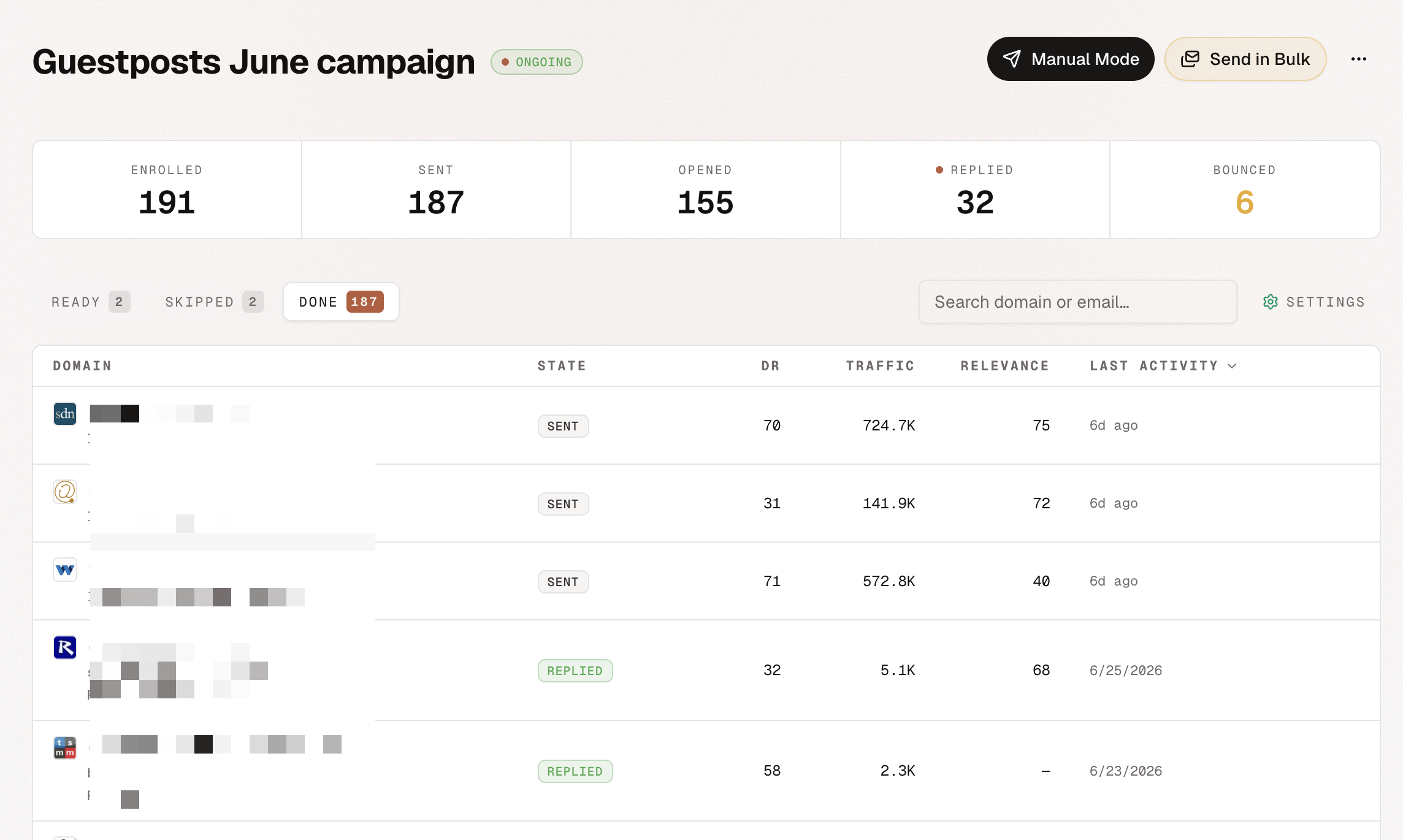
I sent 187 link-building outreach emails and got 32 replies. That is a 17.1% reply rate. The copy was not magic. The result came from the list, not the template. So use these examples, but read the last section, because that is the part nobody pitches you on.
What a good guest post pitch needs
Before the templates, here is the whole thing in five lines. An editor scanning their inbox is deciding, fast, whether to keep reading:
- A subject line that names the topic, not your intention to "collaborate."
- One line proving you read their site, a specific page, not "I love your blog."
- One concrete topic idea with a working title and why their audience cares.
- Proof you can write, one link to your best relevant piece.
- A single, easy ask, "want the outline?" beats "let me know your thoughts."
If a pitch is missing two of these, it reads as a blast. Editors delete blasts.
Why most guest post pitches get ignored
Most pitches fail before the editor reaches the topic idea.
They open with fake flattery. "I've been following your blog for years" is the most ignored sentence in outreach, because everyone says it and nobody means it. They pitch the writer's goals, not the reader's. They propose a vague topic ("a post about marketing") that forces the editor to do the thinking. Or they bury a generic article behind a paragraph of throat-clearing.
The pattern underneath all of these is the same: the pitch is about the sender. A pitch that gets a reply is about the recipient's page and the recipient's audience.
That is the whole shift. Stop writing "here is what I want." Start writing "here is what your readers are missing."
Guest post pitch examples you can copy
Six templates. The placeholders in [brackets] are yours to fill. Each one assumes you have already found a real, relevant page, see the prospecting section after the examples, because that is what makes any of these land. If you would rather buy that step than do it by hand, we scored the link prospecting tools on how much of the qualifying they actually do.
1. The page-specific pitch (the one I'd start with)
Subject: Idea for your [exact post title] post

Hi [First name],

Your guide on [specific topic] ranks well, but the section on
[sub-topic] stops short of [the gap]. I'd like to write you a
standalone piece that covers it: "[Working title]."

It would walk your readers through [outcome], with [the specific,
concrete thing you bring, original data, a framework, a worked
example]. Here's a relevant piece I wrote: [URL].

Want the outline first, or should I send a draft?

[Your name]
Why it works: it references a real page, names a real gap, and proposes one specific article that fills it. The ask is binary and low-effort. This is the template I lean on, because it forces you to have done the homework, you cannot write it without reading the site.
Where it falls down: it is useless if the "gap" is invented. Editors know their own content. Name a gap that isn't real and you've proven you skimmed.
2. The specific-topic-idea pitch
Subject: "[Working title]", guest post for [Site]?

Hi [First name],

You publish a lot on [theme]. One angle I haven't seen you cover:
[specific, slightly contrarian angle].

I'd pitch it as "[Working title]", roughly [word count], aimed at
[their audience segment], with [the concrete element]. Example of my
work: [URL].

Happy to adjust the angle to fit your calendar.

[Your name]
Why it works: it leads with the idea, not with you. The contrarian angle gives the editor a reason this isn't the tenth identical pitch this week.
Where it falls down: "slightly contrarian" has to be real. A fake hot take is worse than a safe one.
3. The "I'll make your existing post better" pitch
Subject: Quick addition to your [topic] post

Hi [First name],

Your post on [topic] is missing [specific update, a 2026 stat, a
new method, a step]. I can write a short companion piece, or draft
an update you can drop in.

Either way you get fresher content. Here's how I write: [URL].

Want me to send it over?

[Your name]
Why it works: you are offering to do work that helps them. The link is a byproduct of making their page better, which is the only version of link building that survives a Google update.
Where it falls down: only pitch this when you can genuinely improve the page. Offering to "update" a post that's already current reads as a pretext.
4. The follow-up (where most replies actually come from)
Subject: Re: [original subject]

Hi [First name],

Floating this back up in case it got buried. Still happy to write
"[Working title]" for [Site], and just as happy to take a no.

[Your name]
Why it works: it is short, it assumes good faith, and it gives the editor an easy exit. A single, polite follow-up sent a few days later catches the inbox on a better day. Most people quit after one email; the reply was often waiting in the second.
Where it falls down: one follow-up, maybe two. A fourth "just checking in" is how you become the sender editors filter to spam.
5. Before and after: a generic pitch, rewritten
This is the kind of pitch that gets ignored:
Hi there,

I've been a long-time reader of your amazing blog! I'm a passionate
content writer and I'd love to contribute a high-quality guest post
to your website. I can write about a variety of topics. Please let
me know if you're interested!
No name, no specific page, no topic, all about the sender. Here is the same intent, rewritten:
Subject: Idea for your "broken link building" guide

Hi Sam,

Your broken-link-building guide is the most practical one I've found,
but it doesn't cover finding broken links at scale once you're past a
hundred prospects. I'd like to write "How to Qualify 500 Broken-Link
Targets Without Burning a Week", with the exact filtering steps I use.

Sample of my work: [URL]. Want the outline?

Marie
Why it works: the rewrite is the same length but does four jobs the original skipped, names the editor, names the page, names a real gap, proposes a titled article. Where it falls down: it sets a bar you then have to clear in the actual post.
6. Subject lines worth swiping
The subject line decides whether any of the above gets read. These follow the same rule, name the topic, not your intention:
Idea for your [post title] post"[Working title]": guest post for [Site]?Quick addition to your [topic] guideFound a gap in your [topic] article[Mutual contact] suggested I reach out
Avoid "Guest post collaboration opportunity" and "Partnership request." They announce that a pitch is coming and give the editor a reason to skip it.
What actually decides your guest post reply rate
Here is what the template posts won't tell you: a perfect pitch sent to the wrong page still fails.
Your reply rate is a function of relevance, email quality, and timing. Most people only optimize the email. That is backwards. If the prospect is wrong, the best-written pitch in the world still feels irrelevant, because it is.
In our 17.1% reply-rate campaign, the lever was prospecting, not copy. Every step before sending was designed to remove weak prospects: score each site for topical fit, find the specific page the link belongs on, and verify a real contact before writing a word. The pitch was written around the page the editor actually owns.
For context, that 17.1% sits far above the norm. Recent large-sample benchmarks put the average B2B cold-email reply rate in the low single digits, around 1–3% across 10,000+ campaigns, with even the top 10% reaching only 8–12% (Built For B2B, 2025; Instantly, 2025 reports a 5–9% range). The pitch templates above get you a clean email. The prospecting is what pushes you past that top band.
This is the order that matters. Build the list, find the page, verify the contact, then pick a template. We built AutoBacklinks around that sequence, it scores prospects by relevance, finds verified contacts, and drafts each pitch from the prospect's own page context, so the email is specific by default. You can run that same workflow from Claude, ChatGPT, or Cursor through the MCP server. You can do every step by hand; just do it in that order. If you're sourcing targets from rivals, a competitor backlink scan is a fast way to find pages that already link to sites like yours. For the full picture of which steps to automate and which to keep human, see how AI link building actually works. And if you are choosing software, I compared nine AI link building tools against their live sites.
One reply you should plan for before you send: the editor says yes, then asks for a link back. That is a link exchange, and the answer depends on whether you would have linked to their page anyway. The four honest replies, and what Google's policy actually bans, are worth deciding on before the first campaign goes out rather than at the moment the email lands.
Guest post pitch mistakes that sink a good template
- Mass-merging the same pitch. First-name tokens are not personalization. The page reference is.
- Pitching the homepage. Editors think in pages, not domains. Name the post.
- Leading with your ask. Earn the ask by proving the value first.
- No proof you can write. One link to your best relevant piece does more than a paragraph of claims.
- Quitting after one email. Send one polite follow-up. Then stop.
FAQ
What should a guest post pitch include?
A topic-specific subject line, one line proving you read the site, one concrete article idea with a working title, a single link to your best relevant work, and one easy ask. Keep it under 150 words.
How do you write a guest post pitch for SEO?
Find a specific, topically relevant page first, then pitch an article that fills a real gap on that site. The SEO value comes from relevance and a contextual link, so the pitch must be built around a page where your link genuinely belongs, not a generic "I'd like to contribute" email.
Is guest posting still effective in 2026?
Yes, when the placement is relevant and editorial. Links from sites in your niche, inside content their readers actually want, still pass value and drive referral traffic. Paid links on irrelevant "guest post" farms do not, Google's spam systems flag them.
How long should a guest post pitch be?
Short. Under 150 words for the first email. The editor needs the topic, the proof, and the ask, not your life story. Save the detail for the outline once they say yes.
How many follow-ups should I send?
One, maybe two, spaced a few days apart. Many replies arrive on the follow-up rather than the first send. Past two, you are training editors to ignore you.
Ready to send pitches that are specific by default? Start a free trial and build your first relevant prospect list.
About Rachid Idali
Founder & SEO Strategist
Rachid Idali has spent 10 years in SEO, running multi-six-figure SEO and link-building budgets across content, digital PR, and outreach programs. He writes about practical systems for finding relevant prospects, earning links, and turning SEO operations into repeatable pipelines.
More from Rachid Idali