

AI Link Building: How It Actually Works

by Rachid Idali
Last Updated: June 25, 2026
AI link building means using AI to do the repetitive work of earning backlinks (finding relevant sites, scoring them, finding contacts, and drafting outreach) while a human keeps the judgment calls. It is not a button that spits out a thousand backlinks. The tools that promise that are the ones that get sites penalized.
So the real question is not "can AI build links for me?" It is "which parts of link building should AI do, and which parts should it never touch?" That distinction is the whole game, and most articles on AI link building skip it.
I have run link-building campaigns for ten years, and I now build software that automates the outreach side of it. That shift is also why the cost math on outsourcing link building has flipped for most teams: the labor AI now handles is exactly what you used to pay an agency for. So I will be specific about where AI actually saves you hours, where it quietly wastes your time, and where letting it run unsupervised gets your domain flagged.
Here is the short version: automate the labor, not the judgment. The rest of this guide is how to do that, step by step.
If your question is specifically about getting cited by ChatGPT, Perplexity and AI Overviews rather than ranking in Google, that is a different target list and I covered it separately in link building for AI search.
What AI link building actually is
Link building is the process of getting other websites to link to yours. Those links still matter because Google treats a relevant, editorial link as a vote of confidence. The word editorial is carrying weight there: half the links in a typical backlink profile sit in a footer or a navigation bar, and those were never votes. The hard part has never been the concept. It is the volume of manual work: finding sites worth a link, checking they are real and relevant, finding the right person, writing something they will actually reply to, and following up.
AI link building applies machine learning and large language models to that manual work. In practice, that means a model can read a web page and tell you what it is about, find the email behind a domain, draft a first email tuned to the page you found, and sort a list of two thousand sites into the twenty that are worth your time.
What it does not mean: generating backlinks out of thin air. There is a category of "AI backlink generator" tools that auto-post links across directories, comment sections, and junk sites. That is not link building. That is link spam with a new coat of paint, and Google's systems are built to catch exactly that pattern. We will come back to why later.
The useful mental model is that AI is an operator, not a strategist. It executes the parts of the workflow you can describe precisely. It cannot decide what is worth doing. Keep that line clear and everything else falls into place.
The AI link-building workflow, stage by stage
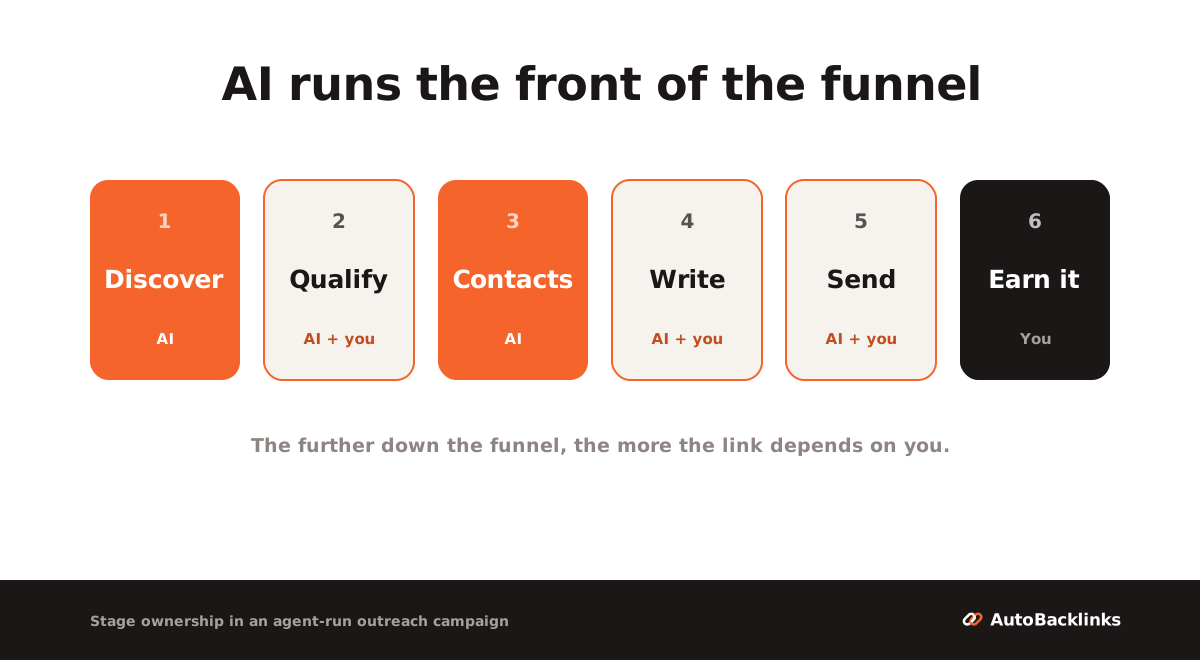
Every link-building campaign runs through the same six stages, whether you do them by hand or with software. AI changes how much of each stage you do yourself, not the stages themselves.
Stage 1: Discover prospects (AI does this well)
This is the most tedious stage by hand, and the one AI changes most.
The old way was opening twenty browser tabs, running search operators, and pasting domains into a spreadsheet. AI can do this at a scale you cannot match manually. Point it at your topic and it pulls hundreds of candidate sites: blogs in your niche, resource pages, listicles you could be added to, and sites that already link to your competitors.
That last source is the strongest. If a site linked to a competitor, it has already shown it will link to a company like yours. A competitor backlink scan turns a rival's best links into your prospect list in minutes instead of an afternoon.
The how-to here is simple: feed the system your core keywords and two or three competitor domains. Let it build the raw list. Do not filter yet, the next stage does that. The goal of Stage 1 is coverage, not precision.
Stage 2: Qualify by relevance (AI scores, you decide)
This is where most campaigns are won or lost, and where the AI-versus-human line gets sharp.
A raw prospect list is mostly noise. Some sites are irrelevant, some are spammy, some have strong metrics but no topical fit. Relevance is the filter that matters most. A high-authority site with no connection to your topic is a worse target than a smaller site that covers exactly what you do.
AI is genuinely good at the first pass. It can read each page and score how well it fits your topic, sort the list, and push the obvious mismatches to the bottom. That alone saves hours.
But the final call is yours. AI can tell you a site is topically relevant; it cannot always tell you a site is good, that the audience is real, that the editorial standards are serious, that a link there would mean something. That judgment comes from looking. So let AI rank the list, then review the top of it yourself. You are not re-checking every site. You are spot-checking the ones AI wants you to pursue.
When you spot-check, you are looking for the things a relevance score misses:
- A real audience: recent posts, comments, signs of life. A site that stopped publishing two years ago is a dead link.
- Editorial standards: does it run genuine articles, or is every post a thinly veiled paid placement?
- The outbound link profile: a page stuffed with unrelated dofollow links to casinos and crypto is one to skip, whatever its domain rating says.
- Whether it sells links openly: a "submit a guest post" page with a price list is exactly the kind of site Google discounts. (This is the model behind every guest post and link building marketplace, which is why I treat them with caution.)
None of these checks take long once you know to look for them. But they are the difference between a link that helps you and one that quietly works against you, and they are precisely the calls a model cannot make for you.
Stage 3: Find verified contacts (AI does this well)
Bad contact data kills good campaigns. If the list is relevant but the emails bounce or land in an inbox nobody reads, the campaign fails before it starts.
This stage is pure labor, and AI tooling handles it cleanly: find the editor, content lead, or marketing contact behind a domain, and verify the address is deliverable before you send. There is no judgment to protect here, a verified email is a verified email. Let the machine do all of it.
One sequencing note: find contacts after you qualify, not before. Contact lookup costs money and time. Running it on a list you have not filtered means paying to enrich sites you were never going to email.
Stage 4: Write the pitch (AI drafts, you approve)
Here is where AI is both genuinely useful and genuinely dangerous.
Useful: a model can read the specific page you are targeting and draft a first email built around it, referencing the actual article, the actual gap, the actual audience. That is far better than a merge-field template blasted to everyone, and it is the kind of personalization that lifts reply rates. (If you want to see what a strong pitch looks like, I broke down real templates in guest post pitch examples that actually get replies.)
Dangerous: the same model will happily generate a thousand near-identical emails with a name swapped in. Editors can smell that instantly, and so can spam filters. "Generic mass personalization" (fake compliments, hollow flattery, the same three sentences with a variable in the middle) is worse than no personalization at all.
The rule for Stage 4: let AI draft, never let it send unread. Treat every draft as a first version. Read it, cut the filler, make sure the page reference is real and the angle is honest. A draft you approve in twenty seconds is the sweet spot. A send you never looked at is how you torch your domain reputation.
Stage 5: Send and follow up (AI sequences, you handle replies)
Sending and follow-ups are mechanical, and automation handles them well, as long as you respect deliverability. Use pre-warmed inboxes, keep daily volume sane, and let the system schedule a follow-up or two a few days apart. Most replies arrive on the follow-up, not the first email, so this stage matters more than people think.
What AI should not run on autopilot is the conversation that starts when someone replies. A reply is a human opening a door. That is where the relationship begins, and a canned auto-response slams it shut. Handle replies yourself.
Stage 6: Earn the link (this is you)
The link itself is a human outcome. Someone on the other side decided your page was worth citing. AI got you to the conversation faster and cheaper. It did not earn the trust. The further down this funnel you go, the less the model matters and the more you do.
What AI link building tools do well today
Strip away the hype and the picture is clear. AI is excellent at the parts of link building that are high-volume and rules-based: search, classification, enrichment, drafting, scheduling, and tracking.
Concretely, AI today can:
- Find prospects at scale: sweep the web and competitor backlink profiles for relevant sites far faster than you can by hand.
- Score topical relevance: read each page and rank your list so the best-fit sites rise to the top.
- Verify contacts: find and confirm deliverable email addresses for qualified domains.
- Draft page-specific outreach: write a first email and follow-ups tuned to the exact page you found.
- Run the sequence: schedule sends and follow-ups and keep the cadence consistent.
- Track and learn: monitor opens, replies, and live links, and surface what is working.
This is genuine time saved. A campaign that used to take a week of manual work can be set up in an afternoon. The AI outreach agent we built runs exactly these steps (discovery, relevance scoring, contact lookup, drafting, sending, and tracking) in one workflow, so the labor collapses into review-and-approve. The same steps are available from Claude, ChatGPT, or Cursor through the MCP server, and building backlinks with Claude gives the prompt for each link type. If you are weighing your options, I reviewed the best AI link building tools against their live sites, and scored the wider category in which AI SEO agents actually act on their own.
What AI cannot (or should not) do in link building
Now the other half of the answer, the part that decides whether AI link building helps you or hurts you.
AI cannot decide which links are actually worth it. It can measure relevance and authority, but the call on whether a site is genuinely credible (real audience, real editorial standards, a link that will still look good in two years) is yours. Google itself has said the links that help are the ones that reflect real editorial judgment. A model does not have that.
AI cannot judge whether a pitch truly lands. It can write a competent email. It cannot feel the difference between a pitch that sounds human and one that sounds like a machine wearing a human mask. That read still takes a person.
AI cannot build the relationship. Link building is relationship-driven at the edges that matter. The reply, the back-and-forth, the small favor, the editor who remembers you next quarter, none of that survives automation. This is the human layer that AI cannot remove, no matter how good the models get.
AI cannot create the thing worth linking to. The strongest links point at something genuinely useful: original data, a real tool, a piece of work people want to cite. AI can help you draft it, but the substance (the actual experiment, the real numbers, the lived insight) has to be real. Mass-produced content built only to attract links is exactly what Google's systems target.
AI cannot own your strategy. Which pages need links, which anchors to vary, how aggressive to be given your domain's age, those are decisions that depend on your situation. A model executes a strategy. It does not set one.
AI cannot keep you safe from penalties. Left unsupervised, AI will scale whatever you point it at, including mistakes. Scaling bad outreach does not make it good. It makes it a footprint.
The AI link building rule: automate the labor, not the judgment
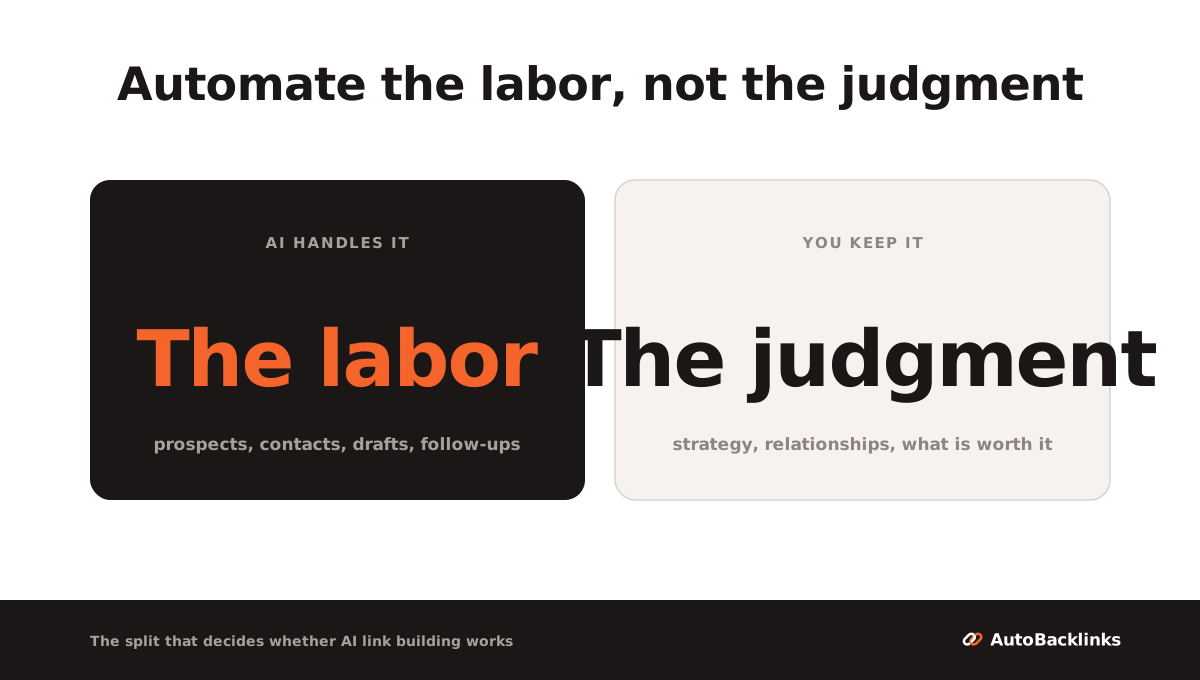
Put the two halves together and you get a single principle. The parts of link building that are labor (searching, sorting, enriching, drafting, scheduling) should be automated as far as they will go. The parts that are judgment (what is worth pursuing, what to say, who to build a relationship with, where the line is) stay with you.
I have seen this play out in real numbers. In a real outreach campaign, we sent 187 emails and got 32 replies, a 17.1% reply rate, well above the low single digits that large-sample benchmarks report for cold outreach (Built For B2B, 2025). The lever was not volume. It was judgment: a tightly relevant list, the right page on each site, and an email written around that page. AI built the list and drafted the emails. The relevance call and the final read were human. That combination is what produced the result.
If we had let automation run the whole thing (blast a big unfiltered list with generic AI emails) the reply rate would have collapsed and the sending reputation with it. More volume would have made the campaign worse, not better. That is the trap of treating AI link building as a volume play.
There is a simple way to see the split in hours. The labor stages (discovery, qualification, contact lookup, drafting) are where most of the manual time used to go, and where AI hands almost all of it back. The judgment stages (the final site review, the reply, the relationship) are a small slice of the time but close to all of the outcome. Automating the labor so you can spend more attention on the judgment is the whole point. Automating the judgment as well is how campaigns quietly fall apart.
How to set up your AI link-building workflow
Here is the practical version, the steps to put this into practice, whether you use one tool or stitch a few together.
- Define the target. Decide which page on your site needs links and what topic it is about, and size the gap against the pages already ranking (how many backlinks you need is measurable, not a guess). Everything downstream depends on this. AI cannot make this call for you.
- Generate the prospect list. Feed your keywords and two or three competitor domains into your tool of choice. Aim for coverage, a few hundred candidates is fine at this stage.
- Let AI score relevance, then review the top. Have the system rank prospects by topical fit. Read the top of the list yourself and cut anything that does not deserve a link, no matter what its metrics say.
- Enrich only the survivors. Run contact lookup on the filtered list, not the raw one. Verify deliverability before sending.
- Draft with AI, edit every email. Generate page-specific first emails and follow-ups. Read each one, cut the filler, confirm the page reference is real. Never send a batch you have not looked at.
- Send slowly, follow up once or twice. Use warmed inboxes, keep volume controlled, and space follow-ups a few days apart. Most replies come from the follow-up.
- Handle replies as a human. When someone responds, drop the automation and have a real conversation. This is where links are actually earned.
- Track and refine. Watch reply rates and live links. Feed what works back into your targeting. The system gets sharper as you tell it what a good prospect looks like.
Notice the shape of this: AI does steps where the work is mechanical, you take over wherever a decision matters. That is the whole method.
AI link building and Google's spam policies
This is the part the "1,000 backlinks with AI" crowd ignores, and it is the part that protects your site.
In March 2024, Google added scaled content abuse to its spam policies. The policy explicitly names "using generative AI tools or other similar tools to generate many pages without adding value for users" as a violation, and it makes clear that how the content is produced (AI, human, or a mix) does not matter. What matters is whether you are mass-producing to manipulate rankings (Google Search spam policies).
Google's link spam policy is just as direct. It targets "creating links to or from a site primarily for the purpose of manipulating search rankings," and it specifically lists "using automated programs or services to create links" as a violation (Google Search spam policies). That is the auto-backlink-generator category, named outright.
So the safe use of AI in link building is narrow and clear: use it to do the work of earning real, editorial links faster, research, qualification, drafting, sending. Do not use it to manufacture links or to spray low-value content across the web. The first saves you time. The second is a footprint that Google's systems, including its AI-powered spam detection, are designed to find.
The honest test: if a real editor would be glad to have linked to you once they saw your page, AI just helped you reach them faster. If the only reason the link exists is automation, it is the kind of link Google removes the value from, or penalizes you for.
Three AI link building mistakes to avoid
I see the same three errors over and over, and each one comes from trusting automation with a judgment call.
Sending unread. The fastest way to damage your domain is to let AI send emails nobody reviewed. One batch of obviously robotic pitches teaches editors (and spam filters) to ignore the address. The few seconds it takes to read a draft is the cheapest insurance you will ever buy.
Chasing volume. AI makes it easy to email two thousand sites at once. That is a reason to be more selective, not less. A bigger unfiltered list lowers your reply rate, burns your sending reputation, and leaves a footprint. Relevance beats volume every time, and AI does not change that, it just makes the wrong choice faster.
Confusing motion with progress. A dashboard full of sent emails feels like work. Live links are the only number that counts. If relevance and judgment are missing, more activity simply manufactures more noise, and none of it earns a link.
FAQ
Can AI do link building?
AI can do most of the work of link building, finding prospects, scoring relevance, verifying contacts, drafting outreach, and tracking results. It cannot do the judgment parts: deciding which links are worth pursuing, building relationships, and creating content worth citing. Used for the labor and supervised on the judgment, AI makes link building much faster.
How do you create backlinks using AI?
You do not create backlinks with AI, you earn them faster with AI. The workflow is: use AI to find relevant prospects and score them, verify contacts, and draft page-specific outreach emails. Then a human reviews the targets, edits the emails, sends them, and handles replies. Tools that claim to auto-generate backlinks are link spam and violate Google's guidelines.
Is AI link building safe?
It is safe when AI handles the labor and a human keeps the judgment. It becomes risky when you let it mass-produce content or auto-create links, both are named in Google's spam policies. The line is simple: use AI to reach real sites for real editorial links, not to manufacture links at scale.
Can you fully automate link building?
No, and you should not try. The front of the workflow (discovery, qualification, enrichment, drafting) automates well. The back (judging quality, building relationships, replying like a person) does not. Full automation removes the human judgment that makes links worth having and is the fastest way to get a footprint flagged.
Does link building still work in 2026?
Yes. Relevant, editorial links still pass value and drive traffic. What has changed is the cost of doing it: AI removes most of the manual labor, so small teams can run campaigns that used to need an agency. The links that work are the same ones that always worked, earned from relevant sites through real outreach.
Want to put this workflow into practice without stitching five tools together? Start a free trial and run your first AI-assisted campaign end to end.
About Rachid Idali
Founder & SEO Strategist
Rachid Idali has spent 10 years in SEO, running multi-six-figure SEO and link-building budgets across content, digital PR, and outreach programs. He writes about practical systems for finding relevant prospects, earning links, and turning SEO operations into repeatable pipelines.
More from Rachid Idali