

How Many Backlinks Do You Actually Need? (2026 Data)

by Rachid Idali
Last Updated: August 22, 2026
Here is the short answer. In July 2026 we pulled the backlink profiles of the top-10 ranking pages for 125 commercial SaaS keywords across the difficulty spectrum. For easy keywords (difficulty 0–10), the pages on page one had a median of 23 referring domains. At difficulty 11–30, the median was 80. At 31–50, 323. At 51–70, 878. For the brutal head terms, 1,308. The number you personally need is none of these: it is the median of the pages already ranking for your exact keyword, and this article shows you how to pull that number in about twenty minutes.
That is the whole game. Everything else you have read about this question is either fake precision or a cop-out.
I have run link-building budgets for ten years, and this question ("how many backlinks do I need?") is the one every client, founder, and junior SEO asks first. The answers ranking on Google today are bad in two opposite ways. Half of them throw out a number with no methodology behind it: one popular guide says an established website should have "40–50 backlinks to the homepage," another says you need "300–500 high-quality backlinks" to see good traffic. Nobody shows where those figures came from, because they came from nowhere. The other half shrug and say "it depends," which is technically true and practically useless.
Both camps skip the two things you actually need: real data, and the effort math behind it. So this piece does both.
How many referring domains top-ranking pages have
We queried DataForSEO for 125 commercial SaaS keywords in July 2026, from "notion alternatives" (difficulty 3) to "website builder" (difficulty 100), and recorded the average number of referring domains pointing at each keyword's ten ranking pages. Every keyword is a solution-seeking search: "best X" roundups, "X software" categories, AI-tool terms like "ai sales agent," and "X alternatives" queries. No informational padding, because informational SERPs are softer and would flatter the numbers. And not domain-level authority: the links pointing at the specific pages that rank.
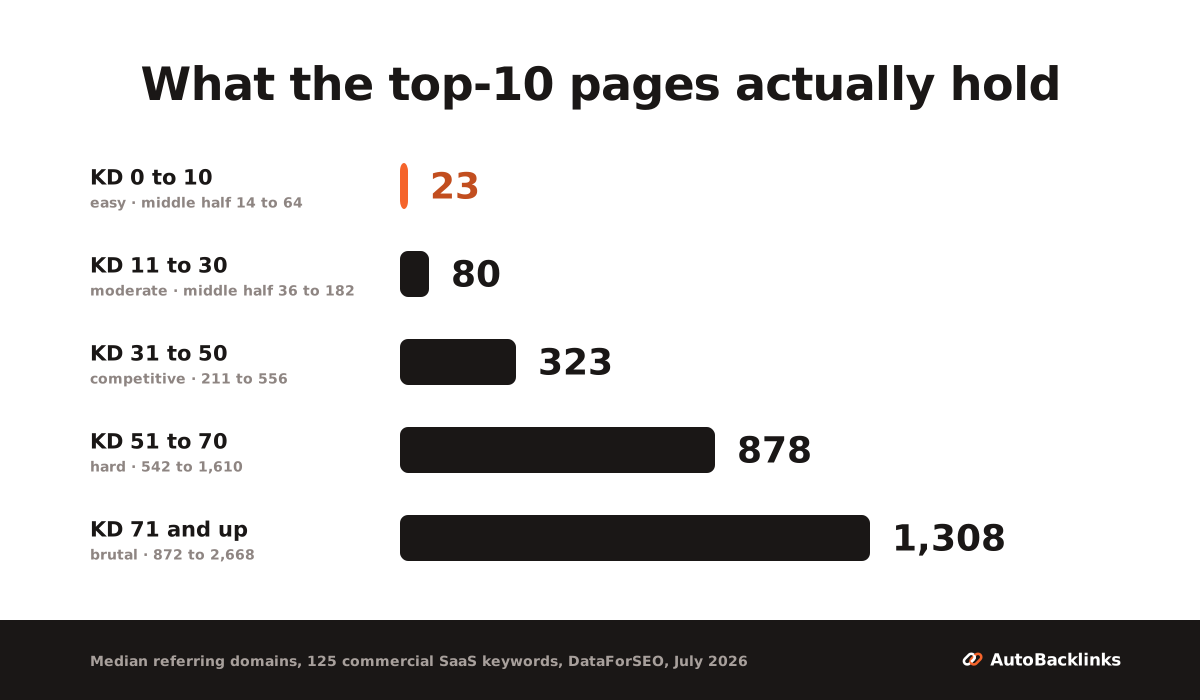
| Keyword difficulty | Median referring domains (top-10 pages) | Middle half of SERPs | Example keywords from the study (avg RDs) |
|---|---|---|---|
| 0–10 (easy, n=18) | 23 | 14–64 | notion alternatives (6) · best hr software (23) |
| 11–30 (moderate, n=38) | 80 | 36–182 | best crm software (55) · ai sdr (114) |
| 31–50 (competitive, n=44) | 323 | 211–556 | best payroll software (329) · ai note taker (337) |
| 51–70 (hard, n=18) | 878 | 542–1,610 | ai video generator (718) · crm software (967) |
| 71+ (brutal, n=7) | 1,308 | 872–2,668 | backlink checker (1,308) · website builder (20,996) |
To make the tiers concrete: "mailchimp alternatives" ranks with pages holding around 16 referring domains, "lead generation software" around 55, "cold email software" around 117, and "email marketing software," one of the most contested terms in SaaS, around 5,966. Same industry, four different wars.
Three honest caveats, because a benchmark without caveats is a trap.
First, these are averages of each SERP's top ten, and averages skew high. One Wikipedia page or one viral post in a SERP drags the whole number up. The pages at positions 6 through 10 usually hold far fewer links than the average suggests.
A related warning on units: every number here counts referring domains, never raw backlinks. The median site we measured in what backlinks actually are carries 71 backlinks per referring domain, so a target set in backlinks would be off by roughly that multiple.
Second, look at the spread. Within the 11–30 tier alone we found "sales prospecting tools" at 8 referring domains and "best appointment scheduling app" at 2,386: a 280x difference inside one difficulty band. Across the full dataset, difficulty tracks link counts well on average and terribly per keyword. Difficulty scores compress a messy reality into one digit, and the spread inside each tier is the proof. This is exactly why the tier table is a starting point and your own SERP pull is the real answer.
Third, page-level is the number that matters, and most published benchmarks get this wrong. The one genuine study ranking for this query reports that page-one sites have a median of 907 referring domains, which sounds terrifying until you notice it counts links to the entire domain, not to the ranking page. You are not competing with a site's whole backlink profile. You are competing with one URL, and one URL on an easy SERP typically holds a dozen links, not nine hundred.
Two patterns in the data are worth stealing before we get to the method. "X alternatives" keywords are the cheapest commercial SERPs we measured: median difficulty 5, median 12 referring domains, on queries like "notion alternatives" (1,600 searches a month, top-10 pages averaging 6 referring domains). If you sell software, that is where your first links buy the most. And AI-category keywords punch above their difficulty score: "ai X" SERPs hold a median of 301 referring domains against 106 for "best X" roundups, because every page ranking for an AI term is a funded startup actively building links. "ai sales agent" scores like an easy keyword (difficulty 8); its top-10 pages still average 90 referring domains.
So when someone quotes you "40–50 backlinks to the homepage" or "300–500 to rank," ask one question: measured on which SERP? There is no methodology behind those numbers. There is one behind yours, and here it is.
Count referring domains, not backlinks
One correction before the method, because it changes what you count.
A site that links to you 500 times from its footer is one vote, not 500. Google's own John Mueller said it plainly in April 2024: don't focus "so much on the absolute count of links," because "over-focusing on links will often result in you wasting your time doing things that don't make your website better overall." The large-scale data agrees with him. Semrush's Ranking Factors Study 2024, which analyzed 300,000 ranking positions across 16,298 keywords, found top-ranking pages hold an average of 2,418 backlinks but a median of just 13, from a median of only 6 referring domains. Read that again: the average is inflated by a few mega-pages, and the typical page-one result wins with a handful of unique linking sites.
Referring domains are the unit of progress. Every number in this article, and every number you pull in the next section, should be referring domains. When a tool shows you "backlinks: 4,812" and "referring domains: 37," the second number is your scoreboard.
How to calculate how many backlinks you need in 20 minutes
Forget the universal benchmark. Your target is a property of your specific SERP, and computing it takes four steps.
1. Pick one keyword and one page. Not your site. One target keyword, one URL you want to rank for it. The math is meaningless at the site level.
2. Pull the top 10 and drop the outliers. Search your keyword, list the ten ranking URLs, and remove the ones you are not actually competing with: Wikipedia, Reddit, YouTube, government pages, and mega-brands that rank on domain reputation alone. What remains, usually six to eight pages, is your real competition.
3. Record page-level referring domains for each. Any backlink tool shows this per URL. Now take two medians: the median of positions 4–10 is your entry target, the number that historically gets a page onto page one. The median of positions 1–3 is your breakout target, the number the winners hold.
4. Subtract what your page already has. The difference is your link gap. If the entry target is 18 and your page has 4 referring domains, you need roughly 14 new referring domains from sites of comparable quality. That is your number. Not 50, not 500: the number this SERP demands.
The manual version of this takes twenty minutes per keyword. The reason most people never do it is that the next step, turning that gap into an actual prospect list, used to take days. That part is now automatable: a competitor backlink scan reads the profiles of the pages that outrank you and turns their links into your outreach list, which is the same analysis in minutes. However you do it, do the math before you build anything. Link building without a target number is how people end up with 25 directory links and no movement.
How many outreach emails those backlinks cost
Here is the section none of the ranking articles will write, because it makes link building look like what it is: work.
Say your gap is 15 referring domains. Links earned through real outreach arrive at a conversion rate, so let us model it. BuzzStream analyzed 51 million outreach emails in a May 2025 study and found link-building outreach averages a 3.59% reply rate: roughly 1 email in 28 gets any answer at all. Assume, conservatively, that one reply in four eventually becomes a live link (that ratio is an assumption you should test against your own campaigns, not a published benchmark). The arithmetic:
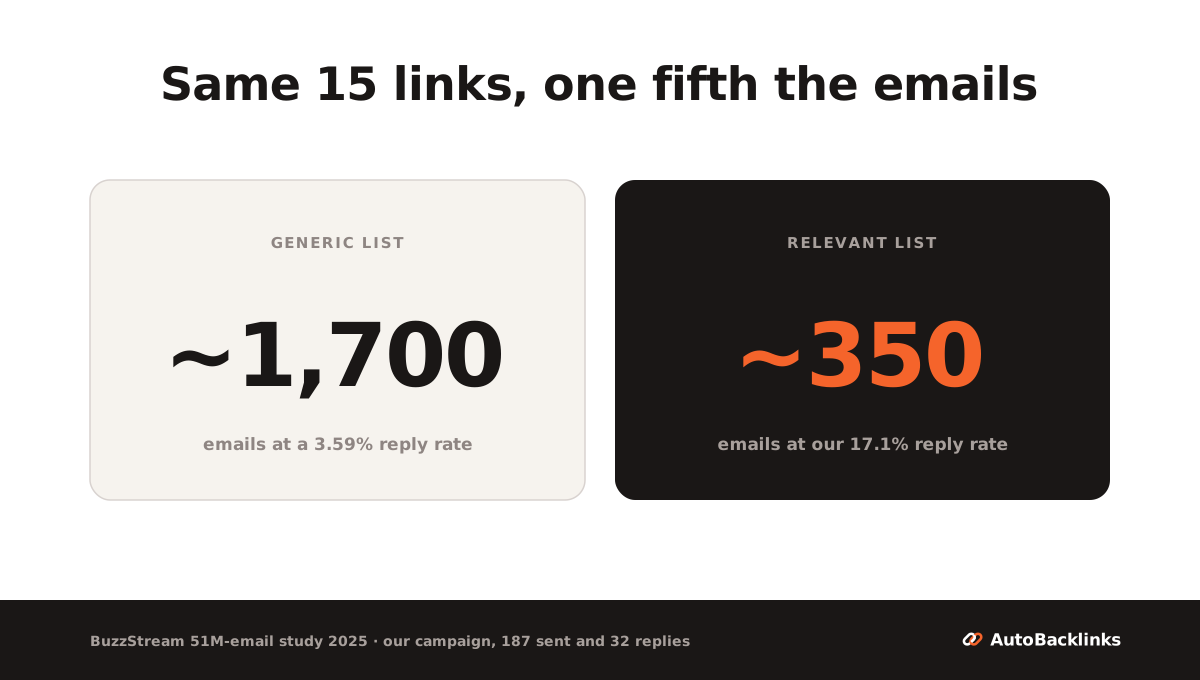
- 15 links × 4 replies per link = 60 replies needed
- At the 3.59% industry reply rate: about 1,700 emails
- At a 17.1% reply rate: about 350 emails
That second rate is not hypothetical. We ran a campaign and published every number: 187 emails sent, 155 opened, 32 replies, 6 bounces, a 17.1% reply rate. Nearly five times the industry average, and the difference was not the email copy. It was prospecting. Every prospect on that list had a topical reason to care, so far more of them answered.
Which asks are worth sending is the next question, and it has a measured answer: nine backlink methods ranked by what they produce classifies 11,971 real referring domains by where each link came from, so you can spend the emails on the methods that actually fill a profile.
This is the real answer to "how many backlinks do I need." The number itself is usually small and knowable. The cost lives in the outreach behind it, and relevance is the only lever that collapses that cost. It also reframes the buy-versus-build question: at agency rates of $300 to $1,000 per link, that 15-link gap is a $4,500 to $15,000 invoice. As a few hundred well-targeted emails an outreach agent drafts and sends for you, from the dashboard or from Claude through the MCP server, it is a month of background work.
Which backlinks actually count toward your gap
The gap math assumes the links you build are comparable to the links your competitors hold. Most cheap links are not, and Google has spent a decade saying so.
In March 2024, Google quietly edited its spam documentation, demoting links from "an important factor" to "a factor" in how it determines relevancy. A month later, Google's Gary Illyes told a conference audience: "we need very few links to rank pages... over the years we've made links less important." The direction is unmistakable: the algorithm keeps getting better at counting only the links that look like genuine editorial citations, and at ignoring the rest.
So count honestly. Toward your gap:
- Editorial links from topically relevant pages. A site in your niche, linking from a real article, because your page is useful. This is the unit the medians in our data are made of.
- Guest posts on sites with real readers, where the link sits in context.
- Resource-page and listicle placements on pages that already rank for related terms.
Not toward your gap:
- Directory submissions, bookmark sites, and forum profiles. This is the classic trap. A famous Reddit thread on this exact question came from someone who had built 20–25 directory and bookmarking links and seen no movement. Nothing was broken. Those links simply count for approximately nothing. Real links are scarce (Ahrefs' 2023 study of 14 billion pages found 96.55% get zero Google traffic, with "no backlinks" as a leading reason), and that scarcity is exactly why the algorithm trusts the earned ones and discounts the manufactured ones.
- Paid placements without disclosure. Google's spam policies name "buying or selling links for ranking purposes" as link spam. Whatever you buy that way can be ignored or worse, and either way it does not close your gap.
- A hundred links from one domain. One referring domain. Counted once.
Stop worrying about "safe" link velocity
The adjacent question is always "how many backlinks per day or month is safe?" It has a clean answer: there is no such number, and Google has been saying so for years. Asked about link velocity, John Mueller explained that it is not about how many links you gain in a period; unnatural links are a problem at any speed, and natural ones are fine at any speed. Nothing Google has published since (its live spam policies included) defines a safe rate. The policies talk about intent and manipulation, never pace. A page that lands national press can earn 300 legitimate links in a week. A PBN drip of two spam links a day is still spam.
What actually matters is that ranking pages keep earning. As Search Engine Land's 2025 assessment of backlinks notes, top-ranking pages keep gaining followed links at 5–14% per month (a dynamic Ahrefs first measured across 200,000 top-ranking pages). Your target is not static. Hit the entry median, keep publishing things worth citing, and keep a low, steady outreach cadence running, because your competitors' numbers are still moving while yours are.
Backlinks and AI search: the number matters less, the name matters more
One more 2026 wrinkle, since a growing share of your traffic now comes from AI answers rather than blue links.
The data says backlinks still matter there, but differently. Semrush's study of 1,000 domains found that a domain's backlink-based Authority Score correlates with how often AI tools mention it at a strong 0.65, with the gains showing up after authority thresholds rather than linearly. But Ahrefs' study of 75,000 brands found the strongest correlate of AI Overview visibility is not links at all: it is brand web mentions, at 0.664, versus 0.218 for backlink count. And by March 2026, only 38% of pages cited in AI Overviews also ranked in the organic top 10, down from 76% eight months earlier. I went through the full body of research on this, including which tactics survive measurement, in link building for AI search.
The practical read: the same outreach that earns your links is now doing double duty. Every placement that gets your brand named on a relevant page raises both your ranking signal and your odds of being the answer an AI cites. Chasing a raw link count was always the wrong frame; in the AI era it is doubly wrong. Earn mentions on pages that matter in your topic, and the link count takes care of itself.
How many backlinks do you need? The honest answer
You need enough referring domains to match the pages already ranking for your keyword, from links of comparable quality. In our July 2026 data the easiest commercial tier runs a median of 23 referring domains per ranking page, and it climbs fast from there. The universal benchmarks are noise: pull your own SERP, take the median of positions 4–10, subtract what you have, and you hold a real number, usually smaller than you feared.
Then respect what the number costs. Fifteen links is somewhere between 350 and 1,700 outreach emails depending entirely on how relevant your prospect list is. That is the part worth automating: the prospecting, the filtering, the contact verification, and the first drafts. If you want the whole loop (gap analysis from a competitor scan through verified contacts to sent outreach) running this week, you can start a trial and test it on one keyword before you commit to anything. And if you are still deciding whether to run this yourself or pay someone, read the honest cost math on outsourcing first. For what AI can and cannot do in that loop, the AI link-building breakdown draws the line clearly. If your budget is the binding constraint, we mapped what a low cost SEO stack can actually close against these same difficulty tiers: under difficulty 30 a $79 plan gets there, above it the arithmetic stops working.
The question was never really "how many backlinks do I need?" It was "what does my SERP demand, and what does that cost?" Now you can answer both with data instead of someone else's invented benchmark.
FAQ
Can you rank with zero backlinks?
Yes, but only on SERPs where nobody else has links either. Ahrefs' study of roughly 14 billion pages found that of about 20 million pages with zero referring domains, only 2,997 attract more than 1,000 monthly search visits: odds of roughly 1 in 6,671. For very low-competition, long-tail keywords a strong page on a trusted site can rank linkless. For anything commercially valuable, the top-10 pages in our data held a median of 23 referring domains even at the easiest tier.
How many backlinks per day or month is safe to build?
There is no safe number, because velocity is not what Google evaluates. John Mueller has said directly that it is not about how many links you gain in a time period: unnatural links are a problem at any pace, and natural ones are fine at any pace. Worry about whether each link would exist without manipulation, not about the calendar. As a planning reality, one good outreach-earned link per week is a strong sustained pace for a small team.
Does my homepage really need 40 to 50 backlinks?
That widely quoted figure has no methodology behind it. Rankings are won at the page level: what matters is how many referring domains point at the specific page you want to rank, compared with the specific pages ranking above it. Homepages accumulate links naturally as a byproduct of brand mentions. Spend your outreach effort on the pages that target your money keywords, sized against your measured link gap.
Do referring domains matter more than total backlinks?
Yes. A domain linking to you 500 times counts as one vote, not 500. Semrush's Ranking Factors Study 2024 (300,000 ranking positions) found top-ranking pages hold a median of just 13 backlinks from 6 referring domains, while averages run in the thousands: a handful of unique linking domains does the work. Google's John Mueller warned in 2024 against focusing "on the absolute count of links." Track referring domains as your progress metric and treat raw backlink counts as noise.
Are backlinks still worth building in the AI search era?
Yes, with a reframe. Semrush found domain authority (a backlink-driven score) correlates with AI mentions at 0.65 across 1,000 domains. But Ahrefs found brand web mentions predict AI Overview visibility three times better than raw backlink count (0.664 vs 0.218). The outreach that earns links also earns the mentions AI systems learn from, so the work is the same: get named on relevant pages. Only the scoreboard has widened.
About Rachid Idali
Founder & SEO Strategist
Rachid Idali has spent 10 years in SEO, running multi-six-figure SEO and link-building budgets across content, digital PR, and outreach programs. He writes about practical systems for finding relevant prospects, earning links, and turning SEO operations into repeatable pipelines.
More from Rachid Idali