

Outsource Link Building 2026: Agency, Marketplace, or DIY?

by Rachid Idali
Last Updated: August 22, 2026
Outsourcing link building means paying an agency, a freelancer, or a marketplace to earn or place backlinks for you instead of running the outreach in-house. For a decade that was the sensible default, because the alternative was hiring a $80,000 outreach person and buying a $1,000-a-month tool stack. In 2026 that alternative changed. An AI outreach agent now does the manual work that salaried person used to do, which means for most teams the honest answer is: keep link building in-house, automate the labor, and outsource only the few things software genuinely cannot do.
That is not the answer you will read anywhere else on this search. Here is why.
I have run link-building budgets for ten years and now build outreach software. I have hired the agencies, bought from the marketplaces, and staffed the in-house teams. So when I read the articles ranking for "outsource link building," I notice the thing they have in common: every single one is published by a company that sells outsourcing, and every single one concludes that you should buy it. That is not a coincidence. It is the business model writing the article.
So this piece does the comparison they cannot: an honest one, from someone with nothing to sell you on the outsourcing side.
What outsourcing link building actually means
Strip away the sales copy and there are four ways to get backlinks built. Outsourcing is any of the three that involve paying someone else to do it.
| Model | What you pay for | Typical cost | Who runs it |
|---|---|---|---|
| In-house | Your own time or a hire, plus tools | Salary + ~$1,000/mo tools | You |
| Freelancer | One person's outreach hours | $200–$1,000/mo, uneven | A contractor |
| Agency | A managed team and their publisher network | $3,000–$10,000/mo retainer | The agency |
| Marketplace | A catalog of pre-priced placements | ~$460 per placement | You, from a menu |
The agencies want you comparing the middle two against the first, because on their math in-house always looks expensive. The trick is in how they cost the in-house column. Watch it closely, because it is where the whole argument lives.
One category sits above all three rows and deserves its own note: digital PR agencies bill $5,000 to $15,000 a month, which works out at $367 to $1,200 per earned link. They are buying you newsroom coverage rather than placements, so the comparison only holds if that is what you actually want.
Link building agency pricing: the cost model and what it leaves out
Open any of the top-ranking guides and you will find the same in-house cost model, because it makes outsourcing look like a bargain. Here are the real figures, pulled from those articles:
- The salary. A link builder runs $50,000 to $98,000 a year, and the guides that quote the high end quote it because it makes the comparison land where they want. Add benefits and the fully loaded first-year cost sits around $100,000 to $118,000.
- The tools. Ahrefs at $249 a month, Pitchbox at $165, Semrush at $250. The in-house stack tallies to roughly $1,000 a month, about $12,000 a year.
- The output. At those inputs, a solo in-house builder placing around ten links a month costs you close to $767 per link once you add it all up. That is genuinely expensive, and the agencies are right to point it out.
Then they show you their side: outsourcing, they claim, runs 30 to 60 percent cheaper than in-house. Case closed, apparently. Outsource and save.
Except the whole model rests on one assumption that quietly went stale: that the in-house option requires a full-time human doing the outreach by hand. That human was spending their week on prospecting, filtering sites by SEO metrics, hunting down verified contact emails, writing pitches, and chasing follow-ups. That is the $80,000 line. And that is exactly the work an AI agent now does.
So the honest cost table has a fourth column the agencies never include.
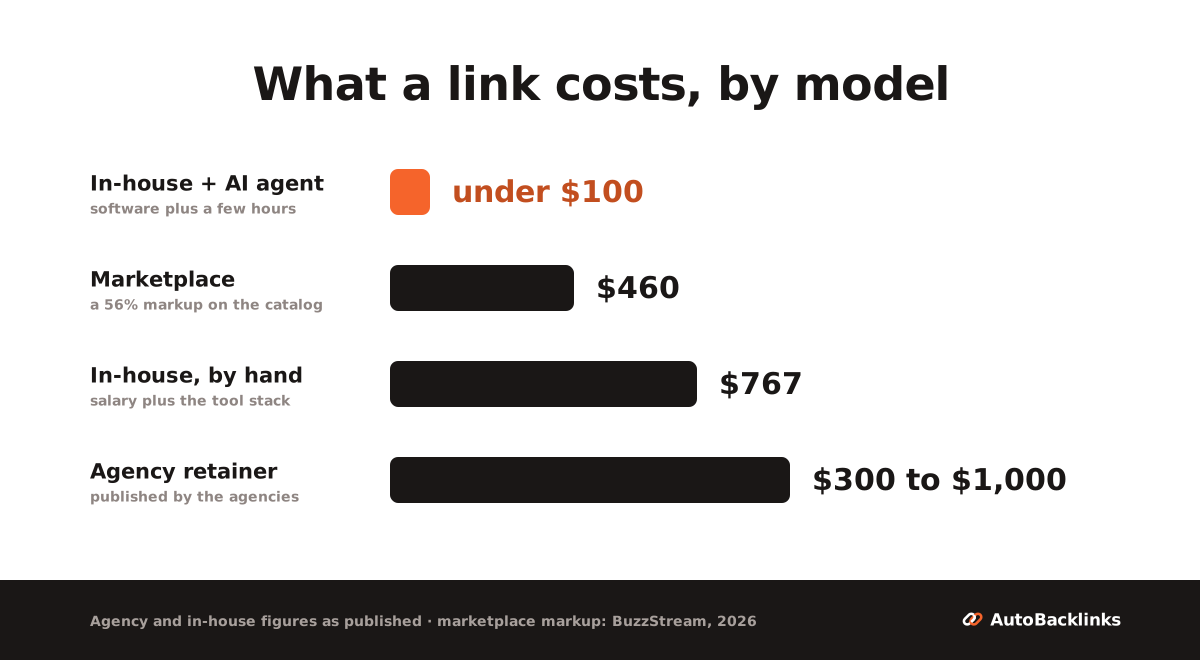
Replace the salaried outreach labor with an agent and the math inverts. The software runs $179 a month on a mid-tier plan, about $2,148 a year, against that $12,000 tool stack and $80,000 salary. You still need a person, but not a full-time one: the agent does the grinding, so an existing marketer running it a few hours a week can place as many links as the old full-time hire, sometimes more. Value that person's slice of time honestly and the all-in cost per link still lands far below the $300 to $1,000 an agency charges, and below the $460 a marketplace does.
That is the argument in one line. Outsourcing was never really cheaper than in-house. It was cheaper than in-house done by hand. Once the hand-work is automated, the reason to outsource mostly disappears.
If you want the vendor-by-vendor version of that math, I priced the main SEO outreach services against one basket of ten placements: the cheapest published DR40+ placement costs more than a full month of the software.
The service side of the same question is broken down in link building services, priced per link, where ten named services are reduced to one DR band and the monthly packages are divided out into a real per-link figure.
In-house link building vs agency vs marketplace vs AI agent
Cost is only one axis. Here is the full comparison the agency articles gesture at but never finish, with the column they leave off.
| Agency | Marketplace | In-house (manual) | In-house + AI agent | |
|---|---|---|---|---|
| Cost per link | $300–$1,000 | ~$460 | ~$767 | Under $100 + your time |
| Control | Low | Medium | High | High |
| Speed to start | 2–4 weeks | Same day | 4–6 month ramp | Days |
| Relevance | Their picks | You filter a catalog | You choose | You choose, AI pre-scores |
| Penalty risk | Their tactics, your domain | Paid links, higher risk | Yours to control | Yours to control |
| Real relationships | The agency owns them | None | You own them | You own them |
| Best for | Hands-off, big budget | One-off bursts | Teams with spare headcount | Almost everyone else |
Two rows matter more than the rest. Control and real relationships are the things you permanently give up when you outsource. The agency builds relationships with publishers on your behalf and keeps them; leave the agency and the links stop. The marketplace hands you a paid placement with no relationship at all, which is also the option most exposed to Google's stance on link schemes. The in-house paths are the only two where the relationships and the judgment stay with you. The agent version just removes the reason those paths used to be slow and expensive.
What an AI link building agent automates (and what it doesn't)
The reason "do it yourself" got a bad reputation is that doing it yourself used to mean doing all of it yourself. It does not anymore. The split is clean, and being honest about it is the difference between a tool that helps and one that gets your domain flagged. I wrote about this line in detail in what AI can and can't do for link building, but here is the short version.
The agent does the labor:
- Finds relevant prospects from a topic, a keyword, or a competitor's backlink profile
- Filters them on real SEO signals: Domain Rating, organic traffic, referring domains
- Finds and verifies the contact email before anything sends
- Drafts a pitch written from each prospect's own page, not a merge-field blast
- Schedules the follow-ups and tracks who replied and which links went live
You keep the judgment:
- Deciding which links are actually worth pursuing
- Reading the draft and knowing whether the pitch lands
- Building the real relationship once someone replies
- Creating the page worth linking to in the first place
- Setting the strategy and the anchor-text mix, and staying clear of anything spammy
That division is the rule of thumb: automate the labor, not the judgment. An agency sells you both halves as a bundle and marks up the labor half, which an agent now does for a rounding error. What you were really paying the agency for, most of the time, was the grinding. The judgment was always going to be better coming from someone who understands your business, which is you.
The reply rate a solo link builder can actually hit
The agencies' strongest claim is not about cost. It is that you cannot match their results on your own, because they have the expertise and the connections. It is worth testing against a real number.
We ran a real campaign and published every figure: 187 emails sent, 155 opened, 32 replies, 6 bounces. That is a 17.1 percent reply rate from a solo operator, not an agency floor of specialists. And the thing that produced it was not clever copy or a decade of publisher relationships. It was prospecting. The campaign won because the list was relevant, so the pitches landed on people who actually had a reason to say yes.
That is the part the agency model overcharges for and the part an agent is genuinely good at: building a relevant list at scale and writing to it in context. The reply rate does not come from the connections. It comes from relevance, and relevance is exactly what software can produce more of, faster, than a person clicking through Ahrefs by hand.
When you should still outsource link building
I am not telling you to fire every agency. There are real cases where outsourcing is the right call, and pretending otherwise would make this the same kind of one-sided article I am arguing against.
Outsource when:
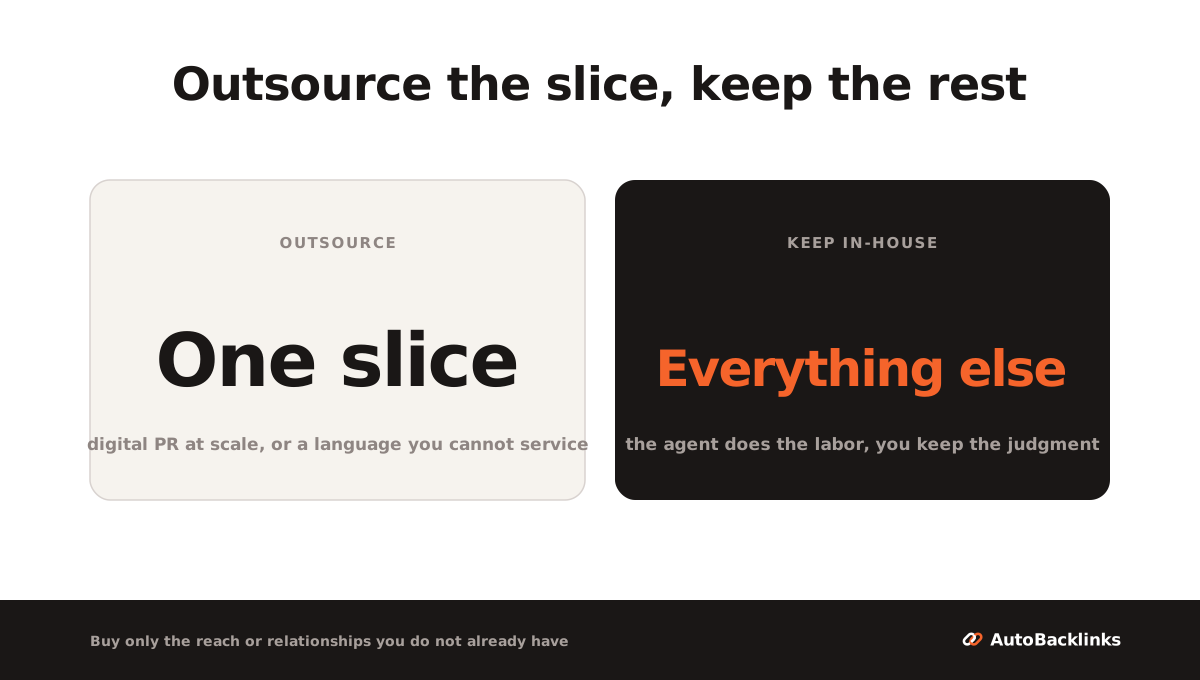
- You need digital PR at real scale. Landing coverage in major publications is a relationships-and-pitching craft that a good PR team does better than any tool. If that is your play, buy it.
- You cannot service the language or niche. Building links in a market you do not speak, or a technical niche you do not understand, is a place where an agency's existing network genuinely beats starting from zero.
- You have money but no time at all. If there is truly no one to spend even a few hours a week running the agent, a done-for-you service is the honest choice. You are buying attention you do not have. (This is also the one case where a per-placement service beats owning outreach software; I cover that trade in my BuzzStream alternatives breakdown, where Respona's managed model sits next to the tools you run yourself.)
- You want a one-off burst. For a single push where you do not intend to build an ongoing capability, a marketplace placement or two can be faster than standing anything up, as long as you go in knowing you are paying the markup. If the catalog you are weighing is one of the newer AI-curated ones, start with the PressWhizz alternatives breakdown to see what to verify first. And before you pay any sticker price, the full 2026 price ladder for that trade, marketplace versus agency versus going direct, is in what buying backlinks actually costs.
Notice what those cases have in common. They are about relationships, reach, or a genuine absence of time. None of them is "the manual outreach work is too hard to do in-house," because that reason is the one that stopped being true.
How to bring link building in-house this month
If the math above lands, here is the smallest version of doing it yourself that actually works. You do not need to hire anyone.
- Pick one target page and its topic. Everything downstream is judged against relevance to this page, so start narrow. Then size the goal with a real number: how many backlinks you actually need is a property of your target SERP, not a guess.
- Generate the prospect list from a competitor. Their best backlinks are sites that already link to something like you. A competitor backlink scan turns that profile into a prospect list in minutes, which is the step that used to eat a full afternoon.
- Let the agent filter and enrich. Score the list on DR, traffic, and topical fit, then find verified contacts only for the ones that survive. Do not pay to enrich a list you have not filtered.
- Review the drafts, then send slowly. The agent writes a page-specific pitch for each prospect. Read them. Send in small batches with one or two follow-ups. This is where you spend your few hours a week.
- Handle replies as a human. When someone answers, you take over. That is the judgment half, and it is the half worth your time.
That is the entire loop. The outreach agent runs steps two through four end to end; you own step one and step five. You can also run those steps from Claude, ChatGPT, or Cursor through the MCP server. It is the same work an agency does, minus the retainer and minus handing your relationships to a vendor. You can start a trial and run one campaign before you commit to anything, which is roughly the cost of a single agency link. And if the retainer was never in reach to begin with, the low cost SEO breakdown prices a full stack at $79 a month and shows exactly which keywords that budget can still win.
The question was never really in-house versus agency. It was whether the boring 80 percent of link building was worth a salary or a retainer. In 2026, it isn't.
FAQ
Is it cheaper to outsource or do link building in-house?
In-house is now cheaper for most teams, which reverses the old advice. The agencies' own cost models show in-house costing around $767 per link, but those models assume a full-time human doing the manual outreach. Replace that labor with an AI agent (roughly $179 a month instead of an $80,000 salary) and the in-house cost per link drops below $100 plus a few hours of your time, well under the $300 to $1,000 an agency charges.
How much does it cost to outsource link building?
Agencies charge $3,000 to $10,000 a month on retainer, which works out to roughly $300 to $1,000 per link depending on site quality. Marketplaces average around $460 per placement, which is about a 56 percent markup over buying direct. Freelancers range from $200 to $1,000 a month with uneven quality. Digital PR placements in major publications run $1,500 and up.
Can AI do link building on its own?
AI can do the labor of link building: finding prospects, scoring relevance, verifying contacts, drafting outreach, and tracking replies. It cannot do the judgment: deciding which links are worth it, building relationships, and creating pages worth citing. Fully automated link building that skips the human review is link spam and violates Google's guidelines, so the working model is an agent for the labor with a person supervising the judgment.
Is outsourced link building safe for my site?
It depends on the tactics, and the risk is that you do not control them. Agencies build links on your domain using their methods, so their shortcuts become your penalty exposure. Marketplaces sell paid placements, which is the model most directly in tension with Google's stance on link schemes. Running outreach in-house is the only path where you fully control what gets built in your name.
Should a small business outsource link building?
Usually not anymore. A small business is exactly the case where an AI agent changes the answer, because it removes the need to hire a specialist you cannot afford. Run the agent yourself a few hours a week and you get agency-style output without the retainer. Outsource only the specific pieces that need reach or relationships you do not have, such as digital PR or a foreign-language market.
About Rachid Idali
Founder & SEO Strategist
Rachid Idali has spent 10 years in SEO, running multi-six-figure SEO and link-building budgets across content, digital PR, and outreach programs. He writes about practical systems for finding relevant prospects, earning links, and turning SEO operations into repeatable pipelines.
More from Rachid Idali