

Best Guest Post and Link Building Marketplaces 2026

by Rachid Idali
Last Updated: July 2, 2026
The best guest post and link building marketplace for most buyers is the one that shows you the most before you pay: the publisher's real metrics, verified traffic, and a price you can compare against buying direct. On that test, Collaborator and WhitePress lead, with Adsy the easiest place to start. But there is a catch that none of the marketplaces ranking for this term will tell you, because their business depends on you not noticing it: the markup.
I have run link-building budgets for ten years and now build outreach software. I have bought from most of these platforms. So instead of recycling another roundup, I pulled each marketplace's live data (sizes, pricing, and models, checked July 2026) and put the one number that matters next to it: what a placement costs through the marketplace versus what it costs going direct.
Here is the short version, then the full comparison.
The 11 guest post marketplaces at a glance
| Marketplace | Sites | From | Model | Links | Prices upfront? | Best for |
|---|---|---|---|---|---|---|
| Collaborator | 43,000+ | ~$22 | Pay per placement | Guest posts | Partial | Verified traffic data |
| WhitePress | 143,000+ | Varies | Pay-as-you-go | Posts + insertions + PR | After signup | Biggest global network |
| Adsy | ~150,000 | ~$10 | Pay per placement | Posts + insertions + PR | Yes | Beginners |
| Linkhouse | 74,000+ | Varies | Pay per placement | Posts + insertions | After signup | Multilingual / EU |
| PRNEWS.IO | 105,000+ | $4.94 | One-time payment | Sponsored articles + PR | Yes | News and media placements |
| Getfluence | 45,000+ | Varies | Pay per publish | Sponsored articles | After signup | Premium editorial |
| Vefogix | 111,000+ | $6 | Pay per placement | Guest posts (managed) | Partial | High volume, low entry |
| PressWhizz | 41,000+ | Varies | Pay per placement | Posts + insertions | After signup | AI-curated filtering |
| Link Publishers | 73,000+ | Varies | Pay per placement | Posts + niche edits + PR | After signup | AI niche edits |
| iCopify | 32,000+ | $4.99 | Pay if satisfied | Posts + insertions | Yes | Cheapest self-serve |
| FATJOE | Managed | $72/link | Per link, by DR | Posts + niche edits | Yes (fixed) | Hands-off ordering |
A definition first, because the labels get used loosely. A guest post marketplace (also called a link building marketplace) is a platform that connects buyers with publishers so you can purchase a backlink, guest post, or niche edit by filtering sites on metrics like Domain Rating, traffic, and niche, then paying for a placement. It is a catalog of paid links. That is the model, and understanding the model is the whole game.
How I compared these guest post marketplaces
Three rules kept this honest.
- Live data only. Every size and starting price comes from the platform's own current site or its published pricing, checked July 2026, not from a directory that last updated a year ago. Where I cite a third-party number, I say so and link it.
- Transparency is the scoring axis. A marketplace's job is to remove the work of finding and vetting publishers. The good ones do that with verified data shown upfront. The weak ones hide prices and metrics behind a signup wall and hope you do not check.
- The markup is the headline, not a footnote. Every marketplace is a reseller. It buys (or brokers) a publisher's slot and sells it to you at a margin. So the real comparison is not marketplace versus marketplace. It is marketplace versus going direct.
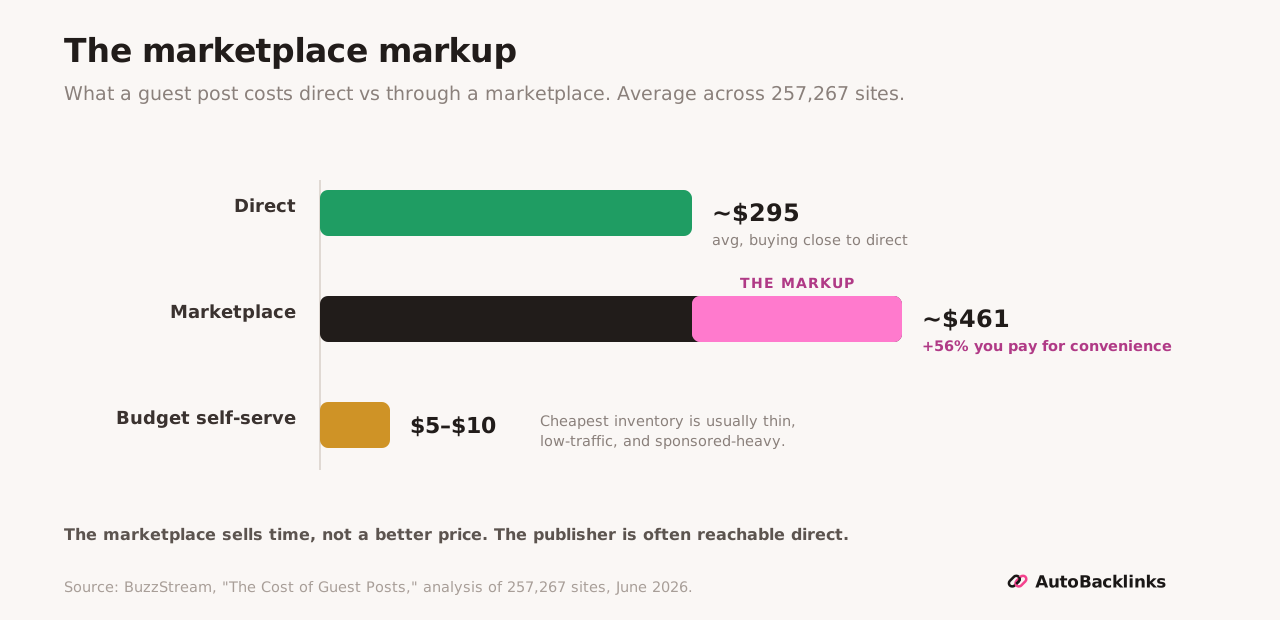
That last point deserves a number. BuzzStream analyzed 257,267 sites in a major link marketplace and found the average guest post costs $295 buying as close to direct as the data allowed, and $461 buying through a vendor (BuzzStream, The Cost of Guest Posts, June 2026). That is roughly a 56% premium for the convenience layer, and BuzzStream notes even the "direct" figure carries some markup. The year before, their model assumed vendors mark prices up by 75%. I priced that spread against agency rate cards and direct deals, door by door, in what buying backlinks costs in 2026.
So the marketplace is selling you time, not a better price. Whether that trade is worth it depends on how much of your own vetting you are willing to skip. Keep that ratio in mind through every review below.
1. Collaborator
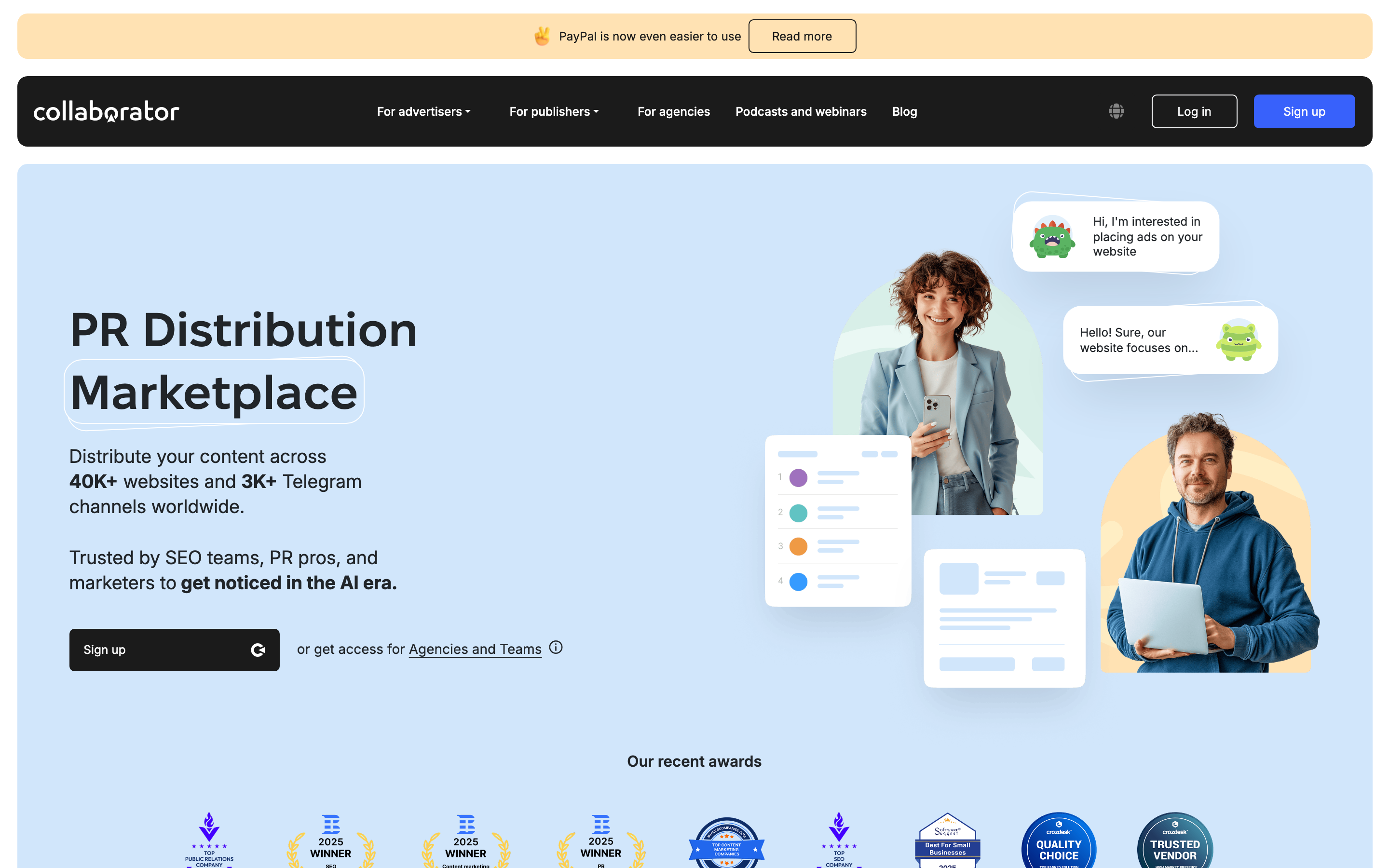
Collaborator is the marketplace I point people to when they ask which one to trust, because it shows its work. Founded in 2017, the catalog now lists more than 43,000 quality websites plus 3,000-plus Telegram channels across 150-plus countries and 50-plus languages, with Ukraine, the US, Poland, and the UK its deepest markets. But size is not the pitch. Verified data is.
The differentiator is that Collaborator shows the publisher's actual analytics, not a self-reported guess. More than 8,500 sites expose real Google Analytics audience data and over 7,000 are verified through Google Search Console, so clicks and impressions feed straight into the listing. Most marketplaces show you a self-reported Domain Rating and a third-party traffic estimate; Collaborator layers Ahrefs Rank, Domain Authority, and Trust Flow on top of analytics you can actually check, and it nudges publishers to verify by handing out a rating bonus for connecting GA4 and Search Console. That is the difference between a metric a publisher claims and one you can check.
On top of the data, over 75% of placements go live within 48 hours, and every standard deal includes a free three-month link-protection guarantee, extendable to twelve months with non-indexation cover for 10% of the deal price. The friction is real too: the full filter set and pricing only open after you sign up, deposits and withdrawals carry fees (10% and 15%), and placements still run at a marketplace margin, from about $22 into the hundreds.
| Pros | Cons |
|---|---|
| Verified Google Analytics and Search Console traffic on thousands of sites | Full filters and pricing unlock only after signup |
| Ahrefs, Domain Authority, and Trust Flow metrics on every listing | Deposit (10%) and withdrawal (15%) fees |
| 75%+ of placements go live within 48 hours | Placement prices still carry a marketplace margin |
| Free 3-month link guarantee, extendable to 12 months | Inventory skews toward Eastern Europe |
Best for: buyers who want to vet on verified data, not vendor claims.
2. WhitePress
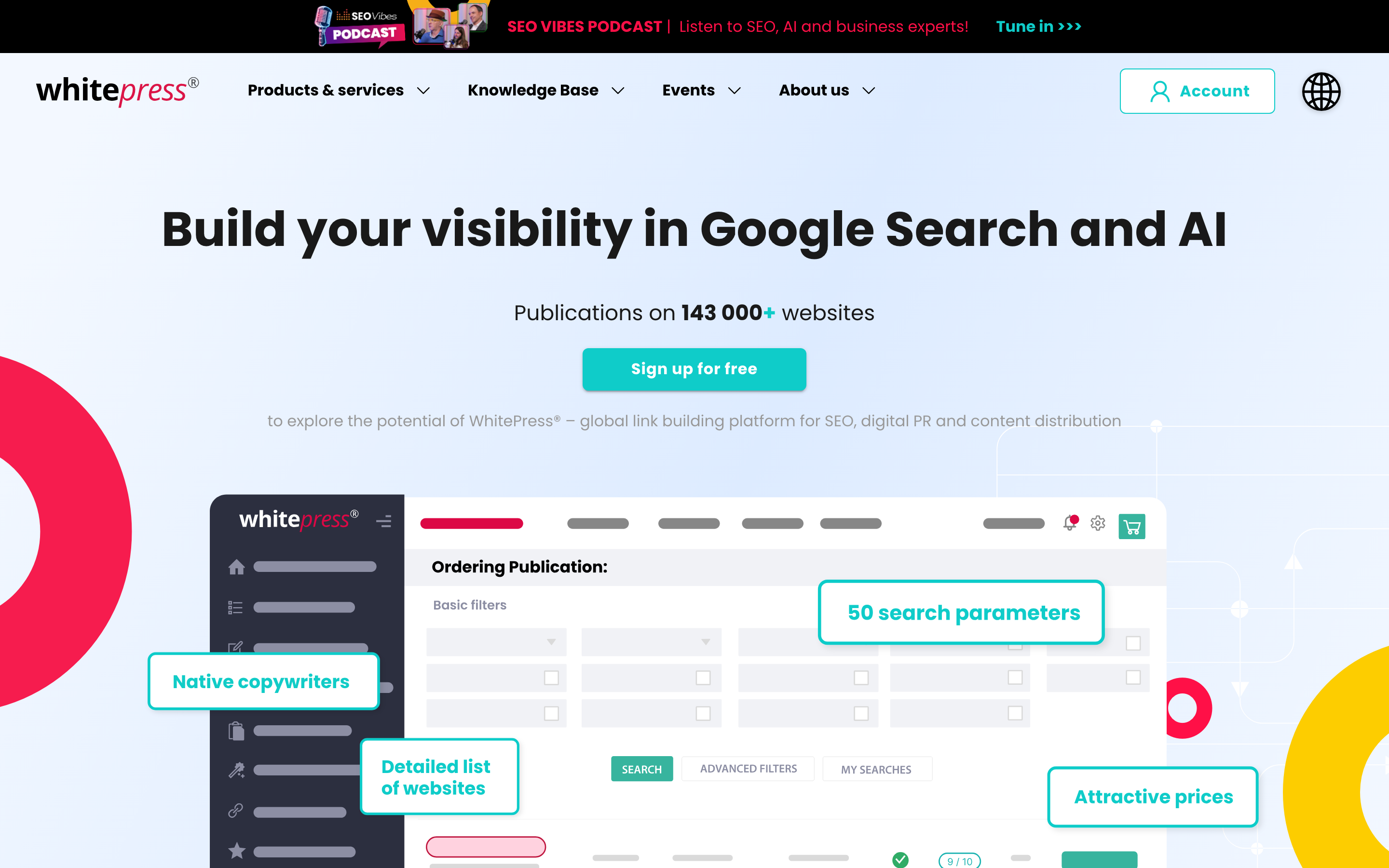
WhitePress is the largest network here. The platform advertises publications on 143,000-plus websites with more than 374,000 offers live inside it, built over 12 years from its base in Poland and now serving a stated 30,000-plus customers. If raw reach is the requirement, nothing else on this list matches it.
Two things set WhitePress apart beyond size. First, content: it offers native copywriting in 36 languages, so you can commission the article and the placement in one pass across almost any European market. Second, protection: publications carry a 36-month guarantee with daily link monitoring: three years of link protection is the longest commitment of any marketplace here, and the reason agencies running long campaigns tolerate the platform's density. The marketplace browser exposes more than 50 filters plus quality scoring built on Ahrefs and Semrush metrics and referring-domain counts.
The trade is that scale cuts both ways. A network of 143,000 sites inevitably includes a long tail of low-value and resold domains, so the filtering discipline is on you, and prices and most metrics sit behind a free account rather than on the open catalog. It runs a straightforward pay-as-you-go model, so at least there is no subscription to commit to.
| Pros | Cons |
|---|---|
| Largest network here: 143,000+ sites, 374,000+ offers | Huge long tail of low-value and resold domains |
| Industry-longest 36-month link guarantee with daily monitoring | Prices and most metrics require a free account |
| Native copywriting in 36 languages | Filtering discipline is entirely on the buyer |
| 50+ filters and Ahrefs/Semrush quality scoring | Density can overwhelm first-time buyers |
Best for: large, multi-market campaigns where you need volume and want links monitored over years.
3. Adsy
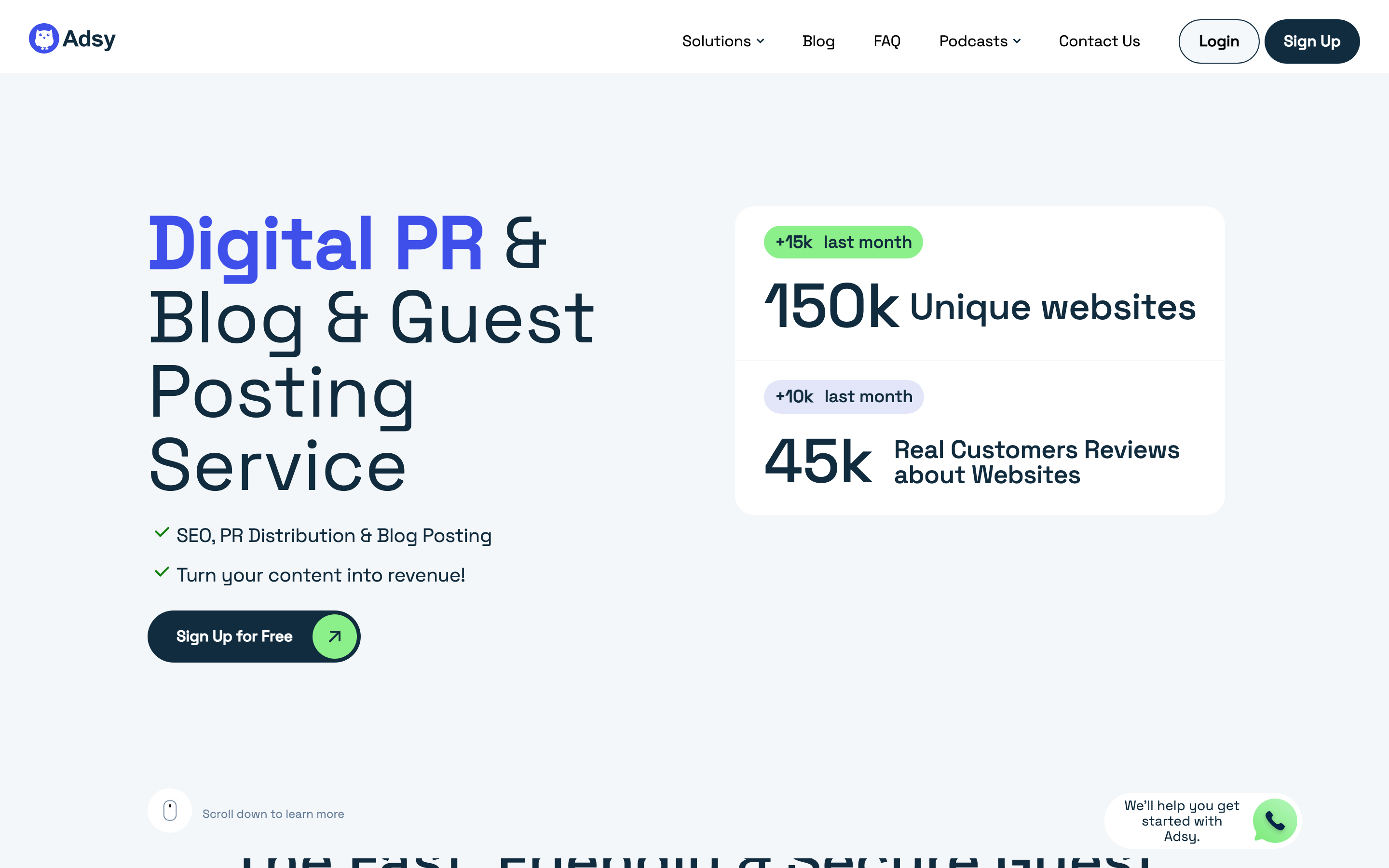
Adsy is the friendliest on-ramp. It claims around 150,000 unique websites, adding a stated 15,000 a month, and unlike most rivals it shows publisher metrics before you commit: Moz DA, Ahrefs DR, Ahrefs organic traffic, SimilarWeb traffic, and Semrush Authority Score all sit on the listing. For someone buying their first placements, being able to browse real numbers before paying is the whole appeal.
Beyond guest posts, Adsy handles link insertions and has added press releases and broader digital-PR coverage, and it monitors links after publication with automated content verification plus fund credits if a placement comes back low quality. It carries a 4.9 rating from 82 Google reviews and surfaces 45,000-plus customer reviews about the sites themselves, which helps when you are choosing between two similar listings.
The catch is that those metrics come from third-party tools, not verified analytics, so a high DA can still hide thin real traffic. Treat the scores as a starting filter, then open the actual pages before you buy. No public starting price is posted, though entry-level placements sit in the low tens of dollars.
| Pros | Cons |
|---|---|
| Publisher metrics (Moz, Ahrefs, SimilarWeb, Semrush) visible before signup | Metrics are third-party estimates, not verified analytics |
| ~150,000 sites, growing by a stated 15,000/month | A high DA can still mask thin real traffic |
| Guest posts, link insertions, and press releases in one place | No public starting price posted |
| Post-publication link monitoring and quality credits | Beginner focus means less depth for advanced buyers |
Best for: beginners buying their first placements who want to see numbers before paying.
4. Linkhouse
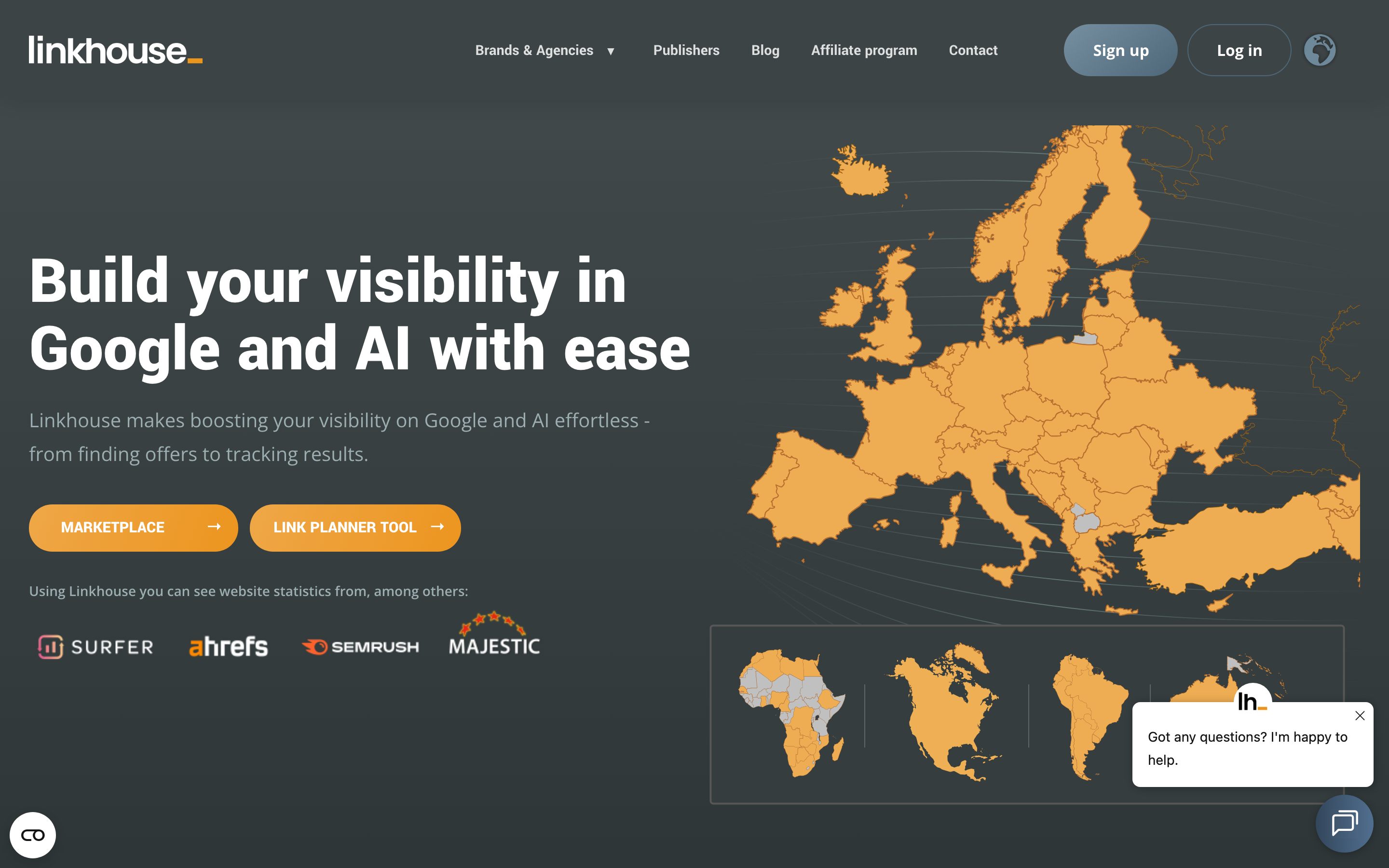
Linkhouse, founded in 2014, lists more than 74,000 websites from around the world and supports publication in up to 25 languages, which makes it one of the deepest catalogs for European and multilingual campaigns. It is run by a 25-person team and reports around $5 million in annual backlink sales, so it is an established operation rather than a thin reseller.
What separates Linkhouse from a plain catalog is that it is built as a campaign tool. Its Link Planner sets up a campaign from just three or four inputs, its Backlink Gap surfaces where competitors have links you do not, and its marketplace browser carries more than 60 filters, with metrics integrated from Surfer, Ahrefs, Semrush, and Majestic. You can buy guest posts and link insertions, plus copywriting, in the same place.
The usual caveats apply: prices and full inventory open after signup, and like every large network some listings are resold across other platforms, so relevance vetting is still on you. But for agencies coordinating multilingual work, the planning tooling earns its place.
| Pros | Cons |
|---|---|
| Deep multilingual reach: 74,000+ sites in up to 25 languages | Prices and inventory unlock only after signup |
| Link Planner and Backlink Gap make it a campaign tool, not just a catalog | Some listings resold across other platforms |
| 60+ filters with Surfer, Ahrefs, Semrush, and Majestic data | Interface depth has a learning curve |
| Established operation (since 2014, ~$5M annual sales) | Less useful for one-off English placements |
Best for: agencies running multilingual or EU-focused campaigns.
5. PRNEWS.IO
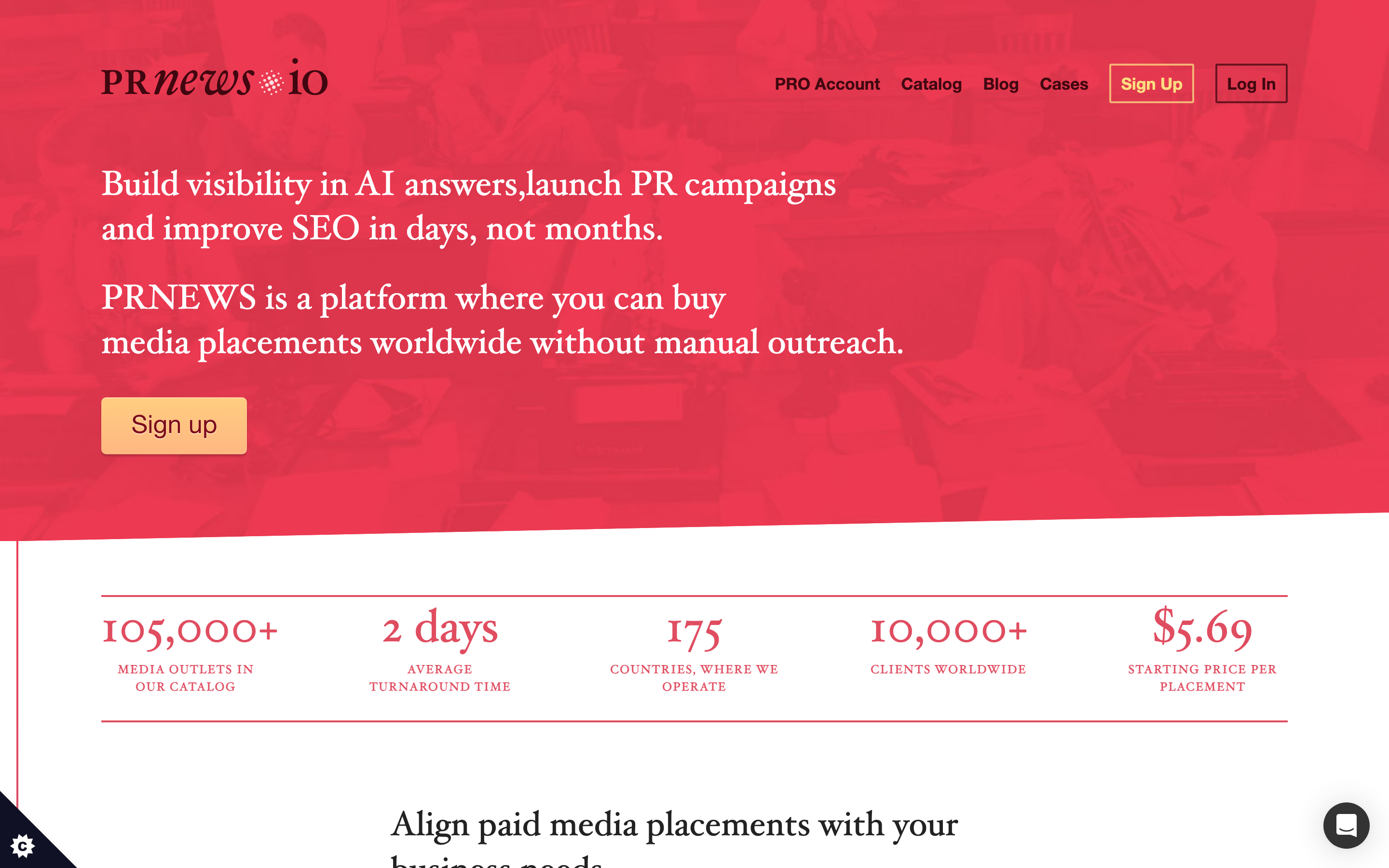
PRNEWS.IO is less a backlink shop and more a media-placement marketplace. It lists 105,000-plus outlets across 175 countries, runs on one-time payments with no contracts, and lets you buy sponsored articles, press releases, branded content, brand mentions, and native advertising in verified publications. Placements start as low as $4.94 for small blogs and climb into the thousands for premium news sites, with most content published within three to five business days of approval.
If your goal is to see your brand named in actual publications rather than SEO-built blogs, this is the catalog to browse. The outlets skew toward real media and regional press, and pricing is shown transparently per placement rather than hidden behind a wall.
The catch matters for SEO buyers specifically: many placements are sponsored or native content, which means the links are frequently nofollow. That is fine for digital PR and brand visibility, less so if a followed link is the entire point. Read the terms per outlet before you buy.
| Pros | Cons |
|---|---|
| 105,000+ real media outlets across 175 countries | Many placements are sponsored/native, so links are often nofollow |
| Transparent per-placement pricing from $4.94 | Not built for pure followed-link buying |
| One-time payment, no contracts or subscriptions | Premium news outlets get expensive fast |
| Strong for brand mentions and regional press | Quality and link terms vary widely by outlet |
Best for: digital PR and brand mentions in media, not pure followed-link buying.
6. Getfluence
Getfluence positions itself as a premium content-marketing marketplace. It advertises access to more than 45,000 media outlets and says over 2,000 international companies and agencies use it, with named partners including Le Monde, The Economist, Eurosport, and BFM-TV: inventory that skews far higher-end than the typical SEO marketplace.
The model is buyer-friendly on cost structure: creating an account and browsing the catalog is free, and you only pay when you publish, at the price each outlet sets. What you are buying is editorial credibility: sponsored articles, press releases, and native content on established media rather than link farms, which is why brands chasing authority rather than volume gravitate here.

The trade-offs are the mirror image of the strength. The full catalog and prices require registration, and premium placement on real editorial media costs what real editorial media costs, so this is not where you go for cheap volume.
| Pros | Cons |
|---|---|
| Premium, editorially credible media (Le Monde, The Economist, etc.) | Premium placements are priced accordingly |
| 45,000+ outlets, trusted by 2,000+ companies and agencies | Full catalog and prices require registration |
| Free to browse, pay only on publication | Not suited to high-volume, low-cost link buying |
| Strong fit for brand authority and digital PR | Weighted toward European editorial media |
Best for: brands that want fewer, higher-authority editorial placements.
7. Vefogix
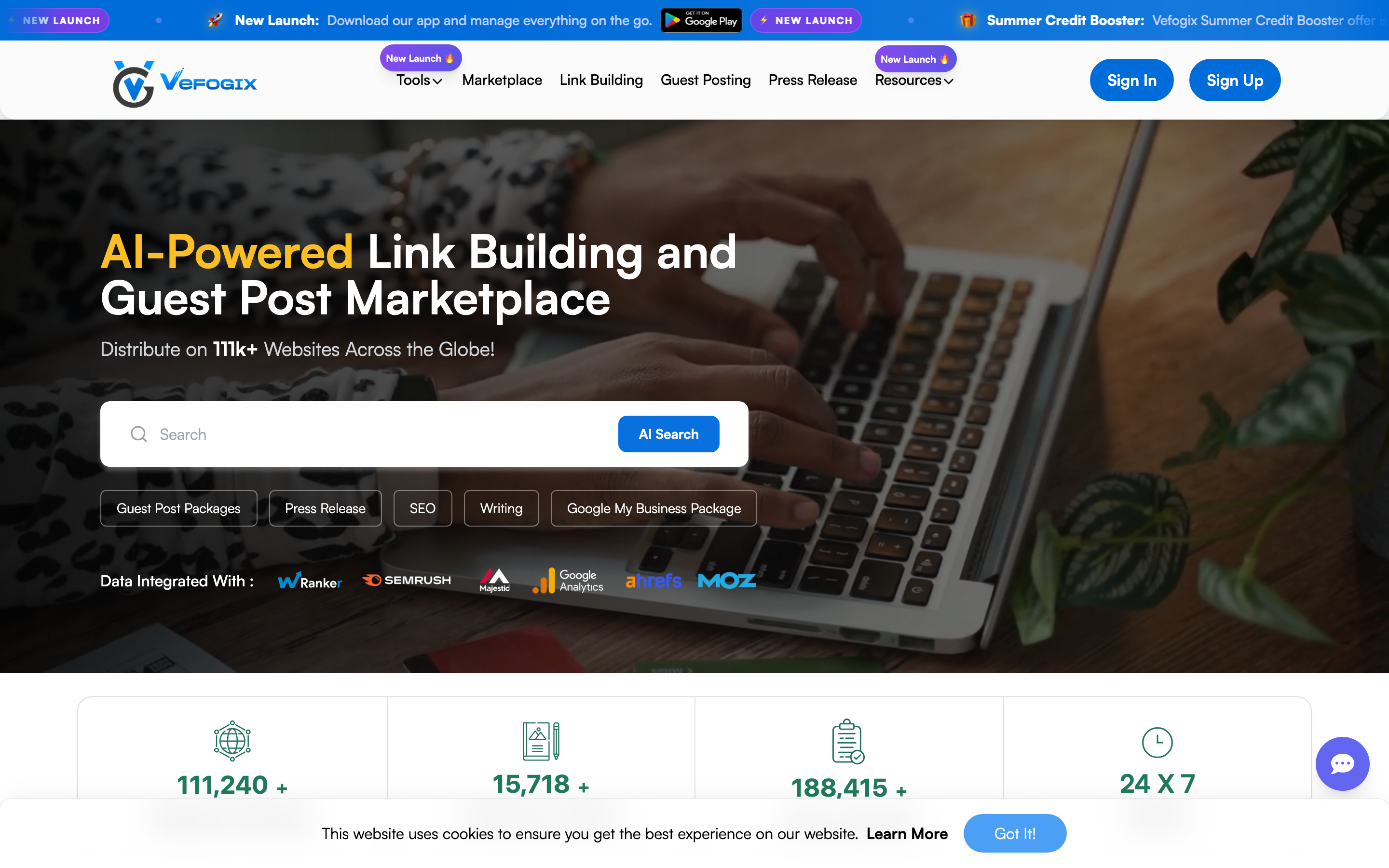
Vefogix leans on volume. Its guest-posting marketplace advertises more than 111,000 websites and blogs that accept guest posts, supports 40-plus languages, and starts placements around $6, with a stated average delivery of one to three days. It runs as a hybrid: a self-serve catalog you can filter by DA, DR, traffic, and backlinks, with managed freelancer packages layered on top if you would rather hand off the work.
Each listing shows domain authority, domain rating, organic traffic, and backlink data, and the platform claims a 99%-plus publisher acceptance rate and 100% human-written, manually edited content. For high-volume buyers who want a big catalog and a low floor price, it delivers on breadth.
Two honest notes. First, Vefogix is upfront in its own FAQ that no ethical provider can guarantee rankings, which is a good sign in a market full of guarantees nobody can keep. Second, breadth at this price means quality varies widely: the cheap end of any marketplace is where recycled and low-traffic domains live, so the vetting burden sits with you.
| Pros | Cons |
|---|---|
| Very large catalog: 111,000+ sites from about $6 | Quality varies widely at the low end |
| Fast stated delivery (1–3 days), 40+ languages | Recycled and low-traffic domains need careful vetting |
| DA, DR, traffic, and backlink data on each listing | Metrics are third-party, not verified analytics |
| Self-serve plus managed packages | No ranking guarantee (honest, but the vetting is on you) |
Best for: high-volume buyers on a budget who will do their own quality control.
8. PressWhizz
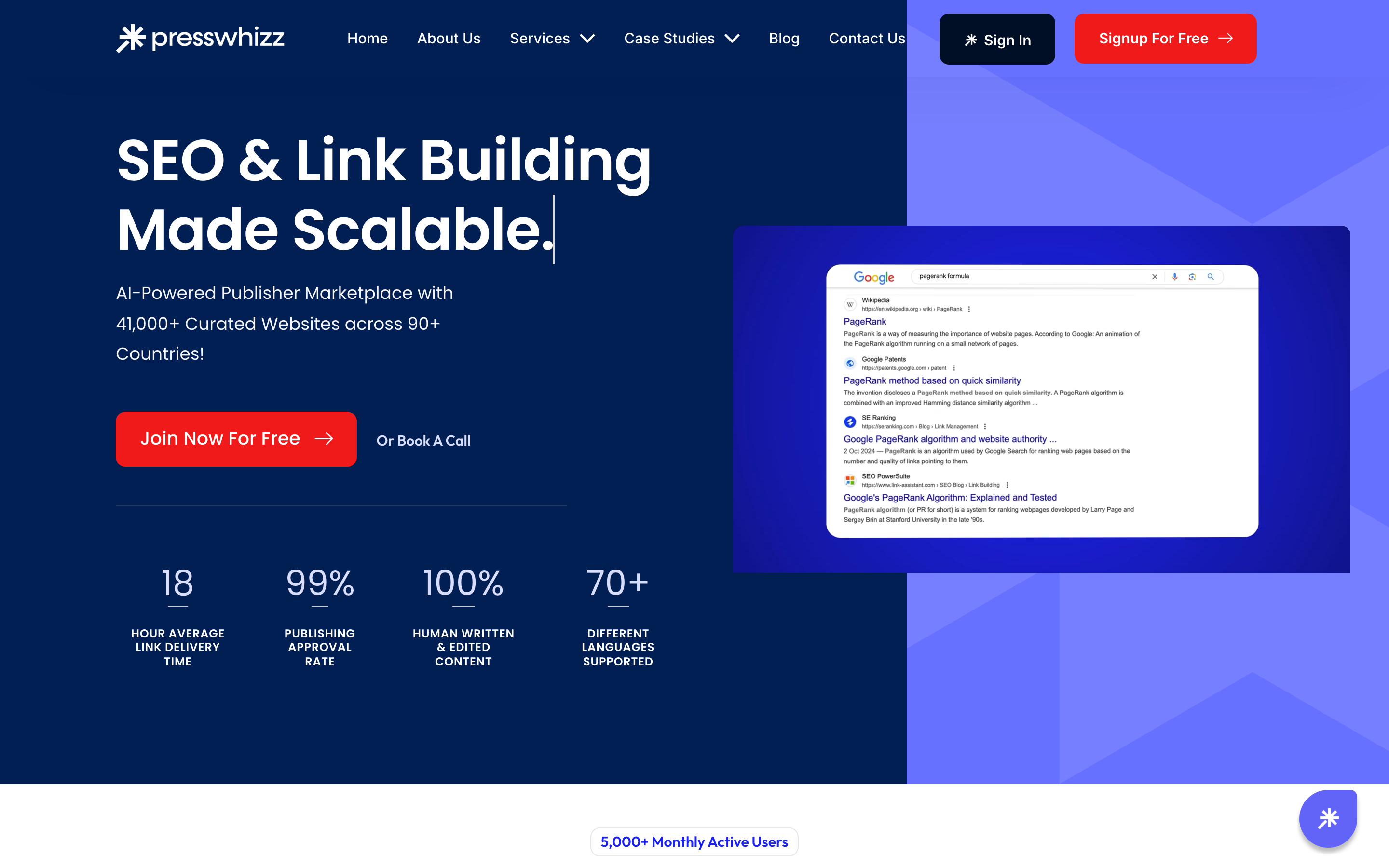
PressWhizz is one of the newer AI-curated marketplaces, with 41,000-plus curated websites across 90-plus countries and a stated 5,000-plus monthly active users. The interface is built around filtering for pages already relevant to your keyword, so the pitch is less raw catalog, more guided selection.
On mechanics it is refreshingly clear. Everything is a one-time fee with no subscriptions and no hidden costs, it accepts both cards and crypto (Bitcoin, Ethereum, USDC, and others), and it backs links with a 12-month replacement guarantee: if a link is removed, it is replaced within seven days of being notified. The platform says 95% of orders are delivered within 24 hours. You can buy guest posts, link insertions (niche edits), and even tier-2 links to strengthen existing placements.
The honest caveats: it is younger and smaller than the leaders, and "AI-curated" still means you apply judgment to each page rather than trusting the filter blindly. I went deeper on its fine print, and where to go instead, in the best PressWhizz alternatives.
| Pros | Cons |
|---|---|
| AI filtering surfaces topically relevant pages, not a raw list | Younger and smaller than the market leaders |
| One-time fees, no subscriptions, cards and crypto accepted | AI curation still needs your judgment per page |
| 12-month replacement guarantee, 7-day replacement window | 41,000 sites is mid-sized versus the biggest networks |
| 95% of orders delivered within 24 hours | Newer brand with a shorter track record |
Best for: buyers who want help narrowing a large catalog to relevant targets.
9. Link Publishers
Link Publishers markets itself as an AI-powered link building and digital PR platform, and it puts its customer base at 6,000-plus. Its dashboard lets you search a network of tens of thousands of websites (the marketplace search advertises around 73,000) and buy guest posts, niche edits, press releases, and brand mentions, with metrics integrated from Ahrefs, Semrush, Moz, and Google.
The standout feature is ReleVink AI, its niche-edit engine: rather than making you hunt, it uses AI to suggest existing articles where your link can be inserted naturally, scored on relevance and authority. Every placement is backed by a live-link or money-back replacement guarantee, which is a meaningful backstop given how often cheap links quietly drop.
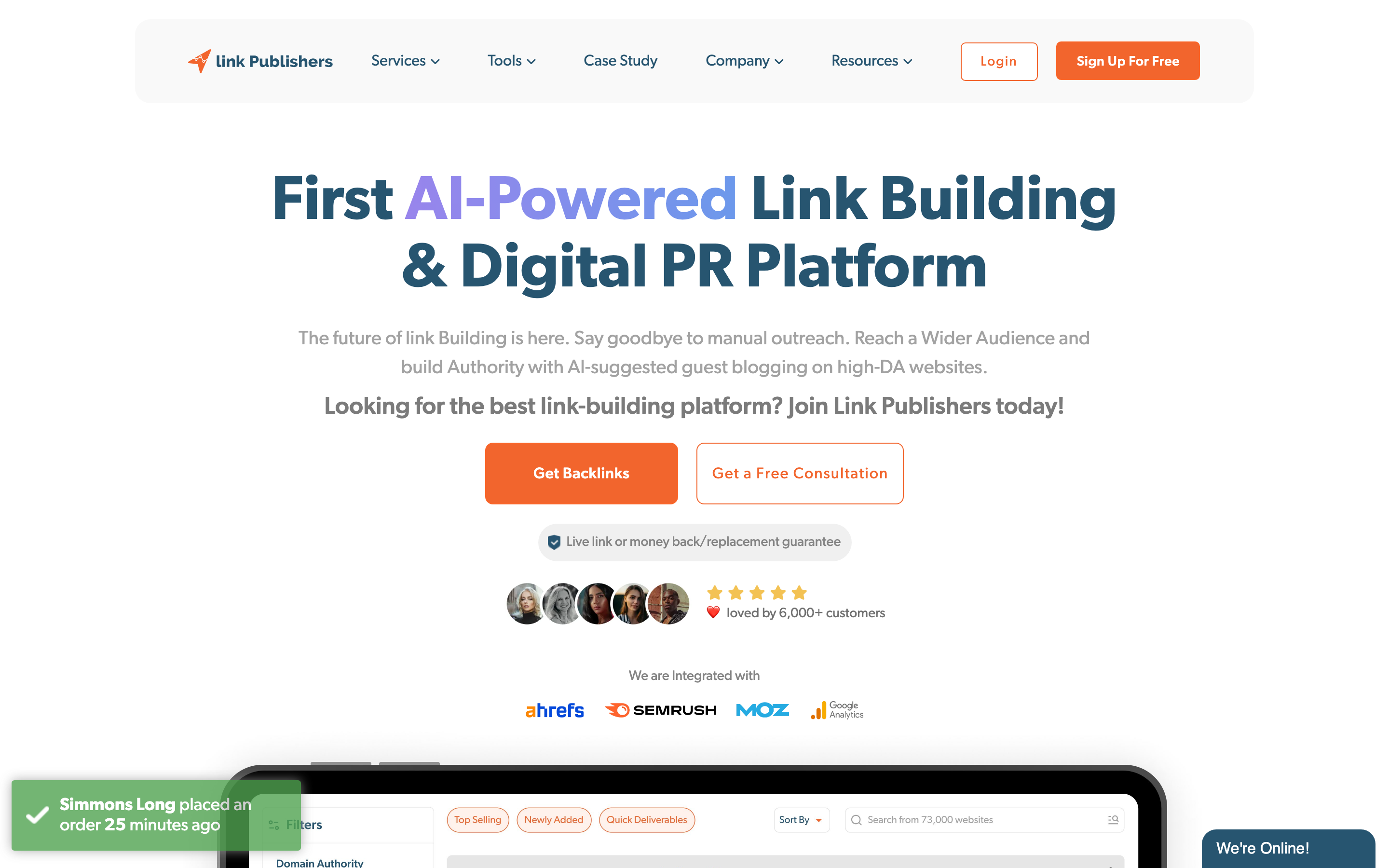
The honest read is that "AI-powered" is doing a lot of work in the marketing. Underneath, it is still a paid-placement marketplace, and specific prices sit behind signup rather than on the open page.
| Pros | Cons |
|---|---|
| ReleVink AI suggests natural niche-edit placements | "AI-powered" framing oversells a standard marketplace model |
| Live-link or money-back replacement guarantee | Specific prices only appear after signup |
| Guest posts, niche edits, PR, and mentions in one dashboard | Network-size claims vary across the site |
| Ahrefs, Semrush, Moz, and Google metrics integrated | Still a paid-link model with the usual SEO risk |
Best for: buyers who want niche edits and a refund backstop if a link drops.
10. iCopify
iCopify is the cheapest genuine self-serve marketplace, with a stated 32,000-plus active publishers and placements advertised from $4.99. Its model is what makes it distinct: publishers set their own prices, iCopify says it takes zero platform markup on them, and an integrated escrow holds your funds until the live link is verified: a "pay only if satisfied" structure that lowers the risk of paying for a placement that never appears.
You pick content placement or link insertion, the publisher fulfils it, and turnaround varies by publisher (each site shows its own average). Because pricing is publisher-direct, iCopify is often the closest thing on this list to buying without a middleman margin.
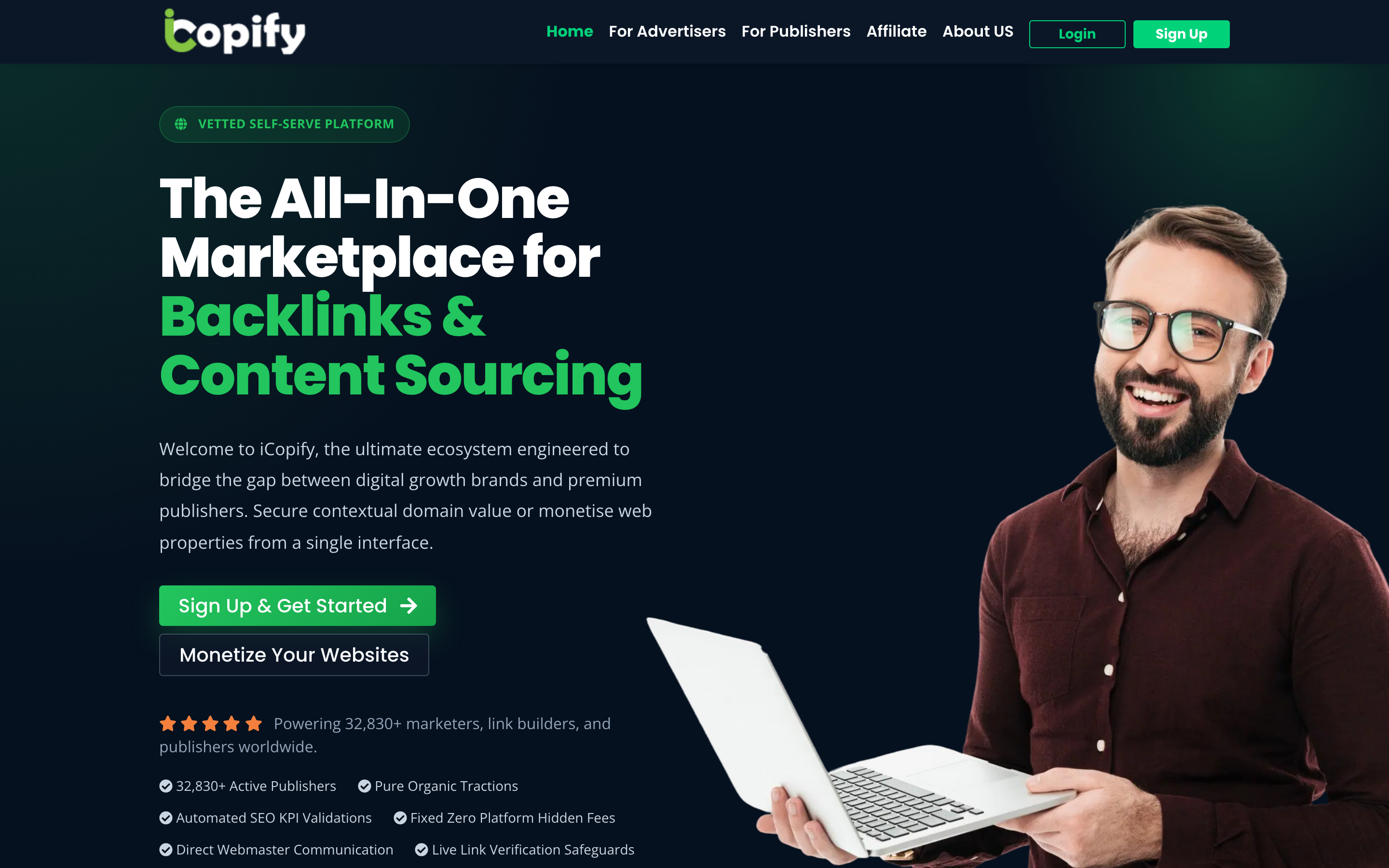
The catch is the flip side of rock-bottom pricing: the cheapest inventory anywhere is also the most likely to be thin, sponsored-heavy, or low-traffic. The escrow protects you against non-delivery, not against a weak link. You trade money for vetting time.
| Pros | Cons |
|---|---|
| Lowest entry pricing here (from $4.99), publisher-direct | Cheapest inventory is often thin or low-traffic |
| Escrow + "pay only if satisfied" protects against non-delivery | Escrow guards delivery, not link quality |
| Publishers set prices; iCopify claims zero platform markup | Heavy vetting burden on the buyer |
| Self-serve control over placement or insertion | Turnaround varies by individual publisher |
Best for: experienced buyers who can sort quality themselves and want the lowest price.
11. FATJOE
FATJOE is not a browse-it-yourself marketplace. It is a managed, white-label ordering service, and one of the most established here, with 251,916 orders delivered since 2012 and a stated 40,000-plus agency accounts. You order from 20-plus productized services (blogger outreach, niche edits, digital PR, content, and more), their team handles the outreach and placement, and you approve the result.
The appeal is predictability. Blogger-outreach pricing is fixed and public by Domain Rating tier: $72 at DR10+, $120 at DR30+, up to $456 at DR60+, with content writing included, do-follow links, Ahrefs traffic verification, and a 10% discount for monthly subscribers. Delivery starts from around 14 days, and every service carries both a money-back and a lifetime link guarantee.
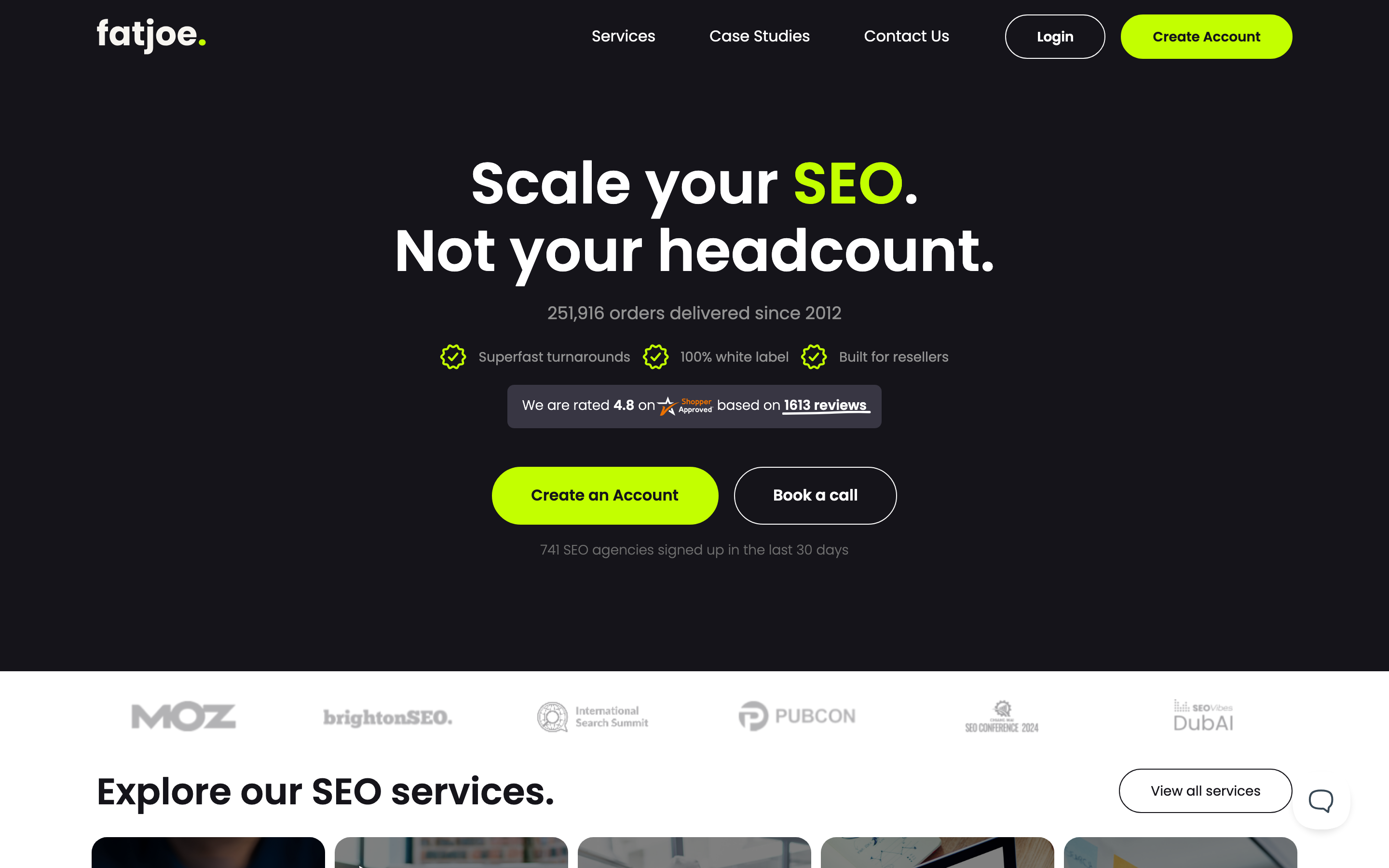
The trade-off is control. Fixed-tier pricing means you pay the same whether the specific site is a gem or filler, and you do not choose the exact publisher: you buy a DR band and trust their team to fill it.
| Pros | Cons |
|---|---|
| Fully managed and white-label: zero browsing or vetting | You don't choose the exact publisher |
| Fixed, public per-DR-tier pricing ($72–$456), content included | Same price whether the site is strong or filler |
| Lifetime link guarantee, do-follow links, Ahrefs traffic verification | Managed model costs more than raw self-serve |
| Established (251,916 orders since 2012), 4.8 from 1,613 reviews | Delivery from ~14 days, slower than self-serve |
Best for: buyers who want a predictable per-link price and none of the work. If that model appeals but you want to compare it properly, I priced the best FATJOE alternatives tier by tier.
Are guest post marketplaces safe for SEO?
This is the part the roundups skip, so I will be direct. Every link you buy through these marketplaces is a paid link. Google's link spam policy names "buying or selling links for ranking purposes" as a link scheme, and it expects paid links to carry a rel="sponsored" or rel="nofollow" attribute. Almost no marketplace placement does, because a followed link is the entire reason buyers pay.
That does not mean every placement gets you penalized. Plenty of sites buy marketplace links and rank fine. But three risks are real, and they compound at the cheap end:
- Recycled inventory. The same domains appear across multiple marketplaces, selling sponsored links to anyone. A page stuffed with paid outbound links passes less value and draws more scrutiny.
- Self-reported metrics. A DR 50 with 200 real monthly visitors is common in these catalogs. This is why Collaborator's verified analytics matter, and why a high score alone should never close a buy.
- Footprint. Buy from the same low-quality networks everyone else does, and your link profile starts to look like everyone else who buys cheap links.
Guest post marketplaces vs earned outreach
There is a third option the marketplaces have a reason to keep quiet about: earning the same placement directly.
Most of the publishers in these catalogs accept guest posts and link insertions from people who simply ask, often at the publisher's own rate, sometimes for free in exchange for genuinely good content. The marketplace is a convenience layer between you and that publisher, and the convenience costs the 56% premium the BuzzStream data shows. When you reach out directly, you skip the markup, you build a relationship you can use again, and the link does not sit in a catalog next to a hundred other paid placements. If you are choosing between a marketplace, an agency, and running it yourself, I put real numbers on all three in outsource link building versus doing it yourself.
The trade is time. Direct outreach means finding relevant sites, finding the right contact, and writing a pitch worth answering. That is exactly the work AI link building tools now automate: discovery, relevance scoring, contact lookup, and drafting, with you approving each send. It is the difference between buying a link and earning one.
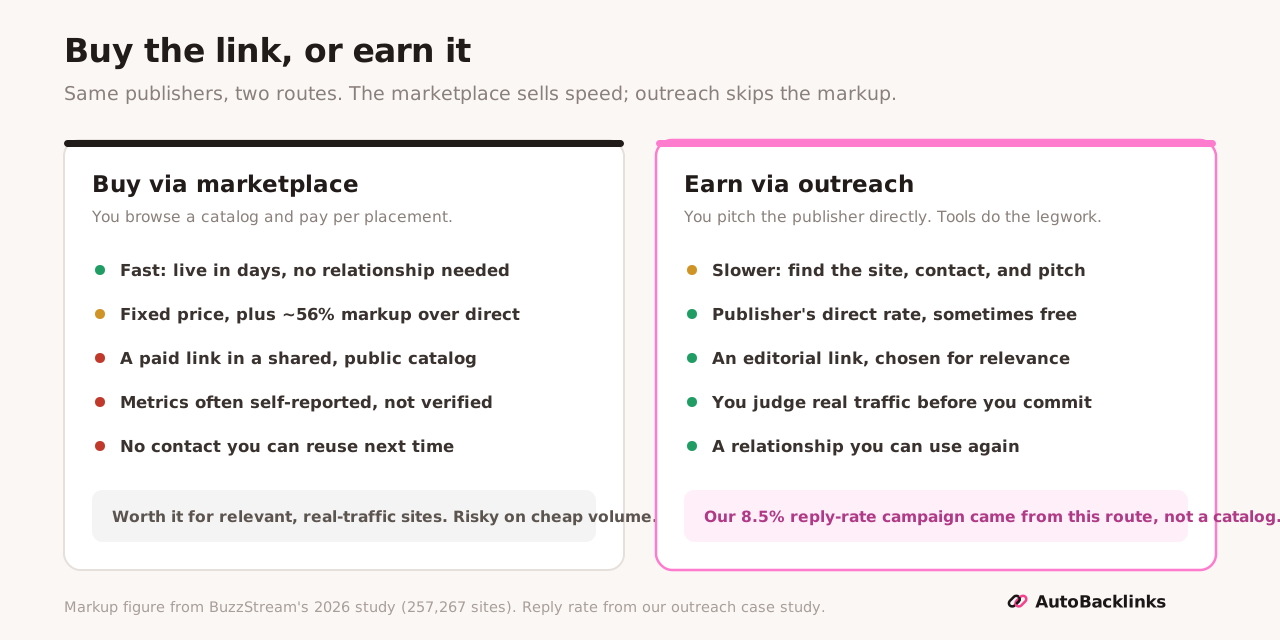
We tested this split on a real campaign. In our outreach case study, we sent 187 emails and got 32 replies, a 17.1% reply rate, well above the low single digits most cold-outreach benchmarks report. None of those links cost a marketplace markup, and every one came from a site we chose for relevance, not from a catalog. The lever was prospecting, not budget.
That is the case for tools like ours. AutoBacklinks is not a marketplace and never will be: we do not sell, broker, or place paid links. We help you find relevant publishers, score them on topical fit, find verified contacts, and draft the pitch, so you can earn guest posts and insertions at the publisher's direct rate instead of the marketplace's. You can run that workflow from the dashboard or from Claude, ChatGPT, or Cursor through the MCP server. If you want to mine your competitors' best links as a starting list, the competitor backlink scan turns their profile into your prospect list.
How to vet a guest post placement before you buy
If you do buy, these five checks separate a placement worth the markup from a waste of budget:
- Check real traffic, not just DR. Open the site. If a DR 50 has a few hundred monthly visitors, the score is bought, not earned. Prefer marketplaces that show verified analytics.
- Count the outbound paid links. A page or site littered with sponsored links to unrelated topics passes little value. Relevance and restraint matter more than authority.
- Confirm the link is followed and permanent. Ask the placement terms. A nofollow or a link that vanishes in three months is not what you paid for.
- Match the topic. A relevant link from a smaller site beats a strong but off-topic one, every time. Filter on niche fit before metrics.
- Compare to direct. Before you buy, ask what the same placement would cost going direct. If the gap is large and the site is relevant, outreach may be the better spend.
How to choose a guest post marketplace
Match the marketplace to the job:
- Want to buy on verified data? Start with Collaborator for its real analytics, or Adsy if you want metrics visible before you sign up.
- Need scale or multiple markets? WhitePress for the largest network and a 36-month guarantee, or Linkhouse for multilingual reach.
- After media and PR placements? PRNEWS.IO or Getfluence for real publications rather than SEO blogs.
- On the tightest budget? iCopify or Vefogix, knowing the vetting work is entirely on you.
- Want it fully hands-off? FATJOE for fixed per-link pricing with the work done for you.
But before any of them, decide whether you are buying speed or buying links. Marketplaces sell speed, at a markup the BuzzStream data puts near 56%. If your budget is tight and your standards are high, the same publishers are usually reachable directly, for less. Automate the discovery and drafting, keep the judgment, and earn the link instead of renting a spot in a catalog. If you want to see what that outreach looks like in practice, I broke down real pitches in guest post outreach templates that get replies.
Whichever route you take, the principle holds: a relevant link from a real-traffic site is worth ten cheap ones from a recycled catalog. Buy, or earn, on that test.
Want to earn the same placements without the markup? Start a free trial of AutoBacklinks and run your first outreach campaign end to end.
FAQ
What is the best guest post marketplace?
For verified data and trustworthy metrics, Collaborator is my pick, because it shows real Google Analytics and Search Console traffic rather than self-reported scores. For the largest network, WhitePress. For beginners, Adsy, which shows metrics before you sign up. The "best" one depends on whether you value verified data, scale, or price.
What is the difference between a guest post marketplace and a link building marketplace?
There is almost none. Both are catalogs of paid placements you filter by metrics and buy. "Guest post marketplace" emphasizes new articles; "link building marketplace" usually includes niche edits and link insertions too. Most platforms here, like WhitePress, Linkhouse, and Adsy, offer both, so the labels overlap.
Are guest post marketplaces worth it?
Sometimes. They save the time of finding and vetting publishers, which is real value if you buy carefully from relevant, real-traffic sites. But you pay a markup of roughly 56% over going direct, and the cheap end of every catalog is thin, recycled inventory. They are a tool, not a strategy.
How much do guest posts cost on a marketplace?
Entry prices start around $5 on budget platforms like iCopify and PRNEWS.IO, and run to several hundred dollars for high-authority sites. BuzzStream's 2026 analysis of 257,267 sites put the average vendor price at $461 per guest post, versus about $295 buying closer to direct.
Are marketplace backlinks safe for SEO?
They carry risk. Google's link spam policy treats buying links for ranking as a link scheme and expects paid links to be tagged sponsored or nofollow, which marketplace links rarely are. Placements on relevant, real-traffic sites are lower risk; cheap, recycled, sponsored-heavy domains are where penalties and wasted budget live.
Can I get guest posts without a marketplace?
Yes, and often cheaper. Most publishers in these catalogs accept direct pitches, frequently at their own rate or free for strong content. Direct outreach skips the markup and builds a reusable relationship. The trade is time, which is what outreach tools like BuzzStream and its alternatives automate: finding sites, scoring relevance, and drafting the pitch.
Which guest post marketplace is cheapest?
iCopify (from $4.99) and PRNEWS.IO (from $4.94) have the lowest entry prices, with Vefogix close behind (from $6). Cheapest to buy is not cheapest to rank, though. Low-priced inventory is usually low-traffic and sponsored-heavy, so budget the vetting time you will spend sorting it.
Do marketplaces verify publisher traffic?
Most do not. They display self-reported Domain Rating and third-party traffic estimates, which publishers can inflate. Collaborator is the exception, verifying thousands of sites through real Google Analytics and Search Console access. Always open the site and judge real traffic before you buy.
About Rachid Idali
Founder & SEO Strategist
Rachid Idali has spent 10 years in SEO, running multi-six-figure SEO and link-building budgets across content, digital PR, and outreach programs. He writes about practical systems for finding relevant prospects, earning links, and turning SEO operations into repeatable pipelines.
More from Rachid Idali