

AutoBacklinks vs BuzzStream (2026): Agent or Outreach CRM?

by Rachid Idali
Last Updated: August 24, 2026
AutoBacklinks and BuzzStream sell the same outcome: backlinks earned through email outreach.
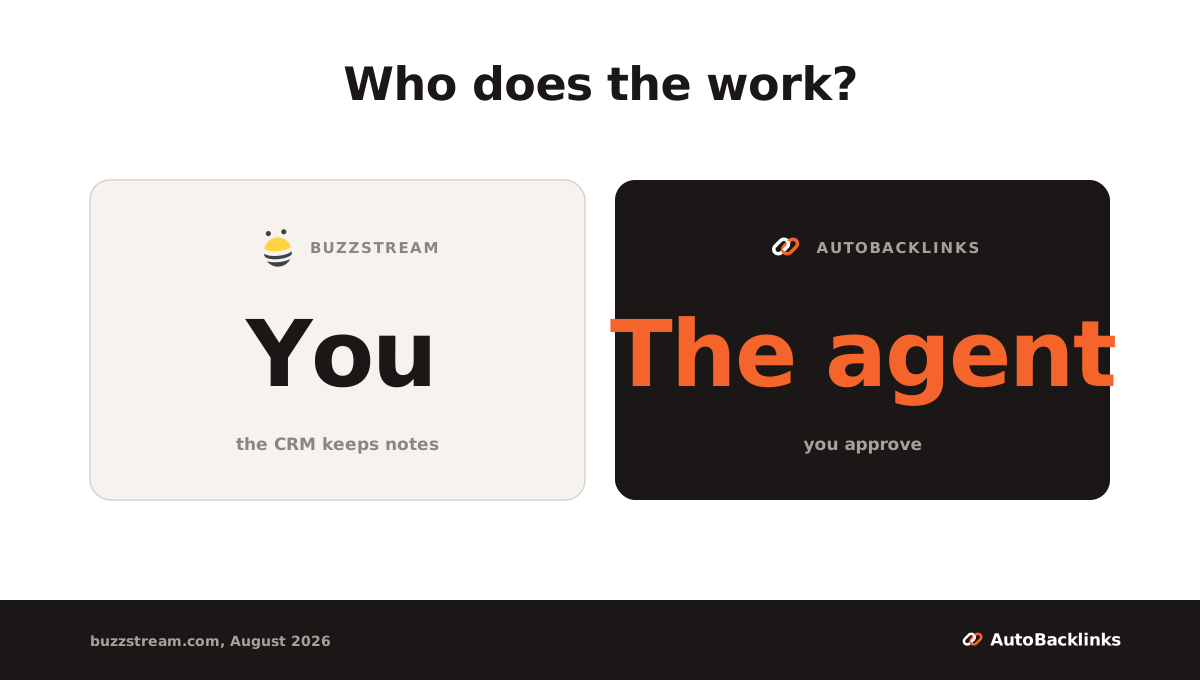
They are opposite answers to one question: who does the work?
BuzzStream calls itself "the world's best outreach CRM," and the description is exact. It is a system of record for outreach you do yourself: you run the searches, judge the sites, write the emails, and work the inbox, while the CRM keeps every note, stage, and reply organized.
AutoBacklinks is an AI agent. You tell it the goal, it finds the prospects, qualifies them, gets the contacts, writes the emails, and stops where you want to approve. You can brief it in the dashboard or from Claude, ChatGPT, or Cursor through the MCP server.
One setup note before the breakdown. This comparison uses BuzzStream's Growth plan at $174/mo, not the $49 Starter, and that is deliberate. Starter has no bulk send, no automated follow-ups, and no reports. It is note-taking software for outreach you send one email at a time.
The plan BuzzStream actually built for campaigns is Growth, so that is the one worth comparing.
Here is the full breakdown, priced from both live pricing pages and BuzzStream's own help docs.
AutoBacklinks vs BuzzStream at a glance
| AutoBacklinks | BuzzStream | |
|---|---|---|
| What it is | AI agent that runs the outreach pipeline | Outreach CRM you drive by hand |
| Price for real outreach | $79/mo (Starter) | $174/mo (Growth; Starter lacks bulk send and follow-ups) |
| Contract | Monthly, cancel anytime | Monthly, cancel anytime |
| Trial | Self-serve, 7 days, 120 credits (card required) | Self-serve, 14 days |
| Campaign setup | About 2 minutes in a wizard | You build searches, templates, and sequences yourself |
| SEO metrics | Domain Rating + organic traffic included | Moz DA + crawl stats; Ahrefs through your own Ahrefs account (Growth+) |
| Prospect qualification | AI relevance score with reasoning | You approve or reject each site by hand |
| Email writing | AI drafts from your goal and each prospect's page | Your templates with merge fields, no AI |
| Warmup | Included free on every mailbox | Not offered |
| Follow-ups | Automated, drafted per prospect | Automated sequences from Growth up |
| Reply handling | AI Reply Analyzer + kanban opportunities board | Unified inbox + relationship stages |
| AI | Included in the plan | ListIQ, a separate product at $24 to $399/mo, for media lists |
| MCP | Claude, ChatGPT, Cursor, any MCP client | Not offered |
| Reviews | Newer product, small public footprint | G2 4.2, Capterra 4.5 |
| Best for | Solo SEOs, in-house teams, and agencies | Teams that want a record system for manual outreach |
AutoBacklinks is an AI agent, BuzzStream is a CRM you operate
BuzzStream describes its own operating model precisely, and it has for years. Its research pages tell you to "flip through search results." Its help docs tell you to click approve or reject on each site once you:
"eyeball results in your list to see if they're relevant"
Its email pages tell you to write:
"a relevant, personalized message based on your conversation history, notes, and your contact's recent posts."
And its blog states the philosophy outright:
"Building a media list shouldn't be scalable."
That is a coherent product. It is a CRM: software that remembers what you did so a team can do manual outreach without losing track.
It was the right shape when every stage needed human hands. In 2026, the stages it organizes are exactly what an AI agent automates.
AutoBacklinks removes the manual stages instead of recording them.
One quick note before I compare them: AutoBacklinks is our product, so weigh my conclusions accordingly. Every BuzzStream claim in this piece comes from its own pricing page, help docs, blog, or public reviews, and I will be specific about the things BuzzStream does that we do not.
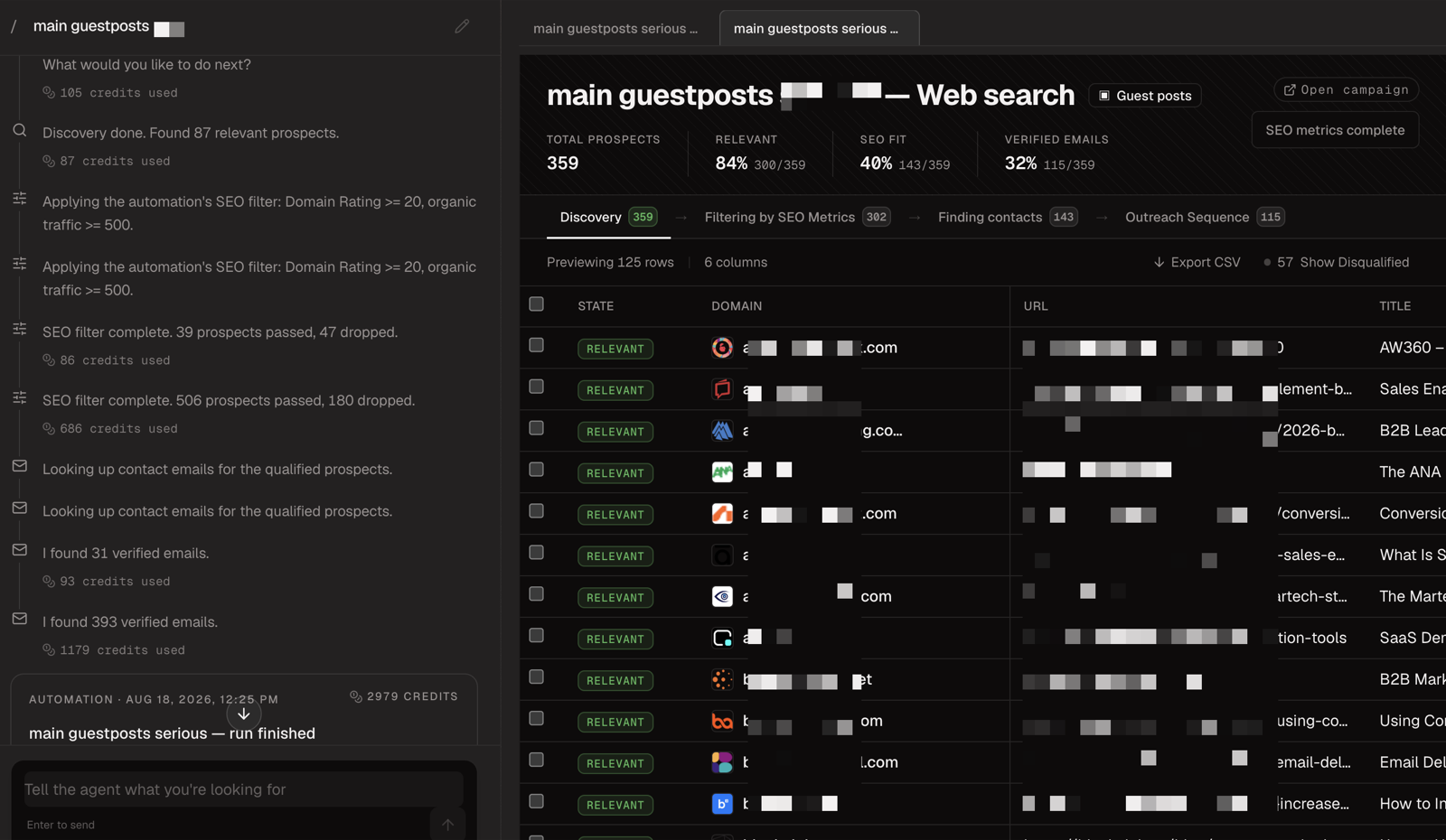
The AutoBacklinks agent works like a colleague you brief in chat:
- It proposes keywords and runs discovery.
- It applies your SEO filters and looks up contacts.
- It drafts the outreach.
- It reports each step and what it cost in credits.
- You can also brief it from Claude, ChatGPT, or Cursor through the MCP server.
If you would rather watch the difference than read about it:
BuzzStream pricing: the $49 plan is not the real price
BuzzStream's entry price gets quoted everywhere as its advantage, so look at what the entry plan contains.
Starter, at $49/mo, gets you:
- 1 user
- 500 contacts
- 30 prospecting searches a month
- No bulk send, no email scheduling
- No automated follow-ups
- No reports of any kind
The follow-up gate matters most, and BuzzStream's own research says so. Its study of 65,000 campaigns found sequences with follow-ups get an 85% higher reply rate than one-and-done emails.
The feature its own data calls the single biggest lift is the one it holds back until you pay $174.
Two more things reviews rarely mention.
First, the entry price roughly doubled in 2026. Most comparison articles still cite the old $24 tier, which no longer exists.
Second, in fairness, BuzzStream's billing is clean: every plan is monthly with no minimum term, cancelling is a settings-page action, and prepaying a year by email gets you one month free. No contract games, which is more than I could say for Pitchbox.
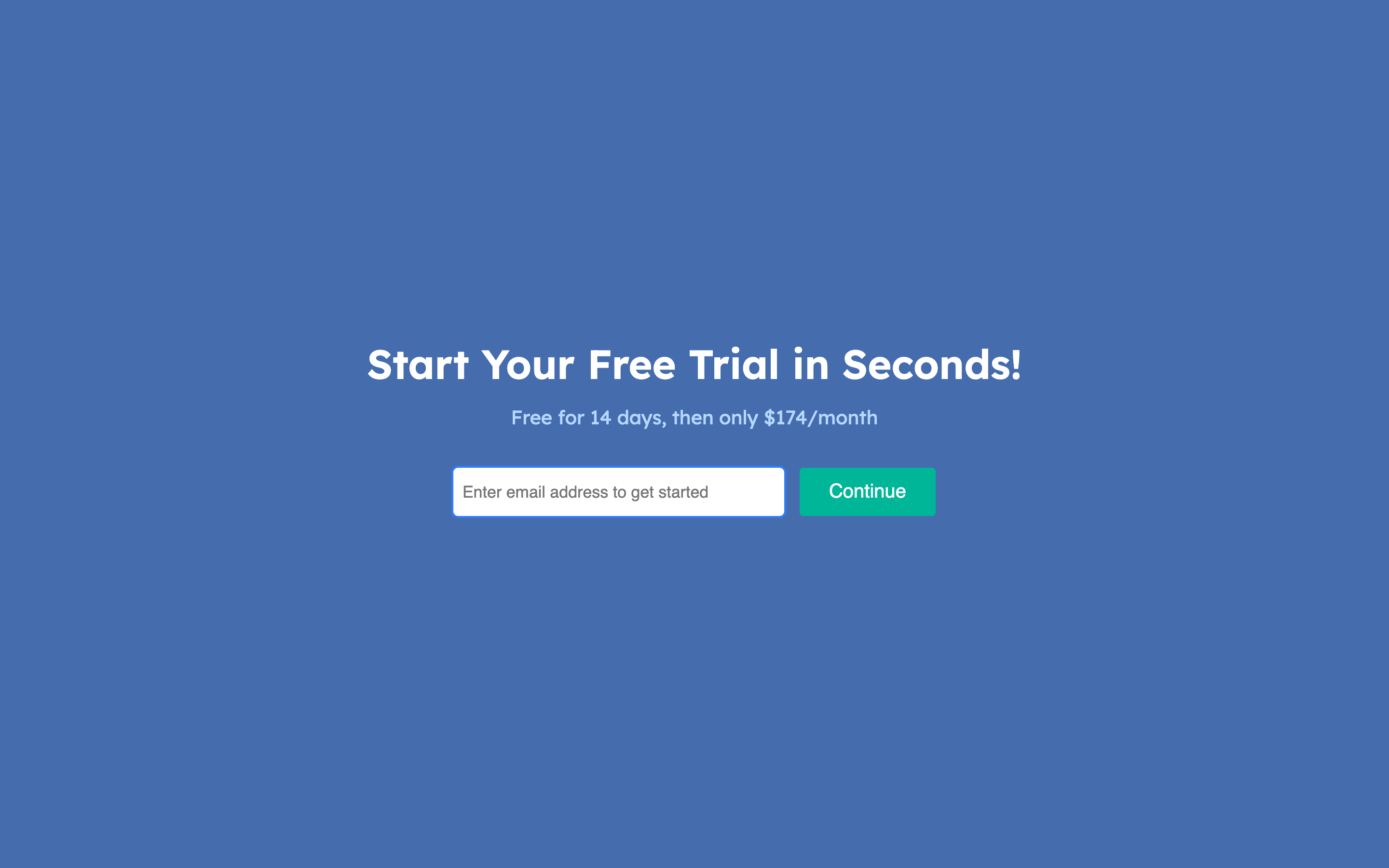
So the comparison for anyone doing real outreach is $174 against $79. Everything below prices BuzzStream at Growth.
Campaign setup: BuzzStream starts blank, AutoBacklinks takes minutes
BuzzStream hands you primitives. You create a project, connect your mailbox, build prospecting searches, design templates with merge fields, and assemble sequences.
Backlinko's review, which is otherwise positive, describes the start honestly:
"It was just a blank page"
No recommendations on what to do. The same review calls the learning curve steep and asks for pre-built campaigns.
The official onboarding is webinars and help videos; several core how-to articles are literally a video with no text. A human onboarding arrives at the $424 plan as a dedicated account manager, and a formal implementation plan is reserved for the custom tier from $999.
An AutoBacklinks campaign is a six-step wizard: goal, sources, SEO filters, approach, mailbox, review. It takes about two minutes, and the campaign that comes out is automated end to end.
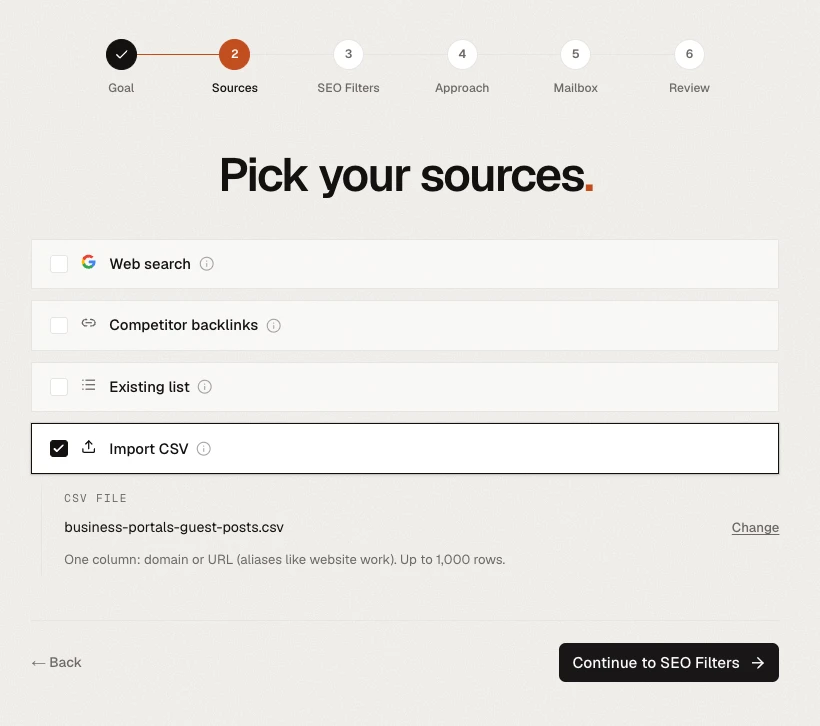
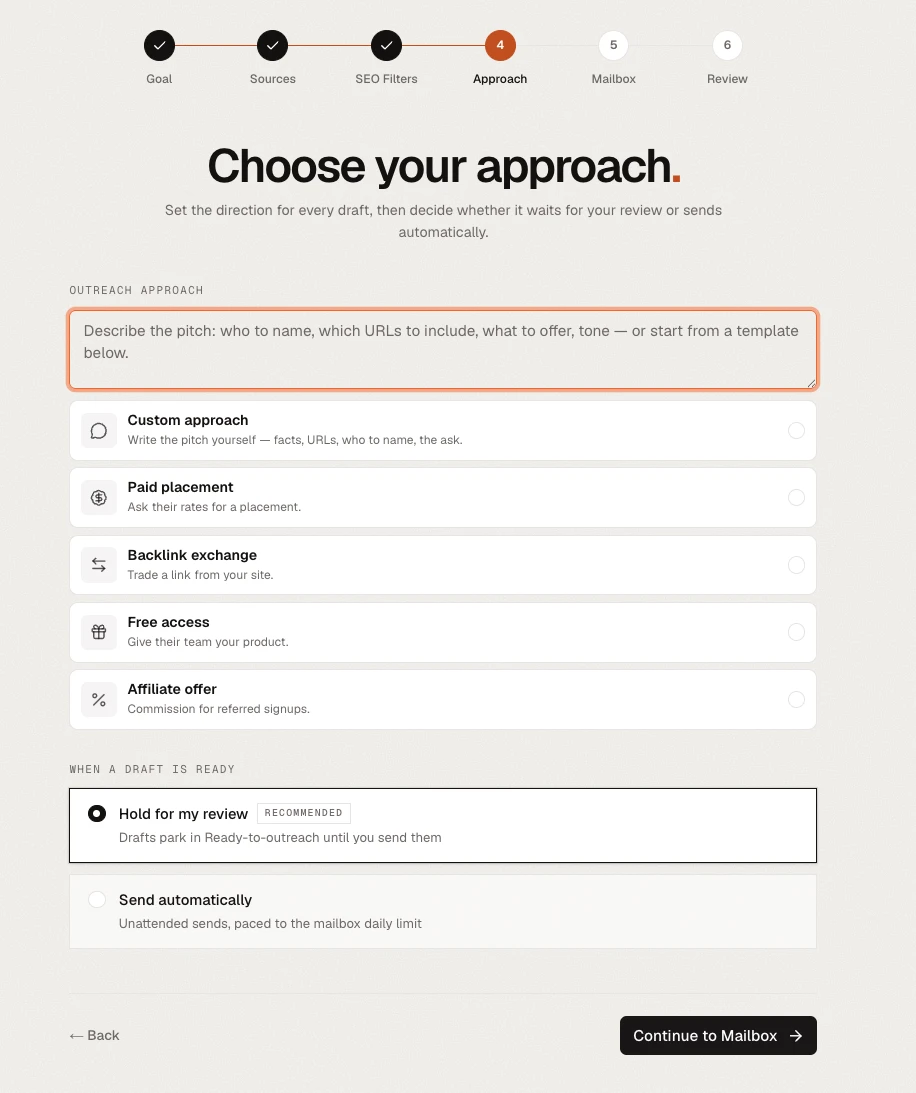
Step four sets the pitch and the control level. Describe your approach in plain words or pick a proven one (paid placement, backlink exchange, free access, affiliate offer), then choose whether finished drafts wait for your review or send automatically, paced to your mailbox's daily limit:
Campaigns can also recur weekly, biweekly, or monthly, and every run repeats the whole pipeline: find, filter, get contacts, draft.
BuzzStream has no equivalent; a new batch of prospects means you go run new searches.
Link prospecting: BuzzStream searches vs AutoBacklinks agent scans
BuzzStream prospecting is keyword-driven Web and News searches whose results you flip through and judge, plus CSV imports and the BuzzMarker Chrome extension. Searches are metered: 30 a month on Starter, 250 on Growth.
What BuzzStream calls "automatic prospecting" is enrichment, not discovery: upload a list of URLs and it fills in contact info, site stats, and social metrics. The finding is still yours to do.
Credit where due: BuzzMarker is genuinely liked. Reviewers use it to add sites and contacts while browsing, with the relationship history one click away. If your outreach style is reading twenty sites a day and pitching the five you love, it is a good research companion.
And if you build journalist media lists, BuzzStream now sells AI for that: ListIQ generates vetted media lists from news searches. It is a separate product at $24 to $399/mo, its credits are separate from your CRM plan, and it targets journalists, not link prospects.
AutoBacklinks runs six scan types, and the agent runs them rather than handing you a query builder:
- Competitor backlink scans that classify each link type
- ChatGPT source scans that find the pages AI answers actually cite
- Guest post scans with AI-suggested keywords
- Link insertion scans over live articles
- Product review scans for blogs already covering your competitors
- Directory scans, marked free or paid
SEO data: BuzzStream needs your Ahrefs, AutoBacklinks includes it
This is the least-known fact in the comparison, and it comes straight from BuzzStream's help center.
BuzzStream's native metrics are Moz Domain Authority plus its own crawl stats: posting frequency, outbound links, HTTP status. Deeper SEO data means the Ahrefs integration, which is gated to Growth and connects through your own Ahrefs account.
Their setup doc tells you to check how many integration rows your Ahrefs plan allows and to review the credits "that will be charged to your Ahrefs account" for each site added. So the DR column in your BuzzStream project bills your Ahrefs subscription, on top of the $174.
There is no Semrush or Majestic option; BuzzStream's own comparison post concedes Pitchbox has more SEO integrations.
Qualification on top of that data is manual. There is no relevance scoring of any kind: you filter by the numbers, then approve or reject each site by hand.
AutoBacklinks includes the data. Domain Rating and current monthly organic traffic cost 0.5 credits per site from the same plan credits everything else uses.
An AI relevance score reads each site and drops generic publishers with no topical fit, with the reasoning shown per site. High DR does not rescue an irrelevant site, which is the property that actually moves reply rates.
Contact finding: BuzzStream discovers, AutoBacklinks verifies
BuzzStream discovers contact info automatically when you add sites, on every plan, and that inclusion is real: emails, social profiles, sometimes phone numbers, pulled without a separate tool.
What the docs never mention is verification. There is no published accuracy number and no verification step, and the pattern shows up in reviews: G2's summary lists "limited and sometimes inaccurate email discovery" among the recurring complaints.
BuzzStream's own research makes the general point for me: when it tested popular email lookup tools, only 38% of the addresses they returned were correct.
AutoBacklinks treats contacts as a paid, verified step that runs after qualification:
- You spend 3 credits per verified email.
- You get name, role, and verification status.
- You spend it only on sites that already passed your DR, traffic, and relevance gates.
On a metered budget, order of operations is money.
Outreach emails: BuzzStream templates vs AutoBacklinks AI drafts
The BuzzStream writing model is templates plus you. You build templates with dynamic fields, and you personalize each send from the contact's history, notes, and recent posts.
Done diligently, that produces good email. It also produces an afternoon per fifty prospects.
And none of it is assisted: there is no AI drafting anywhere in the CRM. BuzzStream says so itself. Its own comparison post marks AI personalization at scale with an ❌ for BuzzStream and states that if you want AI tools that craft and personalize emails, Pitchbox is the better choice. The email composer's last listed update on their new-features blog is December 2022.
The results of the hand-template model are on record too, in BuzzStream's own dataset. Across 51 million outreach emails, link builders' reply rate comes out at 3.59%, about 1 in 28. That is the baseline the manual workflow produces at scale.
AutoBacklinks does not start from a template. You give the campaign a goal and an approach, and the agent writes each first touch and its follow-ups from that prospect's own page: what the site covers, which article the pitch references, why the ask fits. Every generated email costs 1 credit.
In our published campaign, that page-level angle put 187 emails out and brought 32 replies back. A 17.1% reply rate. The lever was not clever copy. It was that every email was about the prospect's actual page.
Email sending: AutoBacklinks includes warmup, BuzzStream has none
Both tools send from your own mailboxes, not a shared pool. BuzzStream's sending layer:
- Connects Gmail and Google Workspace, Office 365, Exchange, or any IMAP/SMTP provider
- Lets you throttle daily volume under your provider's cap
- Supports send windows like weekdays nine to six
- Adds bulk send and scheduling with Growth
What it does not have is warmup. There is no warmup feature anywhere in the product or help center, so a fresh outreach mailbox starts cold and its reputation is your problem.
Bounce handling is a relationship stage: bounced contacts are set aside "so you can modify or remove the email address," which means you fix them by hand.
AutoBacklinks connects Gmail, Google Workspace, or any SMTP provider, paces sends to your mailbox's daily limit, and includes warmup free on every mailbox: it holds real conversations so your domain builds reputation, and you can switch it off per mailbox. Starter includes roughly 1,500 outreach emails a month across 2 mailboxes.
Follow-ups and reply handling: BuzzStream vs AutoBacklinks
BuzzStream's sequence mechanics are solid:
- Automated follow-ups (on Growth and up) stop the moment a reply arrives.
- The relationship stage updates itself on send and reply.
- Unmatched emails land in a folder for triage.
For a team running conversations by hand, the bookkeeping is genuinely good, and it is the reason agencies kept BuzzStream around for a decade.
The reading, though, is yours. Every reply is a thread you open, parse, and answer, and nothing in the CRM tells you whether the number a publisher quoted is fair.
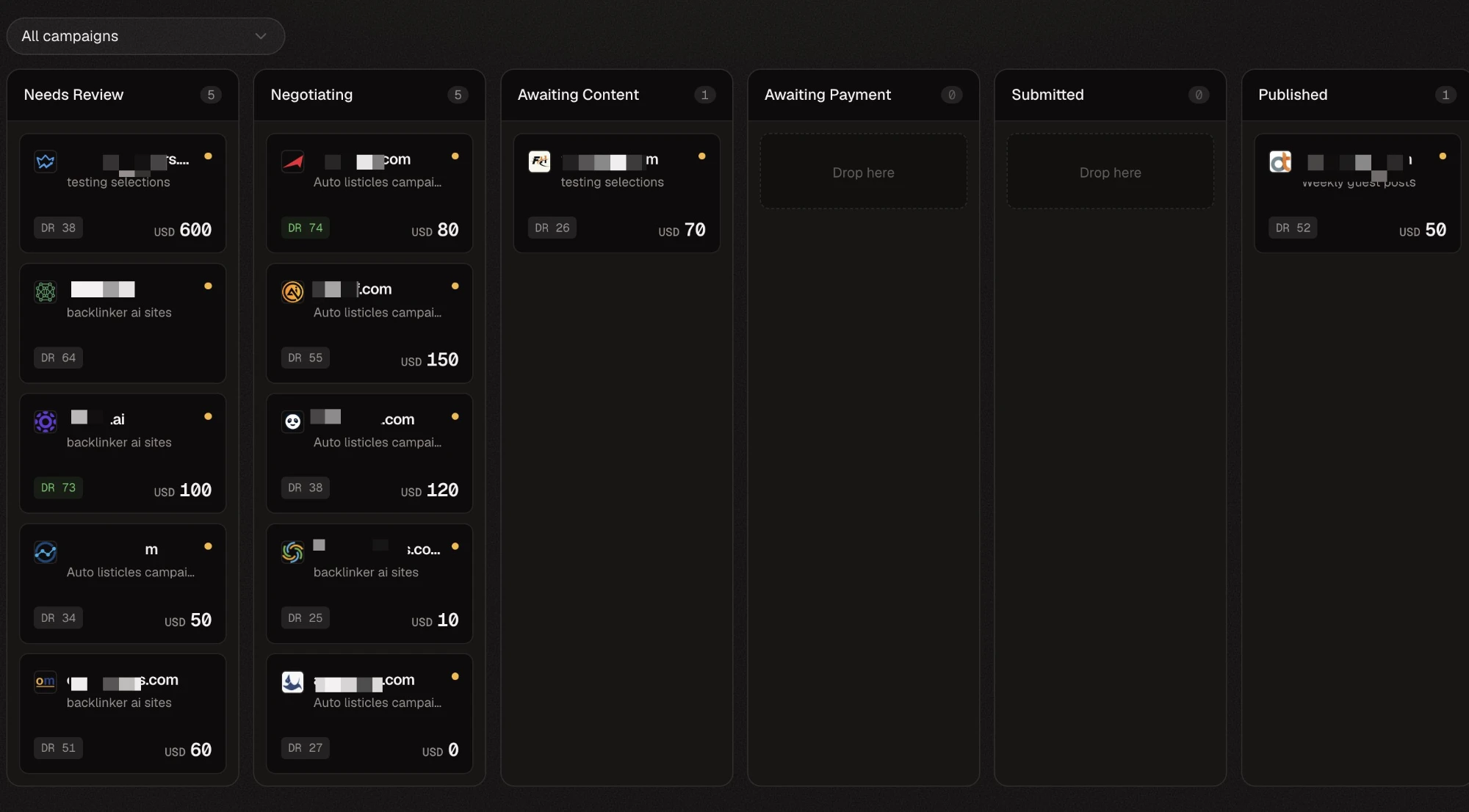
AutoBacklinks treats replies as decisions to prepare. The AI Reply Analyzer reads each publisher reply and extracts the entire offer: every price, placement type, content requirement, and payment term.
Positive replies land on a kanban opportunities board with the terms already structured, moving from Needs Review through Negotiating, Awaiting Content, Awaiting Payment, and Submitted to Published:
And before you pay anyone, the backlink valuation tool scores an offer against the site's authority, traffic, and placement terms, returning a fair-value range and a recommended maximum (10 credits per evaluation).
BuzzStream vs AutoBacklinks for teams, CRM, and reporting
Here is BuzzStream's real depth, and it deserves an honest paragraph. The relationship record is the best-kept in the category:
- Every email, note, tweet, and team task against a contact
- Stages that update themselves
- Custom fields and do-not-contact rules
- Client projects with per-project team access
And the record is not all. Link monitoring rechecks your won placements every two weeks and flags removals, nofollows, and anchor changes, with 25,000 links covered on Growth. The report catalog runs from funnel charts to team leaderboards.
Now look at what that machinery manages: people doing manual outreach. The history exists so a teammate can pick up a thread you started. The leaderboards exist because throughput depends on operator effort.
Hand the stages to an agent and most of that layer has nothing left to track.
And the machinery has gaps of its own:
- Permissions are essentially owner versus administrator.
- White-label client reports do not exist (BuzzStream's own comparison table says so).
- The API requires the $424 plan.
- The documented integrations catalog is three items: Ahrefs, Hunter.io, and that API. No Zapier, no Slack, no webhooks.
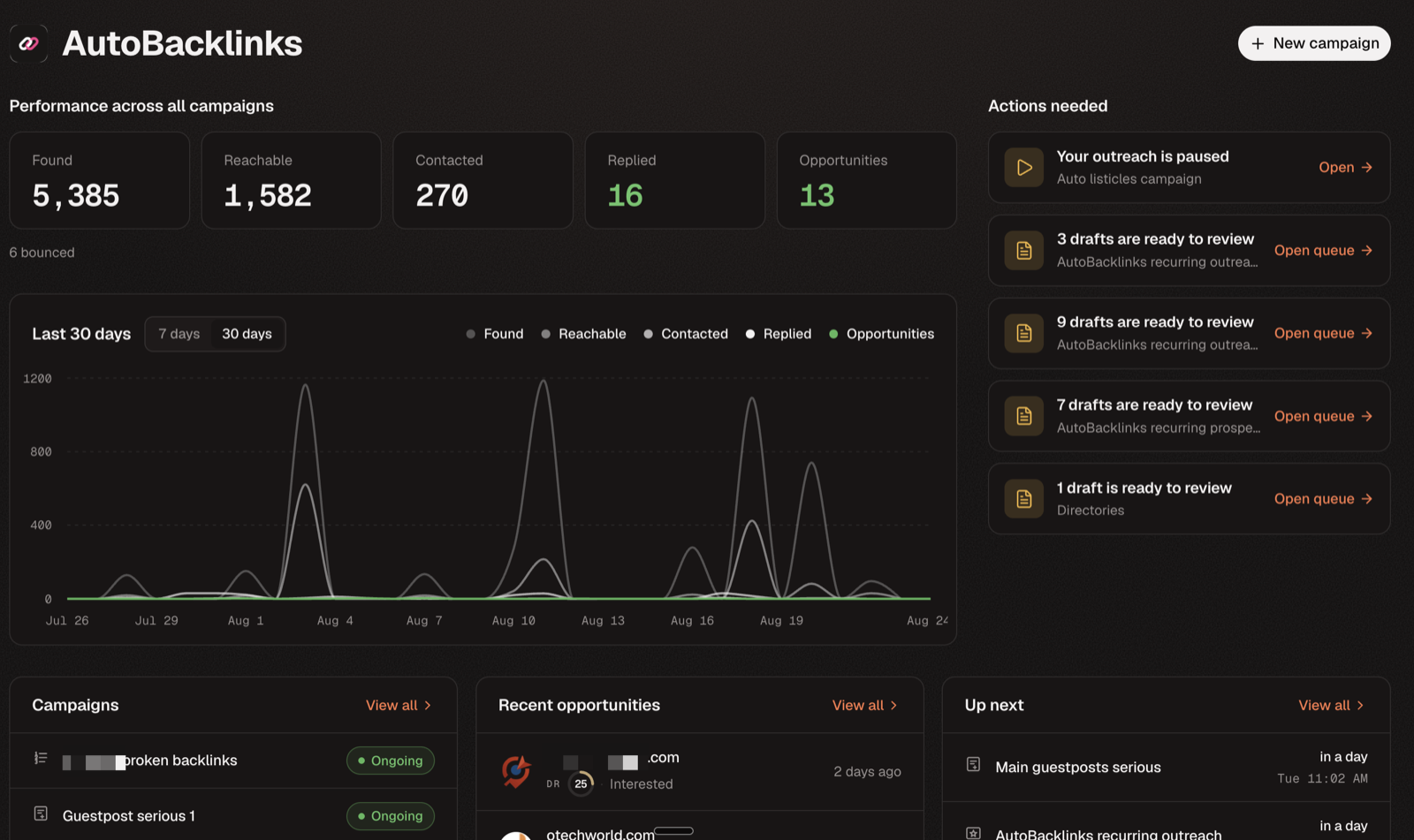
Agencies run AutoBacklinks too; they just run it lean. Growth covers 5 websites and Scale covers 25, each with its own campaigns and funnel: Found, Reachable, Contacted, Replied, Opportunities, charted per campaign and across all of them:
What AutoBacklinks does not have today: white-label reports and a public API. BuzzStream only half-fills that gap itself (no white label, API at $424), so if both are hard requirements, neither tool is your answer and the honest pointer is the Pitchbox alternatives breakdown.
AutoBacklinks vs BuzzStream pricing: what a month costs
Put the pieces together, because the sticker prices are not comparing the same thing.
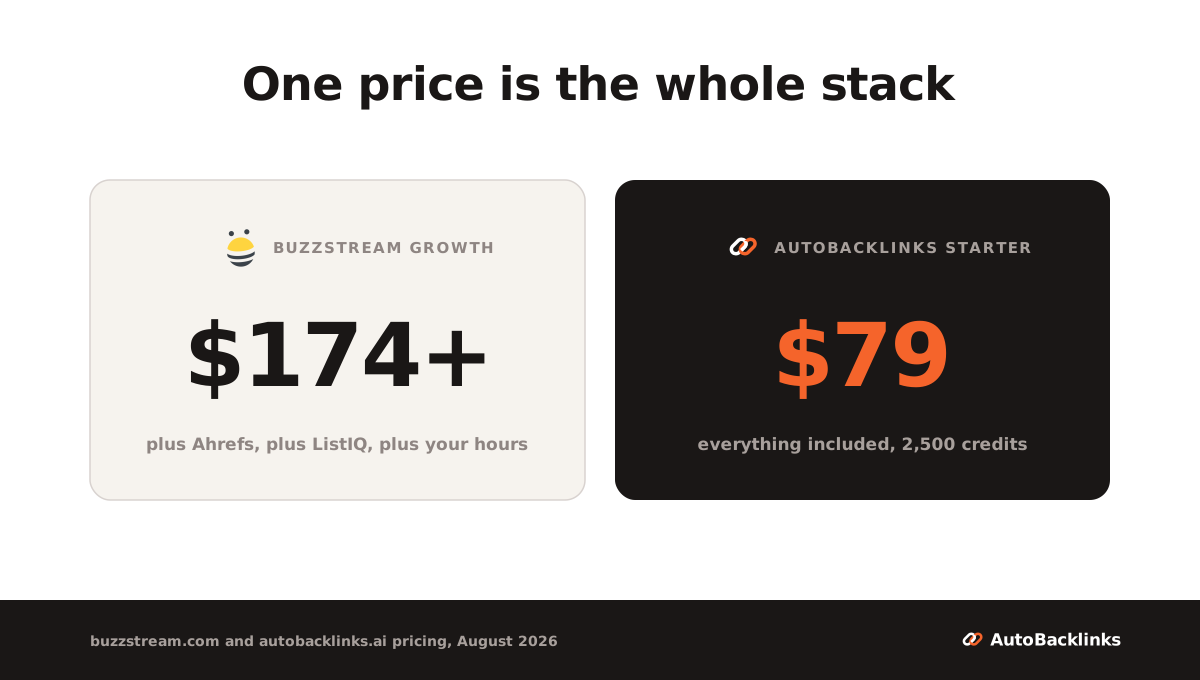
BuzzStream Growth is $174/mo for 3 users, with extra seats at $58. What sits around that number:
- The SEO data you filter with runs on your own Ahrefs subscription and spends your Ahrefs credits.
- The only AI in the family is ListIQ, sold separately at $24 to $399/mo, and it builds journalist lists, not link prospects.
- A year on Growth is $2,088 billed monthly, or one month cheaper if you arrange annual prepay by email.
To BuzzStream's credit, all of it cancels anytime, and the 14-day trial is self-serve. I priced the whole ladder, tier by tier, in the BuzzStream alternatives guide.
AutoBacklinks Starter is $79/mo with a 7-day, 120-credit trial (card required), $869/year on annual billing, and one credit pool that covers everything:
- 1 credit per prospect found
- 0.5 per site for SEO metrics
- 3 per verified email
- 1 per AI email
- 10 per backlink valuation
A typical Starter month, from finding 500 prospects to drafting sequences for the ones that survive filtering, runs about 1,500 of the 2,500 credits, with the rest left for another scan or a stack of valuations.
The quiet line item is your calendar. On BuzzStream, the subscription buys the filing system; the searching, judging, writing, and inbox work stay on your team's clock every single week.
That cost never shows on the pricing page, and it is the largest number in the stack.
AutoBacklinks or BuzzStream: which should you pick?
Choose AutoBacklinks if:
- You run link building yourself: founder, in-house SEO, small team, or an agency that would rather not staff a manual workflow.
- You want the work done rather than remembered: campaigns configured in minutes, run on a schedule, drafts waiting for a yes.
- You want SEO data, AI writing, verified contacts, and warmup in one $79 price instead of a CRM plus an Ahrefs plan plus an add-on AI product.
- You believe the reply-rate math: 3.59% is what templates at scale earn in BuzzStream's own dataset, and per-page relevance is how you beat it.
When does BuzzStream still make sense?
- Your team has years of relationship history in it; the record is real and it does not export into anything comparable.
- You depend on its link monitoring at volume: 25,000 links rechecked every two weeks on Growth is a genuine inclusion.
- Your work is journalist and digital-PR list building, the lane its ListIQ product (sold separately) is built for.
Even then, be clear about what you are buying: a well-kept filing cabinet for a manual workflow, at $174/mo plus your Ahrefs subscription, with the searching, qualifying, writing, and reply-reading still on you.
Starting fresh in 2026, I would not take on the manual grind a CRM exists to organize when an agent now does the grind itself.
The wider field, eight tools tested against live sites, is in my AI link building tools roundup. If you want to see the agent run a campaign on your own site, start the free trial and give it a goal.
FAQ
Is BuzzStream worth it in 2026?
BuzzStream is a well-built CRM for teams doing manual outreach: it holds a 4.2 on G2 and a 4.5 on Capterra, its relationship history is the deepest in the category, and its billing is honest monthly with no contract. The model is the problem in 2026. The $174 Growth plan organizes work you still do by hand: searching, qualifying, writing, and reading replies, with SEO data billed to your own Ahrefs account and no AI in the product. An agent tool like AutoBacklinks does that work for $79/mo.
Why compare BuzzStream's Growth plan instead of Starter?
Because Starter, at $49/mo, cannot run a real campaign: it has no bulk send, no email scheduling, no automated follow-ups, and no reports, and BuzzStream's own study found follow-ups lift reply rates by 85%. Growth at $174/mo is the first plan with the automation features outreach actually needs, so it is the honest point of comparison.
Does BuzzStream include Ahrefs or Domain Rating data?
Not on its own. BuzzStream's native metrics are Moz Domain Authority plus its own crawl stats. The Ahrefs integration is gated to the Growth plan and connects through your own Ahrefs account, spending your Ahrefs plan's integration rows and credits for each site you add. AutoBacklinks includes Domain Rating and organic traffic at 0.5 credits per site with no external subscription.
Does BuzzStream write outreach emails with AI?
No. The CRM's writing model is templates with dynamic fields that you personalize yourself, and BuzzStream's own comparison content confirms it has no AI personalization at scale. Its only AI product is ListIQ, sold separately at $24 to $399/mo, which builds journalist media lists rather than writing outreach. AutoBacklinks drafts each first touch and follow-up from the prospect's own page for 1 credit per email.
BuzzStream vs Pitchbox: which should you pick in 2026?
They are the same manual model at different scales. BuzzStream is the lighter, cheaper option: $174/mo for the automation tier, monthly billing, no contract, but no AI and no warmup. Pitchbox is the heavier operator platform: $210/mo on a one-year commitment, more automation and AI features, and G2 reviewers rate it easier to use than BuzzStream. Both assume your team does the outreach. I broke down the full head-to-head with Pitchbox in the AutoBacklinks vs Pitchbox comparison, and both tools' alternatives in their own guides.
How much does AutoBacklinks cost compared to BuzzStream?
AutoBacklinks Starter is $79/mo with 2,500 credits, roughly 1,500 outreach emails, SEO metrics, verified contacts, AI drafting, and warmup included; a year is $869 to $948. BuzzStream Growth is $174/mo, or $2,088 a year billed monthly, before your own Ahrefs subscription for SEO data and before ListIQ at $24 to $399/mo if you want its AI list building. Both cancel monthly.
About Rachid Idali
Founder & SEO Strategist
Rachid Idali has spent 10 years in SEO, running multi-six-figure SEO and link-building budgets across content, digital PR, and outreach programs. He writes about practical systems for finding relevant prospects, earning links, and turning SEO operations into repeatable pipelines.
More from Rachid Idali