

Link Building for AI Search: How to Get Cited by ChatGPT

by Rachid Idali
Last Updated: August 18, 2026
Backlinks still decide who gets cited. What is changing is which kind of backlink counts. Across the largest datasets available, raw backlink volume correlates weakly with AI citations (roughly 0.2 to 0.3), while branded anchor text correlates at 0.511 to 0.628 and being mentioned on pages that already carry authority correlates at 0.70 for Google AI Overviews. The shift is from volume and equity toward branded, editorial placement on the pages these engines actually retrieve.
I have run link-building budgets for ten years and now build outreach software. If you want the broader picture first, I covered what AI can and cannot do for link building separately. What follows is what the research actually supports, including the parts that contradict the usual advice, and the tactics that survive a look at the evidence.
What correlates with AI citations
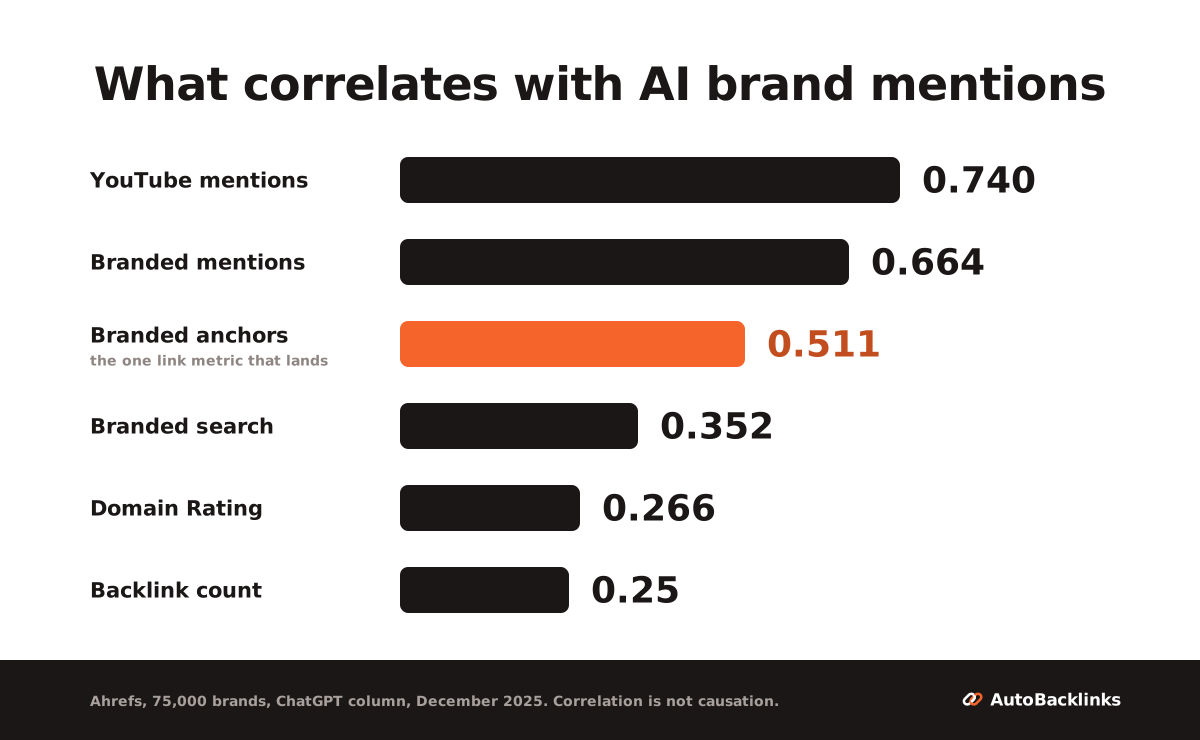
The most complete measurement comes from Ahrefs, which ran Spearman correlations across 75,000 brands against ChatGPT, Google AI Mode and Google AI Overviews (December 2025).
| Factor | ChatGPT | AI Mode | AI Overviews |
|---|---|---|---|
| YouTube mentions | 0.740 | 0.737 | 0.712 |
| Branded web mentions | 0.664 | 0.709 | 0.656 |
| Branded anchors | 0.511 | 0.628 | 0.527 |
| Branded search volume | 0.352 | 0.466 | 0.392 |
| Domain Rating | 0.266 | 0.285 | 0.326 |
| Number of backlinks | ~0.2–0.3 | ~0.2–0.3 | ~0.2–0.3 |
Ahrefs' own conclusion on links: "we found very weak correlations between link metrics ('number of backlinks' and 'URL rating') and brand mentions across all AI systems."
Two caveats before anyone builds a strategy on this. Ahrefs states plainly that correlation is not causation, and that every factor measured lands in the moderate-to-weak band. And this is a single dataset. Treat the ranking of factors as directional, not as physics.
Where link building fits in AI search
Read that table carefully, because the popular reading of it goes wrong immediately.
"Backlinks are dead" is the wrong conclusion. Branded anchors are backlinks. They are links whose anchor text is your brand name, and they sit fourth out of eleven factors, above Domain Rating and roughly double raw link count. On top of that, Ahrefs found that being mentioned on pages with many referring domains correlates at 0.70 with Google AI Overviews visibility (0.40 for Perplexity, 0.12 for ChatGPT).
Backlinks still decide this. What is evolving is which kind of backlink carries weight. The old model rewarded volume and equity: more links, from higher-authority domains, passing more strength to your pages. AI citation rewards something narrower and more editorial. A link earns its keep here when it carries your brand name, sits in genuine editorial context, and lives on a page the engines already pull from. Count alone does very little.
There is also a floor. SALT.agency analyzed 5,825 URLs and found no domain rated DR 40 or below appeared in the top quartile of cited domains. At the same time, 18.5% of DR 80+ domains sat in the bottom quartile. Authority qualifies you to compete. It does not win the citation.
That pattern holds elsewhere. In xfunnel's analysis of 250,000 citations, 31.5% of cited pages had a Domain Authority of 80 to 100, but roughly 27% sat below DA 40. High authority helps. It does not gate.
Semrush reached the same conclusion from a different direction. Its study of 1,000 domains across five AI platforms found Authority Score correlates with AI mentions at 0.57 (Spearman), and reported that "real gains appear only after reaching certain authority levels" rather than climbing linearly. That is a threshold, described independently by a second vendor.
Worth flagging honestly: Semrush's 0.57 for Authority Score and Ahrefs' 0.266 for Domain Rating are measuring roughly the same idea and disagree substantially. Different metrics, different samples (1,000 domains against 75,000 brands), different methods. Take the shared direction, which is that authority matters in tiers, and treat any single coefficient with suspicion.
The most revealing number in the Semrush data is a detail that is easy to skip. Nofollow links correlated with AI mentions at 0.509, and follow links at 0.504. Statistically identical. If link equity were the mechanism, follow links would pull away. They do not, which suggests what the models respond to is your brand appearing on the page at all, not the authority the link passes.
So the practical model is: clear the authority floor, then compete on placements and mentions. That is an outreach problem, not a link-volume problem.
Brand mentions come before AI citations
The sequencing matters more than most people realize. Seer Interactive analyzed 541,213 LLM responses across 20 brands and six platforms. When a brand was mentioned in the response, it was cited 53.1% of the time. When it was not mentioned, 10.6%.
Their framing is the most useful sentence in this entire field: "citations are the bibliography, not the brainstorm." The model decides which brands to name first, then goes looking for sources that support the choice.
Two other datasets point the same way. Semrush's AI Visibility Index, built on 126 million prompts, found Gemini's overlap between the brands it mentions and the domains it cites can run as low as 30%. BuzzStream's study of 12,000 AI responses found only 23.1% of brand mentions carry a citation at all.
Getting linked is downstream. Getting known is upstream.
Why ranking in Google does not get you cited by AI
The instinct is to assume that if you rank, you get cited. The data does not support it.
Ahrefs checked 15,000 long-tail queries against four AI assistants and found only 12% of cited URLs ranked in Google's top 10. Their summary: "80% of those citations don't rank anywhere in Google for the original query." Perplexity was the exception at 28.6%, roughly three times more search-aligned than ChatGPT.
For Google's own AI Overviews the number is contested, and the disagreement is worth knowing before you quote anything. Measurements range from about 17% (BrightEdge) to 38% (Ahrefs, March 2026) depending on how citations are counted. seoClarity found 44% of citations came from URLs outside the top 20 entirely.
You will also see a widely repeated claim that top-10 sourcing "collapsed from 76% to 38%." Be careful with it. The 76% figure counted only the three most visible citations per overview, which are the ones most likely to be top rankers, and Ahrefs notes the two datasets are not directly comparable. Semrush measured 20% to 26% back in September 2024, long before any supposed collapse. The low numbers appear to be the stable reality.
Ranking helps. Ahrefs' own analyst put the ceiling well: even at the top of the results, being cited "is a coin flip at best."
ChatGPT, Perplexity, and Google AI Overviews cite differently
There is no single AI search to optimize for. Profound analyzed 100,000 prompts and found ChatGPT and Perplexity share only 11% of cited domains. Their conclusion: "nearly 89% of AI citations come from completely different sources depending on which model users query."
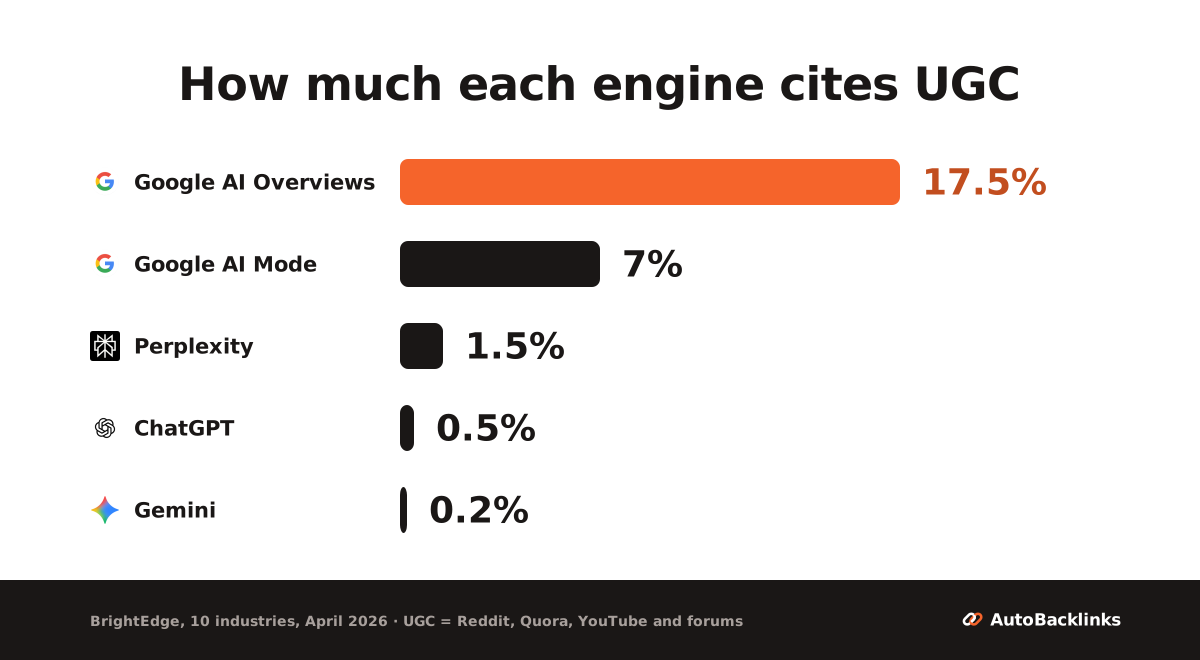
The character of each engine differs just as much. BrightEdge measured user-generated content share across ten industries:
| Engine | UGC share | Institutional / academic |
|---|---|---|
| Google AI Overviews | 17.5% | 10% |
| Google AI Mode | 7% | 14% |
| Perplexity | 1.5% | 22% |
| ChatGPT | 0.5% | 18% |
| Gemini | 0.2% | 26% |
Reddit is an AI Overviews play. Gemini is an institutional play. Treating them as one channel wastes budget.
How to Build Backlinks for LLMs like ChatGPT
Four tactics have real evidence behind them. They are ordered by the weight of that evidence, and every one of them is placement and outreach work rather than link volume.
Tactic 1: Get into the listicles AI already cites
This is the best-supported tactic in the field, and it is a placement problem rather than a link problem.
Evertune analyzed roughly 400 million citations across six engines and found 63% pointed to listicles, with ranked lists making up 71% to 86% of those. Wix's AI Search Lab, working from 75,000 AI answers, found listicles rise to 40.9% of citations on commercial-intent queries. In professional services, 80.9% of cited pages were third-party listicles versus 19.1% self-published.
Position inside the list matters too. Peec AI's study of roughly 200,000 AI responses found that ranking first in a cited third-party listicle lifted a brand's appearance in AI answers by 16.5 percentage points in B2B SaaS, and moved the brand 1.8 positions earlier in the answer for US finance queries.
One thing to avoid: publishing your own "best tools" list and expecting it to work. Lily Ray tested 100 B2B software queries using Ahrefs Brand Radar and found self-promotional listicles were cited 323 times, but in roughly 69% of those cases Google cited the brand's own page and then recommended the competitors named inside it. You can get cited and still lose the recommendation.
Freshness is a real dependency. Seer found ChatGPT's listicle citations fell about 30% month over month between December and January, and the lists that kept growing shared four traits: current dates, 10 to 20 or more options rather than five, disclosed methodology or external ratings, and a clean numbered structure.
Tactic 2: Get into the pages AI already cites
If citations cluster on a finite set of pages, the direct move is to find those pages for your own market and earn a place on them.
The mechanism is well established. Semrush studied 50,000 brands and found only 21% of the most-cited domains were also the most-mentioned brands, meaning the pages driving AI answers are usually not your own. Reboot Online ran a controlled experiment publishing a fabricated superlative across ten expired domains, all rated DR 5 or below, and saw ChatGPT and Perplexity repeat it. It only worked when the model used live search, which tells you the retrieval layer is doing the deciding.
Researchers at Cornell Tech demonstrated the same principle rigorously, and much more uncomfortably. In a paper on poisoning deep-research agents, they showed that appending around 13 words to a single frequently-retrieved page could promote a chosen entity, producing citation rates of 60% to 100% once the page was retrieved. It was published as a security vulnerability, not a marketing tactic, and it should be read that way. The legitimate takeaway is narrow: the pages an engine retrieves are the pages that shape its answer.
The practical constraint is that most cited pages are not pitchable. When Ahrefs classified ChatGPT's 1,000 most-cited pages, Wikipedia accounted for 29.7%, homepages and landing pages 23.8%, educational pages 19.4%, app stores 6.6% and review sites 5.8%. Only about a third had an editorial slot you could realistically pitch for.
So the workflow is: run the prompts your buyers actually ask, collect the pages each answer cites, discard the ones with no editorial slot (Wikipedia, app stores, vendor pages, documentation), and pitch the rest. That last set is mostly listicles, alternatives roundups, comparisons and resource pages, which is the same target as Tactic 1 arrived at from a different direction. Our ChatGPT sources finder runs that loop end to end, and it opens pitches on a fact you can verify: their article is one of the sources ChatGPT cites for a specific question.
The placement you are asking for has a name and a method of its own. I ran 12 buyer questions and sorted every cited page by the route it accepts in AI search niche edits, which is where the step-by-step version of this tactic lives.
Worth saying plainly: no one has published a controlled study measuring citation lift from this kind of outreach. The mechanism is proven, the workflow is sound, and the outcome data does not exist yet. Treat vendors who claim otherwise with suspicion.
Tactic 3: Earn branded links on authoritative pages
This is classic link building with the target refined. Two signals stack here. The link itself still counts, which is what the branded-anchor correlation of 0.511 to 0.628 measures. And the page you earn it from counts, because being named on a page that already has links pointing at it correlates at 0.70 for AI Overviews. The page's own authority does as much work as the link you get from it, which is why the target list matters more than the target count.
Combine that with the branded-anchor finding and the target profile is specific: an editorially relevant page, already well linked, that will name your brand in the text. That is a digital PR and outreach brief, not a link-volume brief. It is also why buying placements from a marketplace does little here: the citation data rewards earned editorial context, not purchased slots.
Note the engine split before you commit budget. The same signal is weak for ChatGPT at 0.12. If ChatGPT is your priority, the platform tactics below will do more.
Tactic 4: Reddit, review profiles and YouTube
Three platform plays carry real data, and each one is engine-specific.
Reddit is heavily cited but wildly uneven. Tinuiti, working with Profound data, found Reddit accounted for about 24% of all Perplexity citations in January 2026 and roughly 0.1% for Gemini. SE Ranking, analyzing 129,000 domains, found brands with heavy Reddit presence averaged 7.0 ChatGPT citations against 1.8 for those with little. The counterweight is that Ahrefs' analysis of 1.4 million ChatGPT prompts found Reddit URLs were cited only 1.93% of the time they were retrieved, and made up 67.8% of all retrieved-but-not-cited URLs. Reddit gets pulled constantly and quoted rarely. It is also actively policed, with Reddit reporting roughly 25,000 spammy posts and comments removed daily, so seeded threads are a liability rather than a strategy.
Review profiles are the strongest non-link move in this entire body of research. Seer analyzed 804,491 AI responses across 1,926 brands and found median citation rates by Trustpilot tier of 1% with no profile, 53.5% with a basic profile of 1 to 13 reviews, and around 81% for optimized profiles. The detail that should get attention: brands rated DR 0 to 15 with a basic profile reached a 54.5% citation rate, beating DR 16 to 35 brands at the same tier. A review profile outperformed domain authority.
YouTube is the strongest single correlate in the Ahrefs table at 0.740, and it is corroborated on citation share elsewhere. Ahrefs' analysis of over three million US queries found YouTube was the most-cited domain in AI Overviews at 21.1% mention share. Both Google and OpenAI have trained on YouTube transcripts. Sponsorships, review videos and podcast clips put your brand name into that layer.
AI search tactics that do not work
Three tactics sold as generative engine optimization do not survive measurement.
Schema markup. Ahrefs ran a matched difference-in-differences test on 1,885 pages that added JSON-LD against roughly 4,000 controls. AI Overviews citations fell 4.6%, a small but statistically significant decline. AI Mode and ChatGPT moved 2.4% and 2.2%, both statistically indistinguishable from zero.
llms.txt. Ahrefs checked 137,210 domains and found 97% of published llms.txt files received zero requests. Otterly.AI's 90-day server-log study recorded 84 hits to /llms.txt out of more than 62,100 AI bot visits, or 0.1%. Google lists it as a myth in its own documentation.
Chasing word count. Across 560,346 AI Overviews, Ahrefs found the correlation between word count and citation position was 0.04, effectively zero. More than half of cited pages ran under 1,000 words.
Fake AI search statistics you will see repeated
Several numbers circulate widely in this space with no primary source behind them. Two are worth naming because they get quoted in strategy decks.
The claim that backlinks correlate with LLM mentions at 0.10 does not appear in any study. It is attributed to Seer, whose published research says only that backlink impact was "weak or even neutral," with no coefficient given.
The claim that sites with 32,000 or more referring domains are 3.5 times more likely to be cited by ChatGPT is attributed to Ahrefs' 1.4-million-prompt study. That study does not analyze backlinks, referring domains or Domain Rating at all.
If a number matters to your plan, open the study before you act on it.
What Google says about optimizing for AI search
Google published guidance on generative AI features in May 2026, and it is more useful than most commentary about it.
Its position on the discipline: "From Google Search's perspective, optimizing for generative AI search is optimizing for the search experience, and thus still SEO."
Its eligibility rule, from the AI features documentation: a page needs to be indexed and eligible to appear with a snippet, and "there are no additional technical requirements."
Most relevant here, Google lists five myths, and one of them is seeking inauthentic mentions: "seeking inauthentic 'mentions' across the web isn't as helpful as it might seem. Our core ranking systems focus on high-quality content while other systems block spam; our generative AI features depend on both."
That is a real constraint on everything above, and it draws a clean line. Earned mentions are what the correlation data measures. Manufactured ones are what Google's spam systems target, and its spam policies now explicitly cover "attempting to manipulate generative AI responses in Google Search," while naming advertorials, guest posts and press releases carrying ranking-credit links as link spam.
The economics agree with the policy. Muck Rack, analyzing more than 25 million cited links across ChatGPT, Claude and Gemini, found earned media accounted for 84% of AI citations while paid and advertorial content accounted for 0.3%. Buying placement does not buy citation.
How to measure AI search visibility without fooling yourself
AI citations are far noisier than rankings, and most reporting on them is overconfident.
SparkToro ran 12 prompts across 2,961 runs with 600 volunteers and concluded there is "a less than 1 in 100 chance that ChatGPT or Google's AI, if asked 100 times, will give you the same list." Rand Fishkin's verdict on tools that report an AI ranking position: "full of baloney." Profound measured month-over-month domain-level drift of 40% to 59% depending on engine.
The resolution comes from Ahrefs, which tracked 43,000 keywords with repeated AI Overview observations. Citations changed about 70% of the time between consecutive checks, and 45.5% of URLs were entirely new. But the semantic similarity of the answers themselves held at 0.95.
The links churn. The consensus does not. You are not competing for a citation slot, you are trying to join the consensus the model keeps rephrasing. Measure share of voice across many runs, not position on any single one.
Where to start with link building for AI search
A workable first pass, in order:
- Pick ten prompts your buyers actually type, including "best [category]" and "[competitor] alternatives."
- Record which pages each engine cites for those prompts, and which of them have an editorial slot.
- Claim your review profiles. Given the 1% to 53.5% jump in Seer's data, this is the cheapest move available.
- Pitch the pitchable pages, aiming for inclusion in ranked lists rather than a link to your homepage.
- Track mentions, not positions, across enough runs to see past the noise.
None of this is new work. It is digital PR and outreach, aimed at a different target list. If you want the discovery and pitching handled in one workflow, that is what our backlink outreach agent does, from the dashboard or from Claude, ChatGPT, or Cursor through the MCP server, and the competitor backlink scan is a fast way to build the initial target list. The same relevance-first approach that produced a 17.1% reply rate on a conventional campaign applies here without modification. You can start a trial and run the first prompt set before committing to anything.
FAQ
Do backlinks help you get cited by AI?
Yes, but the type of link matters far more than the count. Raw backlink count correlates weakly with AI brand mentions (around 0.2 to 0.3 in Ahrefs' 75,000-brand study), while branded anchor text correlates at 0.511 to 0.628 and being mentioned on already-authoritative pages correlates at 0.70 for Google AI Overviews. Authority also acts as a floor: SALT.agency found no domain at DR 40 or below reached the top quartile of cited domains, and Semrush reported that gains appear only above certain authority tiers. Notably, Semrush also found nofollow links correlate with AI mentions as strongly as follow links, suggesting presence on the page matters more than passed equity. Earn branded editorial links, do not buy volume.
How do you get your brand mentioned by ChatGPT?
Get onto the third-party pages ChatGPT already cites for your buyers' questions. Those are mostly ranked listicles, alternatives roundups and comparison pages. Run the prompts, collect the cited sources, discard the ones with no editorial slot such as Wikipedia and app stores, then pitch the rest for inclusion. Review profiles on sites like Trustpilot and G2 and presence on YouTube also carry strong citation data.
Is generative engine optimization different from SEO?
Google's position is that it is not: "optimizing for generative AI search is optimizing for the search experience, and thus still SEO." The tactics that differ are the target list rather than the method. AI engines cite pages that often do not rank in the top 10, so the work shifts toward third-party placements and brand mentions rather than ranking your own pages.
Does llms.txt help you get cited by AI?
No. Ahrefs checked 137,210 domains and found 97% of llms.txt files received zero requests. Otterly.AI's server-log study recorded 0.1% of AI bot visits hitting the file. Google lists it as a myth in its own generative AI documentation.
Do AI Overviews only cite pages that rank in the top 10?
No. Estimates range from about 17% to 38% of AI Overview citations coming from top-10 pages, depending on how citations are counted, and seoClarity found 44% came from outside the top 20 entirely. Across AI assistants generally, Ahrefs found only 12% of cited URLs ranked in Google's top 10 and 80% did not rank at all for the original query.
About Rachid Idali
Founder & SEO Strategist
Rachid Idali has spent 10 years in SEO, running multi-six-figure SEO and link-building budgets across content, digital PR, and outreach programs. He writes about practical systems for finding relevant prospects, earning links, and turning SEO operations into repeatable pipelines.
More from Rachid Idali