

AI Search Niche Edits: What They Are and How to Get Them

by Rachid Idali
Last Updated: September 24, 2026
An AI search niche edit is a link insertion into a page that an AI engine already cites as a source, rather than a page that ranks in Google. Same mechanic as a classic niche edit, you ask an editor to add your link to an article that already exists, but the target list comes from what ChatGPT quotes instead of from what Google ranks.
The reason the distinction is worth a name is that the two target lists barely overlap, and a quarter of what ChatGPT cites cannot be pitched at all.
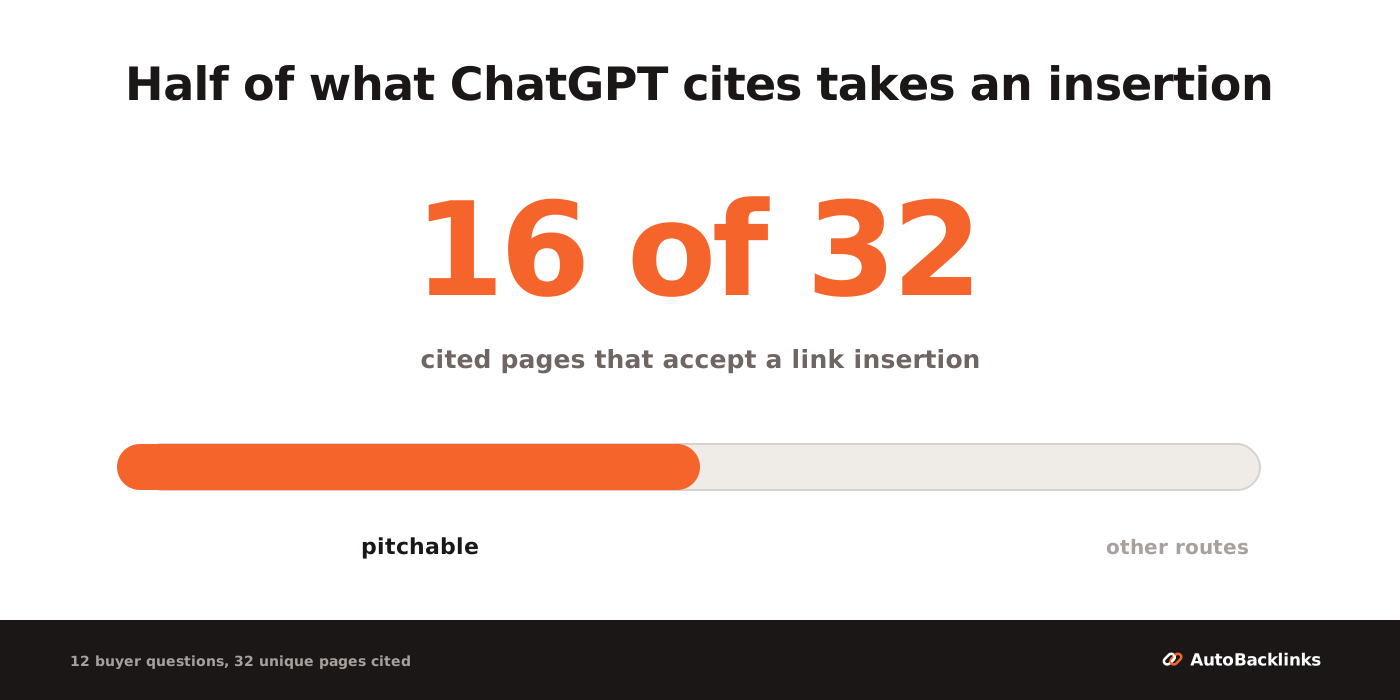
I ran 12 buyer questions through ChatGPT with web search on, collected every page it cited, and sorted all 32 of them by the outreach route each one actually accepts. Half are third-party lists where adding one more named option is a normal edit. Just over a quarter have no route at all.
What an AI search niche edit is
A classic niche edit works like this: you find a published article on someone else's site that already covers your topic, and you ask the editor to add a link to your page inside a paragraph where it belongs. Nothing new gets written. The link inherits the host page's age, rankings and crawl history.
An AI search niche edit is the identical ask. The only thing that changes is how you pick the page.
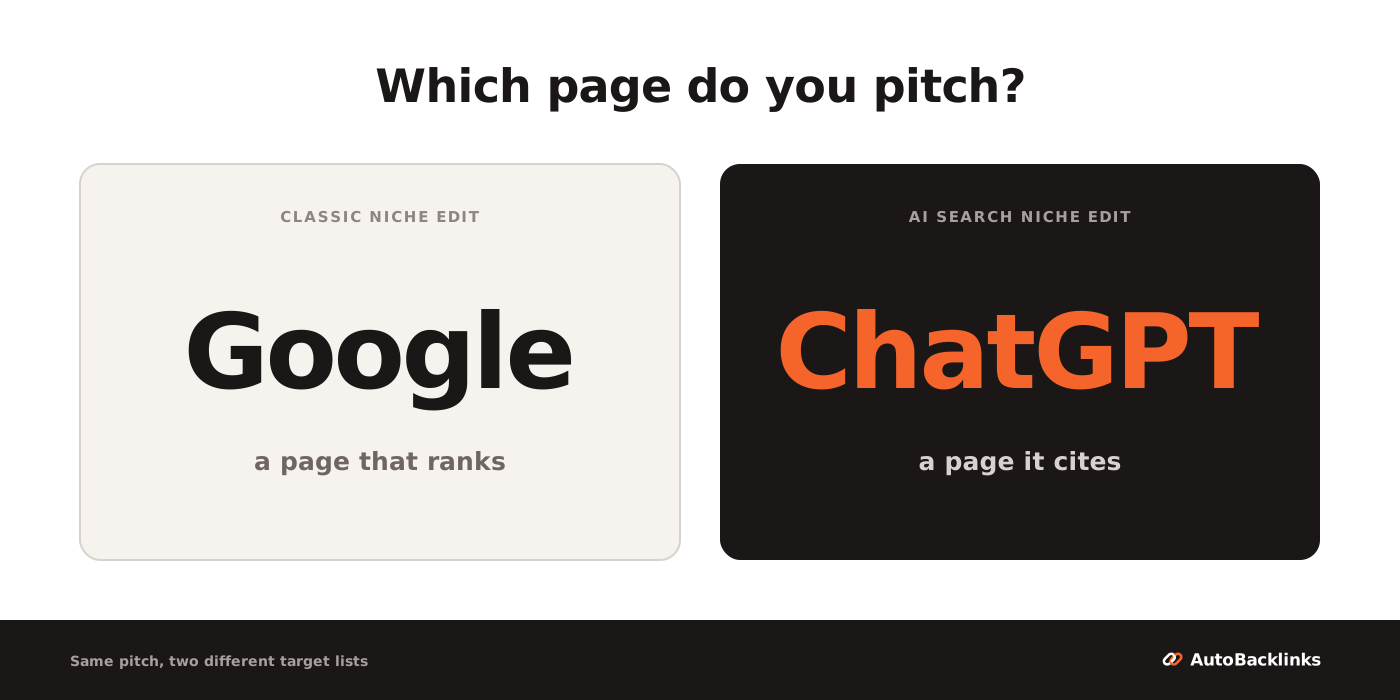
Instead of "this article ranks for a term my buyers search", the qualifying test becomes "this article is one of the sources an assistant quotes when my buyers ask about my category". You find it by asking the question and reading the citations, not by searching the keyword.
The payoff is different too. A classic insertion earns you a backlink on a page people find through search. An insertion into a cited source can put your brand inside the answer itself, each time the assistant re-reads that page for a new question. Nothing guarantees that it will.
The wider discipline gets called generative engine optimization. Most of what is sold under that name is measurement: dashboards that tell you your share of voice. An AI search niche edit is the part that changes the share of voice rather than reporting it.
One thing to be plain about before any of this: nobody has published a controlled study measuring citation lift from this kind of outreach. The mechanism is straightforward. The outcome data does not exist yet, and any vendor quoting you a citation guarantee is selling something they cannot measure.
AI search niche edits vs classic niche edits
The two differ at five points, and the pitch itself is not one of them.
| Classic niche edit | AI search niche edit | |
|---|---|---|
| Target page | ranks in Google for your term | cited by an assistant answering your buyers' question |
| How you find it | keyword search, competitor backlink scan | ask the buyer question with web search on, read the citations |
| What qualifies it | real organic traffic, topical overlap | appears as a source, topical overlap, has an editorial slot |
| What the win looks like | a link on a page readers find through search | a link plus your brand inside the generated answer |
| How you measure it | rankings and referral traffic | share of voice across repeated runs, not a position |
The pitch is unchanged. You still name the article, name the section, and say what your link adds for the reader. What changes is that you can open on a checkable fact: their page is one of the sources ChatGPT cites for a specific question.
What ChatGPT cites for 12 buyer questions
I ran this study for this article, and here is enough of the method to rerun it.
I wrote 12 questions of the kind buyers in my category actually type before they buy link building software. Ten are some form of "best X"; two are phrased as process questions instead. I sent each one to ChatGPT (gpt-5.5) with web search enabled, from a US location, through DataForSEO's ChatGPT responses API rather than the consumer ChatGPT product, so the raw citations came back as data rather than as something I had to copy by hand. Citation behaviour can differ between the two, which is worth knowing before you compare your numbers to mine. Then I pulled every page cited in each answer and classified each unique page by the outreach route it accepts.
Here are all 12, so you can run the same count on your own category:
- What are the best link building tools right now?
- Best Pitchbox alternatives?
- Is link building software worth it in 2026?
- Which backlink tool is best for agencies?
- What is the best link building service to buy backlinks from?
- Best guest posting services?
- How do I automate link building outreach?
- Best cold email outreach tools for SEO?
- What are the best niche edit and link insertion services?
- Best AI SEO tools for link building?
- Best BuzzStream alternatives?
- What tools do SEO agencies use to build backlinks?
Across the 12 answers, ChatGPT cited 32 unique pages on 24 distinct hostnames. Ten of the 12 answers cited something, at a mean of 3.4 unique sources per citing answer, counted before I deduplicated across questions.
Here is the route split, which is the number that should change what you do:
| Route | Pages | Share | What you actually do |
|---|---|---|---|
| Third-party list or alternatives page | 16 | 50.0% | pitch the editor: this is the AI search niche edit |
| No route at all | 9 | 28.1% | no editorial slot and no editor to ask |
| Review platform profile (G2) | 3 | 9.4% | claim and populate the listing |
| Community thread (Reddit) | 3 | 9.4% | take part honestly, never pitch |
| Single-product review | 1 | 3.1% | pitch a review, not an insertion |
Here is the rule I applied for each bucket, so you can disagree with a specific call rather than with the split:
- Third-party list: an editorial page whose subject is a set of tools or services, where adding one more named option is a normal edit. The listicle, the "best of" roundup, the alternatives page.
- Single-product review: an editorial page about one product. You can pitch a review of your own, but there is no list to join.
- Review platform profile: a listing on a platform where vendors hold their own page. Nobody edits you in; you claim the profile.
- Community thread: a forum or social post written by its participants.
- No route: a page whose owner sells the thing being discussed, a primary document, or a static file. No editorial slot and nobody to ask.
Those 16 pages sat on 16 different domains, so there is no single publisher to win. It is 16 separate conversations. Here they are, because a classification you cannot check is just an assertion:
backly.org, backlinkforme.com, buybacklinksforseo.org, cuttingedgepr.com, impressionsthroughmedia.com, linkbuilding.wiki, linkbuildingrankings.com, marketraa.com, medialyst.ai, mentionagent.ai, outreachz.com, rankmath.com, reporteroutreach.com, rhinorank.io, thekilleredge.com and ahrefs.com.
Two things jump out of that list. Almost none of them are names you would have put on a prospect list from memory, and several are small sites you would have filtered out on Domain Rating alone.
Three findings from the same run matter as much as the split.
The cited sets barely overlap. 30 of the 32 pages were cited by exactly one of the 12 questions. Only two pages appeared in more than one answer. A placement that covers one buyer question does not cover the next one, which means the target list is built per question, not per niche.
Two of the 12 answers cited nothing at all. Questions 7 and 8 both named brands with no sources attached, and question 7, the only "how do I" phrasing in the set, ran no searches whatsoever before answering. There is no page to pitch behind an answer like that, and no amount of outreach reaches it. That is a real ceiling on this tactic and I would rather state it than sell around it.
28.1 percent of the cited pages are unreachable. Those nine were vendor pricing and FAQ pages, Google's own documentation, and two static PDF reports. Nobody is adding your link to Google's spam policy page.
Now the caveats, all of which cut against me. This is one niche, one model, one country, one day, and it is ChatGPT alone. Perplexity and Google's AI Overviews build their source lists differently and would return a different split, so the routes transfer but the percentages do not.
Twelve questions is a small sample. The route classification is my own judgement, applied unblinded by a single rater, which is exactly the setup that flatters the rater. Treat 50 percent as the shape of the opportunity rather than a constant for your market, and run the same count on your own questions before you budget against it.
How far the ChatGPT citation set drifts from Google's top 10
For the eight questions that returned both a citation set and a Google top 10, I checked how many cited pages also ranked for the same question wording.
Across the eight questions where I could compare both, 4 of the 30 cited pages also ranked in Google's top 10 for the same wording. Six matched at domain level. The assistant and the search engine were reading largely different pages for the same question.
That lands close to what Ahrefs found across four assistants and 15,000 queries, where only 12 percent of cited URLs ranked in Google's top 10. My sample is far too small to confirm theirs, but it points the same way, and the practical consequence is the one that matters: a prospect list built from Google rankings will miss most of what the assistant is actually quoting.
This is why the discovery step cannot be borrowed from classic link building. You have to ask the question.
How to find the pages ChatGPT cites
By hand, the loop is simple and slow.
- Write the commercial questions your buyers ask, in their words. In my experience bare keywords rarely pull a sourced answer, where a real question usually does.
- Ask each one with web search turned on, and copy every cited URL out of the answer.
- Merge the lists and remove duplicates. Expect very few duplicates.
- Drop anything with no editorial slot, using the route table above.
- Qualify what is left on topical fit first, then check the page pulls real traffic.
That is a couple of hours per question set, and it decays, because the citation set moves.
Our ChatGPT sources finder runs the same loop end to end:
- turns your niche and competitors into buyer questions
- asks them with web search on
- merges every citation into one deduplicated list
- scores each page for topical fit, Domain Rating and traffic before anything gets pitched
It remembers the prompts it has already asked, so each run looks for sources the last one did not have.
Either way, the output is the same artifact: a ranked list of cited pages with an editorial slot. What you do with it is ordinary outreach.
How to get AI search niche edits, step by step
The sequence below is the classic insertion method with steps two and six changed.
1. Fix the target page and the anchor first. Decide which of your URLs deserves the link and what phrase carries it. For AI search, I favour anchors that carry the brand name. That is my inference, not a tested finding: Semrush's study of backlinks and AI search compared follow against nofollow links, not anchor text, and found the two correlate with AI mentions about as strongly as each other. What that supports is the narrower point that the engines respond to your brand appearing on the page rather than to the equity the link passes.
2. Build the list from citations, not from rankings. Run the questions, collect the cited pages, discard the routes that are not insertions. This is the only step that differs from classic link building.
3. Qualify on relevance before authority. Read enough of the page to name the paragraph or the list position where your entry belongs. If you cannot name it, the pitch has nothing to say.
4. Find a verified contact. The named editor or author has always beaten a generic inbox on my campaigns, and a bounce costs you sender reputation as well as the placement.
5. Open on the citation, because it is checkable. Telling an editor that ChatGPT quotes their article for a specific question is a fact they can verify in thirty seconds, which is the opposite of template flattery. Keep it under 120 words:
Subject: ChatGPT cites your backlink tools roundup
Hi Sam, when someone asks ChatGPT for the best link building tools, your roundup at zapier.com/backlink-tools comes back as one of its sources. Your list covers the research suites, but every entry stops at finding the prospect. Ours runs the outreach after it, so it would sit naturally after the Hunter entry in section three. Here is the line if you want it: "AutoBacklinks (autobacklinks.ai) finds the prospects, verifies the contact and writes the pitch, then sends it from your own mailbox." Ignore it if it does not fit. Either way, worth knowing your piece is feeding those answers.
6. Follow up twice, then stop, and recheck the answer later. Two follow-ups is my limit on any campaign. The addition here is the recheck: once a cited page adds you, the assistant has to re-read it before you appear, and there is no fixed timeline for that.
Steps two through six are the ones software can run for you. That is what our backlink outreach agent does, from the dashboard or from Claude, ChatGPT or Cursor through the MCP server, with the send held for approval.
On a conventional campaign I sent 187 emails and got 32 replies, a 17.1 percent reply rate. 155 opened, 6 bounced. That was one uncontrolled campaign, so I cannot prove which variable carried it, but my read is that the target list did more than the writing.
Which ChatGPT sources you cannot pitch for an insertion
Four groups. Three of them are closed doors, and the mistake is treating those as slow prospects. The fourth is open, just not to a pitch.
Vendor pages, documentation and PDFs. Nine of my 32 were these: competitors' pricing and FAQ pages, Google's developer documentation, and two static PDF reports. There is no editorial slot and no editor. When Ahrefs classified ChatGPT's 1,000 most-cited pages, Wikipedia alone accounted for 29.7 percent, with homepages and landing pages at 23.8 percent and app stores at 6.6 percent, so a large unreachable share is normal rather than a quirk of my sample.
That set leaves about a third of pages with an editorial slot, against the half I measured, and the gap is the useful part. Ahrefs sampled the most-cited pages across everything anyone asks. I sampled 12 commercial buyer questions. Commercial intent appears to pull a more pitchable citation set than the citation graph at large, which is convenient, because commercial questions are the ones worth being inside.
Community threads. Reddit threads were three of mine. You can take part in those conversations if you actually belong there, but a seeded thread is a liability: Reddit reports removing roughly 25,000 spammy posts and comments a day, and an account that shows up to name its own product reads exactly like what it is.
Review platform profiles. Three of my 32 were G2 pages, two of them the "alternatives to X" listings that map straight onto a buyer question. There is no editor to pitch, and that is the good news: you claim the profile and fill it in yourself. It is the cheapest route on this list and the only one where nobody can say no.
Wikipedia and reference pages. None appeared in my 32, so this group comes from Ahrefs' numbers rather than my run. High trust, heavily cited, and every edit policed by volunteers. The route is earning the notability first. There is no shortcut and attempting one is worse than doing nothing.
What an AI search niche edit costs
There is no market price for an AI search niche edit, because the pages worth having are not for sale. What you pay is tooling and hours, not a rate card. The three routes below are the same three as any link insertion, in this order for a reason: for any given site, the owner's own price is the floor, and every middleman prices upward from it.
Direct, by asking. The site owner sets the number, and in my experience a fair share say yes for nothing when the addition genuinely improves their page. Your fixed cost is tooling and hours. AutoBacklinks plans run $79 to $399 a month whatever number of placements land.
Marketplace. You are buying from a catalog of sites that agreed to be listed, which is a different pool from the pages an assistant happens to cite. Across the 62,916 sites in BuzzStream's database that offer an insertion at all, the average is $179. Guest posts, priced on essentially every site in that 421,259-site database, average $461. Read the $179 as a statement about which sites agreed to be listed, not about which road is cheaper: budget catalogs fill with smaller, lower traffic pages, and the owner's own price is still the floor under every one of them. Either way the overlap between catalog inventory and your citation list is mostly accidental. You cannot order a placement on a page that is not for sale.
Agency. A managed provider prices by authority tier and works from its own inventory, which has the same overlap problem, one layer further from the owner's price. I put the managed providers side by side in what buying backlinks actually costs.
There is a policy problem sitting under the two paid routes, and it is the same one that applies to any bought link. Google's spam policies name "buying or selling links for ranking purposes" as link spam, and allow such links only when they carry rel="nofollow" or rel="sponsored", which also stops them passing ranking value.
Google's own guidance on generative AI features adds a second line specific to this tactic, listing among its myths that seeking inauthentic mentions across the web is not as helpful as it might seem, because its ranking and spam systems both feed the generative features.
None of that is an argument that nobody should ever buy a placement. Plenty of competent teams do, with their eyes open.
How to measure AI search niche edits
Do not measure a position. I ran each question once, so I cannot measure churn from my own data, but the published evidence on AI citations is consistent: the cited links move a great deal between checks while the substance of the answer holds steady. Treat any single check as a snapshot.
Measure three things instead.
- Coverage of your question set. For each buyer question, are you inside at least one page the assistant cites? That is the target, and my run says you need to ask it per question, because 30 of 32 pages served only one.
- Share of voice across repeated runs. Ask the same question several times over several days and count how often your brand appears at all. Mentions first, citations second.
- The ordinary link metrics. The placement is still a backlink on a real page, and it still earns referral traffic and anchor text you can read in any backlink tool.
If you want the broader evidence base behind all of this, the correlation data, what the engines cite, and the tactics that do not survive measurement, I went through it in link building for AI search. The wider picture of what software can and cannot do is in how AI link building actually works. You can start a trial and run one question set before committing to anything.
FAQ
What is an AI search niche edit?
An AI search niche edit is a link inserted into an article that already exists and that an AI engine already cites as a source when it answers questions in your category. The mechanic is identical to a classic niche edit or link insertion: you ask the editor to add your link to a paragraph or list where it genuinely belongs. What differs is how the target page qualifies. A classic niche edit targets pages that rank in Google. This one targets pages the assistant quotes.
How do you find the pages ChatGPT cites?
Ask the commercial questions your buyers ask, with web search turned on, and collect every URL cited in the answer. Bare keywords do not produce sourced answers, so the questions have to be phrased the way a buyer would type them. Merge the citations across questions, remove duplicates, then drop the pages with no editorial slot such as vendor pricing pages and documentation. Across 12 questions in my own category the answers cited 32 unique pages on 24 domains, and half of those accepted an insertion pitch.
Do AI search niche edits work on Reddit or Wikipedia?
No, and treating them as prospects is the common mistake. Community threads on Reddit are cited often, but they punish self-promotion and seeded threads get removed at scale, so the only honest route is taking part in conversations you belong in. Wikipedia is policed by volunteers and requires you to earn notability first. Both are routes, but neither is an insertion you can pitch for.
Can you buy AI search niche edits?
You can buy insertions, but the pages you want are mostly not for sale, because assistants cite editorial pages whose owners never listed them in a catalog. The paid route also carries the same policy problem as any bought link: Google's spam policies name buying links for ranking purposes as link spam and allow it only when the link is marked rel="nofollow" or rel="sponsored", which stops it passing ranking value. Google separately lists seeking inauthentic mentions as a myth in its generative AI guidance.
How long does it take to show up in a ChatGPT answer?
There is no fixed timeline. Once a cited page adds your brand, you can surface as soon as the assistant searches that topic again and re-reads the updated page, which is the advantage of targeting pages it already pulls from. No controlled study has measured citation lift from this kind of outreach, so treat the timing as unknown and measure share of voice across repeated runs rather than a single check.
About Rachid Idali
Founder & SEO Strategist
Rachid Idali has spent 10 years in SEO, running multi-six-figure SEO and link-building budgets across content, digital PR, and outreach programs. He writes about practical systems for finding relevant prospects, earning links, and turning SEO operations into repeatable pipelines.
More from Rachid Idali