

Best PressWhizz Alternatives in 2026 (Ultimate List)

by Rachid Idali
Last Updated: August 24, 2026
Every price on PressWhizz is a resale.
The publisher accepts one number. You pay a bigger one. The spread in between is the marketplace's revenue, and across the industry that markup often runs past 50%.
So the best PressWhizz alternative depends on how much of that spread you are willing to keep paying.
If the answer is none, AutoBacklinks ($79/mo) is an AI agent that finds the same sites, pulls the owner's verified contact, and pitches them directly at their own rate. Earn one $300 catalog link at the publisher's real $200 price and the software has already paid for itself.
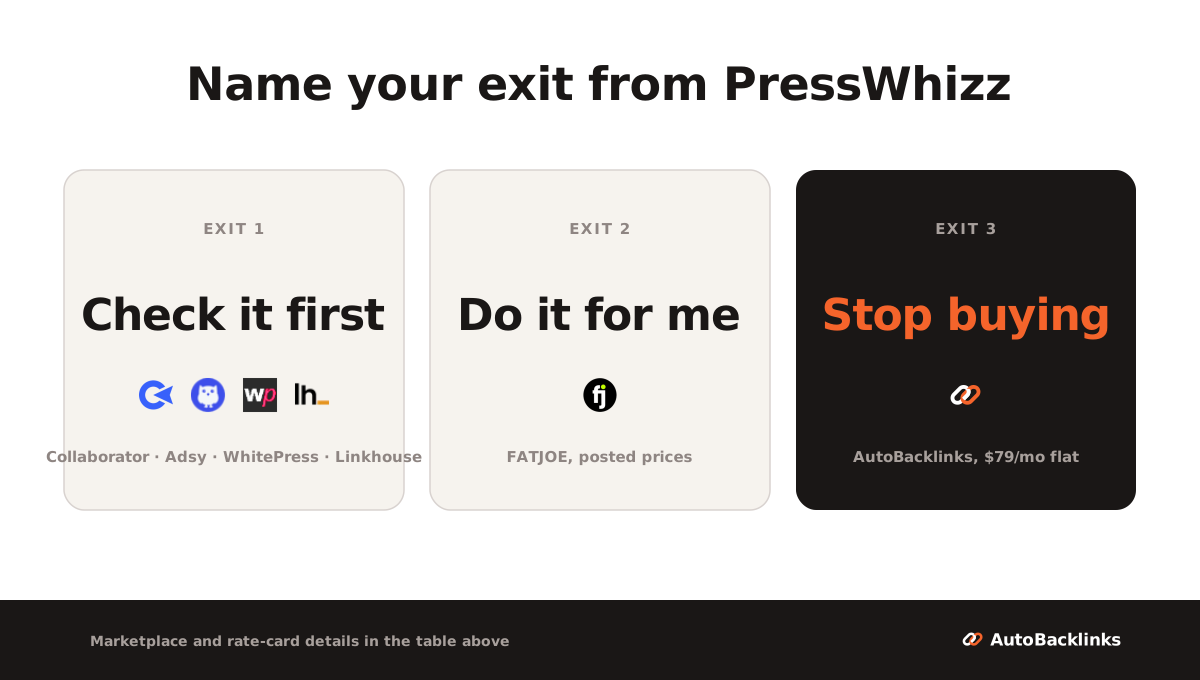
If you still want a catalog:
- Collaborator shows verified traffic data on open listings.
- Adsy shows metrics before signup.
- WhitePress pairs the biggest network here with a written 36-month guarantee.
- Linkhouse goes deepest in Europe.
- FATJOE sells managed placements at posted prices from $83.
To be fair, PressWhizz is not the villain of the category. It is just a clean example of how the category works.
It is cheap to start, with guest posts from $31. It is fast, delivering 95% of orders within 24 hours by its own numbers. Everything is a one-time fee with no subscription.
But its own publisher page offers site owners $30 to $2,000+ per placement, and the distance between that payout and your checkout price is the business model. Three catches:
- You cannot see that distance before you buy, because prices and metrics sit behind a signup wall.
- You cannot lean on other buyers either: full operations began in January 2025, and the Trustpilot profile held zero reviews when I checked in August 2026.
- The replacement guarantee on the homepage does not appear in the terms you actually buy under.
Here is what you are buying, then the math on paying double.
What PressWhizz actually sells in 2026
PressWhizz is an AI-powered publisher marketplace: a catalog of 41,000+ curated websites across 90+ countries where you buy guest posts and niche edits as one-time purchases. It claims 5,000+ monthly active users, and its published floor prices look like this:
| Service | Starting price | Stated delivery |
|---|---|---|
| Guest posts | from $31 | ~18 hours average |
| Niche edits (link insertions) | from $33 | ~24 hours |
| Tier 2 boosting | from $99 | ~2 days |
| iGaming backlinks | from $200 | varies |
| SaaS backlinks | from $150 | varies |
| Managed link building | from $5,000 | monthly engagement |
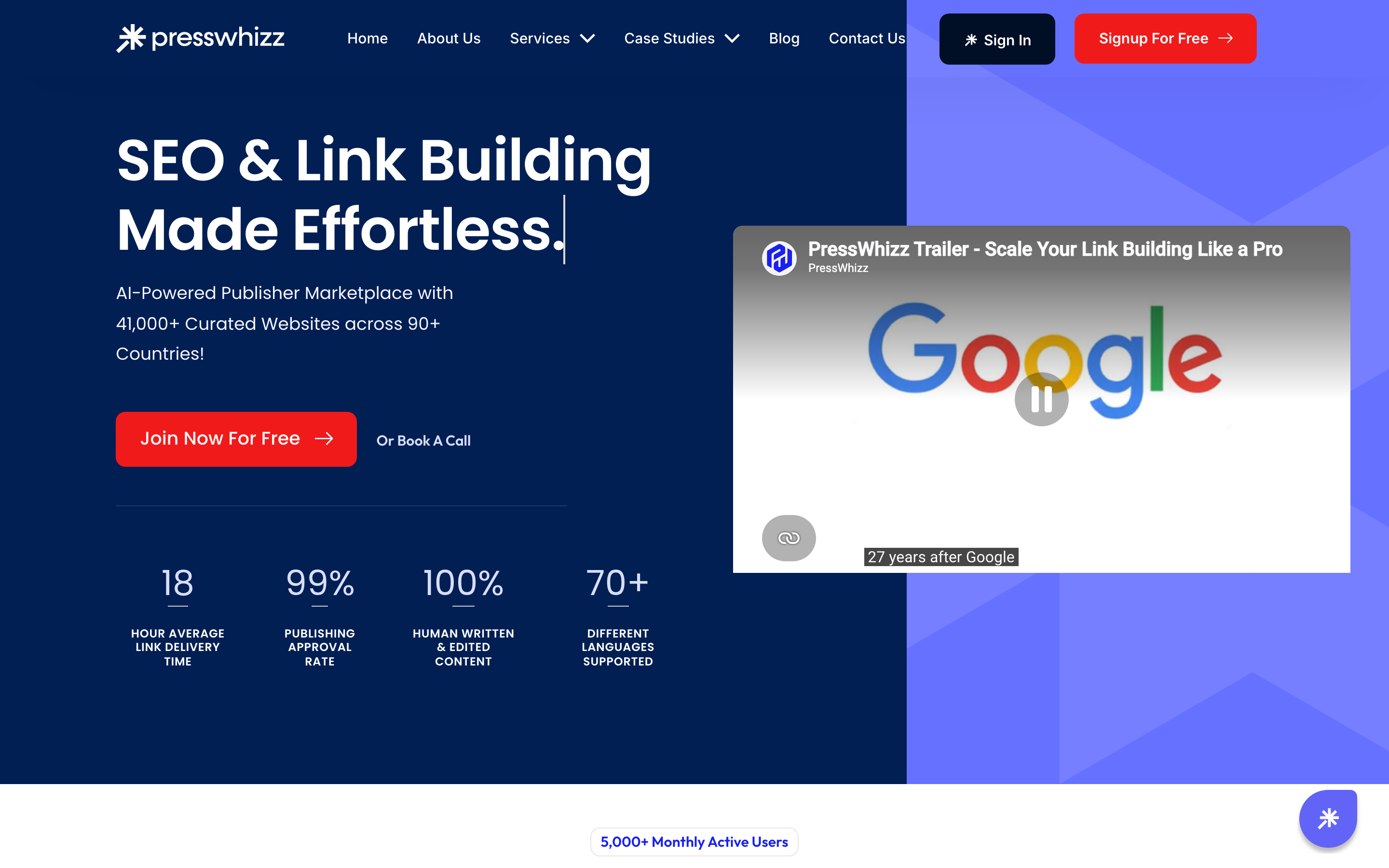
Credit where it is due: PressWhizz publishes more aggregate pricing data than any marketplace on this list.
Its own pricing report, based on 22,703 completed placements worth $3.66M, puts the median link at $112 and the average at $161.25, with guest posts averaging $164 and niche edits $112. Casino and gambling placements average $252.
That report is genuinely useful, and I will use its numbers against the platform's own value question later.
Now the fine print, because this is where the case for an alternative starts.
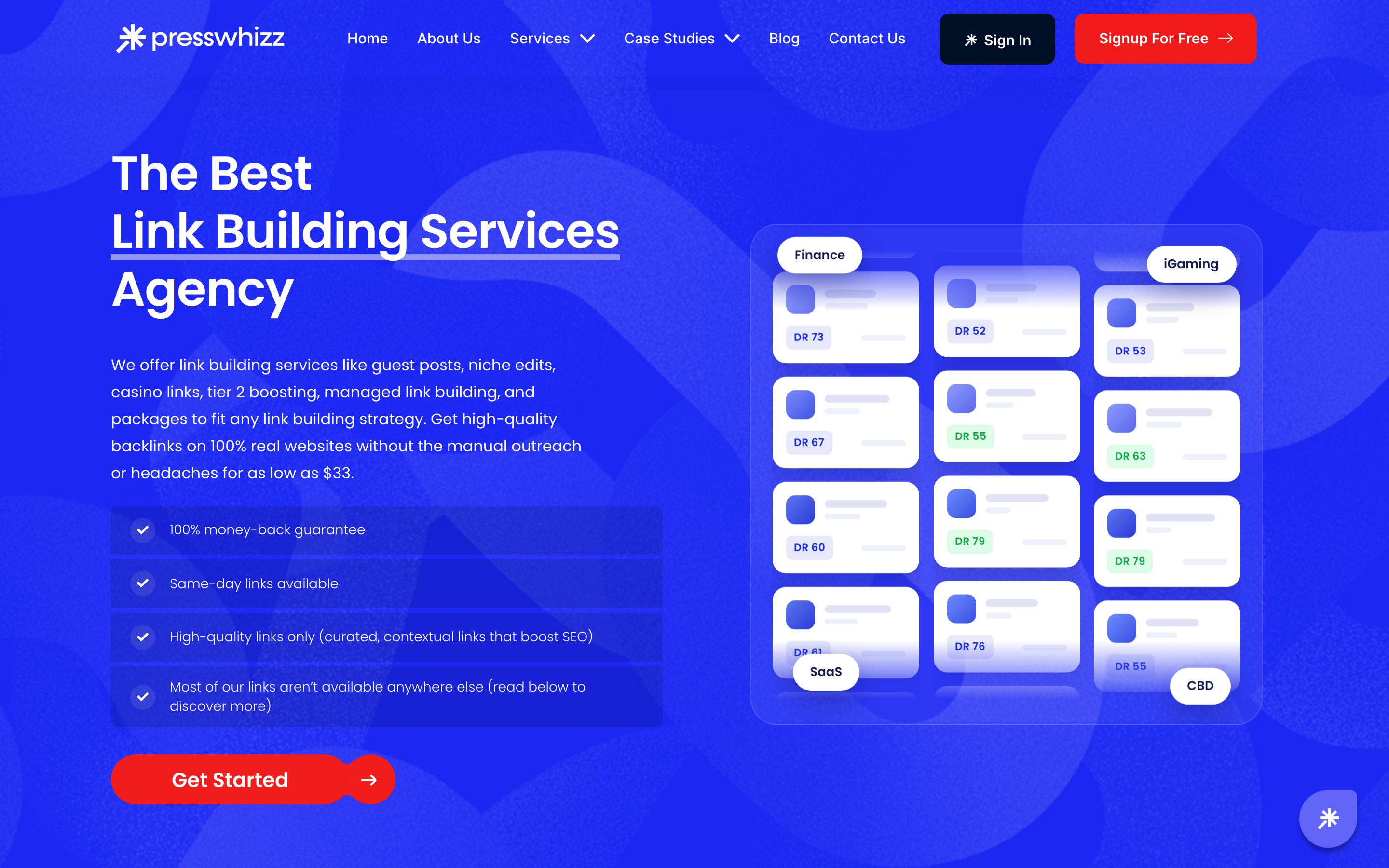
The catalog is a signup wall. There is no public marketplace preview. Prices, site metrics, and inventory are only visible after you create an account, so you cannot compare PressWhizz's rates against another marketplace, or against going direct, before you are inside.
The guarantee lives in marketing copy, not in the terms. The homepage promises that any link taken down within 12 months will be put back or replaced within 7 days. The Terms and Conditions say something different:
The company does not guarantee "the permanence of link placement."
The terms go further:
- Refunds for uncompleted orders go to your wallet balance on the platform, not back to your payment method.
- Completed orders are non-refundable.
- Any delivered order you have not reviewed within 7 days is auto-accepted.
None of that is unusual for the category. But the distance between the promise on the homepage and the document you agree to is exactly what you cannot check from outside the signup wall.
The trust record is thin, verifiably. PressWhizz launched publicly in September 2024 and reached what it calls full-scale operations in January 2025. When I checked in August 2026:
- Its Trustpilot profile, claimed by the company since May 2025, showed zero reviews.
- I found no G2 or Capterra listing.
A young platform is not a guilty platform. It just means you cannot outsource your diligence to other buyers yet.
The inventory policy is broad by design. PressWhizz openly accepts adult, casino, and pharma niches, and takes cards and crypto including Monero. Its own FAQ concedes the limits of its vetting:
Vetted sites "may spam later on" and anchor text and link velocity risks are "not our responsibility."
That honesty is better than the alternative. But it describes a catalog where the vetting burden stays with you.
If you buy anyway, buy the way the platform's own data suggests: mid-priced placements on sites whose traffic you open and check yourself.
But before you buy at all, run the math that every catalog hopes you skip.
The PressWhizz markup: paying double for a link you can get yourself
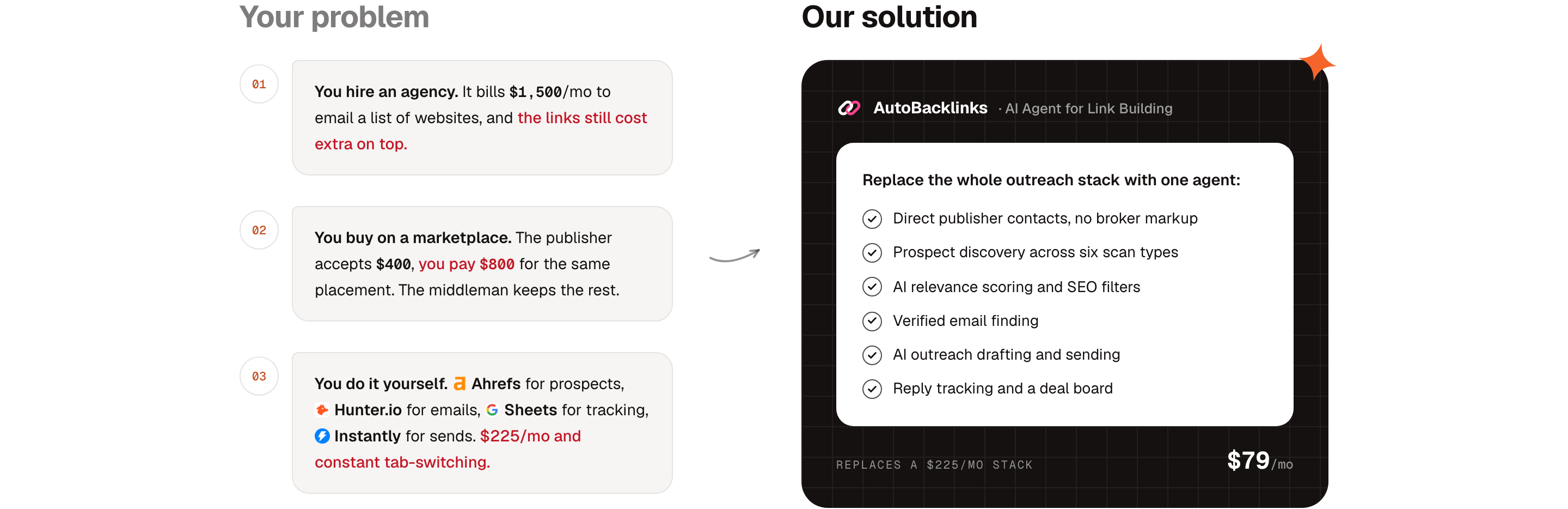
Every marketplace price has two parts: what the publisher actually charges, and what the platform adds for standing in the middle.
PressWhizz's own publisher page offers site owners $30 to $2,000+ per placement and tells them:
"we don't take a cut from what we pay you."
Read that from the buyer's side. The platform's revenue is the distance between the publisher's payout and your checkout price, and the catalog never shows you that distance.
Industry-wide, the distance is not small. BuzzStream analyzed 257,267 sites in a major link marketplace and found the average guest post costs $295 buying as close to direct as the data allowed, and $461 through a vendor (The Cost of Guest Posts, June 2026). That is a 56% premium for the convenience layer.
Now make it concrete:
- Say the placement you want is $300 in a catalog and the publisher's direct rate is $200. Going direct saves $100 on that one link.
- AutoBacklinks Starter costs $79 a month.
- One link, and the agent has covered its own bill with $21 left over. Every link after that is savings.
Buy ten links a quarter at catalog rates and you are handing the middle layer roughly a thousand dollars every quarter for three tasks: finding the site, finding the owner's email, and writing a pitch worth answering.
That labor used to be the honest argument for paying the spread. It took hours per prospect, so the markup was cheaper than your time.
It is not hours anymore. An AI outreach agent runs the discovery, scores each site for relevance, verifies the contact, and drafts a pitch from the prospect's own page; you approve the sends and negotiate the rate. In our published campaign, 187 of those emails brought back 32 replies, a 17.1% reply rate.
The honest counterweight: direct outreach is not same-day.
A marketplace hands you a link inside 24 hours; a pitch takes days to a couple of weeks to turn into a placement, and not every publisher answers. If you need one link this afternoon, the spread is the price of the deadline, and it may be worth paying.
If you buy links every month, you are paying that spread every month, for work software now does. That is the bill the rest of this list exists to cut.
The 6 best PressWhizz alternatives at a glance
| Platform | Best for | Model | Entry price | Network |
|---|---|---|---|---|
| 1. AutoBacklinks | Earning placements instead of buying them | Software (AI agent) | $79/mo | Your own prospect list |
| 2. Collaborator | Verified traffic data on listings | Pay per placement | from ~$2 | 44,258 sites + 3,249 Telegram channels |
| 3. WhitePress | Scale and the longest written guarantee | Pay-as-you-go | after signup | 146,000+ sites |
| 4. Adsy | Seeing metrics before you sign up | Pay per placement | after signup | ~150,000 sites |
| 5. Linkhouse | European and multilingual campaigns | Pay per placement | after signup | 90,165 sites |
| 6. FATJOE | Managed orders at posted prices | Managed service | $83/link | Managed outreach |
1. AutoBacklinks
AutoBacklinks is the one option here that is not a marketplace at all, and that is the point.
It is an AI agent that gets you the same kind of placements PressWhizz sells, guest posts and link insertions, by going to the publisher directly. It finds relevant prospects, scores each one for topical fit, pulls the owner's verified contact, writes page-specific emails and follow-ups, sends them from your mailbox, and tracks replies.
You pay the site's own rate, or nothing when the content earns the link, and the spread from the section above stays in your pocket.
Full disclosure: this is our product, and I will be equally clear about who should not pick it.
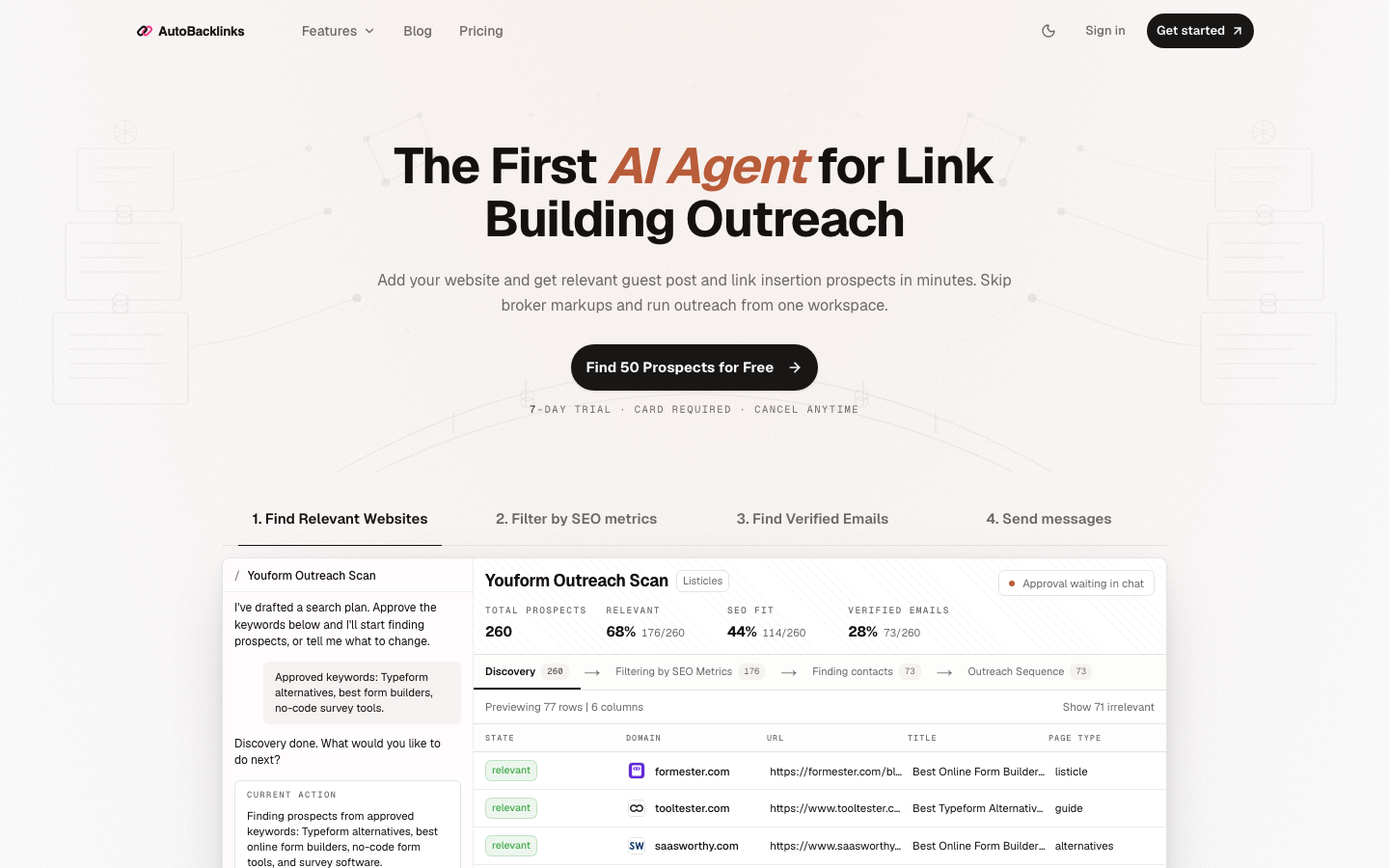
AutoBacklinks features
Best feature vs PressWhizz: there is no middleman in the price.
A marketplace charges the publisher's rate plus the platform's spread, on every link, forever; PressWhizz's own dataset averages $161.25 a placement. The agent pitches the site owner directly, so you pay the publisher's real rate plus a flat $79 a month for the labor.
Save $100 of spread on one link and the month of software is covered. The tenth link costs no more than the first, and the publisher relationship you build is yours to reuse.
Core features:
- AI agent that runs the entire pipeline, from prospecting to sending emails.
- Automated campaigns: set up once and the campaign keeps running.
- Competitor backlink scans that classify each link type and turn the matches into an outreach list.
- One workflow across guest posts, link insertions, resource pages, and general prospects.
- Verified contact lookup that runs after you qualify, not before.
- AI first-touch emails and follow-ups written from each prospect's page, sent from your mailbox (Gmail, Outlook, or SMTP) with warmup.
- Reply tracking plus an opportunities board that moves positive replies from needs-review to published.
- An MCP server so Claude, ChatGPT, Cursor, or any MCP client can run the same campaigns from chat.
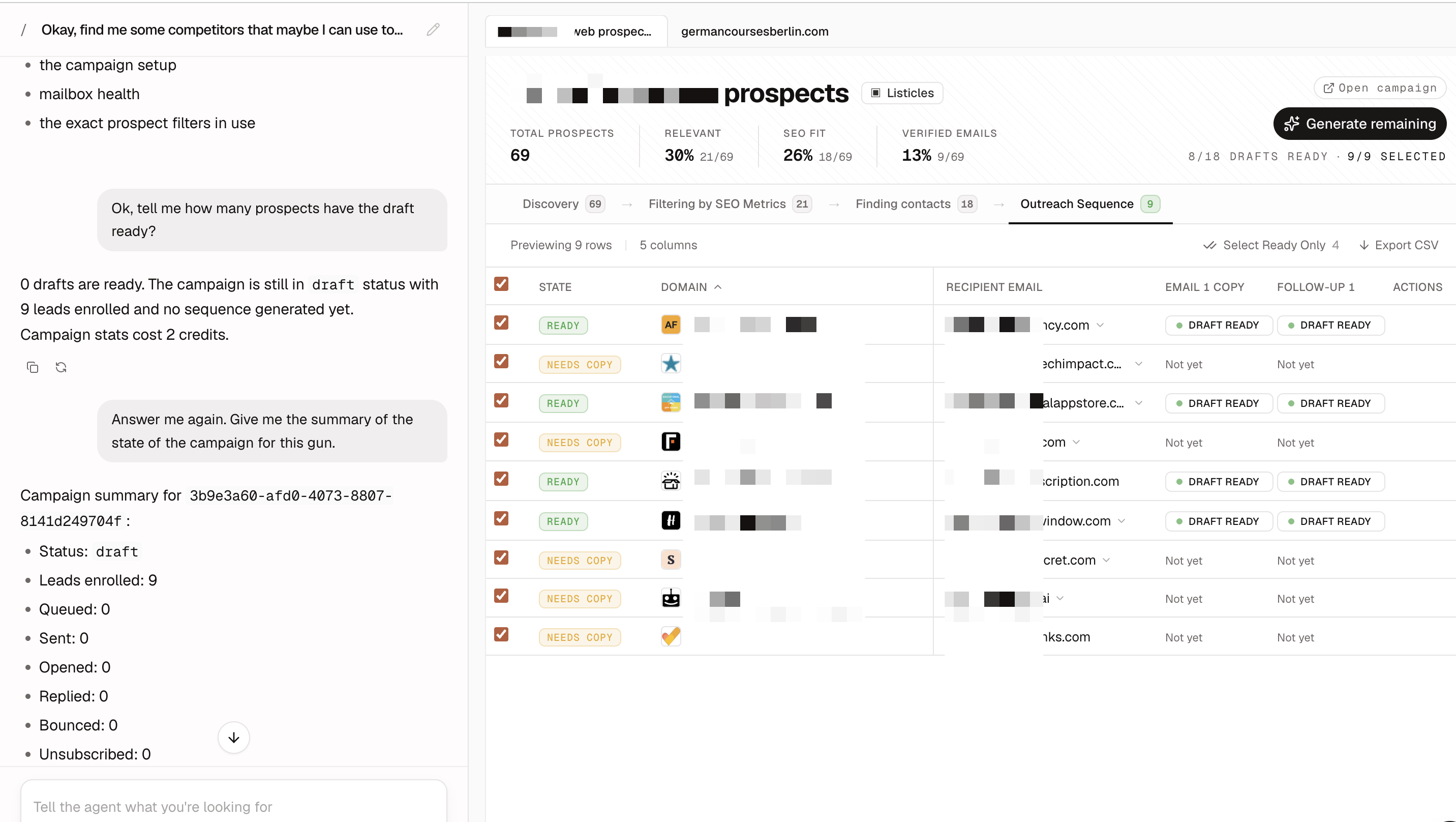
If you would rather watch it than read about it, here is the agent running a real campaign:
| Pros | Cons |
|---|---|
| Direct publisher contact: you pay the site's rate, not a resale | Placements take days to weeks of outreach, not 24 hours |
| Flat $79/mo instead of a per-link spread that repeats forever | |
| Relevance scoring on topical fit, not just DR | |
| You keep the publisher relationships and the contact data | |
| MCP server for Claude, ChatGPT, and Cursor |
AutoBacklinks pricing
| Plan | Price | Credits | Sites |
|---|---|---|---|
| Starter | $79/mo | 2,500 | 2 |
| Growth | $179/mo | 7,500 | 5 |
| Scale | $399/mo | 20,000 | 25 |
Credits are spent per action: 1 for a relevant prospect, 0.5 for SEO metrics on a site, 3 for a verified email. The AI outreach agent runs on a 7-day trial (120 credits, card required), and annual billing adds one month free.
AutoBacklinks vs PressWhizz
The comparison is a spread against a subscription.
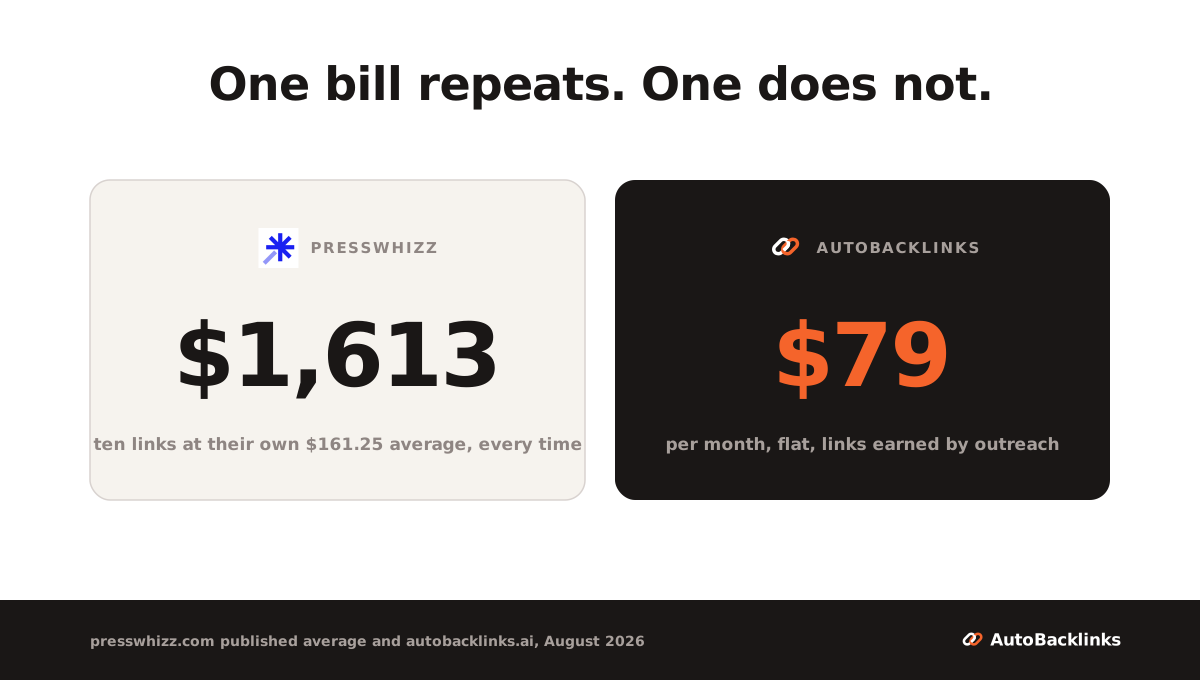
Ten placements at PressWhizz's own $161.25 average cost about $1,613, with the publisher's payout and the platform's cut baked into every price. The next ten cost the same again.
AutoBacklinks Starter is $948 for a full year. Every placement lands at whatever the publisher actually charges, which the industry data above puts roughly a third below vendor prices, and which drops to zero when the pitch and content are good enough to earn the link outright.
The break-even is brutal for the catalog: one link's worth of spread covers a month of software.
In our published campaign, 187 agent-built emails brought 32 replies, a 17.1% reply rate, with every placement earned from a site we chose for relevance.
To be equally clear about the trade: we do not sell, broker, or place paid links, and nothing arrives in 24 hours. If you need a link this week, a marketplace wins the week. If you buy links every month, the spread compounds and the flat fee does not.

2. Collaborator
Collaborator is the direct answer to the verification problem.
Its catalog lists 44,258 websites plus 3,249 Telegram channels, and the numbers that matter are the verified ones: over 8,000 sites expose real Google Analytics audience data and over 7,000 are verified through Google Search Console. The traffic you filter on comes from the publisher's own analytics, not a self-reported score.
No other marketplace on this list matches that.
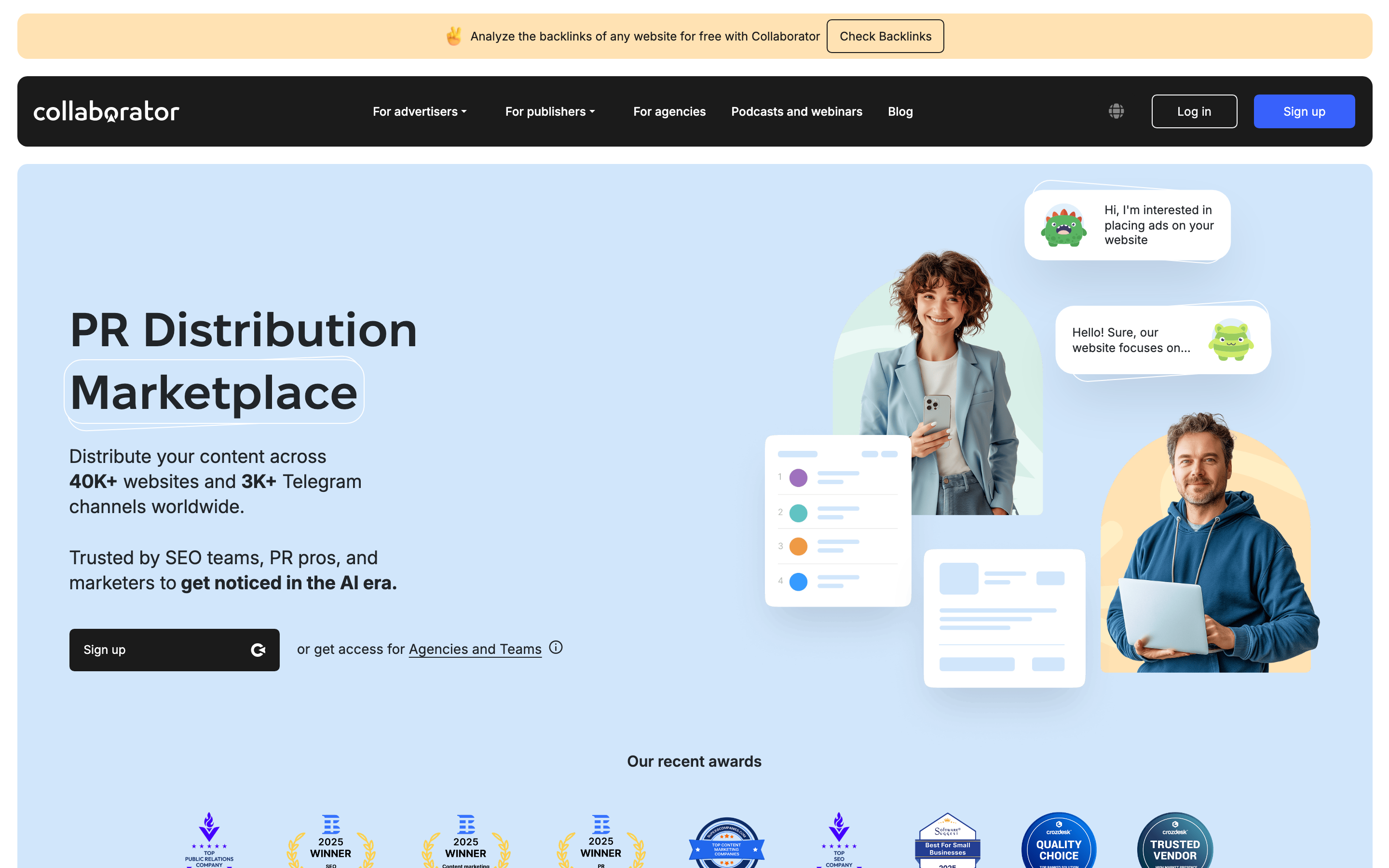
Unlike PressWhizz, the catalog is browsable before signup: you can see listing prices (visible offers start around $2 and climb to the hundreds), metrics, and ratings in the open, with only the exact domain names masked until you register.
The deal mechanics:
- Over 75% of deals finalize within 48 hours.
- Every deal includes free protection from link deletion for 3 months.
- You can extend cover to 12 months, including non-indexing and anchor changes, for 10% of the placement price.
The honest costs: a 10% commission on deposits, 15% on withdrawals, and an inventory that skews toward Eastern Europe.
| Pros | Cons |
|---|---|
| Real GA and Search Console traffic on 8,000+/7,000+ listings | Deposit (10%) and withdrawal (15%) commissions |
| Prices and metrics browsable before signup | Domain names masked until you register |
| Extended 12-month guarantee covers deletion, non-indexing, anchor changes | Extended guarantee costs 10% of the placement price |
| 75%+ of deals finalized within 48 hours | Inventory skews toward Eastern Europe |
Collaborator vs PressWhizz
PressWhizz asks you to trust its AI curation from behind a signup wall. Collaborator shows publisher-verified analytics in an open catalog.
If the reason you are leaving is "I could not check anything before paying," this is the cleanest swap. And the guarantee you pay for is written into the deal rather than living on a homepage.
3. WhitePress
WhitePress is the scale-and-track-record exit.
The platform advertises publications on 146,000+ websites with more than 385,000 offers, built over 12 years and serving a stated 30,000+ customers.
Where PressWhizz's guarantee sits in marketing copy, WhitePress puts a 36-month publication guarantee with daily link monitoring at the center of its offer. Three years of cover is the longest written commitment of any marketplace here.
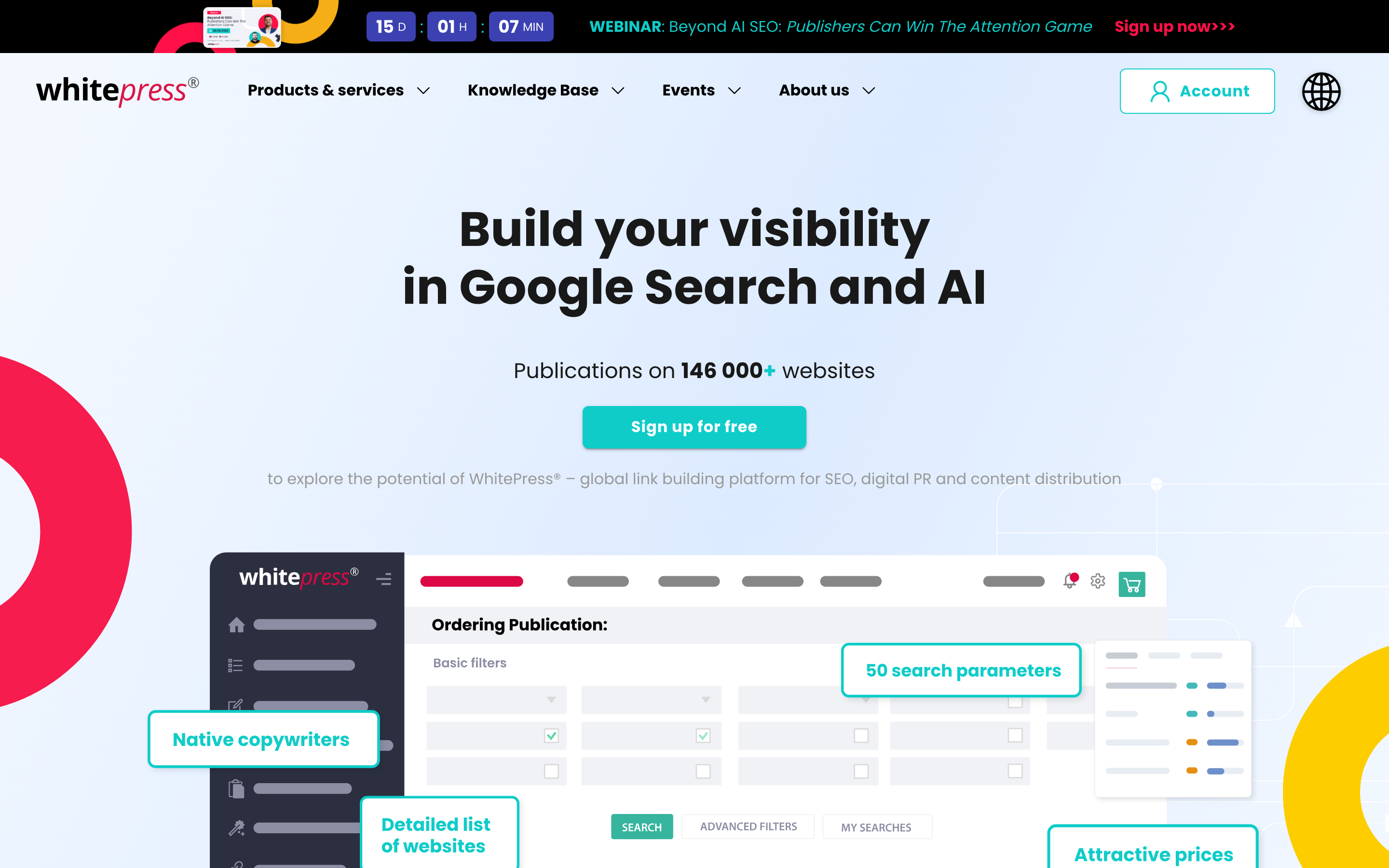
The rest of the package is built for volume: more than 50 search filters, native copywriting in 36 languages, and a pay-as-you-go model with no subscription.
The trade is the same one I flagged in my full marketplace comparison: a network this large inevitably carries a long tail of low-value and resold domains, so the filtering discipline is on you, and prices only appear after a free signup.
| Pros | Cons |
|---|---|
| Largest network here: 146,000+ sites, 385,000+ offers | Long tail of low-value and resold domains |
| 36-month written guarantee with daily link monitoring | Prices and most metrics require a free account |
| Native copywriting in 36 languages | Density can overwhelm first-time buyers |
| 12 years of operating history | Quality vetting is entirely on the buyer |
WhitePress vs PressWhizz
This is 12 years and 146,000 sites against 2 years and 41,000, with a guarantee that is three times longer and actually written into the offer.
PressWhizz is cheaper at the floor and faster on delivery. WhitePress is the platform you pick when the campaign spans markets and the links need to survive for years.
4. Adsy
Adsy answers the signup-wall complaint at the beginner end.
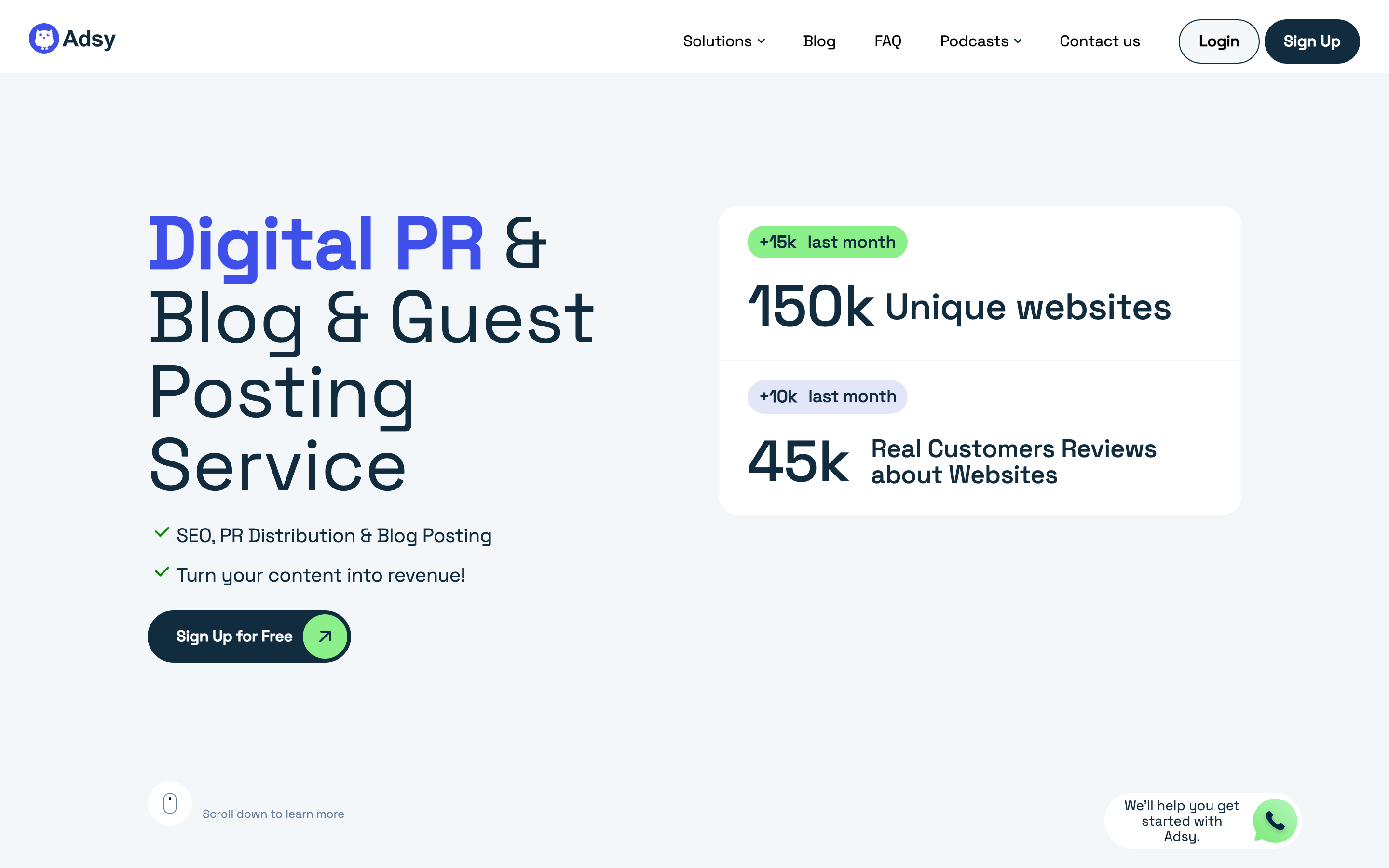
It claims around 150,000 unique websites, growing by a stated 15,000 last month, and its sample listings show Moz DA, Ahrefs DR, Ahrefs organic traffic, SimilarWeb traffic, and Semrush Authority Score before you create an account.
It also surfaces 45,000+ customer reviews about the listed sites, which is the kind of buyer-side signal PressWhizz's catalog does not have yet.
Two caveats keep this honest:
- The metrics are third-party estimates, not the verified analytics Collaborator shows, so a high DA can still hide thin real traffic.
- Adsy's FAQ states plainly that all purchases are final and non-refundable, which makes the pre-purchase check matter more, not less.
Exact placement prices still require a free signup.
| Pros | Cons |
|---|---|
| Publisher metrics (Moz, Ahrefs, SimilarWeb, Semrush) visible before signup | Metrics are third-party estimates, not verified analytics |
| ~150,000 sites with post-publication link monitoring | Purchases are final and non-refundable |
| 45,000+ customer reviews about listed sites | Exact prices still require a free account |
| Guest posts, link insertions, and digital PR in one place | Less depth for advanced, multi-market buyers |
Adsy vs PressWhizz
Both are self-serve catalogs at similar price points. The difference is what you see first: Adsy shows its metrics and its site reviews on the open page, PressWhizz shows a signup form.
For a first-time buyer deciding whether marketplace links are worth it at all, being able to browse real numbers before paying is the whole game.
5. Linkhouse
Linkhouse is the established-operator exit.
Founded in 2014, its marketplace now counts 90,165 websites with around 9,700 publications a month, and it integrates metrics from Surfer, Ahrefs, Semrush, and Majestic.
Where PressWhizz leans on AI curation, Linkhouse leans on campaign tooling: its Link Planner builds a campaign plan from a few inputs (including modes driven by your Search Console data or your competitors), and its Backlink Gap surfaces where rivals have links you do not.
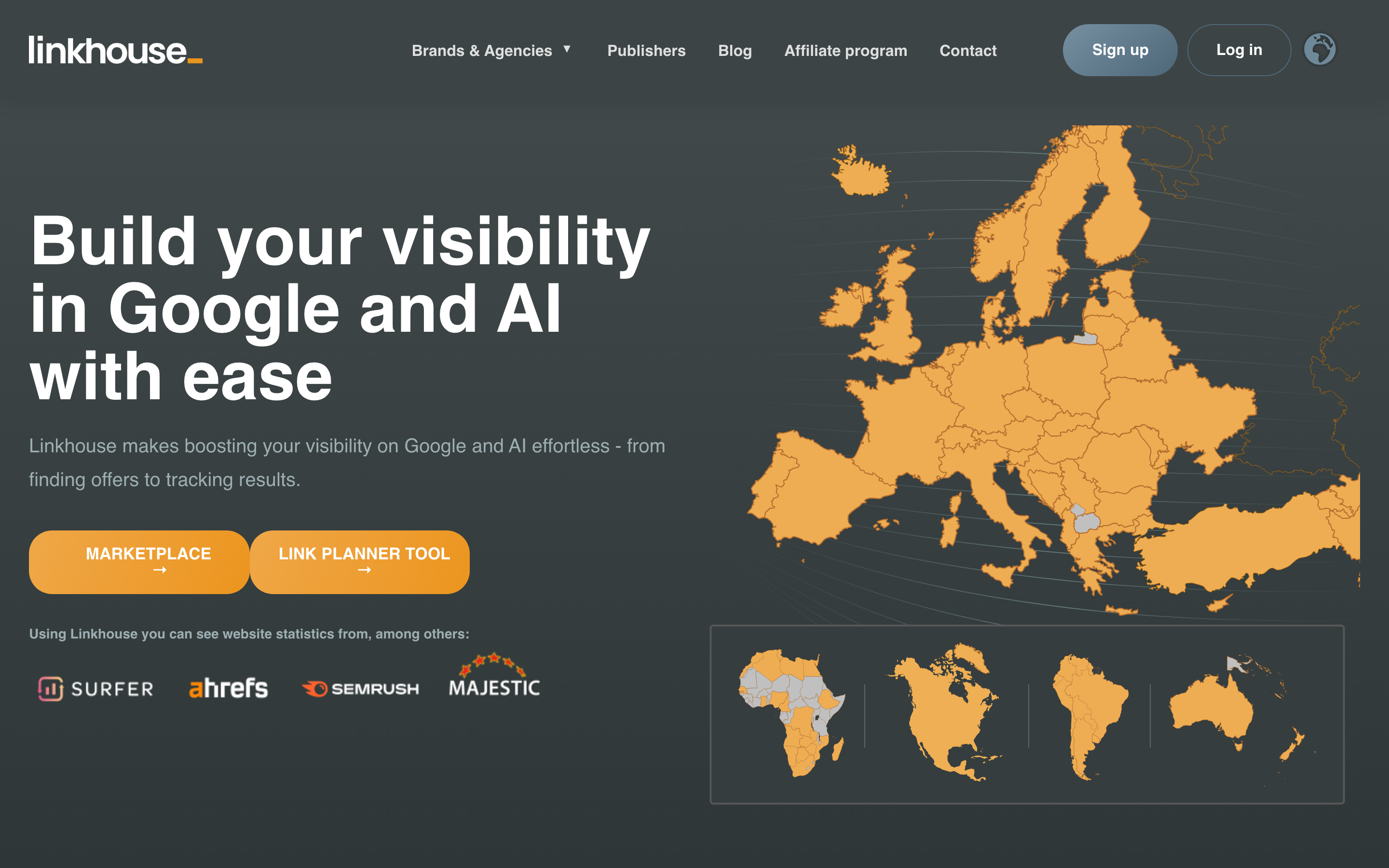
The catalog is deepest in Europe and multilingual work, which is exactly where PressWhizz's US-and-English-leaning inventory thins out.
The familiar trade-off applies: no public prices, so you sign up free to see offers, and as with every large network, listings resold across platforms mean relevance vetting stays your job.
| Pros | Cons |
|---|---|
| Established since 2014, 90,165 sites and growing | Prices and inventory appear only after signup |
| Link Planner and Backlink Gap make it a campaign tool, not just a catalog | Some listings resold across other platforms |
| Surfer, Ahrefs, Semrush, and Majestic data integrated | Interface depth has a learning curve |
| Deepest European and multilingual coverage here | Less useful for one-off English placements |
Linkhouse vs PressWhizz
A decade of operating history against a platform in its second year, and planning tools against a filtered list.
If your campaigns cross European languages and markets, Linkhouse's catalog is simply built for it in a way a US-leaning marketplace is not.
6. FATJOE
FATJOE is the hands-off exit, and the one whose prices you can read without an account.
It is not a browse-it-yourself marketplace but a managed, white-label service: 256,745 orders delivered since 2012 and 40,000+ agency accounts. Blogger outreach is priced publicly by Domain Rating tier:
- $83 at DR10+
- $111 at DR20+
- $139 at DR30+
- $250 at DR40+
- $389 at DR50+
- $528 at DR60+
Each tier has a monthly-traffic floor and content included. Every placement carries a lifetime link guarantee and a money-back guarantee.
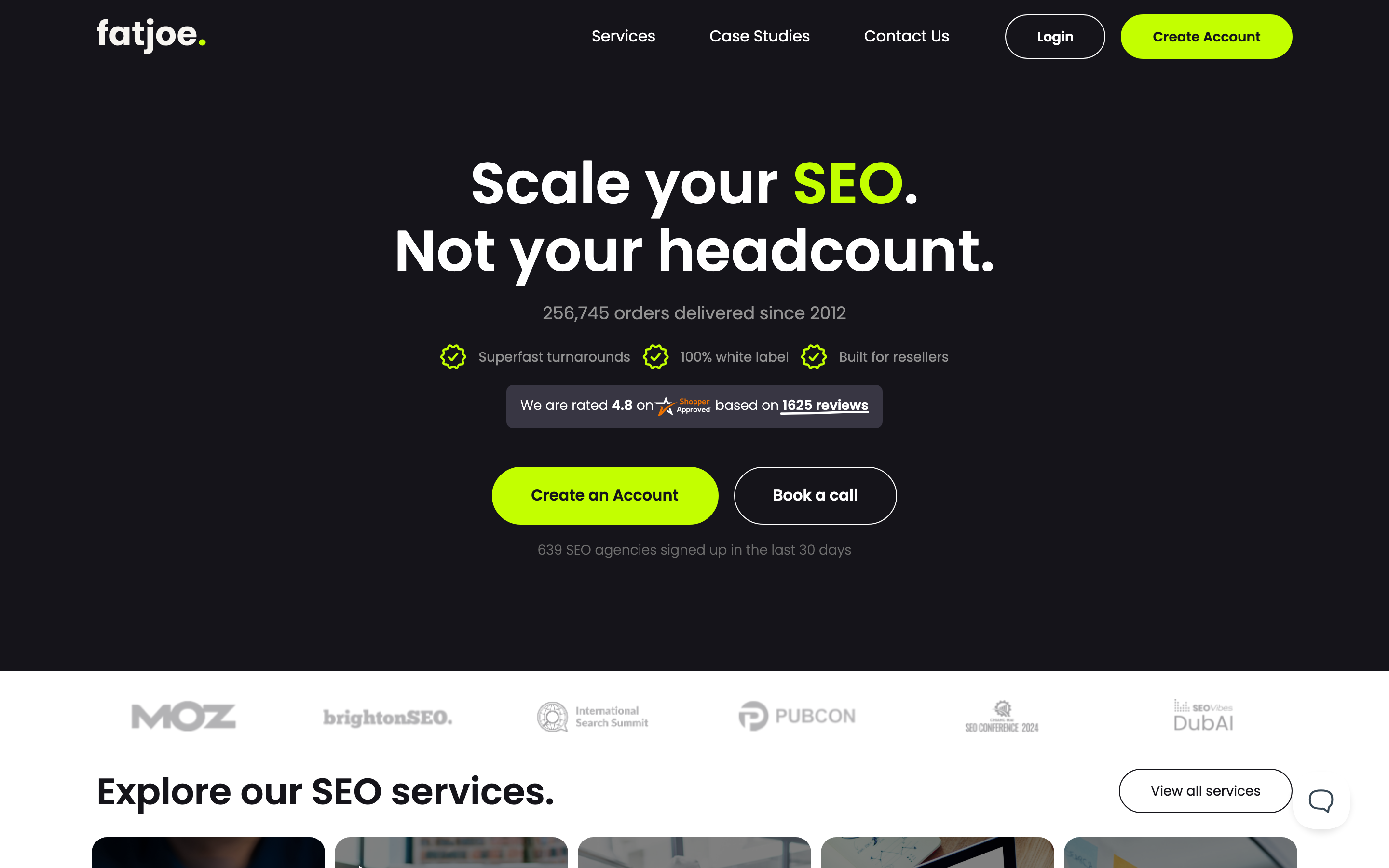
Note that FATJOE's prices moved up across the board this year: the DR10+ tier was $72 and the DR60+ tier $456 as recently as July 2026, so budget from the current table, not from memory.
The structural trade-off is control: you buy a DR band, not a specific site, and delivery starts around 14 days rather than 24 hours.
| Pros | Cons |
|---|---|
| Fully managed: zero browsing, vetting, or outreach on your side | You don't choose the exact publisher |
| Public per-DR pricing ($83–$528), content included | Same price whether the site is strong or filler |
| Lifetime link guarantee and money-back guarantee | Delivery from ~14 days, far slower than PressWhizz |
| 4.8 from 1,625 reviews, operating since 2012 | Managed model costs more than raw self-serve floors |
FATJOE vs PressWhizz
PressWhizz gives you a filtered catalog and a fast checkout. FATJOE takes the whole job and hands back a report.
You give up site-level choice and same-day speed. In exchange you get posted prices, a fourteen-year track record, and a public review footprint (a 4.8 from 1,625 reviews) that you can actually weigh before spending.
I priced FATJOE against its own rivals, tier by tier, in the best FATJOE alternatives.
The Google risk every link marketplace shares
Whichever catalog you pick, you are buying placements. Google's link spam policy treats buying links for ranking as a link scheme unless they carry a rel="sponsored" or rel="nofollow" tag, which paid placements rarely do.
That risk does not disappear because the platform is bigger or older. It compounds at the cheap, recycled end of every catalog.
I walked through the full risk picture, and the markup economics of the whole category, in my guest post and link building marketplaces comparison, and the buy-versus-build math in outsource link building.
The short version: the markup math from earlier does not change with the logo on the catalog, and the same publishers mostly accept direct pitches. Earning the placement through your own outreach skips both the spread and the shared-catalog footprint, and the relationship survives for the next link.
How to choose a PressWhizz alternative
Start from your exit, not from a feature grid:
- "I could not verify anything before paying." Collaborator, for publisher-verified GA and Search Console data in a browsable catalog.
- "I want metrics on the open page and a gentle start." Adsy, with third-party metrics and site reviews visible before signup.
- "I need scale, languages, and a guarantee in writing." WhitePress, 146,000+ sites and 36 months of daily-monitored cover.
- "My campaigns live in Europe." Linkhouse, twelve years in and 90,165 sites deep.
- "Just handle it, at a price I can read." FATJOE, managed placements from $83 with a lifetime guarantee.
- "I am done paying the spread." AutoBacklinks: the AI agent contacts publishers directly for $79/mo, you pay their real rate, and one link's worth of markup covers the month.
- "None of these: I need cheap links today." Then PressWhizz's floor prices and 24-hour delivery are the honest fit. Go in knowing the terms you buy under, and check every site's real traffic yourself.
A few other names you will run into while comparing:
- Bazoom: 80,000+ media outlets, prices after signup.
- Linksman: a smaller catalog of about 9,000 vetted sites with visible pricing, guest posts $150–$350.
- Specialist shops like INSERT.LINK and RhinoRank for link insertions and curated links.
None of them changes the calculus above: every marketplace is a convenience layer over publishers you can usually reach yourself.
That is the real decision. Marketplaces sell speed at a per-link price that never amortizes. Outreach costs time and pays back a pipeline: relevant prospects, your competitors' best links turned into your list, and reply rates that come from relevance, not volume.
Our own numbers are the proof I can offer: 187 emails, 32 replies, 17.1%, published in full.
Want the placements without the per-link bill? Start a free trial of AutoBacklinks and let the agent run your first campaign end to end.
FAQ
What is PressWhizz?
PressWhizz is an AI-powered link building marketplace launched publicly in September 2024, listing 41,000+ curated websites across 90+ countries. You buy guest posts, niche edits, and tier-2 links as one-time purchases, with no subscription. Inventory, metrics, and prices are only visible after creating a free account.
How much does PressWhizz cost?
Posted floor prices start at $31 for guest posts and $33 for niche edits, with iGaming links from $200 and managed link building from $5,000 a month. The platform's own pricing report across 22,703 placements puts the median link at $112 and the average at $161.25, with casino placements averaging $252.
Is PressWhizz legit?
PressWhizz is a real company (PressWhizz Media LLC) with real placements and published aggregate pricing data. It is also young: full operations began in January 2025, its Trustpilot profile showed zero reviews as of August 2026, and its homepage replacement guarantee is not mirrored in its Terms, which disclaim link permanence and route refunds to a platform wallet. Treat it as usable but verify each placement yourself.
What is the best PressWhizz alternative?
It depends on your exit. For verifiable data, Collaborator, which shows publishers' real Google Analytics and Search Console traffic. For scale and a written 36-month guarantee, WhitePress. For visible metrics before signup, Adsy. For managed placements at posted prices, FATJOE. For earning links instead of buying them, AutoBacklinks runs outreach for a flat $79/mo.
Does PressWhizz have a subscription?
No. PressWhizz sells everything as one-time fees and states it does not do subscription links. Note the refund mechanics in its Terms: refunds for uncompleted orders go to your wallet balance on the platform, completed orders are non-refundable, and delivered orders auto-accept after a 7-day review window.
Are marketplace links safe for SEO?
They carry risk on every platform, not just PressWhizz. Google's link spam policy treats buying links for ranking as a link scheme and expects paid links to be tagged sponsored or nofollow, which marketplace placements rarely are. Relevant sites with real traffic are lower risk; cheap, recycled, sponsored-heavy inventory is where penalties and wasted budget live.
Is it worth paying double for a marketplace link?
Only when the deadline is the point. A marketplace delivers in about a day and charges the publisher's rate plus the platform's spread; if a $300 catalog placement costs $200 direct, one direct link saves more than a month of outreach software. Pay the spread when you need a link this week; skip it when you buy links every month.
What is the cheapest way to get the links PressWhizz sells?
Most publishers in marketplace catalogs accept direct pitches, often at their own rate. BuzzStream's 2026 data puts the vendor markup near 56% ($461 versus $295 per guest post). Earning placements through your own outreach costs time instead: outreach software like AutoBacklinks runs the prospecting, contacts, and drafting for a flat monthly price.
About Rachid Idali
Founder & SEO Strategist
Rachid Idali has spent 10 years in SEO, running multi-six-figure SEO and link-building budgets across content, digital PR, and outreach programs. He writes about practical systems for finding relevant prospects, earning links, and turning SEO operations into repeatable pipelines.
More from Rachid Idali