

Buying Backlinks in 2026: Marketplace, Agency, or Direct?

by Rachid Idali
Last Updated: August 24, 2026
A bought backlink costs anywhere from $6 to $1,500 or more in 2026.
But the market runs on one rule the guides rarely state: the site owner's price is the floor, and every middleman adds a layer on top. Site owners ask $295 on average for a guest post. The same sites average $461 through a marketplace vendor, a 56 percent markup. Agency rate cards run $83 to $528 per placement by authority tier, and retainers land at $300 to $1,000 per link.
Three doors, one site owner, and a price that grows with every hand the deal passes through.
This piece prices all three doors from primary data. And it treats the third door honestly, because it is the one the middlemen would rather you skip: dealing with site owners directly is not just the cheapest way to buy a link. It is the only door where a good pitch can drop the price to zero.
I have run link-building budgets for ten years and now build outreach software. I have bought from the marketplaces, hired the agencies, and negotiated with site owners directly.
And when I read the popular guides on buying links, I see two kinds of pages: sellers pricing their own door and nobody else's, and guides recycling a cost figure that was collected in 2018. Neither tells you what you actually want to know, which is what the same link costs on each road, and who takes a cut along the way.
Where to buy backlinks: marketplace, agency, or direct
Every paid link deal reduces to the same transaction: a site owner accepts money, your link goes live on their page.
What you are choosing between is how many middlemen sit between you and that site owner, and what each layer charges for its convenience.
| Marketplace | Agency | Direct with the owner | |
|---|---|---|---|
| Typical cost per link | $461 average asked: the owner's price plus the platform spread | $83–$528 rate cards, $300–$1,000 on retainers | $0 (earned) to ~$295 (paid): the owner's own price, the floor |
| Speed | Hours to days | 2–4 weeks | Days to weeks |
| Who finds the site | You, from a catalog | The agency | You, with an agent pre-scoring |
| Relationship after the deal | None | The agency keeps it | Yours |
| Google policy status | Paid link | Paid link (usually) | Depends on the deal: earned links are compliant |
| Best for | A link this week | Hands-off budgets | Anyone building links every month |
The prices in that table are not guesses, and they are not the numbers you will find in most ranking guides. So before walking through each door, it is worth being precise about where the real figures come from, because this market runs on recycled statistics.
How much do backlinks cost in 2026?
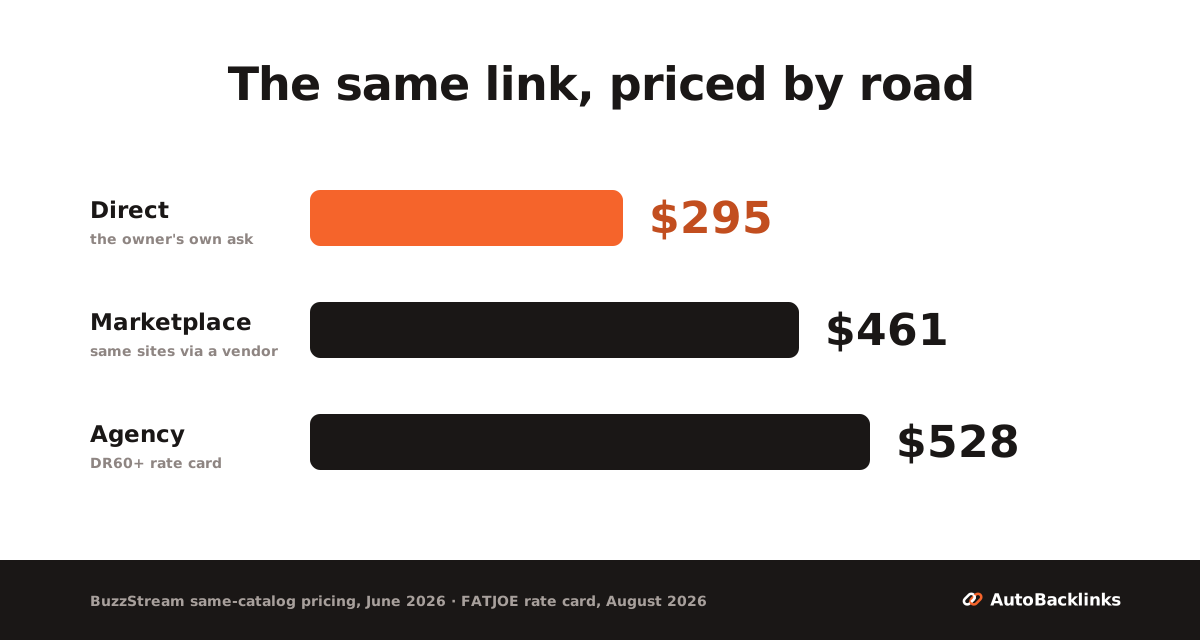
Here is what the current primary data says a link costs:
| What you are buying | Price | Source |
|---|---|---|
| Guest post, direct with the site owner | $295 average | BuzzStream, 257,267 sites, June 2026 |
| Guest post, the same sites through a vendor | $461 average (+56%) | Same study |
| Agency placement, by DR tier | $83–$528 | FATJOE and Stan Ventures rate cards, August 2026 |
| Agency retainer, effective per link | $300–$1,000 | Published retainer math |
| Link insertion (also sold as a niche edit) | $179 average | BuzzStream, 421,259 sites, August 2026 |
| Budget-marketplace order (cheaper inventory) | $112 median, $161 average | PressWhizz pricing report, 22,703 orders, July 2026 |
| Digital-PR-grade placement | $500–$2,000 | uSERP survey of 800 SEOs, 2025 |
| Bulk gigs (not placements) | from $6 | Legiit and Fiverr, August 2026 |
The insertion row is the one worth reading twice, because that market is thinner than its price suggests: only 143 sites in BuzzStream's whole database are both high quality and willing to sell one. I broke that down in how link insertions and niche edits actually work.
So when a marketplace number looks cheaper than the direct average, you are looking at cheaper inventory, not a cheaper road. PressWhizz's own report shows sites with 100,000+ monthly visits selling for about three times the price of sub-1,000-visit sites. A $112 median means the median catalog site is small and low-traffic. It does not mean the marketplace beats the owner's price for the same site.
Three details behind the table are worth keeping:
- PressWhizz's July 2026 pricing report covers $3.66M in completed orders: guest posts averaged $164, insertions $112, and pay-to-play niches ran hotter, with casino placements at $252 and finance at $221.
- BuzzStream's guest post study (The Cost of Guest Posts, June 2026) is the source of the 56 percent vendor premium that runs through this whole piece: $295 buying direct against $461 through a vendor.
- BuzzStream's insertion study (Link Insertion Costs, August 2026) found that only 14.9 percent of sites offer insertions at all, and that just 143 sites in its entire 421,259-site database, 0.34 percent, are both genuinely high quality and selling one.
The low-authority and digital-PR bands come from uSERP's State of Backlinks survey of 800 SEOs (2025).
And here are the numbers you will keep meeting that deserve a skeptical read:
- "The average backlink costs $361.44." That figure comes from an Ahrefs outreach experiment published in 2018. The article has been updated since, so the number keeps circulating as if it were current. It is eight years old, collected before the marketplace boom reshaped both the inventory and the prices.
- "$180 to $380 per editorial link, per Authority Hacker's 2025 survey." No such survey exists. The verifiable Authority Hacker survey is from November 2022 (755 link builders), and its headline finding was an average paid-link price of $83, with 74.3 percent of link builders admitting they pay for links. The "2025" version circulating through vendor blogs is a citation ghost.
- "$508.95 per quality link." Real figure, wrong meaning: it is what surveyed SEOs said they would consider acceptable to pay for one high-quality link (Editorial.link, Link Building Pricing, 2026). Willingness to pay is not a transaction price.
The spread between $83, $112, $295, and $461 is not sources disagreeing. It is different questions being answered: what all paid links average, what budget-marketplace buyers paid for budget inventory, what site owners ask directly, and what vendors charge for those same sites.
Only the last two compare like for like, and that pair is the one that matters: same catalog, $295 direct against $461 resold. Every other comparison across those numbers is really a comparison of site quality, because a link's price tracks its DR and traffic before anything else.
Now, the doors.
Option 1: Buying backlinks from a marketplace
A link marketplace is a catalog: thousands of sites with sticker prices, filters for DR and traffic, checkout in minutes.
Collaborator lists 44,260 sites with sample guest posts at $40 to $91. Adsy advertises placements from $14. PressWhizz, WhitePress, and Linkhouse run catalogs from 41,000 to 146,000 sites.
Those entry prices describe the inventory, not the road: a $14 listing is a small, low-traffic site selling cheap, and for any given site the catalog price sits above what the owner takes. That gap is the business model. I compared eleven of them in the guest post and link building marketplaces breakdown, so here I will keep to what buying from one means.
What you are paying for is speed and a menu. No outreach, no waiting for replies, no negotiation. If you need a link this week, a marketplace wins the week. That is a real advantage and I will not pretend otherwise.
What you are paying, structurally, is a resale spread. Every price on a marketplace is a resale: the publisher accepts one number, you pay a bigger one, and the spread in between is the platform's revenue. BuzzStream's data puts the average distance at $295 direct versus $461 through a vendor. The marketplace is not cheating you; it is charging you for skipping the work. But you should know the markup exists, because at ten links a month it compounds into real money.
Three risks compound at the cheap end of every catalog:
- Recycled inventory. The sites are in the catalog because they sell links. Your competitors filter the same catalog, buy from the same sites, and leave the same footprint.
- Self-reported metrics. Most listings carry DR and traffic numbers the platform or publisher supplies. The good marketplaces verify some of it; most verify none.
- The bulk-gig floor is a different product. Legiit's backlink category lists 722 services from $6, and Fiverr lists 15,000+ guest posting gigs from about $5. At that price you are buying automated Web 2.0 pages, PBN posts, profile links, and blast software output. That is not a cheaper version of a $295 placement. It is bulk spam wearing the same word. And the label is mutating faster than the inventory: the same gig marketplaces now sell "AI visibility" and "AEO backlink" packages at $99 to $101, built from the same bulk pages. The product did not change. The keyword did.
Option 2: Buying backlinks through a link building agency
The agency door has two pricing models, and they behave differently.
Productized rate cards, priced by authority tier. FATJOE publishes the clearest one, writing included, each tier with a traffic floor:
- $83 at DR10+
- $111 at DR20+
- $139 at DR30+
- $250 at DR40+
- $389 at DR50+
- $528 at DR60+
(Dollar prices as shown in August 2026; FATJOE bills in pounds, so the dollar figures drift with the exchange rate.)
Stan Ventures lists $109 at DA30+, $206 at DA40+, and $248 at DA50+ (list prices; it was running a 30 percent promo when I checked in August 2026). Loganix sells guest posts at $200 and self-serve links from $99. Respona now sells done-for-you placements rather than self-serve software, at $100 to $500 per placement by DR band. Some, like LinkGraph, publish no prices at all and gate everything behind a sales call.
Retainers. Traditional agencies charge $3,000 to $10,000 a month, which works out to roughly $300 to $1,000 per link depending on site quality. I took that model apart line by line in outsource link building, so the short version: the retainer buys management, reporting, and the agency's publisher network, on top of the placement itself.
For the agency door specifically, what a DR 50 placement costs sets ten named services against a single authority band and divides every monthly package back into a price per link.
What the agency door actually adds over a marketplace is labor and judgment: someone else finds the sites, writes the content, does the outreach, and handles the back-and-forth.
What it subtracts is ownership. The publisher relationships belong to the agency, and when you stop paying, the pipeline stops with them. Whether the placements themselves are "earned" or paid varies by agency and is worth asking about directly, because it is your domain carrying the answer.
A rate-card curiosity worth noticing: the guides that tell you to buy links through an agency rarely publish what their own links cost to deliver. The rate cards above are the exception, which is exactly why I am quoting them.
Option 3: Buying backlinks directly from site owners
The third door is the oldest one: find the site, email the owner, talk.
BuzzStream's $295-versus-$461 spread is the argument for it in one number: buying as close to the source as possible strips out the middleman layer, roughly a third of the vendor price.
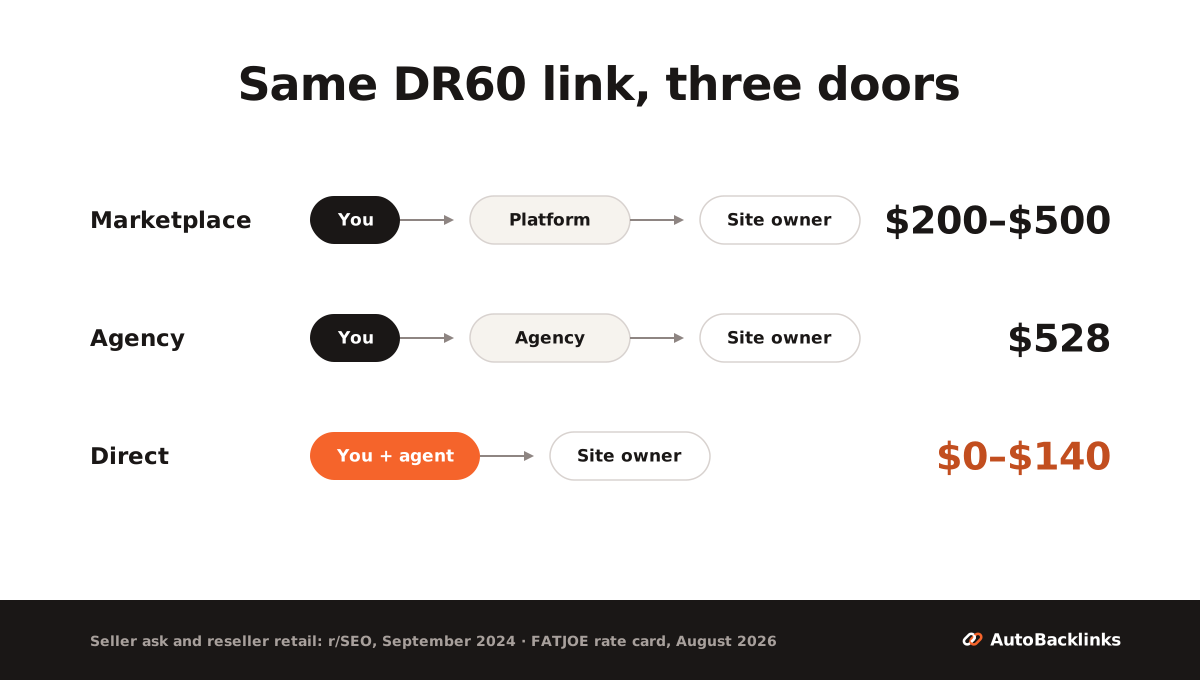
The practitioner market confirms the spread from the other side. In a widely read r/SEO thread from September 2024, a link seller describes charging $90 for DR30–59 placements and $140 for DR60 while resellers moved the same tiers at $200 to $500. Midway through the thread, the seller works out the gap:
"So you're telling me I could be charging $500 plus?"
That is the resale economy describing itself.
Line the DR60 tier up across the doors and the spread stops being abstract:
- The seller in that thread asked $140.
- Resellers moved the same tier at $200 to $500.
- The DR60+ line on FATJOE's rate card reads $528.
One link, one authority band, an almost 4x price range, decided entirely by how many hands the deal passes through.
The catch is that direct is work. You have to find sites worth approaching, check their traffic is real, hunt down a contact, write the email, and follow up. Do it well and you have built the exact machinery of outreach.
And that machinery changes the conversation itself. If you already do the finding, the vetting, and the emailing, the message does not have to open with "how much for a link." It can open with "here is why this fits your page."
Some owners will still quote you the $295. A meaningful share will link because the pitch is genuinely good, and that version costs nothing per link.
That work is also why the middlemen earned their spread in the first place. Before AI, going direct was a full-time job: finding sites, checking metrics one by one, hunting down emails, writing every pitch, chasing every follow-up. Paying an agency made sense because you were buying hours of manual labor, and a marketplace made sense because it skipped the labor entirely.
That assumption broke. An AI outreach agent now runs the manual layer on autopilot, and setting it up takes minutes, not a hire.
Full disclosure: AutoBacklinks is our product, so read the rest of this section knowing that.
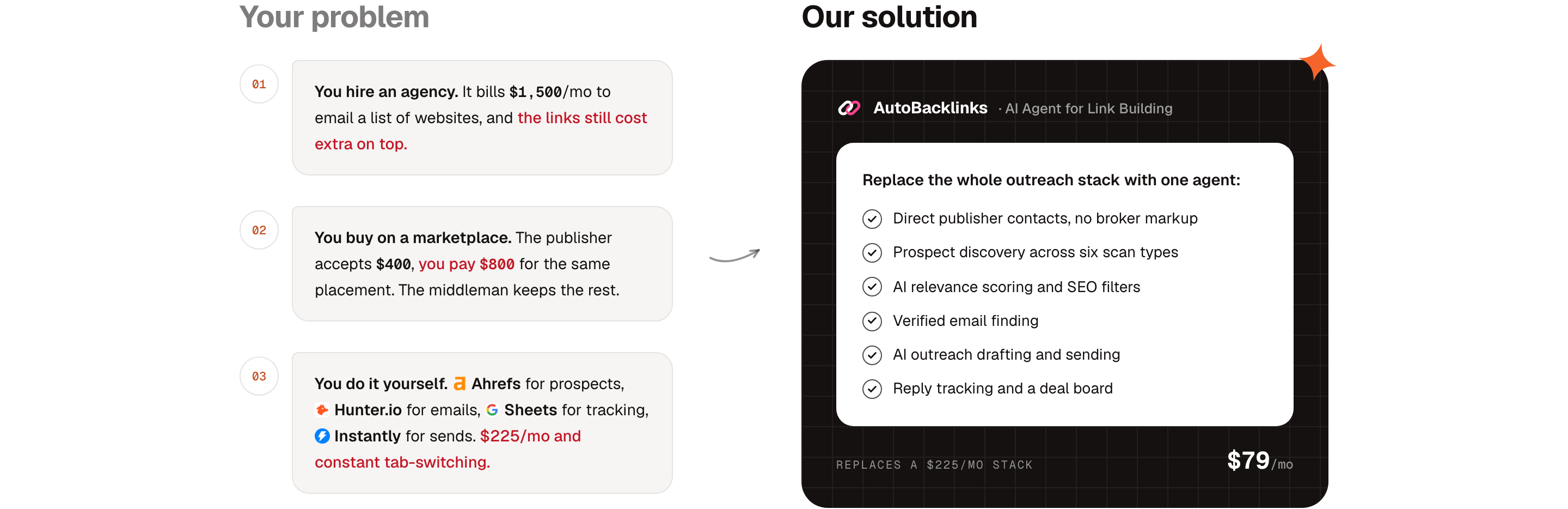
It exists for exactly this road: skip the middlemen and deal with site owners directly. It is not a marketplace and not an agency, so nobody adds a spread on top of the owner's price. The outreach agent runs the whole pipeline:
- Finds relevant prospects from a keyword, a topic, or a competitor's backlink profile, and scores each one for topical fit, not just DR
- Filters them on real SEO metrics (Domain Rating, organic traffic) before you spend anything on contacts
- Looks up and verifies the contact email only for prospects that survive the filter
- Writes the first email and every follow-up from the prospect's own page, not a merge-field template
- Sends through your Gmail, Outlook, or SMTP mailbox, with free warmup included
- Tracks replies and moves each conversation across an opportunities board: Needs Review, Negotiating, Awaiting Content, Published
- Runs from Claude, ChatGPT, or Cursor through the MCP server
Set a campaign to automated and the pipeline stays full on its own: the agent discovers new prospects on schedule, queues the outreach for your approval, and follows up on the conversations you green-light.
You keep the judgment (which sites are worth it, what happens when someone replies); the agent does the grinding. Whether a site owner links because the pitch fits or answers with a price, you are dealing at the source.
Now run the budget against the other two options:
- Ten links a month at the vendor average is $4,610.
- A retainer runs $3,000 to $10,000 a month.
- The agent is $79 a month on Starter (roughly 1,500 emails) or $179 on Growth, plus a few hours of your review time.
So the gap is potentially thousands of dollars a month for the same placements, bought at the owner's price or earned outright.
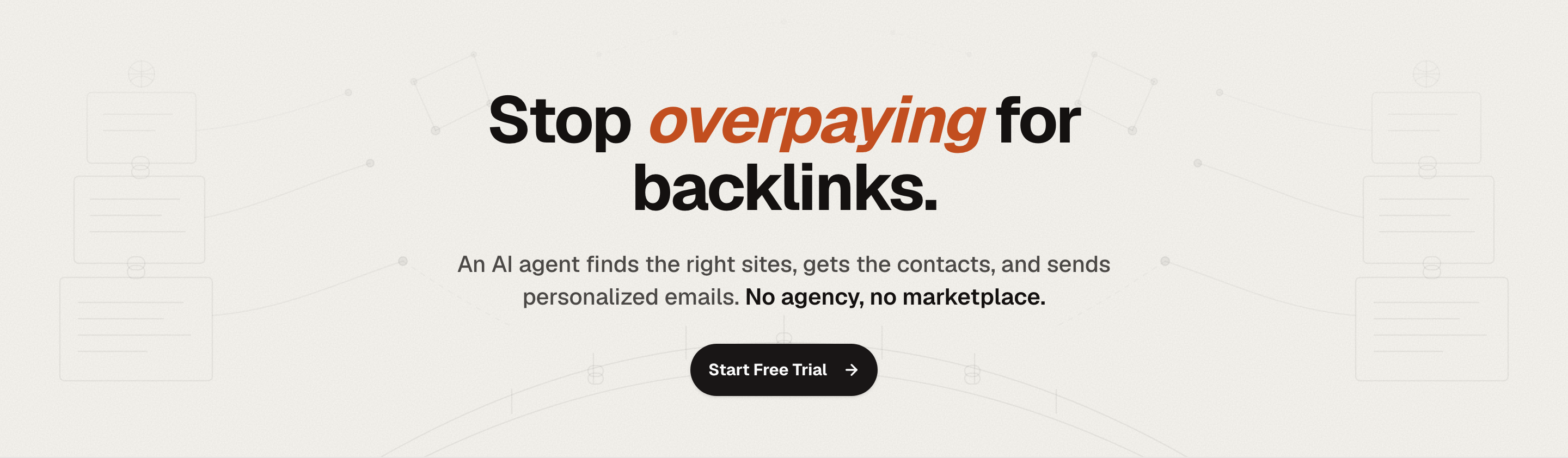
To be equally clear about the trade: direct placements take days to weeks of outreach, not 24 hours from a catalog, and we are a newer product with a smaller public review footprint than the marketplaces above. If you need a link this week, buy it from a catalog. If you build links every month, this is the road the middlemen hope you never price.
You can start a trial and run one campaign for less than the price of one median marketplace link.
Is buying backlinks safe? What Google does in 2026
Here is the part every seller writes vaguely, so I will write it precisely.
Google's link spam policy names "buying or selling links for ranking purposes" as spam, including "exchanging money for links, or posts that contain links." The same policy also says buying and selling links is, in Google's own words:
"a normal part of the economy of the web for advertising and sponsorship purposes."
The line between the two is a single attribute: a paid link is compliant when it carries rel="sponsored" or rel="nofollow", and a violation when it passes ranking credit. The same policy page governs links you trade rather than buy, where the qualifiers Google uses are "excessive" and "exclusively", and what a link exchange is actually allowed to look like turns on those two words. Almost no purchased placement carries the tag, because a followed link is the entire reason buyers pay. Across 141 million live links we counted for the guide to what backlinks are, rel="sponsored" appears on 0.023 percent of them.
What enforcement looks like has changed, and the current shape matters for your decision.
1. The probable failure mode is silence, not a penalty. Since the December 2022 link spam update, Google's stated mechanism is neutralization through SpamBrain: spammy links are ignored and "any credit passed by these unnatural links are lost." Google's spam-update documentation adds that the lost benefit cannot be regained. John Mueller put the practical version plainly in 2023:
"most of those links do nothing; we've spent many years ignoring that kind of thing."
The most likely outcome of a bad link buy is not a penalty notice. It is that you quietly paid $112, or $461, for nothing.
2. Manual actions still exist, on both sides of the transaction. Search Console documents "unnatural links to your site" for buyers and "unnatural links from your site" for sellers. But I could not find a single named, public buyer-side penalty case since 2023, and you should treat that fact honestly: buyer-side enforcement is invisible by design, because devaluation leaves no notice.
3. The enforcement Google actually shipped hit sellers. In May 2024, manual actions under the site reputation abuse policy delisted the coupon sections of CNN, USA Today, and the LA Times: publishers monetizing their authority with third-party content. My read, and I label it as my analysis rather than Google's statement: the risk asymmetry favors the buyer. Your worst realistic case is wasted spend and a devalued profile that needs cleanup; the selling site's worst case is watching a section of its business get deindexed.
4. The value side is drifting down while prices drift up. Google demoted links from "an important factor" to "a factor" in its documentation in March 2024. Gary Illyes said "we need very few links to rank pages" in April 2024 and, in September 2023, that links are not "in the top three" ranking factors. You do not have to take those statements at face value. But paying 2026 prices for a signal Google spent three years talking down deserves at least a pause.
None of this means every bought link is wasted. It means the expected value per paid link has fallen, the price has not, and the seller carrying the catastrophic risk is not you.
Price accordingly.
How to buy backlinks without wasting money
If you decide to buy, the difference between money spent and money wasted is vetting. The checklist I actually use:
- Real organic traffic, trending flat or up. A DR score without traffic is a dead site with good numbers. Check the site in any SEO tool before paying; if the marketplace will not show verified traffic, that is your answer about the marketplace.
- Topical relevance over authority. A DR40 site in your niche beats a DR70 general blog. Relevance is what makes the link plausible to both Google and readers, and it is the factor every practitioner thread ranks first.
- Check the paid-content ratio. Open the site's recent posts. If most of them read like placements, you are buying into a link farm with good metrics, and your link inherits the site's footprint.
- Prefer guest posts over insertions at the cheap end. Of the 421,259 sites in BuzzStream's insertion database, only 143 were both genuinely high quality and selling insertions. A new article at least controls its own context.
- Benchmark every quote against the direct price. The average site owner asks $295 for a guest post. A quote far above that is buying convenience; a quote suspiciously below it is buying inventory nobody wanted.
- Skip the $6 tier entirely. Bulk links are not backlinks at a discount. They are a different product that pattern-matching systems were specifically built to ignore.
- Expect movement in weeks, not days. A placement can go live in hours, but practitioner benchmarks put visible effect at two to eight weeks per placement, and a campaign takes months to read. Whichever door you pick, price in the wait before you judge the spend.
How to get backlinks without paying per link
The two middleman doors share one property: the bill repeats.
Whether a link costs $461 through a vendor or $112 on a budget catalog, it is a per-unit fee that never amortizes, and next month's links cost the same as this month's. Ten links a month at even the budget-catalog median is $1,120 a month, forever, and that is for the small sites.
The direct road is the only one where the per-link price can fall, because the same machinery that negotiates a $295 placement can earn one for nothing when the pitch genuinely fits the page. The free routes are also the better-documented ones: nine backlink methods ranked by what they produce counts 11,971 real referring domains and finds that roundup and resource pages, both of which cost an email, sit second and sixth by yield.
The objection was always that running that machinery is slow, manual work.
That objection is out of date.
We ran a real campaign and published every number: 187 emails sent, 155 opened, 32 replies, 6 bounces. A 17.1 percent reply rate, from a solo operator, and the lever was prospect relevance, not clever copy.
Using the industry's 3.59 percent average reply rate as the floor and ours as the ceiling, an earned link costs somewhere between 23 and 113 emails. I walked through that math in how many backlinks you actually need.
Put those two numbers together and the earned end of Option 3 prices itself: a $79 Starter plan carries roughly 1,500 emails a month, the same budget as a single mid-tier marketplace placement, spent on links you own outright and never pay for again. The agent setup from the direct-deals section above runs this end of the road too; the only difference is that the pitch, not your card, closes the deal.
Buying through a middleman rents someone else's audience by the unit. Going direct builds machinery that keeps producing after the invoice stops.
FAQ
Is buying backlinks a good idea?
Yes, when you want to scale authority fast. Buying backlinks is the quickest way for a new site to build the authority that both Google rankings and AI-engine visibility feed on, and it is far more common than the public conversation admits: 74.3 percent of link builders said they pay for links in the last major industry survey. Most growing companies buy links and say nothing about it, especially early, when the domain has no authority of its own. In some niches it is not even optional: sites there do not link for free, digital PR goes unanswered, and every competitor already buys. The discipline that separates spend from waste is vetting the sites and buying as close to the owner as possible, at prices anchored to the $295 direct benchmark.
How much does a backlink cost in 2026?
Start from the floor: site owners themselves ask $295 on average for a guest post. The same sites average $461 through a marketplace vendor, and agency rate cards run $83 to $528 per placement by DR tier, with retainers at $300 to $1,000 per link. Budget marketplaces show medians near $112, but that reflects cheaper sites with less authority and traffic, not a cheaper way to reach the same site. Digital-PR-grade placements run $500 to $2,000, and anything near $6 is bulk spam, not a placement.
Is buying backlinks against Google's rules?
Buying links that pass ranking credit is against Google's link spam policy. Buying links marked rel="sponsored" or rel="nofollow" is explicitly allowed as normal advertising. In practice most purchased links skip the tag, and Google's main response since 2022 is neutralization: the link is silently ignored and the money is wasted, with manual penalties reserved for larger patterns. The publicly documented enforcement in recent years landed on sites selling placements, not buying them.
Do backlinks still matter in 2026?
Yes, but less than the invoices suggest. Google demoted links from "an important factor" to "a factor" in 2024, and its spokespeople have said very few links are needed to rank. Links still correlate with rankings and AI-search visibility, but the marginal value of one more paid link is lower than it was, which is exactly why overpaying for placements is the wrong place for a small budget.
What is the safest way to buy backlinks?
Buy as close to the site owner as you can, vet the site's real traffic and paid-content ratio before paying, keep anchors natural, and benchmark quotes against the $295 direct average. Safer still is the earned end of the direct road: placements earned through outreach carry no policy risk at all, and with an agent doing the labor they cost a flat software fee instead of a fee per link.
About Rachid Idali
Founder & SEO Strategist
Rachid Idali has spent 10 years in SEO, running multi-six-figure SEO and link-building budgets across content, digital PR, and outreach programs. He writes about practical systems for finding relevant prospects, earning links, and turning SEO operations into repeatable pipelines.
More from Rachid Idali