

Link Insertions (Niche Edits): How to Get Them in 2026

by Rachid Idali
Last Updated: September 10, 2026
In SEO, a niche edit (also called a link insertion) is a backlink added to an article that already exists and already ranks. Curated link, contextual backlink and link placement are three more names for the same thing, sold by vendors who each picked a different word.
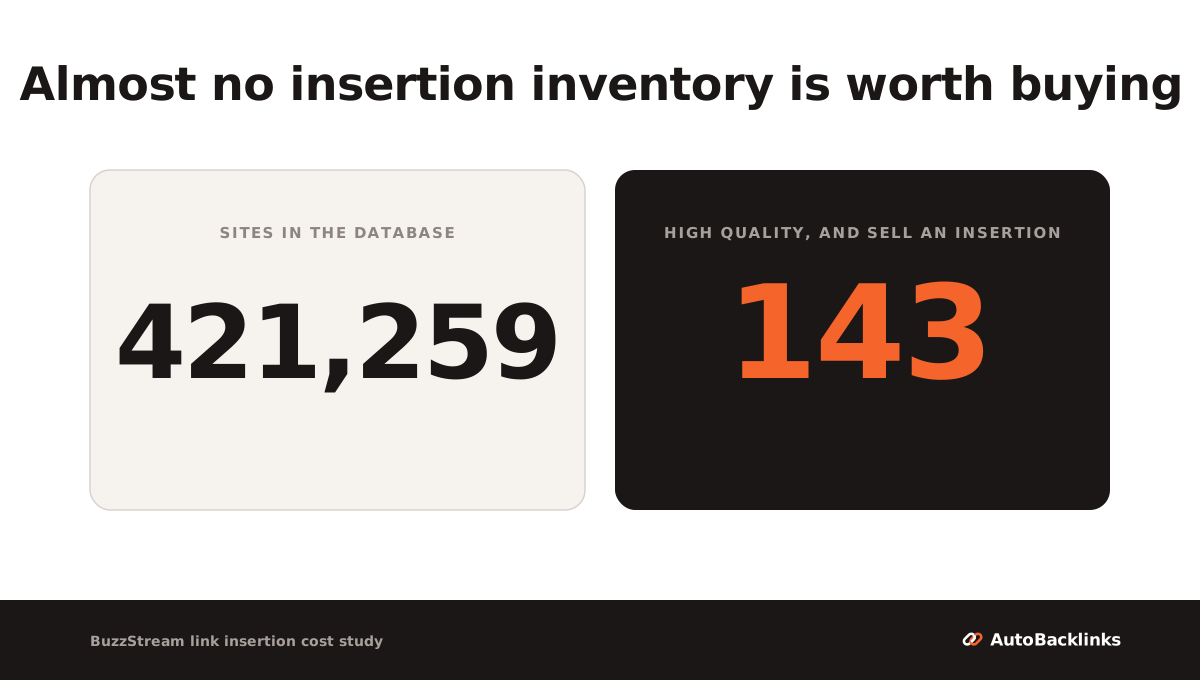
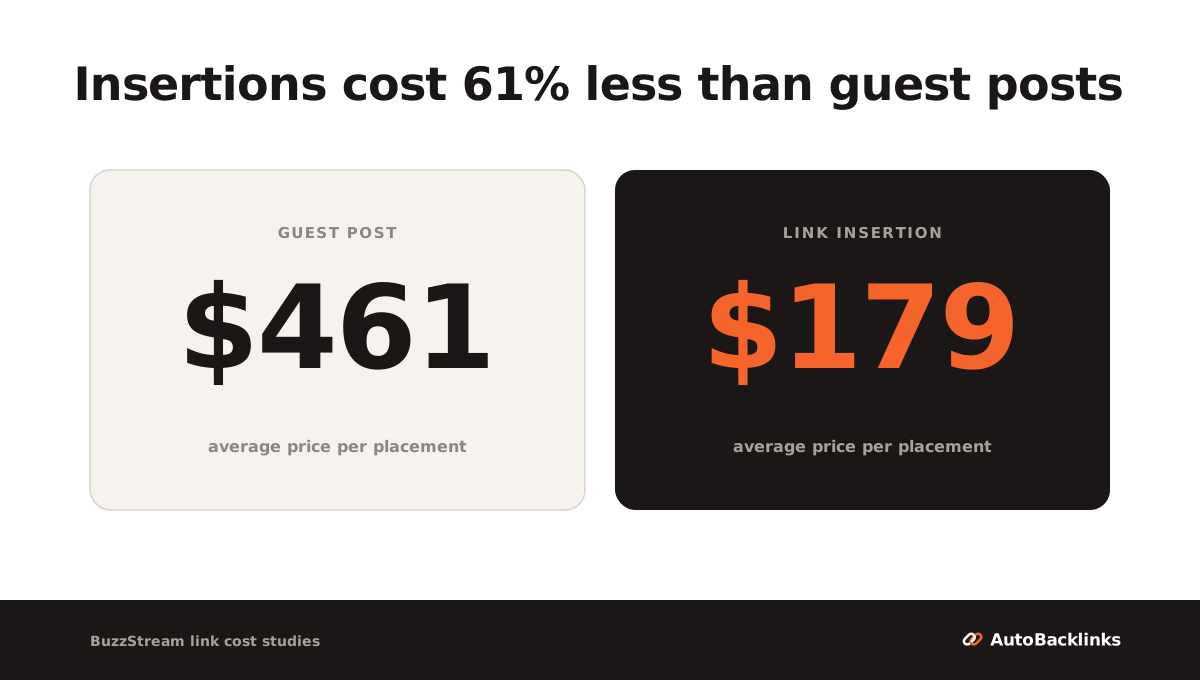
It is the cheapest real link you can buy, and the hardest one to buy well. In BuzzStream's 421,259-site dataset an insertion averages $179 against $461 for a guest post, and yet only 143 sites in that whole database are both genuinely high quality and willing to sell you one.
Most guides answer the price question. That is the easy half. The hard half is reaching the pages worth having, because almost none of them sit in a catalog.
What a link insertion (niche edit) actually is
You find a published article on someone else's site that already covers your topic. You ask the editor to add a link to your page inside a paragraph where it genuinely belongs. That is the whole product.
Nothing new gets written. The host page keeps its existing age, its existing rankings, and its existing backlinks, so your link lands on a page search engines already crawl.
The vocabulary is the only complicated part, so here it is in one place:
- Link insertion: the neutral, descriptive name. Most software and marketplaces use it.
- Niche edit: the same product named after the pitch, an edit to a page in your niche. Most agencies use it.
- Curated link: a marketing name for the same placement, meant to suggest editorial selection.
- Contextual backlink: describes where the link sits, in body copy surrounded by relevant text, rather than in a footer or a sidebar.
- Link placement: the broadest of the five, sometimes used for guest posts too.
Link insertion vs guest post: what the price gap buys
BuzzStream's database of 421,259 sites puts the average link insertion at $179 and the average guest post at $461. Across that database an insertion averages about 61 percent less.
Read those as two averages over two different pools of sites, not one site priced twice. Insertion inventory skews smaller, which flatters the gap.
The gap is labor. A guest post means someone writes 800 to 1,500 words that the host site publishes. An insertion means someone adds one sentence.
There is a second difference that matters more than the money. A new guest post starts at zero: no rankings, no traffic, no crawl history. An aged host page may already rank for terms your buyers search, so a link inside it can be found by both crawlers and readers from day one.
That advantage only exists if the host page really does rank. An insertion into a five-year-old post with no readers is a link on a dead page, and that describes 97.5 percent of the insertions on offer.
How to find link insertion opportunities
There are two reliable methods, and neither one starts with a vendor catalog. There is now a third target list worth building alongside them, the pages assistants quote rather than the pages Google ranks, which I covered separately in AI search niche edits.
Search for pages that already rank and already link out. Take the term your page should rank for and search for the articles that cover it: roundups, listicles, resource pages, and "best X" posts. A page that already links out to five tools has an editor comfortable adding a sixth. A page with no outbound links will not start with yours.
Mine the sites already linking to your competitors. If a page links to a competitor in a sentence your product also answers, it is the single warmest insertion prospect you will find. The topic is proven, the outbound link is proven, and the gap in the page is specific enough to name in one line. A competitor backlink scan turns that into a list in one pass.
Then qualify before you write anything. Check that the host page pulls real organic traffic, that the topic genuinely overlaps yours, and that the outbound links already there look editorial rather than paid. Relevance decides whether they reply. DR only decides how much the yes is worth.
How to get niche edits step by step, with the outreach automated
Nobody takes a cut on this route. You pay for tooling and hours, and the site owner sets the rest. Here is the sequence.
1. Fix the target page and the anchor first. Decide which URL needs the link and what phrase should carry it. Doing this first stops you pitching a page that does not deserve a link yet.
2. Build the prospect list from ranking pages. Search for articles that already rank for your topic and already link out, then scan the pages linking to your competitors. You want live articles, not domains from a catalog.
3. Qualify on relevance before authority. Read enough of the page to know where your link would slot in. If you cannot name the paragraph, the pitch has nothing to say and the editor will feel that.
4. Find a verified contact. The named editor or author beats a generic inbox by a wide margin. Verify the address is deliverable before you send, because bounces cost you sender reputation as well as the placement.
5. Write the pitch from the host page, not from a template. Name the article, name the section, say what your link adds for their reader, and keep it under 120 words. Something like this:
Hi Dana, your piece on switching email providers is the one I keep sending people. In the deliverability section you mention warming a new domain but do not link anywhere for the how. We published a walkthrough with the actual sending schedule we used. If it is useful to your readers, it would slot into that paragraph. Either way, thanks for the article.
More annotated versions are in the pitch examples that actually get replies.
6. Follow up twice, then stop. I stop at two. A third adds little and starts to cost you goodwill.
Steps two through six are the ones software can run for you. That is what AutoBacklinks is built for, through its link insertion outreach: it finds live pages where the link fits, verifies the contact, drafts each pitch from the target page rather than a merge field, sends, and tracks replies in one place. It stops before the send when you want it to, because the decision to approach a site should stay yours. You can also run those steps from Claude, ChatGPT, or Cursor through the MCP server.
I sent 187 emails on one AutoBacklinks campaign and got 32 replies. That is a 17.1 percent reply rate. 155 opened, 6 bounced.
The secret was not better email copy. It was better prospecting. That is why step 3 sits ahead of step 5.
If you want the wider picture of what software can and cannot do here, I wrote it up in how AI link building actually works.
What to do when the editor asks for money
This happens often enough that it is part of the method, not an edge case. You pitch, the editor likes the link, and the reply names a fee.
You now have three options. Pay it and accept the policy trade in the section below. Decline and ask whether they would still link if the addition genuinely helps their reader, which some will. Or walk, and spend the same money on a site that says yes for nothing.
What a niche edit costs by DR band: the insertion rate card
Three routes, in this order for a reason. For any given site, the owner's own price is the floor, and every middleman prices upward from it.
Direct, by asking. The site owner sets the number. Some name a fee, some say yes for nothing because the link genuinely improves their page. When an owner does name a fee it is still the floor: in BuzzStream's guest post data the same sites that ask $295 direct are resold at $461 through a vendor, a 56 percent spread, and insertions run through the same middlemen. Your fixed cost on this route is tooling and hours, and AutoBacklinks plans run $79 to $399 a month whatever number of placements land.
Marketplace. PressWhizz's report covering 22,703 placements worth $3.66 million puts 7,044 link insertion orders at an average of $112. That is lower than the $179 database average, and the reason is not that marketplaces beat the owner's price.
Agency. The HOTH publishes an insertion rate card by authority tier, which is the one place this product is priced by DR band rather than bundled with guest posts:
| Tier | Price per link insertion |
|---|---|
| DR20+ | $200 |
| DR45+ | $250 |
| DR60+ | $450 |
Turnaround is roughly 30 days, links that go down are replaced for six months, indexation is expected within eight weeks, and you supply the target page and anchor text. Other managed providers publish their own tiers; The HOTH's is the one that is live and banded by DR for insertions specifically.
Note that some marketplaces will not show you a price until you sign up. INSERT.LINK advertises placements "from $20 sites" but puts the per site metrics and pricing behind an account, so you cannot compare it against a rate card without registering first.
Whichever provider you ask, get the tier written down before you buy. Agency cards move, and the same DR band can differ by more than double between two vendors selling the identical product. I put the managed providers side by side in the FATJOE alternatives breakdown.
For the full economics of who takes a cut on a bought link, including the spread between what owners ask and what vendors charge for those same sites, see what buying backlinks actually costs.
Why most niche edit inventory is not worth buying
This is the number that should change how you shop, and it comes from the same BuzzStream study as the $179 average.
Of the 421,259 sites in that database, link insertions are offered on 62,916, or just 14.9 percent. Of those insertions, 97.5 percent sit on sites BuzzStream classes as low quality, meaning under 10,000 to 40,000 average monthly organic visits and a DR below 40.
The remaining slice is not all top tier either. Grade it strictly and the number collapses:
Only 143 sites in the entire database are genuinely high quality and sell an insertion.
Read that as a market structure, not a scandal. The sites you actually want are run by people who do not list their pages for sale, because a page that ranks and earns traffic is worth more to its owner as an editorial asset than as inventory.
That is the honest case for the direct route, and it holds even if you never touch a tool. You reach those pages by email. You cannot buy them.
What Google's link spam policy says about paid niche edits
Google's own wording settles this, so here it is.
Google's spam policies list as link spam:
Buying or selling links for ranking purposes. This includes: Exchanging money for links, or posts that contain links; Exchanging goods or services for links; Sending someone a product in exchange for them writing about it and including a link
The same document sets out one exception:
Google does understand that buying and selling links is a normal part of the economy of the web for advertising and sponsorship purposes. It's not a violation of our policies to have such links as long as they are qualified with a
rel="nofollow"orrel="sponsored"attribute value to the<a>tag.
Put those two sentences together and the paid niche edit has nowhere to stand. If you pay for a placement and it stays dofollow, the policy describes what you bought as link spam. If the publisher marks it rel="sponsored", you are compliant, and you have also bought a link that is not meant to pass ranking value.
An insertion you earn by asking sits outside that problem entirely. Nothing of value changed hands, so nothing needs qualifying, and the link is dofollow because the editor decided it improved their page. This is the same reason automated outreach is ordinary link building rather than a scheme: the software does the asking, and a person still decides.
I am not going to tell you nobody should ever buy a placement. Plenty of competent teams do, with their eyes open. But price the risk honestly rather than believing a vendor who tells you their inventory is exempt.
Link insertion best practices for contextual backlinks that hold
Whichever route you take, these are the rules that separate a link that keeps working from one that quietly stops.
- Relevance beats DR every time. A DR30 page about your exact topic sends better signals, and better readers, than a DR70 page about nothing in particular.
- Insist the host page still ranks. Ask for the page URL before you agree to anything, then check it pulls real organic traffic. An aged page is only valuable if age came with authority.
- Anchor text should read like the sentence it lives in. Exact match anchors repeated across placements are the most visible pattern you can leave.
- One link per page. A second link to your domain in the same article adds nothing and looks bought.
- Body copy only. No footers, no sidebars, no author bios, and never a sitewide.
- Check what else the page links to. If it points at casinos, loans and three unrelated SaaS tools, you are buying into a page that already sells its outbound links.
- Learn to spot a PBN posing as a real site. A private blog network reads as a decent DR with almost no organic traffic, outbound links across unrelated verticals, and author pages that are thin or invented. Bought insertions on those pages are the fastest way to a problem.
- Skip anything sold in bulk. Packages of insertions at a flat low price per link are drawing from the 97.5 percent, not the 143.
- Check the link again in six months. An insertion can be edited out, switched to nofollow, or lost in a redesign, and nobody tells you. The agency route carries a replacement window for exactly this reason; on the direct route the recheck is yours.
One pattern runs through all of it. A link insertion works when an editor would have chosen it anyway.
FAQ
What is a link insertion?
A link insertion is a backlink added to an article that already exists on someone else's site, placed inside the body copy where it fits the surrounding text. Nothing new is published. The link inherits the host page's existing age, rankings and crawl history, so it sits on a page search engines already crawl rather than one they have never seen.
Are niche edits and link insertions the same thing?
Yes. Niche edit, link insertion, curated link, contextual backlink and link placement all describe a link added to an existing page. The words come from different vendors rather than different products, so treat quotes for a niche edit and a link insertion as quotes for the same work and compare them on price and on the quality of the host page.
How much do niche edits cost?
Across BuzzStream's 421,259-site database an insertion averages $179, against $461 for a guest post. On agency rate cards the price rises with authority: The HOTH charges $200 for DR20+, $250 for DR45+ and $450 for DR60+. Marketplace averages look lower, at $112 across 7,044 orders in PressWhizz's report, because budget catalogs hold smaller and lower traffic sites, not because a marketplace beats the site owner's own price.
How do I find link insertion opportunities?
Two methods work. Search for articles that already rank for your topic and already link out to other sites, since an editor who links to five tools will consider a sixth. Then scan the pages linking to your competitors, because a page that cites a competitor in a sentence your product also answers is the warmest prospect available. Qualify each on topical relevance and real organic traffic before writing a word.
Are niche edits safe for SEO?
Earning one by asking, with nothing offered in exchange, is ordinary outreach and sits outside the paid-link policy. Paying for one does not. Google's spam policies name "buying or selling links for ranking purposes" as link spam and say such links are only compliant when qualified with rel="nofollow" or rel="sponsored", which also stops them passing ranking value. A paid dofollow insertion is therefore either against the policy or not doing the job it was bought for.
About Rachid Idali
Founder & SEO Strategist
Rachid Idali has spent 10 years in SEO, running multi-six-figure SEO and link-building budgets across content, digital PR, and outreach programs. He writes about practical systems for finding relevant prospects, earning links, and turning SEO operations into repeatable pipelines.
More from Rachid Idali