

Best Backlink Gap Analysis Tools in 2026 (9 Scored)

by Rachid Idali
Last Updated: October 14, 2026
A backlink gap analysis tool subtracts one set from another: every domain linking to your competitors, minus every domain already linking to you. Eight of the nine tools here do that subtraction by default and Semrush makes you set it up yourself, so the subtraction is not what you are choosing between. Score them on the four things that happen afterwards:
- How many competitors you can compare in one run.
- Whether your own linkers are removed without being asked.
- Whether anything judges a prospect beyond its authority score.
- Whether the list goes into outreach or into a file.
I ran one real gap to find out what that list looks like. Using postaga.com as "you" and pitchbox.com, respona.com and buzzstream.com as the competitors, I pulled every referring domain all four sites have from the DataForSEO backlinks index.
The three competitors share 9,750 referring domains between them. 1,728 of those already link to postaga.com. After the subtraction and a spam pass, 6,702 are left.
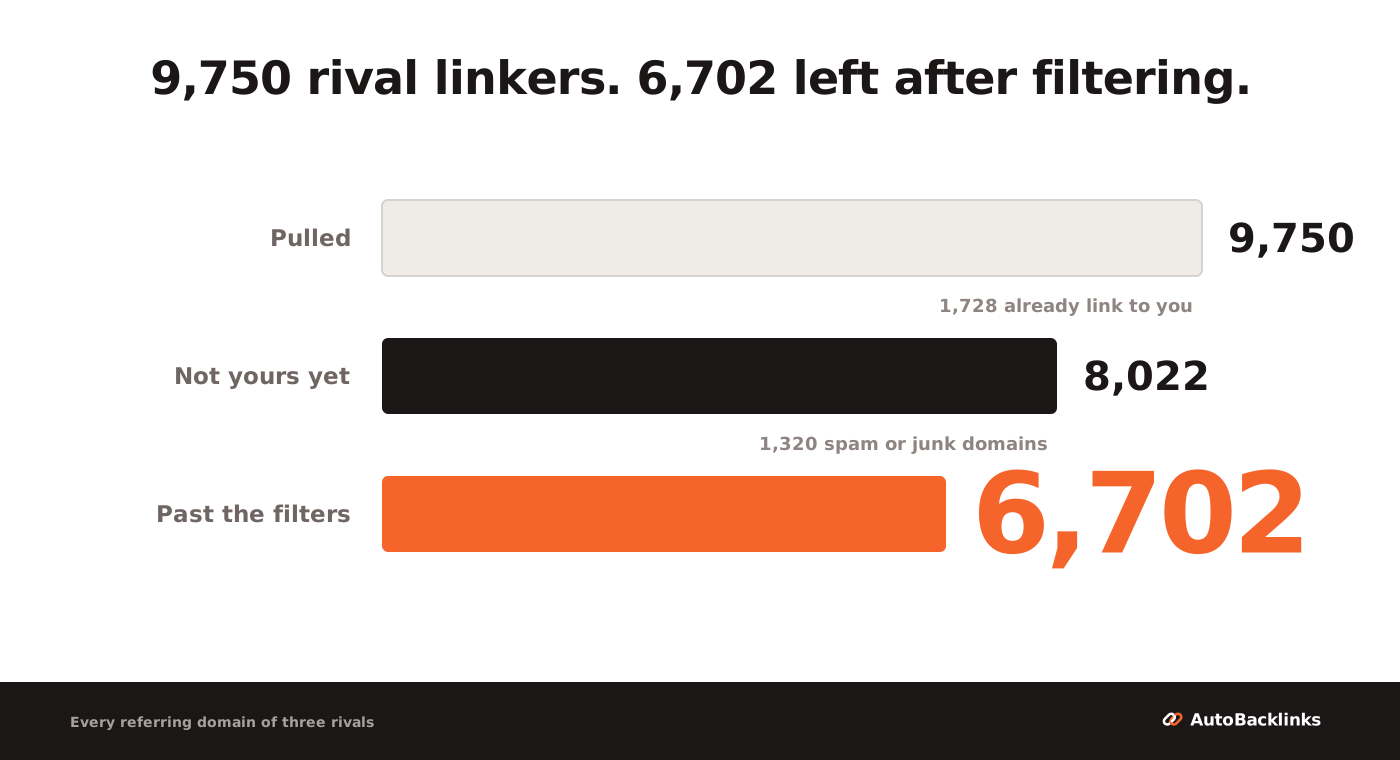
That is the whole product in three numbers.
It is also where most of this list stops.
What a backlink gap analysis tool actually does
A backlink gap analysis tool runs a set difference on referring domains, not on individual links. You give it your domain and anywhere from one to ten competitors, depending on the tool. It returns the websites that link to at least one competitor and not to you.
The unit matters. A site that links to a competitor forty times is one prospect, not forty, because there is one editor behind all forty links. If you are not sure why that distinction changes your numbers, what backlinks are and which ones count covers it.
Vendors give the same operation different names. Semrush and SE Ranking call it Backlink Gap, Ahrefs and Moz call it Link Intersect, seoClarity calls it Link Gaps. The maths is identical.
Two things separate the tools, and neither is the subtraction:
- Whether your own domain is a required input. If it is, you get a gap. If it is optional, you get an intersection matrix and the filtering is your job.
- What the tool knows about each surviving row. Most attach an authority number and an overlap count. Two go further, and one publishes no metric at all.
What one backlink gap analysis actually returns
One backlink gap analysis across three competitors returned 9,750 referring domains, of which 8,022 were the gap and 6,702 survived a spam pass. Those are DataForSEO counts, pulled for this article.
Here is the method, so you can repeat it. Four domains, all real link-building products: postaga.com standing in for "you", with pitchbox.com, respona.com and buzzstream.com as competitors. For each, I pulled every referring main domain from DataForSEO's live backlink index, paginated to the end rather than sampling the top 1,000, with subdomains included.
- Pitchbox: 3,358 referring domains
- Respona: 3,980
- BuzzStream: 6,815
- Postaga, standing in for you: 2,370
The pull cost $1.03 in DataForSEO credit, which is worth holding next to the $49 to $139 a month the mid-market tools in this article charge, and the $2,500 seoClarity starts at. Then the subtraction, and then the filters we ship: the domain rules and the spam threshold of 30 from our own competitor scan code.
| Step | Domains | Share of the competitor union |
|---|---|---|
| Referring domains across the three competitors | 9,750 | 100% |
| Already link to you, so removed | 1,728 | 17.7% |
| The gap | 8,022 | 82.3% |
| Over a spam score of 30, or a known aggregator or wire | 1,320 | 13.5% |
| Survivors worth looking at | 6,702 | 68.7% |
The 17.7 percent row is the one to notice. That is more than one domain in six that a competitor backlink export would hand you as a fresh prospect when it is already a link you own. Pitched cold, those emails land with publishers who have already covered you.
The other way to read the table: 6,702 of the 8,022 gap domains, 83.5 percent, survive a spam and aggregator pass. A gap report is mostly real. It is just mostly unjudged.
Per competitor the share runs higher than the pooled 17.7 percent, and it lands below all three only because the union deduplicates. Your own linkers overlap across the three competitors far more than their other referring domains do: 1,351 plus 1,245 plus 1,396 is 3,992 domain slots, collapsing to 1,728 unique domains.
- Pitchbox: 1,351 of 3,358 referring domains, 40.2 percent, already link to Postaga.
- Respona: 1,245 of 3,980, 31.3 percent.
- BuzzStream: 1,396 of 6,815, 20.5 percent.
Two in five, on the closest comparison. That is the number that makes "does it remove my own linkers" a real buying criterion rather than a feature-table checkbox.
One honest note on basis. I published a different overlap figure in the guide to finding competitor backlinks: 448 of 3,380 domains, 13.3 percent, from the top 1,000 links per competitor across four profiles. This run gives 1,680 of 8,022, 20.9 percent, from complete profiles across three competitors with a fourth site as "you". Different sets, different shares, and sampling the strongest links first is what pulls the smaller number down.
Run each competitor alone and the filters take a similar slice every time: Pitchbox's 2,007-domain gap leaves 1,595 survivors, Respona's 2,735 leaves 2,235, and BuzzStream's 5,419 leaves 4,481. That is 79.5, 81.7 and 82.7 percent surviving, so the smallest profile here is the dirtiest, not the largest.
Why most of a backlink gap links to only one competitor
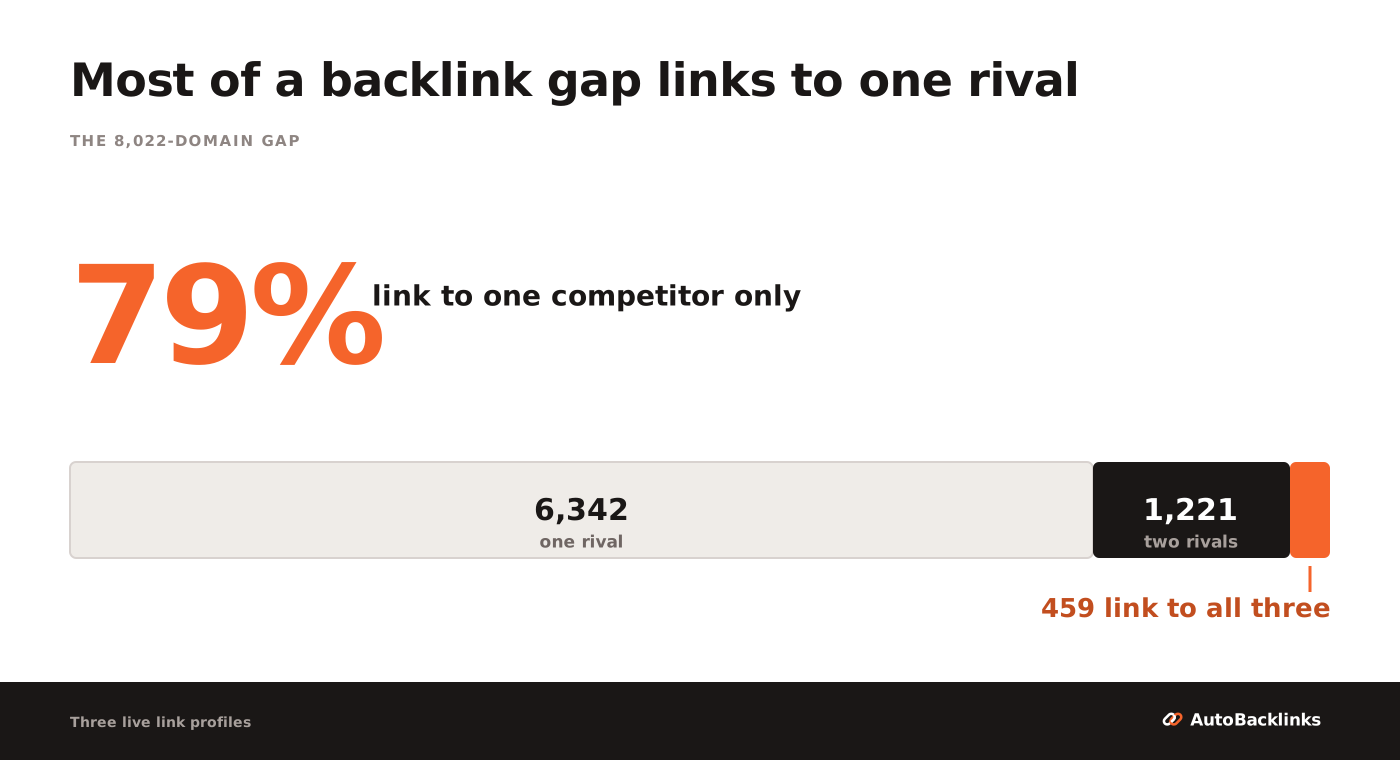
Of the 8,022 domains in the gap, 6,342 link to exactly one competitor. That is 79.1 percent in the DataForSEO pull. 1,221 link to exactly two and 459 to all three, so 1,680 link to more than one.
This is the setting that changes your list size more than any other, and most tools expose it as a quiet dropdown. Semrush ships a "Best" tab for domains pointing at all of your competitors but not you. Ahrefs has a "Links to competitors" selector with an "All competitors" option. Moz lets you sort by how the results intersect.
Set that to "all competitors" on my three inputs and the list goes from 8,022 to 459. Same data, same run, 5.7 percent of the output. After the spam and aggregator pass those 459 become 329.
Adding competitors pushes it the other way, and faster than you would guess:
| Competitors analyzed | Gap size |
|---|---|
| 1 (Pitchbox) | 2,007 |
| 2 (plus Respona) | 4,132 |
| 3 (plus BuzzStream) | 8,022 |
Each competitor roughly doubles the list, and only 459 of the final 8,022 link to all three.
So the competitor count in a vendor's feature table is not a measure of how much signal you get. It is a measure of how much raw list you have to process afterwards.
The best backlink gap analysis tools compared
The best backlink gap analysis tools are Ahrefs Link Intersect for the widest competitor set, SE Ranking for the cleanest default gap report, Linkody for the best free option, Keywords Everywhere Bronze for the cheapest paid route at $84 a year, Moz for the cheapest monthly suite, seoClarity if relevance scoring is worth enterprise money, and AutoBacklinks when the list has to turn into sent email.
The score is a count, not an opinion: one point for comparing three or more competitors in a run, one for removing your own linkers by default, one for documenting how relevance is judged, one for taking the list into contacts and email inside the product. Where a vendor publishes no number, the cell says so and the point is not awarded, because you cannot buy on a promise. Listed alphabetically.
| Tool | Score | Competitors per run | Removes your linkers by default | Judges relevance | Outreach built in | Price |
|---|---|---|---|---|---|---|
| Ahrefs Link Intersect | 2/4 | 10 | Yes | No, DR and traffic filters | No, export | Lite $129/mo |
| AutoBacklinks | 4/4 | No interface cap, credits bound it | Yes, not metered | Yes, scored per page | Yes, contacts and sending | Starter $79/mo |
| Keywords Everywhere | 1/4 | 2 on the documented plan cap, label says 10 | Yes | No, overlap, DA and Spam Score | No, export | Free tier, Bronze $84/year |
| linkgap.io | 1/4 | 1 field, no cap published | Yes, per page copy | No metric published | No, emailed PDF | Free |
| Linkody free gap tool | 2/4 | 5 | Yes | No, overlap and DA | No, export | Free |
| Moz Link Intersect | 2/4 | 5 | Yes | No, DA and Spam Score | No, tracking list only | Moz Pro from $49/mo |
| SE Ranking Backlink Gap | 2/4 | 5 | Yes | No, Domain Trust and Page Trust | No, to-get list only | Core $129/mo |
| Semrush Backlink Gap | 2/4 | 4 (5 sites total) | No, you select your domain | Marketed as relevance-filtered, no metric published | Yes, hands prospects to its Link Building Tool | From $139/mo, limited free tier |
| seoClarity Link Gaps | 3/4 | Top 3 picked for you | Yes | Yes, on keyword overlap | Not documented | From $2,500/mo, quote only |
Two patterns run through that table. Six of the nine attach nothing to a prospect beyond authority, spam and overlap scores, and six of the nine end at a file. linkgap.io attaches nothing at all, because it publishes no metric names, and seoClarity documents no step after the report either way. Semrush is the one third-party tool that moves a prospect onward, through a Start outreach button that pushes it into its separate Link Building Tool, while Moz and SE Ranking offer a saved list that records what you did without doing any of it.
The index behind each report matters as much as the interface, and two of these tools say whose index they use. linkgap.io names DataForSEO as its source. Keywords Everywhere says its upstream API does not return the follow attribute, which is why its gap rows have no follow column.
Ahrefs Link Intersect
Ahrefs takes the widest input in the category. Its help article is explicit: "You can enter up to 10 competitors to compare against." Your target domain is a required first field, so the output is a true gap.
What you can do at this price: filter the result on the best metric set in the category. The help article describes filtering "for a variety of properties and metrics such as DR and Traffic", and Ahrefs' own academy walkthrough recommends setting the do-follow filter and a DR floor of 50.
Nothing past the export button is documented. The workflow ends at a spreadsheet.
Pricing needs care, because two Ahrefs pages disagree. The help article says Link Intersect "is a tool that is available on all subscription plans". The documented tool list for the $29 Starter plan runs Site Explorer, Keywords Explorer, Site Audit, Rank Tracker and a few more, with no Competitive Analysis entry, and Ahrefs Free documents no Link Intersect allowance. Lite at $129 a month is the first plan where both pages agree, so budget for that.
AutoBacklinks competitor backlinks AI analyzer
This one is ours, so read the specification rather than a review.
Our competitor backlinks analyzer is not sold as a gap report with a gap-shaped screen. You scan competitors one at a time and the rows merge into a single deduplicated list, with a column recording which competitors each domain came from. Three to five competitors is what we recommend, and there is no competitor ceiling in the interface.
The subtraction happens on its own. We sync your site's own referring domains and drop any prospect already on that list before any paid enrichment runs. The profile holds up to 10,000 referring domains and refreshes when it is more than 14 days old. The sync is marked in our billing code as an absorbed cost, so it is not metered against your credits, and a campaign can switch the filter off deliberately for link reclamation.
On relevance, seoClarity judges it too, on keyword overlap at the domain level. We judge it per page, and we are the only one of the nine where the row then becomes a drafted email written from that page, with contact finding, sending and reply tracking in the same product. Semrush moves a prospect to a composer. It does not write the pitch from the page. The page classification is the same one measured in our AI backlink analysis agent review.
What you cannot do: get a one-screen gap report with your domain and five competitor fields. The gap is a consequence of how scans and the own-link filter work, not a dedicated report, and if a single gap screen is what you want then SE Ranking or Moz will feel more direct.
Price: Starter is $79 a month with 2,500 credits. A competitor scan costs 5 credits plus 10 per 100 backlinks ingested, capped at 105 credits for a scan of up to 1,000 backlinks. Three scans at that cap is 315 credits, around $10 of a Starter month.
That credit budget, not an interface limit, is what caps how many competitors you run: 2,500 credits is roughly 23 full-depth scans. The trial is seven days and 120 credits, and it takes a card.
Keywords Everywhere Backlink Gap Analyzer
The most generous free allowance here, with a caveat the page states itself.
The tool page says "Compare up to 10 competitor sites" in its input label, then says in the plan-caps paragraph: "On this plan each submission takes up to 2 competitors plus you, and fetches up to 500 backlinks per site." Which paid tier lifts that to ten is not documented. Plan for two competitors unless you confirm otherwise.
The gap logic is correct and well described: "It combines them, removes duplicates, and keeps the rows that link to a competitor but not to you." It sorts by a Found On count, which is the overlap signal, with Domain Authority as the tiebreaker.
What you cannot do: see whether a link is followed. The page is unusually honest about it, saying the upstream API does not provide the signal. That is a real blind spot, not a nicety. On my run, 1,373 of the 6,702 surviving domains carried nothing but nofollow links, so a gap report with no follow column cannot tell you which fifth of your list that is.
Free use is 250 backlinks a day without signing in, 500 with a free API key, and that budget is shared across their backlink tools. Paid plans are annual only, starting at Bronze, $84 billed annually for 100,000 credits a year.
linkgap.io
Worth understanding before you type your domain into it. The form has exactly one competitor field and no add-competitor control, and the result is never shown on screen. The terms page is blunt about why:
First name and email address: Required, so we can email you your PDF report (results are only delivered by email).
The same page names the operator: "LinkGap.io is a free backlink gap analysis tool operated by HeyTony", and the consent box commits you to marketing email from that agency.
What you can do at this price, which is nothing: get one competitor compared against your site, on a tool that documents rate limiting at three analyses an hour per IP, a daily cap per email address, results cached for 30 days, and DataForSEO as the backlink source. The homepage claims it analyzes "500+ backlinks per site".
What you cannot do: see a metric. No metric names are published anywhere on the site, the output is a PDF rather than a table or a CSV, and there is no paid tier.
Linkody free backlink gap tool
The most useful genuinely free gap tool in this set, and the only free one that takes five competitors.
Its page commits to no account, no credit card and no trial: "You can run the tool, see the full list of results, and export everything to CSV with no account, no credit card, and no trial." Your domain is required, so the subtraction is real, and results are "ranked by overlap and authority", which matches what my measurement says the priority should be.
What you cannot do is tell how deep it went. Rows per report and reports per day are not documented, and the page describes analyzing "the strongest referring domains by authority" for each site rather than the full profile.
The gap tool is free. Linkody's paid product is backlink monitoring, from $14.90 a month, or $11.20 a month billed yearly, for 500 monitored links. That is a different job from gap analysis, so do not read the free tool as a trial of the paid one.
Moz Link Intersect
Moz Pro starts at $49 a month, though Moz does not document which tier gates Link Intersect. The cheapest paid plan carrying a gap tool at all is Keywords Everywhere Bronze at $84 a year.
The help article documents five competitors plus your own site, with the gap as the default output: "we'll show you a list of sites linking to your competitors but not to your site." Sorting runs on Domain Authority, Spam Score and how the results intersect.
What you can also do: add rows to Link Tracking Lists "so you can keep track of who you've reached out to". That is a tracking list, not outreach. It stores the state, it does not find the contact or write the email, and SE Ranking's "to-get" list does the same job.
What you cannot do is treat Spam Score as a verdict on an individual page, for the reasons covered in our backlink analysis review.
Pricing: Moz describes its entry-level plan at $49 a month and Standard at $99 a month, or $79 when paid yearly. A free Moz Community account gets 10 queries a month, which is enough to try the report and not enough to work a list.
SE Ranking Backlink Gap Analyzer
The cleanest implementation of the plain gap report.
SE Ranking's help centre takes up to five competitor domains or URLs against a required main domain, and the gap is what you see first: "By default, you will see the domains/URLs that link out to competitors but not to the main domain/URL." Showing everything is the opt-in, which is the right way round.
What you can do at this price: work at URL level as well as domain level, sort by Domain Trust and Page Trust, and export to XLS or CSV. The report shows up to 10,000 backlinks per domain, matching Semrush's entry-tier report cap.
What you cannot do: get a spam score or a follow attribute on this report, neither of which is documented for it. On my run, 1,373 of 6,702 survivors were nofollow-only, so that missing column hides a fifth of the list. The product page assumes relevance rather than measuring it, saying sites linking to your competitors "will often be relevant".
Core is $129 a month, or $103.20 billed annually. There is a 14-day trial and no permanently free tier.
Semrush Backlink Gap
The best-known tool on this keyword, and the one place where the subtraction is not automatic.
Semrush's knowledge base describes comparing "up to five competing websites at once", which is four competitors plus you. Your own domain is not a required input. The article tells you to handle it yourself: "If you want to be able to find backlinks that your competitors have but you don't, be sure to enter your domain in one of the input fields", then select that domain in a dropdown above the table.
That is a real difference, not a quibble. Forget the step and you are looking at a combined profile, and on my measurement 17.7 percent of that combined profile is already yours.
What you can do at this price: the Best, Weak, Strong, Shared and Unique tabs are the clearest exposure of the overlap setting anywhere in this group, and Authority Score, Monthly Visits and the Matches count are on every row. The help article puts results per report at 10,000 on the entry tier.
It is also the only tool in this table that pushes a prospect onward rather than down. Semrush's own walkthrough shows a "+ Start outreach" button that sends selected prospects into its separate Link Building Tool, where you connect a mailbox, write the email and add a follow-up sequence. That is a handoff between two products rather than one workflow, and the Backlink Gap help article does not mention it.
On relevance, read the marketing and the documentation separately. The feature page promises domains "filtered by relevance and sorted by impact", while the help article's documented columns are Authority Score, Monthly Visits and Matches. No relevance metric or column is published anywhere, so treat the claim as unspecified rather than proven.
Price: the pricing page starts at $139 a month for the SEO plan, or $117.33 a month billed annually, while Semrush's own blog prices the same tier at $139.95 under its older plan names. Semrush says Backlink Gap can be used on the free plan with the number of results limited, and that free plan is one demo project and ten reports a day across the platform.
seoClarity Link Gaps
The only tool here that documents how it judges relevance, and the only one you cannot buy without a sales call.
Its page says it "assesses the relevance of potential backlink sites for your desired ranking topics based on the keyword overlap", then adds that "our ML algorithm then guides you to select the most impactful backlink sites for your target topics". It also picks your competitors for you: enter your URL and it surfaces "your top three competitors based on the percentage of keyword overlap".
What you can do at this price: work at a scale nothing else here matches, comparing "the top 50,000 backlinks for your biggest competitors against your site and each other", sorted low, medium and high by competitor quantity.
What you cannot do: choose your own competitor set beyond the three it picks, or see a price. Every call to action is a quote request. The cheapest published figure on its pricing page starts at $2,500 a month for the Research and Content tier, and no plan is documented as including Link Gaps.
What a backlink gap tool leaves you to do
Six of the nine backlink gap tools here leave you all three jobs: judging topical fit, finding a contact, and writing a page-specific pitch.
Work the numbers from the top of this article and the shape of that is obvious. You start with 9,750 rows. Most of these tools hand you 8,022. A spam pass gets you to 6,702, and your month has room for maybe two hundred emails.
Semrush gets closest, handing your list to a separate product with an email column, a connected mailbox and a composer you fill in yourself. seoClarity covers the first job and documents nothing after it.
- Judge topical fit. Overlap count is a proxy for relevance, not a measurement of it. A domain linking to all three of my competitors might be a category blog or it might be GitHub.
- Find a contact. The gap row is a domain. Outreach needs a person and a deliverable address.
- Write something page-specific. The same pitch sent to 6,702 domains is the reason most outreach gets ignored. In our own campaign, 187 sends produced a 17.1 percent reply rate, and the thing that moved it was prospecting quality rather than copy.
Semrush markets Backlink Gap as relevance-filtered but publishes no metric behind it, which is a different thing from seoClarity publishing the mechanism. Everyone else leaves fit to you.
If you want the broader category rather than gap tools specifically, the link prospecting roundup scores ten tools on where each one stops, and the AI link building tools review covers what sits behind the export.
How to choose a backlink gap analysis tool
Match the tool to how far you want to get, not to index size.
- You just want to see the gap once. Linkody's free tool, five competitors, no account, CSV out. Nothing to buy.
- You want metrics on every row and no subscription. Keywords Everywhere, inside its 250 backlinks a day and two-competitor ceiling.
- You already pay for an SEO suite. Use what you have. Ahrefs for ten competitors and the best filters, Semrush for the clearest overlap tabs, SE Ranking for the cleanest default, Moz for the cheapest entry.
- You want to track who you contacted without buying another tool. Moz, for Link Tracking Lists.
- You want relevance scored and you have an enterprise budget. seoClarity, on a quote.
- You want the list to turn into sent email. That is our AI backlink outreach agent, and you can start a trial to see the subtraction run on your own profile.
Whatever you pick, Google Search Console is not an alternative to it. Its Links report covers a property you have verified, so it gives you one half of the subtraction and none of the other.
Then read the top of the overlap list before you trust it. The domains linking to every competitor are often the ones linking to everybody: code hosts, app stores, link shorteners and directories. The three-way band under them is usually the better place to start.
FAQ
What is a backlink gap analysis?
A backlink gap analysis is a set difference between referring domains: every website linking to your competitors, minus every website already linking to you. In a DataForSEO pull across three complete competitor profiles, 9,750 referring domains came back, 1,728 of them already linked to the target site, and 8,022 remained as the gap. The unit is the referring domain rather than the individual link, because one website with forty links to a competitor is still one editor to pitch.
What is the best free backlink gap analysis tool?
Linkody's free backlink gap tool is the most capable, taking up to five competitors with no account, no credit card and a full CSV export. Keywords Everywhere's analyzer is the alternative if you want Domain Authority and Spam Score on each row, within a free ceiling of 250 backlinks a day and two competitors per run. Moz gives 10 free queries a month and Semrush 10 free reports a day, both of which are enough to look and not enough to work a list. linkgap.io is free too, but it takes one competitor and emails you a PDF rather than showing a table.
How many competitors should I use in a backlink gap analysis?
Three to five. Measured on three complete profiles from DataForSEO, the gap grew from 2,007 domains with one competitor to 4,132 with two and 8,022 with three, so each competitor you add roughly doubles the list you then have to process. The useful signal does not grow at the same rate: only 1,680 of those 8,022 domains linked to two or more competitors.
Can Ahrefs do a backlink gap analysis?
Yes. Ahrefs calls it Link Intersect, it accepts up to 10 competitors against your target domain, and it returns the sites linking to them but not to you. It filters on Domain Rating, traffic and the follow attribute, and it ends at an export button, so contact finding and outreach happen somewhere else. Ahrefs' pages disagree on which plan includes it, so Lite at $129 a month is the safe assumption.
Is a backlink gap the same thing as a link intersect?
They are the same operation under two vendor names. Semrush and SE Ranking say Backlink Gap, Ahrefs and Moz say Link Intersect, seoClarity says Link Gaps. The one setting worth knowing is how strictly you define the intersect: on the three-competitor run measured here, asking for domains that link to every competitor returned 459 rows out of 8,022, and 329 of those survived a spam pass.
How often should I rerun a backlink gap analysis?
Quarterly for the competitor side, which does not change quickly, but refresh your own link profile far more often than that. We treat a stored profile as stale after 14 days, because your own campaigns are what change it, and the fastest way to look careless is to cold-pitch a site that linked to you last week.
About Rachid Idali
Founder & SEO Strategist
Rachid Idali has spent 10 years in SEO, running multi-six-figure SEO and link-building budgets across content, digital PR, and outreach programs. He writes about practical systems for finding relevant prospects, earning links, and turning SEO operations into repeatable pipelines.
More from Rachid Idali