
AI Backlink Analysis Agents in 2026: 9 Tools, One Test

by Rachid Idali
Last Updated: September 23, 2026
An AI backlink analysis agent fetches the page that links to a site, reads the content around the link, works out how that link was earned, and acts on the verdict. Almost everything sold under the name does something smaller: it sorts a link list by Domain Rating, traffic and a spam score, and almost none of it publishes a method for reading the page.
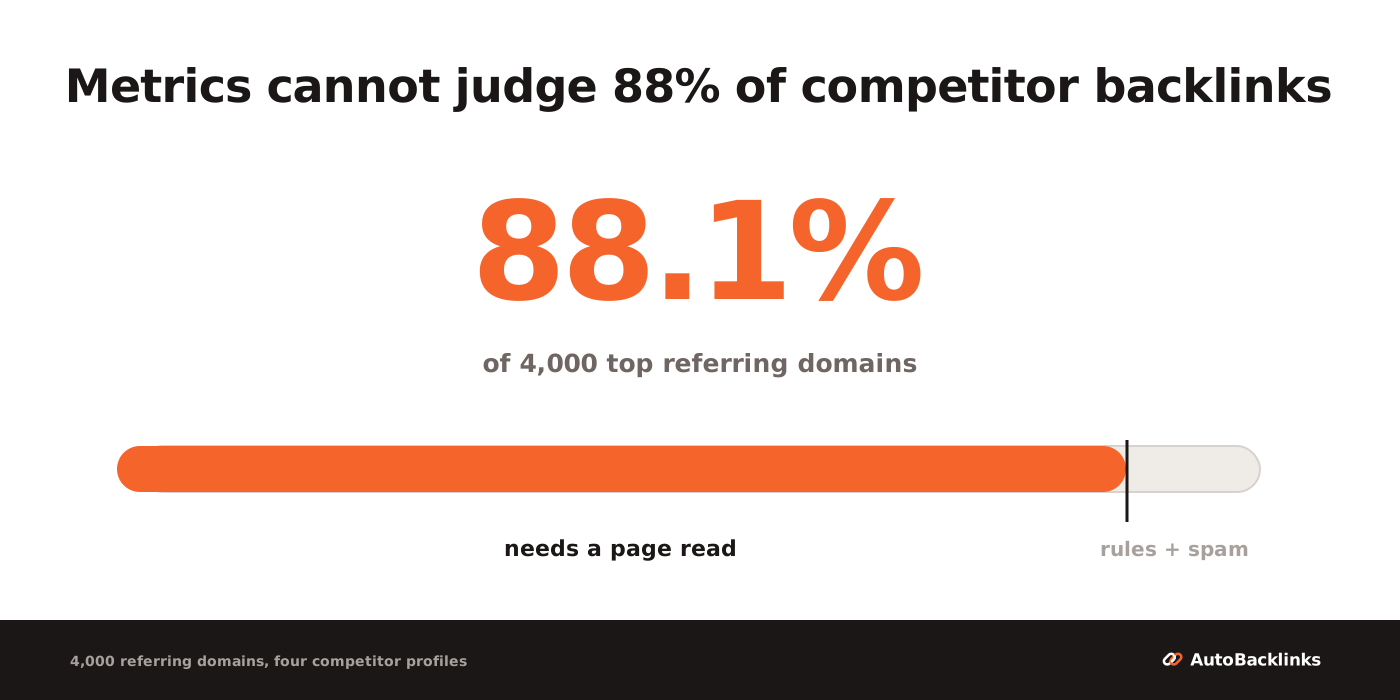
The distinction is not pedantic. I pulled the top 1,000 referring domains for each of four competitor backlink profiles, 4,000 rows, and ran them through the rule stage and the spam filter we ship. 88.1 percent came out the other side unjudged.
Rules removed 0.9 percent of the 4,000. A spam score above 30 removed another 11.0 percent. Everything else needed something to go and read the page.
So this is not a roundup of nine backlink checkers. It is one test applied to nine of them: does the tool document reading the linking page and deciding how the link was earned, or does it sort numbers you already had?
What an AI backlink analysis agent actually is
Three things get called the same name, and separating them is most of the buying decision.
- A filter sorts an existing link list by site-level numbers: Domain Rating, organic traffic, referring domains, outgoing links. It answers how strong is this site.
- An analysis computes a judgment on top of those numbers, usually a toxicity or risk score. It is still working from domain and pattern signals. It answers how risky does this look.
- An agent goes to the linking page, reads it, classifies how the link was earned, and decides whether that same link is available to you. It answers can I get this link.
That third property has a name worth keeping: link replicability, meaning whether the route that produced someone else's link is a route you could walk yourself. A guest post is replicable. A funding-round news story is not.
Here is the test in a form you can apply to any vendor page in about forty seconds. Find the feature description and ask what the product puts into the model. If the inputs are Domain Rating, spam score, traffic and anchor text, it is a filter, however good the chat interface is.
One clarification I want to make before naming anyone. I am describing what each vendor documents, not asserting what its software cannot do. Where a company publishes no method, this article says "not documented" rather than "cannot", because absence of a published mechanism is not proof of absence.
What 4,000 competitor backlinks say about metric filters
I ran this study for this article. Here is enough of the method to rerun it.
I took four link-building tools that compete with us, Pitchbox, Respona, BuzzStream and Postaga, and pulled their referring domains from DataForSEO's live backlinks endpoint, one link per referring domain, ordered by referring-domain rank, top 1,000 each. That is 4,000 rows, pulled in September 2026. The spam score is the provider's, on a 0 to 100 scale.
Two things about that sample, both of which cut against me. It is deliberately the flattering draw: the strongest referring domains each site has, not the tail, so a random sample would look worse rather than better. And all four are link-building SaaS companies, so treat 88 percent as the shape of the problem rather than a constant for your niche.
Then I ran the rows through two things we ship: the rule stage that labels a link before any model sees it, and the spam cutoff that drops a row at ingestion.
| Stage | Removed | Share of 4,000 |
|---|---|---|
| Domain and path rules (forum, directory, press wire, search cache) | 36 | 0.9% |
| Spam score above 30, among what the rules left | 440 | 11.0% |
| Left needing a page read | 3,524 | 88.1% |
The rule stage caught 28 forum pages, 4 directory pages, 3 search or assistant cache pages and 1 press wire. Out of four thousand.
That is not a weakness in the rules. Known-shape junk is a small, cheap slice, and removing it leaves the hard part untouched.
The spam score did more work, and did it unevenly. Respona's best referring domains scored above 30 just 2.7 percent of the time; Postaga's did 27.9 percent of the time. One global threshold treats those two profiles identically, which is exactly the problem.
One more number from the same pull, because it changes what you chase: 934 of the 4,000 links, 23.4 percent, were already broken. Nearly a quarter of the strongest referring domains in four competitor profiles point at something that no longer resolves.
That is a prospecting opportunity rather than a problem. A dead link on a live page is the easiest pitch in link building, because the editor has a broken page to fix and you have the replacement. It is also a reason to check the link still exists before you write anything, which no metric on the row will tell you.
The rel="sponsored" attribute that would settle it is almost never there
If you want to know whether a competitor bought a link, Google's link spam policy asks publishers to mark paid links with rel="sponsored" or rel="nofollow". One of those two is unambiguous. The other is not.
In the 4,000 links I pulled:
- 25 links, 0.63 percent, carried
rel="sponsored". - 34 links, 0.85 percent, carried
rel="ugc", which marks user-generated content. - 1,011 links, 25.3 percent, carried plain
nofollowand nothing else. - 2,930 links, 73.25 percent, carried no
relattribute at all.
Fewer than one link in 150 declares itself paid. The 73.25 percent carrying no attribute at all are dofollow by default, which is the state that passes authority and also the state that tells you nothing about how the link was obtained.
And the 25.3 percent carrying plain nofollow cannot be split into "paid" and "house policy" from the attribute alone, because many editorial publishers nofollow every external link as a rule. So 0.63 percent is a floor, not a measurement, and the gap between the floor and the truth is only closable by reading the page. The attributes themselves are covered in the guide to what backlinks are and which ones count.
What reading the linking page changes about a prospect list
I drew a stratified sample of 100 links, 25 at random from each site's surviving rows, and labelled each one against the same 14-label set our classifier uses.
78 of the 100 were a repeatable outreach motion. 22 were not. The 22 were directory entries, auto-generated list pages, image hotlinks from scraped blogs and one podcast episode. All 22 had already cleared the spam filter and sat among the strongest referring domains their site has.
| Profile sampled | Repeatable links |
|---|---|
| Pitchbox | 23 of 25 |
| Respona | 23 of 25 |
| BuzzStream | 22 of 25 |
| Postaga | 10 of 25 |
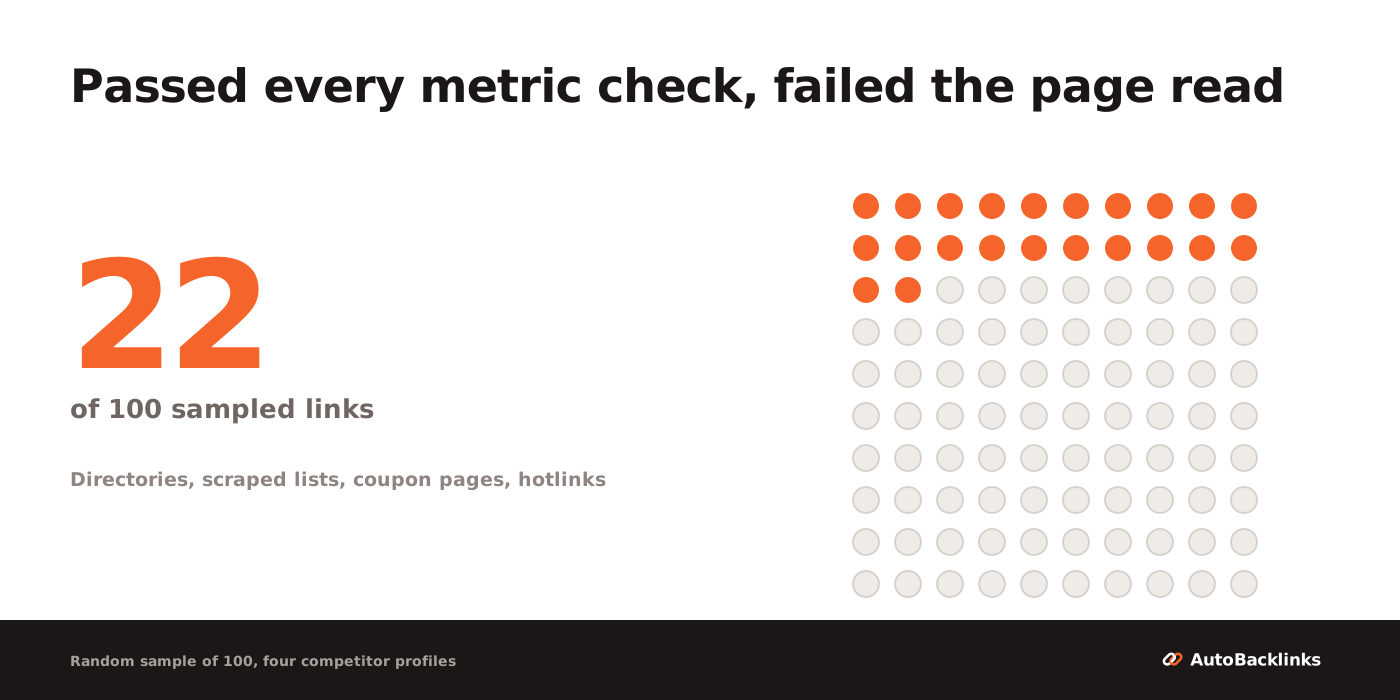
Three of the four profiles came in at 22 or 23 of 25. Postaga came in at 10. At 25 links per site that is a signal worth checking rather than a measurement, and the 78 percent is the unweighted mean of four equal strata, not a population estimate.
What the numbers do not do is find the split for you. I checked the two the sample carries: the keepers had a median referring-domain rank of 347 against 278 for the rejects, and both groups had a median spam score of 0. The rejects scored marginally better on rank. The Postaga rows that failed were tool directories, coupon-code pages and AI-listing sites, all sitting on decent ranks with clean spam scores.
The clearest single example was a Spanish film-industry news site, senalnews.com, announcing the jury for a screenplay contest, linking to Pitchbox. Good domain, no spam signal, entirely irrelevant, and obvious in half a second to anything that reads the page.
The best AI backlink analysis tools and agents compared
How the nine were picked: every product marketed for AI backlink analysis that you can sign up for and run today. Five further products marketed as an "AI backlink analysis agent" are excluded because you cannot run them today. ZBrain, Bluebash, Geeky Tech and Slate are a template listing, two agency contact forms and a waitlist. Emergent is a no-code builder where you would write the agent yourself, which is a different purchase from buying one.
Alphabetical, not ranked. "Reads the linking page" means the vendor documents page content as an input to the judgment.
| Tool | From | Reads the linking page | Classifies how the link was earned | Filters spam | Acts on the result |
|---|---|---|---|---|---|
| Ahrefs | $29/mo, $129 for full Site Explorer | Not documented | Not documented | No spam score, by design | No |
| AutoBacklinks | $79/mo | Link context always, full page on low confidence | Yes, 14 labels | Yes, threshold 30 | Yes, contacts and outreach |
| CrawlConsole | Free tier, $29/mo | Not documented | Not documented | Risk signals | Answers in chat |
| LinkResearchTools | $599/mo | Not documented | Not documented | Yes, DTOXRISK | Disavow file |
| Majestic | $49.99/mo | Not documented | Not documented | Flow Metrics, not a spam score | No |
| Moz | $49/mo | Not documented | Not documented | Yes, Spam Score | No |
| SE Ranking | $129/mo | Not documented | Not documented | Yes, toxicity score | No |
| SearchAtlas | $79/mo, annual billing | Claimed, no method published | Not documented | Yes, spam risk | Builds links separately |
| Semrush | $139/mo | Not documented | Not documented | Yes, Toxicity Score | Disavow file |
The flagship column reads "not documented" seven times out of nine. That is the finding, not a gap in the research: most of these vendors publish their scoring inputs in real detail, and page content is not among them.
Ahrefs backlink analysis: the Best links filter
Ahrefs has the index most people mean when they say backlink analysis, and it is unusually direct about what it does not do.
Asked in its own help documentation whether it can filter out spam links, Ahrefs answers:
No. We don't have such a score.
Its recommended substitute is the Best links filter, which the same Ahrefs help article describes as a way "to filter out less impactful backlinks in your reports". The settings behind it are three site-level metrics:
- Domain Rating below a number. Domain Rating is Ahrefs' own 0 to 100 measure of a site's backlink strength, and it is the number most of this category is built on.
- Backlinks with little or no organic traffic.
- Outgoing external links above a number.
Ahrefs also rejects the toxicity framing that several competitors sell:
"Toxic backlinks" is just a term made up by certain SEO tools to describe backlinks they think could hurt your website's rankings based on several so-called "markers."
I think that is the honest position, and it is worth more than a fake score. Ahrefs publishes a substantial AI feature set, from Ask Ahrefs to AI Content Helper to Brand Radar, and none of the features it lists is attached to judging a linking page.
Semrush Backlink Audit: 45 toxic markers
Semrush is the most explicit about method, and reading that method shows exactly where the ceiling sits.
The Toxicity Score runs 0 to 100, and Semrush's documentation says there are "45+ different toxic markers" behind it, weighted by "each toxic marker's frequency and importance" plus machine learning and user feedback. It publishes six marker groups:
- Link networks
- Spam in communities
- Harmful environment
- Manipulative links
- Irrelevant source domain
- A complementary set, including a link in the footer, mirror pages and a symbol anchor
Read that list again. Every marker group Semrush publishes describes the site or the placement. None of the published groups describes reading what the article around your link actually says.
That is the whole gap in one vendor's own documentation.
Backlink Gap is the other feature people call AI competitor backlink analysis, and its Best filter is a set operation: domains that link to all of your competitors but not to you. Useful, and not a quality judgment.
Moz Spam Score: 27 site features, not a link read
Moz gives the clearest illustration of what a spam score really measures, because it publishes the feature list.
Moz defines Spam Score as "the percentage of sites with similar features to the site you're researching which we've found to be penalized or banned by Google", built on a model that "identified 27 common features among the millions of banned or penalized sites".
Among those 27 features:
- Whether the domain name contains numerals
- Whether the Google Font API is present
- Whether Google Tag Manager is present
- Whether a phone number appears
- Whether the site links to LinkedIn
- Whether it defaults to HTTPS
Those are fingerprints of cheap site construction. They correlate with bad neighbourhoods, and Moz is careful to call it correlation.
But a well-built page can host a bought link, and a plain page with numerals in the domain can host an excellent editorial one. The score also updates quarterly, so a site that cleaned up in January still carries January's number in March.
Link Intersect is Moz's competitor feature, and like Semrush's, it is a set difference, across up to five competitors.
Majestic, SE Ranking, SearchAtlas and LinkResearchTools on link quality
Four more, each drawing the line in a different place.
Majestic: Trust Flow, Citation Flow and Visibility Flow
Majestic does not sell a spam score at all. Its glossary defines Trust Flow as a 0 to 100 quality score seeded from "a manual review of the web", Citation Flow as a measure of the link equity or "power" a page carries, and Topical Trust Flow as a category score putting a domain in a subject area.
The interesting one is Visibility Flow, which combines Trust Flow with link density and is "designed to promote low Link Density, editorial-style links on high Trust Flow pages, while penalising header, footer, and directory links".
That is placement-aware, which is closer than anyone else here gets. It is still reading the shape of a page rather than its meaning.
SE Ranking: a toxicity score with no published method
SE Ranking's Backlink Checker analyses a profile "using dozens of parameters", returning referring domains, backlinks, Domain and Page Trust, anchors, new and lost domains and broken backlinks. It ships a backlink toxicity score described only as "low-quality backlinks that could be harming website rankings".
That is the entire published definition. Compared with Moz's 27 named features and Semrush's six marker groups, there is nothing to audit, which matters because a toxicity number you cannot interrogate is a number you should not act on.
Its AI-named products are AI Search Toolkit, AI Overviews Tracker, AI Mode Tracker and AI Writer. All four are aimed at AI search visibility; none of them is attached to backlinks.
SearchAtlas: the closest claim, and no mechanism
SearchAtlas comes nearest to claiming the thing outright. Its backlink analyzer says it "reads linking domains, linking pages, new and lost domains, anchor text, dofollow ratios, and spam links for you", and its Atlas Agent "reads the backlink signals, flags what changed, and hands the next moves to your dashboard".
Read those two sentences together. The agent is documented as reading signals; no score, model or method is published for judging a linking page's content. That is why the table above says "claimed, no method published" rather than yes or no.
Its separate OTTO product builds links "automatically through trusted networks", which is a different business from evaluating them, and one I would want to understand in detail before switching on.
LinkResearchTools: Link Detox and DTOXRISK
Link Detox is the oldest risk engine here and still the most configurable. DTOXRISK is "an aggregated calculation of multiple patterns and risk signals", applied to every link and to the domain as a whole. Anchor text is classified "based on frequency, words and many more factors", and Link Detox Tune lets you change the weights of the audit rules yourself.
That reweighting is genuinely useful and almost unique: it is the only tool here that admits its rules are opinions and lets you argue with them. It is priced for agencies doing recovery work, not for prospecting.
CrawlConsole and backlink analysis over MCP
CrawlConsole is the one genuinely runnable product among the pages that market themselves as an AI backlink analysis agent, and it takes a sound architectural approach: expose backlink data over MCP and an API so your assistant can query it in chat.
Its free tier allows 50 AI calls, 10 backlink searches and 1 project with three-day retention, which is a tester rather than a working plan. Starter at $29 a month raises that to 5,000 AI calls and 3,000 backlink searches.
The claim to read carefully is "page-level evidence", which it defines as moving "from domain-level backlink lists to source URLs, target URLs, anchors, and context". That is a granularity promise, more rows with more fields, not a promise that the linking page is fetched and read.
This matters for anyone wiring SEO data into an assistant, which I went through tool by tool in the roundup of MCP servers for link building.
How AutoBacklinks analyzes competitor backlinks with AI
This is our product, so treat this section as a spec sheet and check it against the test above rather than as a review. Plans start at $79 a month for Starter and $179 for Growth.
The competitor backlink analyzer runs in three stages.
One, rules. Before any model call, a link is labelled by domain and path patterns:
- Press wire, forum or community, directory pages
- Search and assistant cache pages, archive mirrors, translation proxies
- Sibling-domain redirects
Cheap, deterministic, and as the study above shows, worth about 0.9 percent.
Two, the page context. Every remaining link goes to a classifier with its anchor, the text before and after it, the linking page's title, the destination URL and the rel attributes. It returns one of fourteen labels, a confidence score and a one-line reason.
I want to be exact about this, because it is the same precision I am asking of everyone else. That default pass reads the link's context, not the whole page. Full source-page content comes in during a second pass, for any link labelled unknown or scored below the confidence cutoff. An honest "I cannot tell from this" is what triggers the page fetch, which is why the label exists at all.
The fourteen labels, with the seven that qualify as a repeatable outreach motion marked:
- Journalist quote, a reporter quoting the site's staff by name. Qualifies.
- Listicle, the site as one entry among many. Qualifies.
- Resource page, a curated list of links. Qualifies.
- Paid placement, a bought link or paid guest article. Qualifies.
- Brand placement, a passing brand-name mention. Qualifies.
- Source citation, the site credited for a fact or statistic. Qualifies.
- Editorial, a natural in-body mention that fits nothing more specific. Qualifies.
- Press release, from a newswire domain.
- Podcast interview, an episode page.
- Directory, a structured business listing.
- Forum or community, including Reddit and Q&A sites.
- Aggregator or search cache, including assistant answer pages.
- 301 redirect, pointing at a sibling domain.
- Unknown, which routes to the page fetch.
Guest posts fall under paid placement or editorial depending on whether money changed hands, which the rel attributes and the anchor usually settle.
Three, the verdict. The seven qualifying labels reach the prospect view. The other seven are dropped, because no email turns a search cache page into a backlink. Links scoring above 30 on spam are disqualified at ingestion.
What comes out is a list of sites you can pitch, and it carries into contact finding and outreach without an export. The same actions run over MCP. Every credit spend and every send still waits for your approval.
A 1,000-backlink scan costs 105 credits: 5 to start, 10 per 100 backlinks. On Starter that is $3.32 a scan, and $13.28 for the four profiles in this article. On Growth it is $2.51 a scan.
Whether that is worth it depends on the 88 percent. If your workflow ends at a scored list, a filter is fine and Ahrefs has the better index. If it ends with a sent email, the classification decides what you send and to whom. Prospecting, not copy, is what moved the numbers in our education-niche campaign: 187 emails sent, 32 replies, a 17.1 percent reply rate.
How to choose an AI backlink analysis tool
Match the tool to the question you are actually asking. There are three.
"Are my backlinks dangerous?" You want a published risk methodology and a disavow export. Semrush and LinkResearchTools are built for this, and Moz is the cheapest auditable score. Ignore anyone who will not tell you what the number is computed from.
"How strong is this site?" You want index size and metric depth. Ahrefs, and it is not close. Its refusal to ship a spam score is a feature.
"Which of my competitor's links can I get?" You want the page context, the classification and a path into outreach. That is the job we built for, and the reason the best link prospecting tools and the best AI SEO agents are a different category from backlink checkers.
Two warnings from ten years of running link-building budgets.
A toxicity score is a hypothesis about Google, not a reading of Google. Semrush's 45 markers and Moz's 27 features are correlations with penalised sites, and both companies say so plainly. Treat the number as something to investigate, not something to act on, and do not disavow a link because a third-party score disliked it.
And a chat interface is not an agent. If you can get the same answer by sorting a column, the model added convenience, not judgment. The test is whether it looked at something you had not already downloaded.
If you want to see the classification on your own competitors, start a scan and point it at three rivals. The links that survive are the ones worth an email, and what gets dropped usually says more about your niche than the survivors do. Turning those rows into placements is covered in the guides to niche edits and link insertions and how to get backlinks.
FAQ
What is an AI backlink analysis agent?
An AI backlink analysis agent fetches the page that links to a site, reads the content around the link, decides how the link was earned, and acts on that verdict. That is different from a tool that applies a model to a table of Domain Ratings and spam scores you already had. The practical test is what goes into the model: if the inputs are site-level metrics, it is a filter with a chat window, however good the interface is.
Can AI do a backlink audit?
For risk, largely yes. Semrush computes a toxicity score from 45 or more markers and Moz computes a spam score from 27 site features, and both export a disavow file. For the other half of a backlink audit, deciding which links are worth pursuing and which competitor links you could realistically win, the signals those tools publish do not reach. In a sample of the top 1,000 referring domains for each of four competitors, 4,000 in total, 88.1 percent could not be resolved by domain-shape rules or a spam threshold.
What is the best AI backlink analysis tool?
It depends which of three questions you are asking. For index size and metric depth, Ahrefs. For a documented risk score and a disavow workflow, Semrush, with Moz as the cheaper auditable option and LinkResearchTools as the agency-grade one. For deciding which competitor links you can replicate and then contacting those sites, AutoBacklinks, which is our product and the only one of the nine that documents classifying how each link was earned.
How much do AI backlink analysis tools cost?
CrawlConsole has a genuinely free tier, capped at 50 AI calls and 10 backlink searches. Paid entry prices run from $29 a month (Ahrefs Starter, CrawlConsole Starter) to $599 a month (LinkResearchTools Superhero), with Moz at $49, Majestic at $49.99, SearchAtlas at $79 on annual billing, AutoBacklinks at $79, SE Ranking at $129 and Semrush at $139. One caution worth more than the rest: Ahrefs' full Site Explorer, the feature most people are buying, starts on the $129 Lite plan rather than on Starter.
How is AI backlink analysis different from a spam score?
A spam score is a correlation model over site-level features. Moz says outright that its score represents "the percentage of sites with similar features to the site you're researching which we've found to be penalized or banned by Google", built from 27 features that include whether the domain name contains numerals and whether the site defaults to HTTPS. It is a neighbourhood signal. Reading the linking page answers a different question: how this particular link came to exist, and whether the same route is open to you.
How many competitor backlinks are worth pitching?
In a stratified sample of 100 links I labelled for this article, 25 per competitor, 78 percent were a repeatable outreach motion and 22 percent were not. The average hides the useful part: three of the four profiles came in at 22 or 23 out of 25, and the fourth at 10 out of 25. Which kind of profile you are looking at is not visible in Domain Rating, traffic or spam score, so qualify a competitor profile before you budget outreach time against it.
About Rachid Idali
Founder & SEO Strategist
Rachid Idali has spent 10 years in SEO, running multi-six-figure SEO and link-building budgets across content, digital PR, and outreach programs. He writes about practical systems for finding relevant prospects, earning links, and turning SEO operations into repeatable pipelines.
More from Rachid Idali