

How to Find Competitor Backlinks (and Which to Copy)

by Rachid Idali
Last Updated: October 13, 2026
To find competitor backlinks, pick three to five rivals that outrank you for the keywords you want, export one link per referring domain (one row per linking website, not per link) from a backlink index, then filter the export down to pages a human editor still controls. The export is the easy half.
Here is the part nobody prices. I pulled the 1,000 highest-authority referring domains for each of four real competitors, 4,000 rows in total, and carried them through every filter to the end. Of those 4,000 competitor backlinks, 2,566 survived the mechanical filters. In a labelled sample of 100 surviving competitor backlinks, 21 were pages where one email is the whole job.
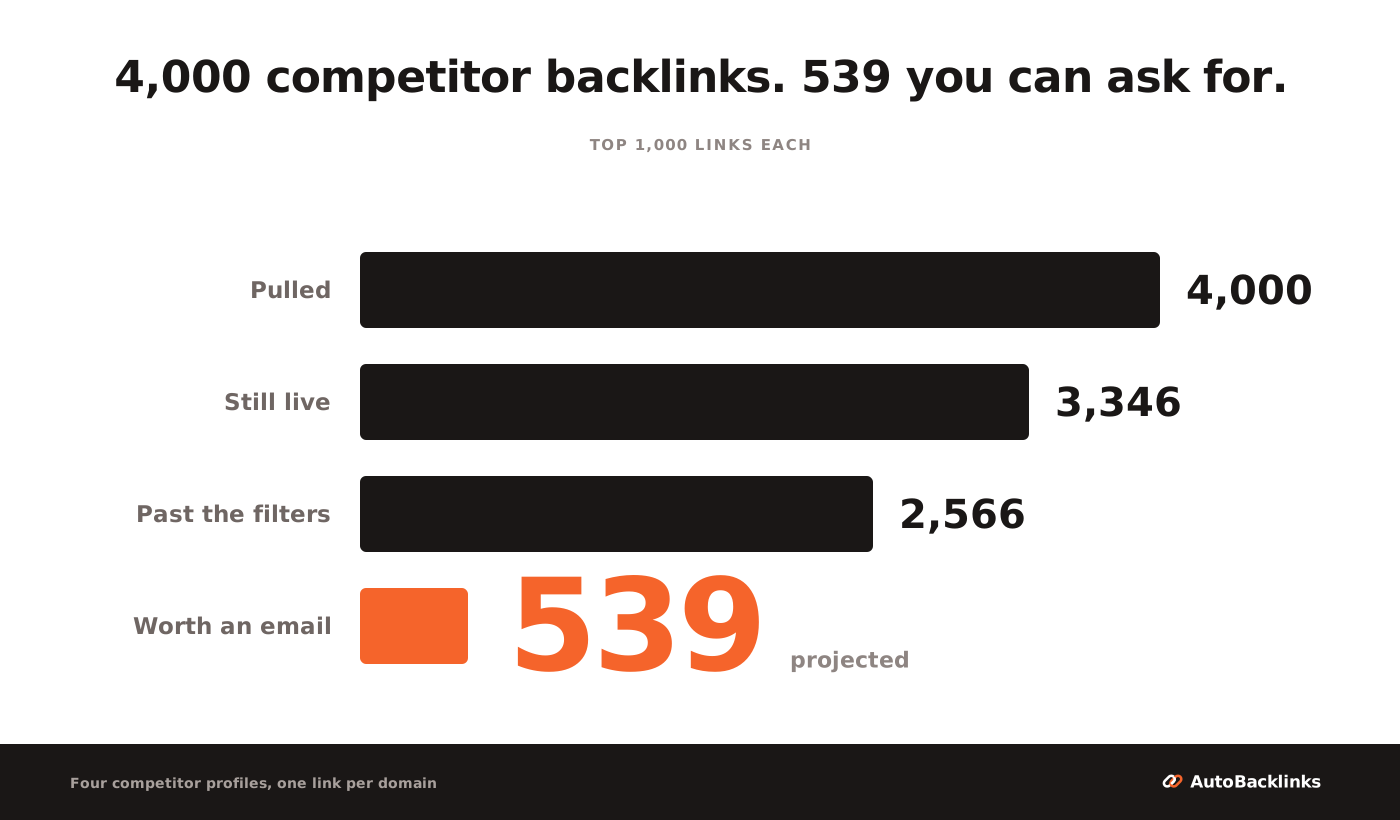
The survivors sort into four buckets: inclusion, citation, one-off and unreachable, and only inclusion is an email away. That ratio is the thing to plan around, and here is the method that produces it.
How to find competitor backlinks in four steps
Finding competitor backlinks takes four steps: pick three to five rivals, export one link per referring domain, strip what you cannot pitch, then judge the rest on reachability.
Before you start you need a backlink index with an export (a paid Ahrefs, Semrush or DataForSEO account) and three to five competitor domains. Steps one to three take about two hours. Step four is the one that scales with the size of the export, and the cost of doing it by hand is further down this page.
- Pick the competitors. Domains that outrank you for the keywords you want, not the companies your sales team loses to. Done when you have three to five domains written down.
- Export their backlinks one link per referring domain, then collapse the files together. A site that links to a rival 400 times is one prospect, not 400, and a site linking to three of them is still one prospect. Paste every export into one sheet, pivot on the referring domain, count the rows, and keep the count: a domain appearing twice or more is your warm list. Done when you have one row per referring domain across all competitors, each carrying how many of them it links to.
- Strip what you cannot pitch. Lost links, image and redirect links, footer and sidebar placements, spam, forums, directories, aggregators and wire copy. Done when every remaining row is a live text link inside the body of a page.
- Judge what is left on reachability, not authority. For each surviving page, ask what you would have to do to get the same link. Most of the time the answer is "nothing I can do." Done when every row carries a decision and you have a list you could start emailing.
Steps one to three are mechanical and a tool does them. Step four is the one that decides your month, and it is the one a filtered spreadsheet hands straight back to you.
Which competitors to analyze for backlinks
Your backlink competitors are the sites that rank above you for your money keywords. They are often not your commercial rivals.
There are two ways to find them, depending on whether you rank yet.
- If you do not rank yet: take your ten money keywords, search each one in an incognito window set to your target country, and tally which domains show up three or more times. Those are your search competitors.
- If you already rank: use the competing-domains report in your SEO tool, sorted by the number of keywords you share. Drop the marketplaces, the media giants and the aggregators, because you are not going to out-rank Amazon and their links are not available to you anyway.
Then apply judgement on top. A site with half your revenue and triple your referring domains is a better subject than the market leader whose links came from a funding round you are not having. Pick the ones whose link profile you could plausibly rebuild.
Three to five is the right number. Fewer and you see one company's idiosyncrasies; more and the deduplication work outgrows the benefit.
If you want the broader picture of what a link profile is made of before you analyze someone else's, what backlinks are and which ones count covers the attributes this article filters on.
How to find competitor backlinks with free and paid tools
No free tool will hand you a competitor's full backlink profile, so a real competitor backlink analysis starts at a paid index: Ahrefs, Semrush or the DataForSEO API. Start with what you already own, then be clear about where it stops.
Google Search Console will not show you a competitor's links. Its Links report is tied to a property you have verified ownership of, which is the whole point of verification. It is still worth opening for your own profile, where Top linking sites tells you who already links to you so you do not pitch them again. Three limits to know before you plan around it:
- The tables cap at 1,000 rows.
- Google calls the result a sample, not a comprehensive list of every link.
- The report does not say whether a link is nofollow.
The free third-party competitor backlink checkers do show competitor data, at domain level. Ahrefs' free Backlink Checker returns referring domains, backlink count, Domain Rating and Ahrefs Rank for any site. Moz Link Explorer returns Domain Authority, Page Authority and linking domains. Ubersuggest's checker adds new and lost link data. Each gates the depth of the link list differently, behind a free account or a daily query cap, and the limits move, so check the current one before you build a process on it.
Free tiers are for spotting the pattern, not building the list. You can see whether a competitor's links come from roundups or from press. You cannot filter 26,000 referring domains down to a prospect list.
For that, the paid tiers:
-
Ahrefs lists Lite at $129 a month, Standard at $249 and Advanced at $449, with up to 17 percent off for annual billing.
-
Semrush prices its entry SEO plan at $139 a month billed monthly, or $117.33 a month billed annually. In any of them the report you want is the backlinks list rather than the referring-domains summary, with the one-link-per-domain option switched on and the sort set to source domain authority. Check your plan's export row cap before you start, because this method is export-shaped.
-
DataForSEO sells the same class of backlink data per API call, which is the route to take if you want the whole export rather than a filtered view inside someone's interface. Every funnel number in this article came from it.
If you want the comparison across the category, I scored ten of them in the link prospecting tools roundup.
How to find the domains that link to two or more competitors
The domains that link to two or more of your competitors are the backlink gap, also sold as link intersect, and they are the highest-signal cut in the whole export. A publisher that has covered your category twice is warmer than one that did it once.
How to produce the list:
- In an SEO suite: use the link intersect or backlink gap report. Put your competitors in the target fields and your own domain in the "does not link to" field.
- From raw exports: concatenate your competitor files, group by referring domain, and keep every domain with a count of two or more. This is also the deduplication step, so do it before you judge anything, or you will evaluate the same site four times.
Here is what the overlap is actually worth, measured on the four profiles in this article. The 4,000 rows resolve to 3,380 unique referring domains. Of those:
| Links to | Domains | Share |
|---|---|---|
| One competitor | 2,932 | 86.7% |
| Two competitors | 302 | 8.9% |
| Three competitors | 120 | 3.6% |
| All four | 26 | 0.8% |
One caution about the top of that list. The 26 domains linking to all four are mostly not opportunities: GitHub, Zapier, Crunchbase, Apple's App Store, Hacker News, bit.ly and the podcast directories. Ubiquity and reachability are different things, and the three-way overlap is the more useful band.
What a competitor backlink export actually contains
A competitor backlink export contains far less than its row count suggests, and here is the measurement. Four competitors in one category, customer support software: Help Scout, Front, Gorgias and Intercom. Measured with DataForSEO, their profiles run from 3,711 referring domains for Front up to 46,435 for Intercom.
The method, so you can repeat it. For each domain I asked DataForSEO for 1,000 backlinks, one per referring domain, sorted by source domain authority, with no quality filters applied at the API. That gives the 1,000 best domains linking to each rival, which is the friendliest possible slice of the profile. Then I applied each filter in turn and counted what was left.
| Filter step | What to look for in your tool | Help Scout | Front | Gorgias | Intercom | Total |
|---|---|---|---|---|---|---|
| Top 1,000 referring domains | one link per domain, sort by source authority | 1,000 | 1,000 | 1,000 | 1,000 | 4,000 |
| Link is still live | a live or active filter, not "all" | 836 | 871 | 839 | 800 | 3,346 |
| Real text link, not image or redirect | link type or item type | 805 | 843 | 788 | 773 | 3,209 |
| In the body, not the footer or sidebar | link placement, if your tool exposes it | 641 | 823 | 758 | 679 | 2,901 |
| Spam score 20 or under | a spam or toxicity score, where one exists | 588 | 712 | 714 | 606 | 2,620 |
| Not a forum, directory, aggregator or wire | platform or page type | 575 | 703 | 705 | 583 | 2,566 |
Two of those have no clean equivalent in every tool. Link placement is not exposed everywhere, and not every suite ships a spam score at all. Where a filter is missing, an organic traffic floor on the referring domain is the usual substitute, and it is a blunter instrument.
1,434 rows of 4,000, just under 36 percent, are gone before a human looks at anything. And these were the top 1,000 domains by authority for each site, so there is no reason to expect the tail below them is better.
Three numbers behind that table deserve their own sentence.
654 of the 4,000, or 16.4 percent, are already lost. The link was there when the index last had a full record and is not there now. That is one row in six on the best part of the profile, and it is why a competitor's headline referring-domain count overstates what is live.
The body filter alone removed 308 rows. Those are links sitting in a footer, a navigation bar, a sidebar or a collapsed block. Google's own spam policies name "Widely distributed links in the footers or templates of various sites" as link spam, so a sitewide footer placement is not a prospect even when you could get one.
Spam scoring removed 281, the third largest cut of the five. It is the step most people think of as the whole job, and two other filters take more.
One more thing about the 2,566 that survive: 684 of them, 26.7 percent, are nofollow. I kept them deliberately, because a nofollow link from a publication your buyers read is still worth an email, but you should know the split before you promise anyone a dofollow count.
Read the totals as a weighted average of four unlike slices rather than one population. A thousand rows is 27 percent of Front's profile and 2.2 percent of Intercom's, and the per-competitor columns move a long way around the mean. Front lost 129 rows to the live filter and Intercom lost 200; the body filter took 20 from Front and 164 from Help Scout.
Competitor backlinks that look pitchable and are not
Inside those 2,566 survivors sit three classes of link that pass every automated check and are still, for the most part, impossible to replicate by asking.
| What it is | How it was matched | Count | Share of 2,566 |
|---|---|---|---|
| Points at a legal, privacy, terms, DPA or GDPR page | the target URL's path | 188 | 7.3% |
| Auto-generated company profile | the referring domain | 49 | 1.9% |
| Integration, partner, connector or plugin page | the linking page's path | 66 | 2.6% |
| Any of the three | the three overlap on 8 rows | 295 | 11.5% |
The legal class is the one that surprised me. When a vendor's widget sits inside other people's products, every customer's cookie policy ends up linking to the vendor's privacy page. Gorgias has 96 of these in its 705 survivors and Intercom has 51 in 583. They are real, live, in-body, low-spam links from decent domains, and the only way to get one is to become an embedded vendor in that company's stack.
The profile class is domains dominated by auto-generated company pages: Glassdoor, Indeed, SimplyHired, Dealroom, Trustpilot, LinkedIn, ScamAdviser and their equivalents. On most of them there is no editor to pitch, and you get the link by existing. The match is at domain level, so a handful are ordinary blog posts that happen to sit on one of those hosts. Treat 49 as the ceiling of the class rather than an exact census.
Integration and partner pages carry the same caveat, because the match is a URL path and a /partners/ path occasionally belongs to something else. An integration page is a product decision, not an outreach target. You get the link by shipping the integration.
Those three classes are the measured floor under the two buckets in the next section. They are the part of "you cannot have this link" that a script can count; the rest takes judgement.
How to decide which competitor backlinks to copy
Copy the links a human editor still controls, and sort the rest by what the ask would be: inclusion, citation, one-off, unreachable. To put numbers on that split I labelled a sample. 25 survivors from each of the four profiles, 100 in total, drawn by a shuffle seeded at 20261013 so I can reproduce the draw. For each one I read the page title, the anchor text and the sentence around the link, and sorted it by what the ask would be.
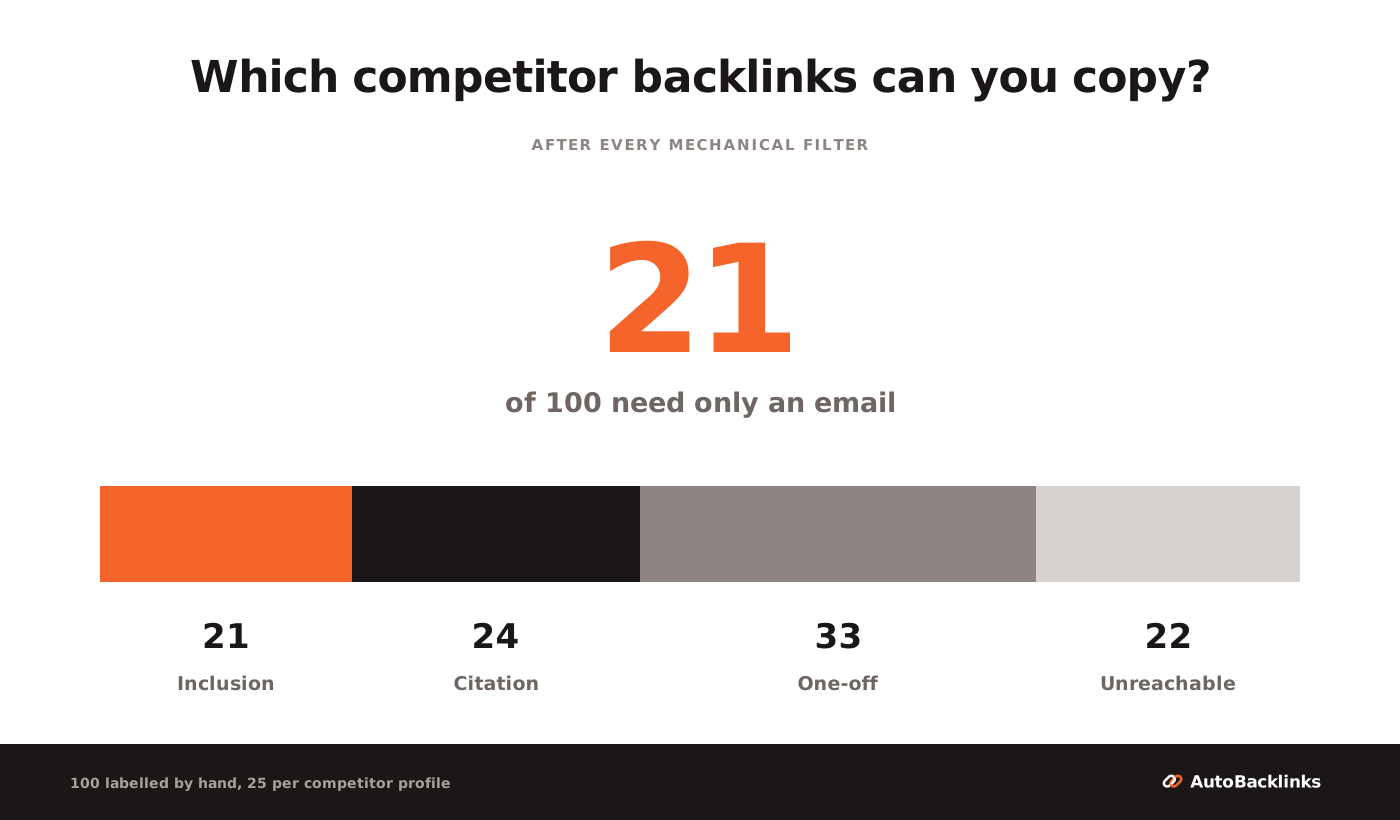
| Bucket | Count | What getting the same link takes |
|---|---|---|
| Inclusion | 21 | One email to the person who maintains the page |
| Citation | 24 | Publish something worth citing first, then pitch it |
| One-off | 33 | Nothing you can send |
| Unreachable | 22 | No editor exists |
Inclusion is a listicle, a roundup, a resource page or a tool mention on a page a human still edits. Calendly's "14 best customer success tools", a CRM comparison on Voyado, a Shopify support apps roundup on uvdesk. You write to the author, you make the case, sometimes you get added. This is the list you send.
Citation is someone quoting a number the competitor published. A survey firm citing "70%", a payments blog citing "84% of software customers". You will rarely get that link by asking for it. You get it by publishing your own number and pitching that, which is a content project before it is an outreach one.
One-off is founder press and other digital PR, funding coverage, a podcast appearance, a customer story, a partner page, a privacy policy. Four of Front's 25 sampled rows are coverage of its founder. No email changes that.
Unreachable is the machine-made web: company profiles, forum threads, mailing-list archives, scraper sites, aggregators that republished someone else's article.
How to sort competitor backlinks into those four buckets yourself
You do not need the page open. The title, the anchor text and the sentence around the link decide it almost every time:
- A title that counts things ("14 best…", "Top 10…", "Best X in 2026") with the competitor's bare brand name as the anchor is inclusion. The page is a list and lists take entries.
- A number or a claim as the anchor text ("70%", "seven times more expensive") is citation. The link is a source credit, and the page owner has no reason to swap the source.
- The competitor's founder, funding, product launch or privacy policy in the title, or a
/partners/,/integrations/or/legal/path on either end, is one-off. - A profile, a forum thread, a Q&A answer or a syndicated copy of someone else's article is unreachable.
The inclusion rate moves a lot by competitor
Pooling the 100 hides a spread of nearly three to one, so qualify a profile before you budget time against it. Read these as counts out of 25, not as rates:
| Competitor | Inclusion | Citation | One-off | Unreachable |
|---|---|---|---|---|
| Help Scout | 6 | 10 | 2 | 7 |
| Front | 4 | 1 | 13 | 7 |
| Gorgias | 8 | 7 | 5 | 5 |
| Intercom | 3 | 6 | 13 | 3 |
Gorgias returns 8 pitchable pages in 25 and Intercom returns 3. Front's profile is the clearest case of a company whose links came from being written about rather than from being listed, which is a fine way to get links and not one you can copy with an email.
Scaled up, the 21 percent inclusion rate puts roughly 539 pitchable pages inside the 2,566 survivors, about 13.5 percent of the 4,000 rows I started with. A 100-row sample is a blunt instrument and the draw was 25 per profile rather than proportional, so read 539 as a projection with a 95 percent range of roughly 330 to 750, not as a count.
Either way the planning number is the same: expect somewhere around one in seven of a competitor's best backlinks to be a page you can ask to join. Four competitor profiles is a few hundred prospects, not a few thousand, and that is a perfectly good quarter of outreach.
One more caveat worth stating plainly. All four of these companies sell customer support software. A category where links come mostly from product roundups would score higher, and one built on digital PR would score lower.
The 21 pages one email would get you
Because a rate is easier to argue with than a list, here is the whole inclusion bucket from the sample, which is what the method actually produces:
| From | Page |
|---|---|
| Help Scout | Coursera, "Customer Analytics: Types, Tools, and Benefits" |
| Help Scout | Calendly, "The 14 best customer success tools" |
| Help Scout | Kinsta Español, the WordPress agency tech stack guide |
| Help Scout | LearnWorlds, "What is User Onboarding?" |
| Help Scout | WPExplorer, "How To Succeed As A WordPress Developer" |
| Help Scout | Paytrail, "Customer Service 101 for E-Commerce in Germany" |
| Front | actiTIME, "Top 10 Email Management Tools" |
| Front | HubSpot Español, the shared-inbox guide |
| Front | UBC Small Business Accelerator, business operations resources |
| Front | Rapheo Web, a favourite-tools roundup |
| Gorgias | Voyado, "CRM for Ecommerce: Compare the Best Tools" |
| Gorgias | UVdesk, "Top 5 Most Popular Shopify Customer Support Apps" |
| Gorgias | Zendesk Brazil, "Top AI Agent tools for e-commerce" |
| Gorgias | Buildlist, "Best Customer Support Software" |
| Gorgias | LiveChat Taiwan, an AI customer service roundup |
| Gorgias | Toki, a loyalty marketing guide |
| Gorgias | ChannelReply's knowledge base, on eBay and Amazon integration software |
| Gorgias | Simplify Ecommerce, a live chat mistakes post |
| Intercom | Realtor.com, "9 must-haves for your real estate tech stack" |
| Intercom | Welcome Pickups, an airline customer experience post |
| Intercom | RocketJobs, a marketer's reading list |
Read down that list and the pattern is obvious: roundups, comparison posts, and guides that name tools in passing. Not one of them is a prestige publication, and that is the point. The highest-authority links in these profiles, rank 700 and up on DataForSEO's 0 to 1,000 scale, are mostly app stores, plugin directories, developer docs and marketplaces, which is to say pages with no editor to write to.
What judging competitor backlinks by hand costs
Judging 2,566 surviving competitor backlinks by hand costs 428 hours if you spend ten minutes on each, or 21.4 hours even at a brisk 30 seconds each.
The ten-minute figure is not invented. Wix's competitor backlink analysis guide prescribes it as the tiebreaker:
If you're still in doubt, run a quality check on the site. Browse it for ten minutes and note whether it has a good UX, covers topics from different angles instead of producing generic content, and publishes content regularly.
To be fair to that advice, it is a tiebreaker for doubtful sites, not an instruction to spend ten minutes on every row, and the same guide prescribes a Domain Trust floor of 30 or 40 and a traffic floor of 3,000 to 5,000 first. Applied to all 2,566 it comes to 428 hours, which is more than ten working weeks. Applied to a filtered shortlist it is less. Nobody publishes how much less, because nobody publishes what the shortlist is.
So take the floor instead. Thirty seconds per row, long enough to read a title and a URL and make a call, is 21.4 hours. The better part of three working days of clicking before a single email goes out.
Worth noting that Domain Trust is SE Ranking's metric specifically, so the 30 to 40 threshold does not transfer to an Ahrefs Domain Rating or a Semrush authority score without recalibration. I am deliberately not giving you a replacement number, because an authority floor does not separate inclusion from one-off. A Glassdoor profile and a Calendly roundup both clear any authority bar you set.
How AutoBacklinks analyzes competitor backlinks with AI
This is our tool, so take the description as a spec sheet rather than a review.
The competitor backlinks AI analyzer applies the same filter set this article applied, most of it at the API rather than after the pull, and then does the step the spreadsheet hands back to you. A scan asks for:
- At most 1,000 backlinks, one per referring domain.
- Live links only, sorted by source domain authority.
- Real anchor links, not images, redirects or canonicals.
- A spam score of 20 or under.
- A placement outside the footer, navigation, header, sidebar and collapsed blocks.
Nofollow links are deliberately kept, for the reason above. Because those filters run before the limit rather than after it, a scan returns up to 1,000 rows that have already survived them, where my run returned 1,000 raw rows that decayed to about 640 each.
Then every surviving row is read and labelled into one of 14 link types, of which 7 qualify as outreach prospects:
- Qualifying: paid placement, listicle, resource page, editorial, brand placement, source citation, journalist quote.
- Not qualifying: directory, forum or community, aggregator or SERP, press release, podcast interview, 301 redirect, unknown.
Paid placement is in the qualifying set as a detection label, not a recommendation. The point is that the scan tells you a competitor bought that link, so you can decide whether you want the same exposure on the same terms. The last section of this article is what to do with that.
Rows the classifier is not confident about, scoring under 0.6, plus any it labels unknown, trigger a second pass that fetches the linking page's content and reads it properly.
A full 1,000-backlink scan costs 105 credits, which is $3.32 on the $79 Starter plan and $2.51 on the $179 Growth plan. Credits bill in steps of 100 rows, so a 101-row scan costs the same as a 200-row one. Four competitors, the set this article used, is 420 credits or $13.27 at the Starter list price. A first-time launch price of $49 a month takes that to $2.06 a scan.
That is $13.27 against 21.4 hours. Do the arithmetic on your own hourly rate and decide whether it is worth it.
For the wider picture of what tools in this category actually read before they score a link, I tested nine of them in the AI backlink analysis roundup. That piece reports 78 of 100 links as a repeatable motion against this article's 21 of 100, and the two are measuring different things: a different four companies in a different category, and "repeatable motion" counts all seven qualifying labels including source citations, where "inclusion" here counts only the links one email gets you.
Competitor backlinks you should not copy
Some links in a rival's profile are there because somebody paid, and copying them buys their risk along with their placement.
Google's spam policies list "Buying or selling links for ranking purposes", "Low-quality directory or bookmark site links" and "Widely distributed links in the footers or templates of various sites" as link spam. If a competitor's best-looking link is a sitewide footer placement on 400 domains, that is not a tactic to steal.
Google's own policy page is more precise than the folklore, in both directions:
Google does understand that buying and selling links is a normal part of the economy of the web for advertising and sponsorship purposes. It's not a violation of our policies to have such links as long as they are qualified with a rel="nofollow" or rel="sponsored" attribute value to the
<a>tag.
So a paid placement is not automatically a violation. An unqualified one is. When you find a competitor link that smells paid, the question is whether the publisher marks it, and whether you would be comfortable asking them to.
Two more to treat with suspicion. A referring domain with real authority and almost no organic traffic is often an expired-domain play rather than a publication. And a domain whose traffic fell off a cliff and never recovered may be carrying a penalty, which Wix's guide flags for the same reason: inheriting that is not worth a link.
Four mistakes that make competitor backlink analysis feel broken
These are the four I see most, and each one has a number behind it earlier on this page.
- Judging the whole export instead of the overlap. The 4,000 rows resolve to 3,380 unique referring domains, and 448 of them link to two or more competitors. Collapse first, judge second, or you will evaluate the same site four times and start with the coldest targets.
- Treating an authority score as a decision. A Glassdoor profile and a Calendly roundup clear any Domain Rating floor you set. Authority tells you what a link is worth, never whether you can have it.
- Sending one email to all four buckets. A citation target has no slot to add you to, and a founder profile has nothing to ask for. Matching the ask to the bucket is the whole method.
- Trusting a referring-domain count. On the strongest part of these four profiles, 16.4 percent of links were already lost and another 308 sat in footers and sidebars that Google's own policy calls link spam.
How to get the competitor backlinks you picked
The bucket decides the pitch. Sending the same email to all four is the mistake that makes competitor backlink analysis feel like it does not work.
- Inclusion is a resource-page or listicle inclusion request. Name the page, say what is missing, say why your entry belongs next to the ones already there. Short. Where the page turns out to be a contributor column rather than a roundup, the same target takes a guest post pitch instead.
- Citation is a digital PR motion. Find the number the competitor got cited for, publish something better, then pitch it to the people already citing them. The skyscraper variant works here too: take the competitor page that earned the most links and build the version worth swapping to.
- One-off is founder press and digital PR, which is a different budget line and a different team. If it is where your competitor's best links come from, that is the finding, and a guest post pitch will not reproduce it.
- Unreachable gets dropped. The discipline is in not spending a week trying to pry open the 55 percent that cannot open.
Relevance beats authority on reply rate, which is the one thing I would stake a claim on from running these campaigns.
From there it is ordinary outreach: find a verified contact, write from the target page rather than a template, follow up twice. Guest post pitch examples that get replies covers the writing, and the outreach agent runs the sending end. If competitor replication is one of several methods you are weighing, nine ways to get backlinks, ranked puts it in context. To run a scan against your own competitor set, the trial is seven days and 120 credits, and it takes a card.
Keeping your competitor backlink list current
Re-run the whole thing quarterly. One row in six on the best part of a profile is already dead, which is a decay rate you cannot ignore for a year, and your competitors keep earning links whether or not you are watching.
Two things to add once the first pass is done:
- Set a new-backlinks alert per competitor. A link earned last month is a page that is actively covering your category, which is a better prospect than one that covered it in 2021.
- Keep the lost rows. A page that linked to a competitor and no longer does has an editor who already decided your category was worth a mention. That is a second, smaller prospect list most people throw away with the filter.
FAQ
How do I find my competitors' backlinks?
Pick three to five domains that outrank you for the keywords you want, then export their backlinks one link per referring domain from a backlink index such as Ahrefs, Semrush or DataForSEO. Google Search Console will not do this: its Links report is tied to a property you have verified ownership of. Treat the export as raw material, because roughly a third of it will not survive basic filtering.
What is the best free competitor backlink checker?
Ahrefs' free Backlink Checker, Moz Link Explorer and Ubersuggest all return competitor data without a paid plan, and all three lead with domain-level metrics rather than the full link list. Use them to see whether a competitor's links come from roundups or from press coverage. Building an actual prospect list from 26,000 referring domains needs a paid tier, because the filters are what you are paying for.
Should I copy every backlink my competitor has?
No, and most of them cannot be copied. In a sample of 100 competitor backlinks that had already survived every automated filter, 21 were pages where one email is the whole ask. The rest were citations of a number the competitor published, one-off coverage such as founder press and partner pages, or machine-generated pages with no editor to pitch.
How many competitors should I analyze for backlinks?
Analyze three to five. Below that you are reading one company's quirks rather than a pattern in your category, and above it the deduplication work outgrows the benefit. Prioritise domains that link to two or more of your competitors: across the four profiles measured here that was 448 of 3,380 referring domains, 13.3 percent, and a publisher that has covered your category repeatedly is a warmer target than one that did it once.
What is the difference between backlinks and referring domains?
A backlink is one link on one page. A referring domain is one website, which might link to you from fifty pages. For prospecting you want referring domains, because every link from the same site reaches the same editor. Every count in this article is one link per referring domain for that reason.
How often should I run a competitor backlink analysis?
Quarterly is enough for most sites. On the four profiles measured here, 16.4 percent of the strongest links were already lost, so a list you built a year ago has decayed meaningfully. Between full runs, a new-backlinks alert on each competitor catches the pages actively covering your category.
About Rachid Idali
Founder & SEO Strategist
Rachid Idali has spent 10 years in SEO, running multi-six-figure SEO and link-building budgets across content, digital PR, and outreach programs. He writes about practical systems for finding relevant prospects, earning links, and turning SEO operations into repeatable pipelines.
More from Rachid Idali