

What Are Backlinks? How They Work and Which Ones Count

by Rachid Idali
Last Updated: September 14, 2026
A backlink is a link on another website whose href points to a page on yours, also called an inbound link. The site doing the linking is a referring domain; the link itself is the backlink. Search engines use backlinks for two jobs: discovering your page, and judging whether other sites consider it worth citing.
That is the definition. The mechanics underneath it are where the money is, and they are mostly unmeasured.
What a backlink is: inbound links, referring domains and link equity
Start with the two words people use interchangeably, because the gap between them is where most link-building arithmetic goes wrong.
A referring domain is one website that links to you. A backlink is one link. If a site puts your URL in its footer and that footer runs on 40,000 pages, most backlink indexes will report 40,000 backlinks. One editor made one decision. You got one vote and forty thousand rows.
Across the twelve live profiles measured for this article, the median site carries 71 backlinks for every referring domain, ranging from 9 to 361. So when you read that a competitor has two million backlinks, the working translation is closer to twenty-eight thousand referring domains, and the count of genuine editorial mentions is smaller again.
Count referring domains. It is the unit that maps to decisions somebody made about you, and it is the unit to use when sizing how many backlinks you actually need for a keyword.
The thing a link is supposed to carry has a name: link equity, the informal term for the ranking value passed from one page to another, descended from Google's original PageRank algorithm. PageRank treated a link as a vote weighted by the voting page's own standing. Google stopped publishing the Toolbar PageRank score in 2016, but the idea that some links carry more than others survived it.
Google uses links for two separate jobs, and they can come apart. The first is discovery: a crawler that finds a link to your page has a route to crawl it. The second is ranking, where the link is one input into whether the page deserves the position. A link can be crawled and still pass nothing.
Internal links, external links and backlinks
Three terms, one difference, and it is only about direction.
- An internal link points from one page on your site to another page on your site. You control it completely.
- An external link, sometimes called an outbound link, points from your site to someone else's. You control it, and it is a vote you are casting.
- A backlink is somebody else's external link, pointing at you. You do not control it, which is exactly why it carries weight.
Internal links do a different job from backlinks and it is worth not confusing them. They build crawl paths, tell search engines which of your pages you consider most important, and distribute whatever equity arrives at your site across it. What they cannot do is act as third-party endorsement, because you wrote them.
That asymmetry is the whole reason link building is hard. You can add a hundred internal links this afternoon. Every backlink requires somebody else to agree.
Types of backlinks: dofollow, nofollow, sponsored and ugc
Every backlink either passes ranking credit or it does not, and the linking site decides which. A plain link with no rel attribute is what the industry calls dofollow. There is no rel="dofollow" value; the term just means the absence of the others.
Google publishes three values for links that should not pass credit:
rel="sponsored"for advertisements and paid placements, which Google's documentation calls paid links.rel="ugc"for user-generated content: comments, forum posts, anything a visitor typed rather than the publisher.rel="nofollow"for everything else you would rather not be associated with.
What happens to them is described carefully in Google's documentation on qualifying outbound links, and the exact phrasing matters:
Links marked with these
relattributes will generally not be followed.
"Generally" is doing real work in that sentence. Google announced in September 2019 that all three would be treated as hints rather than directives, effective immediately for ranking and from 1 March 2020 for crawling and indexing. A nofollow link is not a guaranteed zero, and it is also not something to plan a campaign around.
Now the adoption numbers, which are the part nobody measures. Across 141,328,148 backlinks from twelve live B2B SaaS profiles, rel="sponsored" appears on 32,424 links, or 0.023 percent. rel="ugc" appears on 100,137, or 0.071 percent.
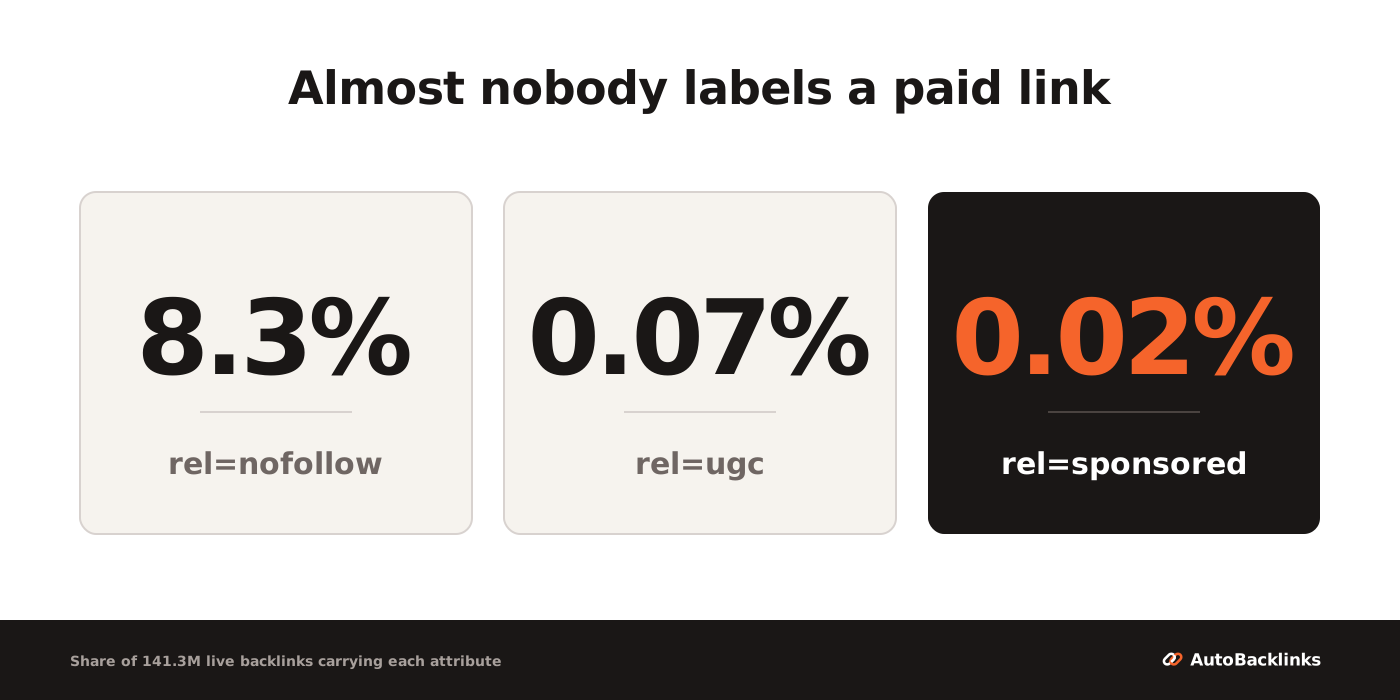
Plain rel="nofollow" is far more common at 11,749,122 links, or 8.3 percent. Measured by referring domain instead, 91,861 of 673,314 domains (13.6 percent) link out with nofollow only, and the median site in the sample sits at 16.1 percent.
Read those three together and the conclusion is hard to avoid. The web adopted nofollow and ignored the two attributes Google introduced to sit alongside it.
Types of backlinks by how you earn them
The rel attribute is one axis. The other is acquisition, which is the axis that decides what a link costs you and how repeatable it is.
- Editorial links. A writer cites you because your page answered something. Unprompted, unpaid, and the hardest to manufacture.
- Guest post links. You write the article, the host publishes it, your link sits in the body or the byline. Scalable, and the quality depends entirely on whether the host has readers.
- Link insertions, or niche edits. Your link is added to a page that already exists and already ranks. Faster than a guest post because there is nothing to write.
- Resource page links. A curated list of tools or references adds you. Relevant by construction, and finite.
- Directory links. A listing in a category index. Usually template-placed, often the source of a high backlink count and a low referring-domain count.
- Digital PR links. A journalist covers a study, a launch or a data point. The highest authority per link and the least predictable.
- User-generated links. Forum replies, comments, Reddit threads, question sites. Usually
rel="ugc"or nofollow where the platform is well run. - Image links. The anchor is an image, so the alt attribute does the work anchor text usually does. In this sample, 6.3 percent of the typed links are images rather than text.
Two of those categories, directories and user-generated links, are where most self-serve link building starts and where most of it stops mattering. They are template placements, and the next two sections are about why that is the distinction that counts.
What makes a backlink high quality
Authoritative, relevant, natural: adjectives are unfalsifiable. Here are four questions with checkable answers, ordered by how much they actually vary in the profiles measured below.
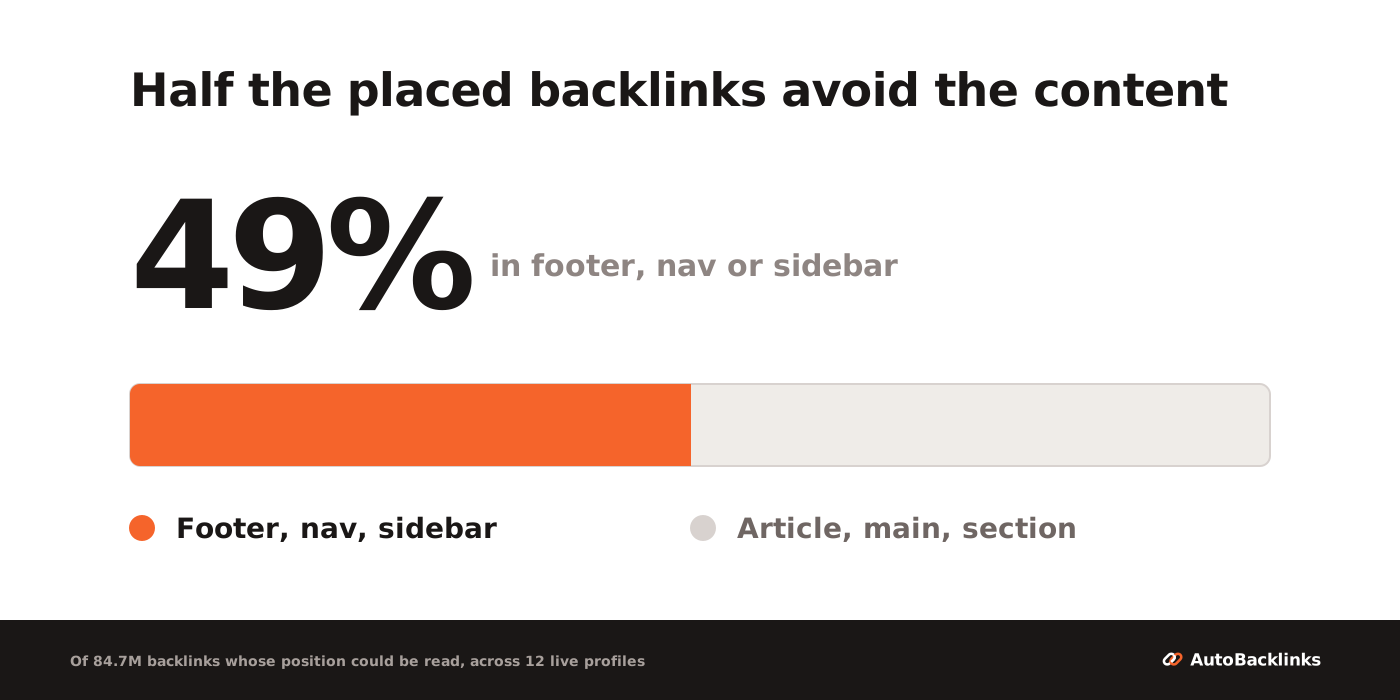
- Is it inside the content? Of the links whose position could be read in this sample, 48.6 percent are not. This is the biggest split by a distance, so it goes first. Below 20 percent site furniture reads as editorial-led; above 60 percent, the profile is template-led and the backlink count is mostly one decision multiplied.
- Does it pass credit? Read the
relattribute. 8.3 percent of the sample carries nofollow, and about one referring domain in seven uses nothing else. - Is the linking page about your subject? No index reports this, which is why it gets skipped. The two-minute manual version: does the page's H1, and the paragraph your link would sit in, contain the same entity your page is about? If you have to explain the connection, the answer is no.
- How many other links share the page? A link on a page with 80 outbound links is worth less than a link on a page with three. In the PostHog sample below, the median linking page carried 15 external links, which is a reasonable line to treat as ordinary.
Domain Rating is deliberately not on that list. It is a useful screen and a poor finishing criterion, because a strong domain that put your link in the footer of a page about nothing has handed you the weakest link in this article.
What 141 million backlinks look like in twelve real profiles
Here is the method, so you can repeat it. I took twelve B2B SaaS domains spanning three orders of magnitude in size, pulled each one's live backlink summary from DataForSEO's index in September 2026, and counted four things: total backlinks, referring domains, the HTML element each link was found inside, and the rel attributes attached.
Three limits, stated before the numbers rather than after them.
The placement denominator is not the whole sample. Of 141,328,148 backlinks, the crawler could pin a page position on 84,662,285. The other 56,665,863, or 40.1 percent, sat in markup too loose to place and are excluded rather than guessed at. Every placement percentage in this article is a share of the 84.7 million, never of the 141 million.
The link-weighted totals lean on two sites. typeform.com alone supplies 56.8 percent of the backlinks, and with ghost.org that reaches 64.1 percent. Typeform is only 33 percent of the referring domains, so the per-site median is the more representative read and I have led with it wherever the two disagree.
This is one index's view of twelve B2B SaaS companies. No publishers, no ecommerce, no local, nothing outside English. It is a sample of complete live profiles rather than a crawl of pages, which is the point: profile-level shape is what you inherit when you take over a site, and it is not recoverable from a page-level study.
| Site | Referring domains | Backlinks | Backlinks per domain | In footer, nav or sidebar | Domains that only nofollow |
|---|---|---|---|---|---|
| typeform.com | 222,465 | 80,264,148 | 361 | 43.5% | 8.8% |
| buffer.com | 95,090 | 18,146,710 | 191 | 3.5% | 16.6% |
| hotjar.com | 88,814 | 6,818,739 | 77 | 67.1% | 14.5% |
| kit.com | 76,604 | 5,048,780 | 66 | 58.6% | 27.8% |
| ghost.org | 57,706 | 10,318,273 | 179 | 98.0% | 7.9% |
| tally.so | 49,859 | 13,816,188 | 277 | 62.4% | 9.5% |
| cal.com | 42,951 | 6,002,313 | 140 | 70.8% | 11.8% |
| plausible.io | 15,251 | 566,726 | 37 | 85.2% | 15.7% |
| posthog.com | 11,924 | 164,566 | 14 | 20.0% | 18.8% |
| fathom.video | 5,109 | 69,271 | 14 | 2.6% | 25.3% |
| baremetrics.com | 4,066 | 35,346 | 9 | 1.1% | 24.7% |
| savvycal.com | 3,475 | 77,088 | 22 | 48.4% | 30.7% |
Three findings come out of that table.
- Placement is the majority case, not a tiebreaker. Of the 84,662,285 links whose position could be read, 41,145,755 sit in a footer, navigation bar, header or sidebar. The median site is at 53.5 percent.
- The spread between sites is enormous. ghost.org has 98.0 percent of its placed links in site furniture. baremetrics.com has 1.1 percent. Same industry, same index, opposite profiles.
- One domain is not one link. The median site carries 71 backlinks per referring domain, from 9 at baremetrics.com to 361 at typeform.com.
Where the backlink sits: footer links versus content links
A link in a footer appears on every page of the linking site. A link in a paragraph appears once, because somebody wrote it there on purpose.
Ghost and Buffer are the clean illustration. Ghost is open-source blogging software, so thousands of sites run a "Published with Ghost" credit in the theme footer: 98.0 percent of its placed links, and the reason it carries 179 backlinks per referring domain. One template link, multiplied by every page on every site running the theme.
Buffer's profile is the inverse at 3.5 percent. Whatever else those links are, they are not site furniture.
Ghost is not doing anything wrong. It is doing something different, and the difference is invisible in a backlink count. If you benchmarked against Ghost's ten million backlinks without looking at where they sit, you would set a target that means nothing.
Google names footer and template links in its spam policies, in a list of examples of link spam:
Widely distributed links in the footers or templates of various sites
Read that for what it says. It describes a scheme, links pushed across many sites to move rankings, and it is not a published discount rate for footer placement generally. What it does establish is that Google looks at where a link sits and at how widely the same link is distributed, which is enough to justify making placement your first filter rather than your last.
Anchor text in a real backlink profile
Anchor text is the clickable words. Vary it, do not over-optimize it, keep commercial anchors rare. Here is what varying it looks like when nobody is managing it at all.
plausible.io has 5,775 distinct anchors pointing at it. Taking the top twenty by referring domain count, which between them cover 12,819 referring domains, 93.2 percent are either the brand name or a bare URL.
- "Plausible" on 3,610 referring domains
- "Plausible Analytics" on 2,472
- the full URL of its data policy on 1,697
- "plausible.io" on 850
- "here" on 221
- no anchor text at all on 318
Not one commercial keyword phrase in the top twenty. No "web analytics tool", no "Google Analytics alternative". The anchors a real profile accumulates are the company's name, its address, and the word "here".
One more entry is worth naming, because every profile of any size collects some of it. The ninth most common anchor pointing at plausible.io is an advertisement for a Telegram channel selling backlinks, sitting on 332 referring domains. All 332 are nofollow, which is both the tell and the reason it does nothing: a link-selling network spraying anchors across junk domains is not passing credit to anybody.
PostHog's highest-authority backlinks are privacy policies
A worked example, because the four questions catch things a summary does not.
I pulled the forty highest-authority referring domains pointing at posthog.com, one link per domain, ranked by the index's own authority score. All forty are dofollow. The median linking page carries 15 external links. On paper, a very clean set.
Twenty-four of the forty link to a privacy or data-policy page rather than to editorial content.
The likeliest explanation is structural rather than editorial: sites that install PostHog disclose the analytics they run, and the convention is to link the vendor's own policy. I have not verified that all 24 are customers, and a competing explanation is that one widely copied privacy-policy template carried the link with it. Either way the mechanism is not somebody choosing to write about the product.
The same pattern shows in plausible.io's anchor list, where its data-policy URL is the third most common anchor across 1,697 referring domains.
These are real links from real sites and they are worth having. They are also compliance boilerplate, and they cluster on a page that will never rank for anything commercial. Scoped to these forty: what they reflect is an install base, not editorial coverage.
Lost backlinks and broken backlinks
Backlinks are not permanent. Sites get redesigned, editors prune old posts, pages get deleted, and the link goes with them. That attrition is normal and mostly outside your control.
The half you do control is the broken backlink: a live link from someone else's page pointing at a URL on your site that now returns a 404. The vote was cast, the equity arrives, and it lands on nothing.
Across the twelve profiles, 1,263,288 backlinks (0.89 percent) point at a dead URL, spread over 45,437 broken pages. The distribution is not even. kit.com has 23,166 broken pages taking 311,890 links, which is what happens when a company rebrands and moves its URL structure. cal.com has 394,894 broken backlinks. baremetrics.com has 297.
The fix is unglamorous and cheap. Pull the list of URLs on your own site that have inbound links and return a 404, then 301 redirect each one to the closest live equivalent. A 301 sends whatever that link carries to a page that exists. A 404 sends it nowhere. Do that before you spend anything on earning new links, because it is the only link building where you do not have to persuade anyone.
Do you need to disavow bad backlinks?
Almost certainly not, and the sample above is the argument.
Google provides a disavow tool inside Search Console, and its documentation is worth reading in full before you touch it. It is a blunt instrument: you are asking Google to ignore links, and a mistake means asking it to ignore links that were helping you.
Look at what spam actually looks like when it lands on you. The 332 domains carrying that Telegram advert at plausible.io are, every single one, nofollow. They pass nothing. Disavowing them would change nothing, because "ignore this link" and "this link already passes no credit" have the same effect.
That is the general shape of unsolicited link spam: cheap, automated, and placed on sites that nofollow everything by default. The scenario where disavowal is the right move is narrow, and it is the one where you have a manual action in Search Console naming unnatural links, or where you inherited a domain that paid for links at scale and you can name the campaign that bought them.
Absent either of those, the honest advice is to look at your spam links once, confirm they are the usual nofollow noise, and go back to work.
How to check your backlinks
Three sources, in the order I would use them, with what each one cannot do.
- Google Search Console, Links report. The only view of your links sourced from Google, and it costs nothing beyond verifying the site. It samples, it lags, and it reports no placement and no
relattribute at all. Use it for existence, not for judgement. - A backlink index such as Ahrefs, Semrush or DataForSEO. Each crawls the web itself, so each disagrees with the others and with Google. Pick one and stay on it: the trend within one index is meaningful, the absolute number across two is not.
- A competitor's profile, which is where the actionable work is. Their links are pages that already link to something like you, so filter that profile by the four questions above and what is left is a list worth pitching. Producing that list is what our competitor backlinks analyzer is for, and several prospecting tools cover the finding half of it.
On placement specifically, be warned that no mainstream backlink UI exposes it as a filter. The numbers in this article come from a field in DataForSEO's API, referring_links_semantic_locations, which returns the count of links found inside each HTML element. If you want your own chrome share, that endpoint is where it lives, and one call per domain is enough.
For the same standard I am applying to everyone else: autobacklinks.ai has 3,225 live backlinks from 104 referring domains, 18 of which link with nofollow only, and none pointing at a dead URL. That is 31 backlinks per referring domain, which by this article's own test means most of those 3,225 are one decision repeated. They are. The largest single source lists us on 580 of its pages, and most of the rest are SaaS tool directories doing the same thing at a smaller scale. It is a small profile built on template placements and I am not going to dress it up as anything else.
What Google's link spam policy bans
The rules are short and public, and reading them beats reading someone's summary. Google's spam policies define the offence like this:
Link spam is the practice of creating links to or from a site primarily for the purpose of manipulating search rankings.
The examples that follow include buying or selling links for ranking purposes, excessive link exchanges, low-quality directory links, forum comments with optimized links, and widely distributed footer and template links.
On paid links, Google is less absolute than the industry assumes:
Google does understand that buying and selling links is a normal part of the economy of the web for advertising and sponsorship purposes. It's not a violation of our policies to have such links as long as they are qualified with a
rel="nofollow"orrel="sponsored"attribute value.
Either attribute qualifies, so the compliant path is wider than the sponsored adoption number alone suggests: 8.3 percent of the links in this sample carry one of the two. What that figure hides is that almost all of it is plain nofollow, applied by platforms that nofollow everything, rather than a publisher deliberately labelling a paid placement. If you are considering buying backlinks, the gap between a paid link and a qualified paid link is the risk you are buying.
How to get backlinks that count
Links that survive the four questions come from a person deciding to cite you. There are four reliable ways to prompt that decision, and they differ mostly in what they cost.
Publish original data
Produce a number nobody else has, then make it easy to quote. This article is an example of the method: twelve API calls, an afternoon of arithmetic, and a set of figures that did not exist before. Cost is your time, the links arrive slowly, and they keep arriving for years.
Get into comparisons people are already writing
Listicles, alternatives pages and category roundups are published constantly, and most authors are looking for entries. The ask is small, which makes the reply rate high. The limit is that the pool is finite and you can only be added once per page.
Replace a broken link
Find a page citing a resource that now 404s, and offer yours. You are solving the author's problem rather than asking for a favour, which is the highest-converting pitch in link building. The work is in the finding, not the asking.
Ask the author of a relevant page
The unglamorous one, and the one that scales furthest. Someone wrote a page adjacent to your subject; you tell them what you have and why it fits their specific paragraph. Reply rate depends almost entirely on whether the page was genuinely relevant.
All four are outreach, and all four end the same way: a person decides to put your link inside a sentence. That is the only kind of link this article has been arguing for.
For what it costs in practice, the one campaign published in full ran 187 emails through 155 opens and 6 bounces to 32 replies. The breakdown is here, including the part that decided the outcome, which was which sites received the email rather than what the email said. That same mechanism is increasingly what decides whether AI search engines cite you, since the editorial mentions do double duty.
If you would rather run the finding, qualifying and asking as one pipeline than as four tools, that is what we built, and you can try it.
FAQ
What is a backlink in SEO?
A backlink is a link on another website that points to a page on yours. Search engines use it for two jobs: finding your page in the first place, and judging whether other sites consider it worth citing. The site that links to you is called a referring domain, and one referring domain can produce many backlinks if it links from a template or a footer.
What is the difference between a backlink and a referring domain?
A referring domain is one website linking to you. A backlink is one link. Across twelve live B2B SaaS profiles measured for this article, the median site had 71 backlinks for every referring domain, because a single footer or sidebar link gets counted once per page it appears on. Referring domains is the more honest number, since it maps to how many separate sites decided to link to you.
Do backlinks still matter in 2026?
Yes, though not on their own. Google uses links both to discover pages and as one input into ranking them, and the same editorial mentions feed which sources AI answers cite. What has changed is the tolerance for volume: across twelve B2B SaaS profiles, 48.6 percent of the links whose position could be read sit in footers, navigation and sidebars, with a spread from 1.1 percent to 98.0 percent depending on the site.
Are nofollow links worth anything?
They are worth having and they are not worth planning around. Google announced in September 2019 that nofollow, sponsored and ugc would be treated as hints rather than directives, and its documentation says links carrying them "will generally not be followed". Across the twelve profiles measured here, 13.6 percent of referring domains link out with nofollow only, so most sites that link to you at all are capable of passing credit from somewhere.
How do I check my backlinks?
Start with the Links report in Google Search Console, the only view sourced from Google itself, which shows that a link exists but not where on the page it sits. Add one backlink index such as Ahrefs, Semrush or DataForSEO for depth, and stay on the same one, because two indexes will never agree on an absolute count. For placement, no mainstream interface exposes it: the figures in this article come from DataForSEO's referring_links_semantic_locations field, one call per domain.
About Rachid Idali
Founder & SEO Strategist
Rachid Idali has spent 10 years in SEO, running multi-six-figure SEO and link-building budgets across content, digital PR, and outreach programs. He writes about practical systems for finding relevant prospects, earning links, and turning SEO operations into repeatable pipelines.
More from Rachid Idali