

Backlink Generators: What They Actually Build

by Rachid Idali
Last Updated: October 12, 2026
A backlink generator does not build backlinks. It prints a list of URLs with your domain pasted into them, and the pages at the other end of those URLs do not link to you.
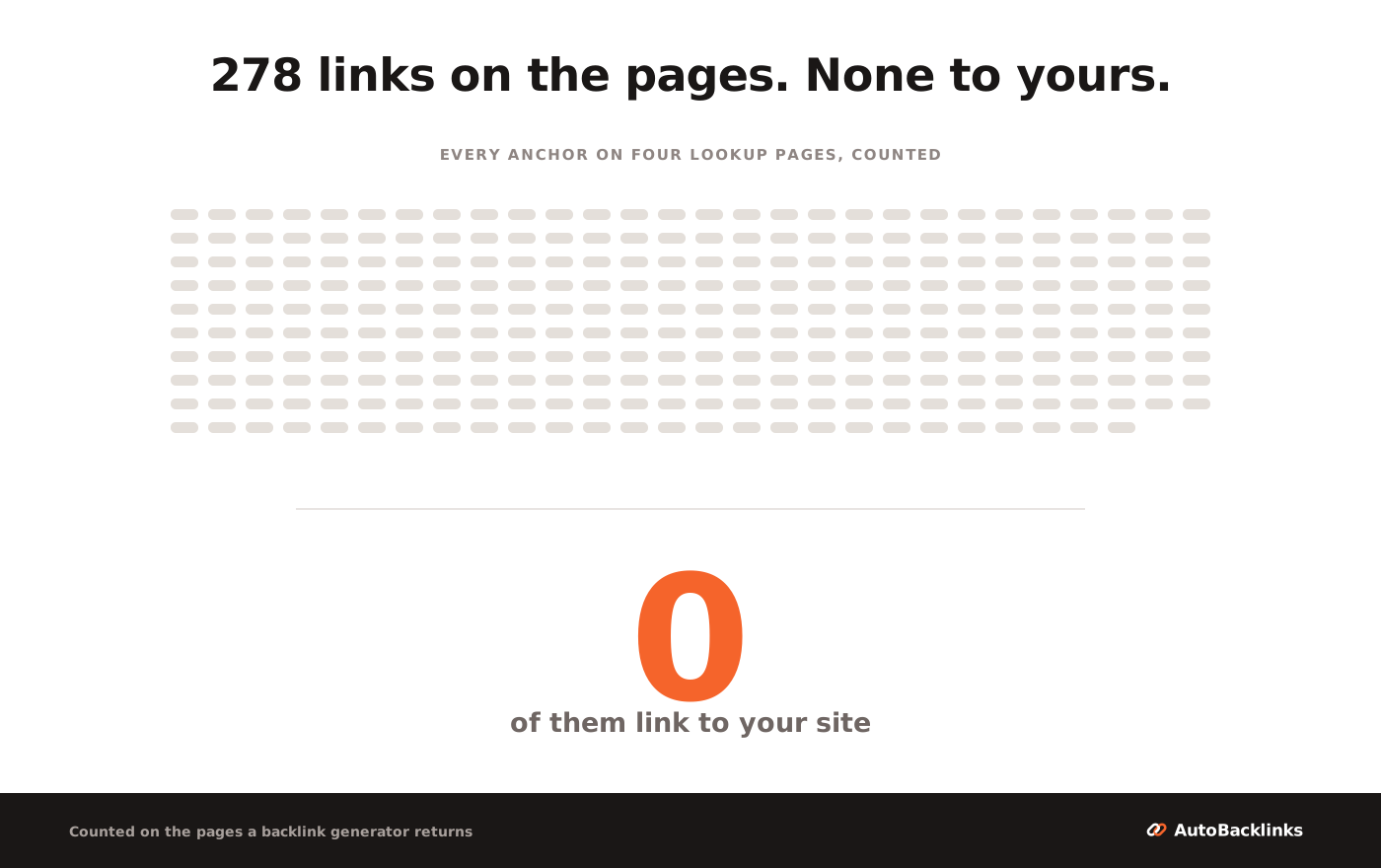
I checked. I took the whois and site-stats pages that these tools hand back, requested each one for my own domain, and counted every anchor tag the page served. 278 links across four pages. Not one of them pointed at autobacklinks.ai. The fifth never served a record at all, which turned out to be the most useful result of the lot.
So the question is not whether these tools work. It is why anyone still builds them, and what you should do instead with the same half hour.
What a backlink generator actually does
The pitch barely varies. Paste your URL, press a button, receive backlinks. Search Engine Reports promises "90+ Free & Authority Backlinks" in its page title. DupliChecker offers "[One-Click] Free High Authority Backlinks" in its own.
The word "generator" implies the tool goes out and makes something: submitting your URL to directories, pinging services, creating pages. That is not what happens, and you can check it yourself, because the code that builds the list is served to your browser. DA PA Checker loads its generator from dapachecker.org/web_assets/js/backlink-generator.js, and the file is 4KB of readable JavaScript.
Here is the line that does the work, with its line break closed up:
domain = data[i][0].replace('{domain}', url);
Read what that says. The server sends back a list of URL templates, each containing the placeholder {domain}. Your browser swaps your domain into each template and prints the result in a table. The function around it makes exactly one request, receives the template list, loops through it, and renders the rows.
Your URL does travel as far as the tool's own server, which is what returns the template list. It goes no further. Not one of the sites in the table is contacted, nothing is posted to any of them, no account is created and no page is written. The "backlinks" are a string operation performed in your own browser.
BackLinkr.net goes further and runs a progress bar reporting how many links were "successfully created" and how many "failed." The counters do move. What its script is counting is one request to its own server per entry on its list, which is a different thing from a link appearing on a page.
What the generated backlinks look like: I counted every link on them
So what is at the end of those addresses? Automatically generated lookup pages: a StatsCrop traffic estimate, a SitePrice valuation, a Website Informer profile, a Whois.com record, a DomainTools whois lookup.
These pages already exist for your site. They existed before you ran the tool and they will exist if you never run it. Nothing about pressing the button brings them into being.
The method, so you can repeat it. One domain, autobacklinks.ai. Each URL requested directly and logged out, the way a crawler arrives. Every <a> tag in the delivered HTML parsed, and the host of each href compared against my own.
| Page | Anchors served | Linking to my domain |
|---|---|---|
| whois.com | 101 | 0 |
| statscrop.com | 68 | 0 |
| siteprice.org | 66 | 0 |
| website.informer.com | 43 | 0 |
| Total | 278 | 0 |
Not one anchor on any of those pages points at my site. The domain name appears as plain text, in the page title and the body copy. A link to it does not.
What is there instead explains why:
- Search queries, not links. SitePrice renders
google.com/search?q=site:autobacklinks.aiand the Bing and Yahoo equivalents. Those are links to Google, not to me. - Internal navigation. StatsCrop links to its own mobile version of the same page. SitePrice links to its own competitors page.
- A sales link. Whois.com carries a
rel="nofollow"link to a Sedo domain-sale listing, which is a link about my domain rather than to it, and a nofollowed one at that. - A tracker redirect. Website Informer is the only one of the four with a path that routes to my domain at all, through
website.informer.com/visit?domain=autobacklinks.ai. That is a redirect through their own click tracker, not a direct link.
That last one is worth a moment on its own, because it is the cleanest thing I found. Website Informer's robots.txt contains the line Disallow: /visit. The single path on the single page that gestures at my domain is the exact path the site tells every crawler to skip. Even the near miss is sealed off.
The fifth page served a CAPTCHA
DomainTools is the highest-authority destination in the whole list, and it never served me the whois record. Logged out, the URL returns a "Whois Lookup Captcha" interstitial instead.
So I dropped it from the count above rather than pass off a challenge page as a record. But the result is more useful than another zero would have been: the strongest domain on the list does not show the page to an anonymous visitor at all, and a request announcing itself as Googlebot got the same challenge.
These are not junk domains, and that is the point. On DataForSEO's backlinks rank score, which runs from 0 to 1,000 and is calculated from referring-domain counts, DomainTools sits at 602, Website Informer at 545, Whois.com at 489, StatsCrop at 426 and SitePrice at 370. For scale, ahrefs.com scores 608 on the same metric. The authority is real, which is exactly why the tools name these sites.
If you want the mechanics of why a link has to be a link before any of this matters, the attributes and placement rules are in our guide to how backlinks actually work and which ones count.
Why free backlink generators are free
Nobody builds and hosts a tool for nothing. When a tool costs you no money, the question worth asking is what it earns instead.
Read what the pages carry. DupliChecker and Search Engine Reports both run a Semrush affiliate banner, and it is the same banner: byte for byte the same affiliate tracking URL on both sites. BackLinkr.net carries four AdSense units on a single page under one publisher ID, plus Fiverr affiliate redirects sitting behind link classes named fiverr1, fiverr2 and fiverr3.
The product is the ad impression and the affiliate click. The link table is the thing that keeps you on the page long enough to produce them.
There is a second tell, inside the tools' own marketing copy. Search Engine Reports explains, correctly, that a link should be related to your niche, and says of a link that is not: "if it is out of your niche, then it will be considered as a low-quality backlink and negatively affect your SEO."
That is sound advice, and it describes the tool selling it. A generator that pastes your domain into a fixed list of lookup pages cannot know your niche, has no way to find a relevant site, and hands the identical list to a dentist in Leeds and a Kubernetes vendor in Berlin.
What Google's link spam policy says about automatic backlinks
Google's spam policies, part of Google Search Essentials, are published and specific. Three lines matter here.
The first names the category directly, in the list of link spam examples:
Using automated programs or services to create links to your site
The second covers where generated links tend to point:
Low-quality directory or bookmark site links
The third is the governing definition, stated above both of those:
Link spam is the practice of creating links to or from a site primarily for the purpose of manipulating search rankings.
That is an intent test. It does not ask what the tool is called. It asks why the link exists.
Now the honest version of the risk, because the two halves of this category fail in different ways.
For the lookup-page generators, the realistic outcome is that nothing happens. No links are created, so there is nothing for Google to count and nothing to act on. You lose an afternoon, not a ranking.
The other half genuinely does post, and that is where the risk lives: automated profile creation, comment drops, bulk directory submissions, forum signatures. Those produce real links on real pages, the policy lines above name them directly, and a manual action for link spam is a documented outcome that appears in Search Console under Manual actions.
You can tell which one you are looking at in about a minute. Run the tool on your own domain, open three or four of the URLs it hands back, and search each page for your domain name. If your domain is absent, or present only as text, nothing was built. If you find a profile page, a forum post or a directory entry that did not exist before, with your link in it, the tool posts, and that is the one to close.
That test also tells you what kind of link you would be getting. rel="ugc" is the value Google defines for user-generated content such as comments and forum posts, and rel="nofollow" is its catch-all for links it would rather not follow. Both tell a search engine to discount the link. A dofollow link, one that passes ranking credit, is the thing that is actually hard to get, and it is hard to get precisely because a person has to agree to it.
Google also publishes the escape hatch honest sites use: paid and sponsored links are not a violation when they carry rel="nofollow" or rel="sponsored", the same machinery covered in our pieces on buying backlinks and on when a link exchange crosses the line.
Automated link building that Google allows
The search that brought you here is not a stupid one. Behind "backlink generator" is a reasonable want: backlinks, without doing hundreds of hours of manual prospecting and emailing. That want is legitimate and automation is a legitimate answer to it.
The distinction is where the automation sits.
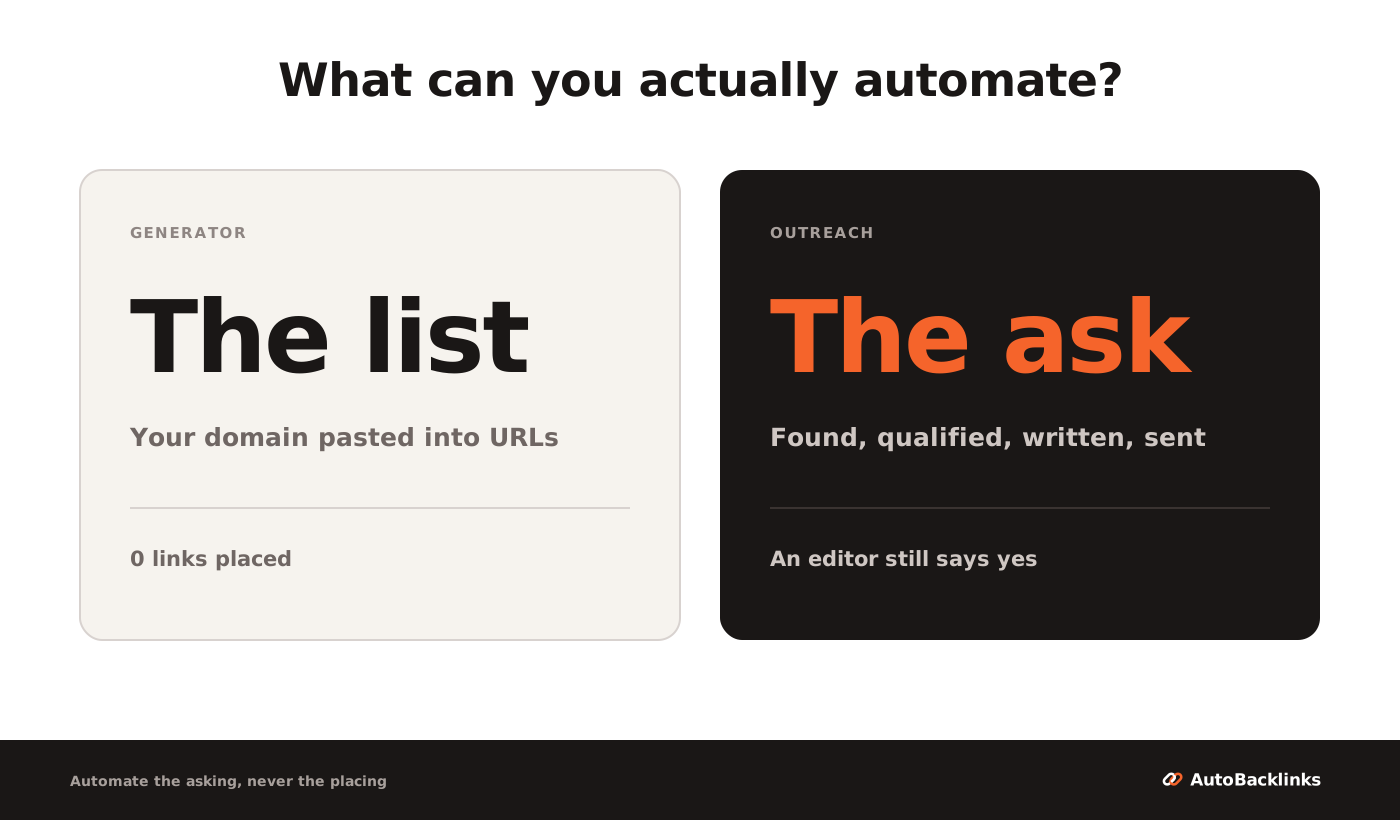
Google's policy names automated creation of links. It does not name automated research, automated qualification, or automated email. Those are ordinary marketing operations, and they are where almost all of the manual labour in link building actually lives.
So the line is simple. Automate everything up to the ask. Never automate the placing.
- Finding candidate pages is a search problem. A machine is better at it than you are.
- Qualifying them on topical relevance, domain authority, organic traffic and referring domains is a filtering problem. Same answer.
- Writing a first draft of the email from the specific page you want a link on is a reading-and-drafting problem. Also automatable.
- Sending and following up on a schedule is a scheduling problem.
- The placement is a human editor reading your email and deciding whether your page is worth citing. That part stays human, and it is the part that makes the link worth having.
A link that an editor chose to publish is a link that exists, is indexed, and carries the editorial judgment Google's whole ranking model is built to reward. A link your browser printed into a table is none of those things.
That is the shape of our own AI backlink outreach agent.
How to get backlinks free without a backlink generator
If the appeal was the price rather than the automation, the free routes are real, and none of them involves a generator. They cost time instead of money, which is the actual trade.
- Get listed where your buyers already look. Industry directories, local listings, supplier and partner pages, the "tools we use" page of a customer. These are requests to a person, and they are usually granted because the listing is true.
- Answer journalist and creator requests. Reporters and bloggers publish calls for sources constantly, and a specific, quotable answer earns a cited link from a publication you could not pitch cold.
- Publish one thing worth citing. A count, a teardown, a small original dataset. This article is an example of the format: the census above is specific enough that someone can repeat it, and specific enough to quote.
- Reclaim the mentions you already have. Find pages that name your brand or your product without linking, and ask. It is the easiest ask you will make, because the writer has already decided you were worth mentioning.
- Fix your own broken inbound links. Links pointing at dead URLs on your site are links you have already earned and are throwing away.
The full set of routes, with the numbers on which ones actually produce links, is in our guide to how to get backlinks, and the tools that handle the research half are compared in our roundup of link prospecting tools.
How AutoBacklinks builds backlinks automatically
AutoBacklinks is our own tool, so treat this section as a spec sheet rather than a review.
It runs the pipeline described above:
- Discovery. Web scans and competitor backlink scans produce candidate pages: guest-post targets, link-insertion opportunities, resource pages, listicles, directories and pages already linking to your competitors.
- Relevance scoring. Each prospect is scored on topical fit. A high-authority site with no topical connection to yours does not make the campaign, which is the opposite of how a generator's fixed list behaves.
- SEO filtering. Domain rating, organic traffic, referring domains and backlink counts, applied as filters rather than as the only criterion.
- Verified contacts. Deliverable addresses with approval controls, so you see the data before anything sends.
- Page-specific emails. Each email and each follow-up is written from the prospect's own page, not merged into a template.
- Sending and reply tracking, so what happened to each prospect is on the record.
The same actions run over MCP, so Claude, ChatGPT, Cursor and other MCP clients can operate campaigns from chat. Every credit spend and every send still waits for your approval.
What it does not do is place the link. It cannot, and neither can anything else that is honest about this. A human editor reads the email and says yes or no.
On what that looks like in numbers: in a published campaign in the education niche we sent 187 emails and got 32 replies, a 17.1% reply rate, with 6 bounces. The lever was not the copy. It was the prospecting, which is the part a generator skips entirely.
There is no permanently free plan. There is a 7-day trial with 120 credits, which requires a card and can be cancelled from billing before it converts, and paid plans start at $79 a month for 2,500 credits. If you want to run the pipeline on your own site, start there.
FAQ
Do backlink generators actually work?
No. I requested the lookup pages one of these tools returns, for my own domain, and parsed every link on them: 278 anchor tags across four pages, none linking back to my site. A fifth, DomainTools, served a CAPTCHA instead of a record. The tool does not submit your URL to any of those sites: it sends your domain to its own server, gets a list of URL templates back, and pastes your domain into them in your browser.
Are free backlink generators safe?
For the whois and stats variety, the honest answer is that they are mostly harmless and useless, because they do not create anything that Google could count against you. The cost is your time and your attention, which is what the AdSense units and affiliate banners on those pages are there to collect. Tools that genuinely do post, through automated profiles, comments or bulk directory submissions, are a different matter and carry real risk.
Can a backlink generator get my site penalized?
Possible, but not the usual outcome. Google's spam policies name "using automated programs or services to create links to your site" as link spam. The catch is that most free generators create no links at all, which leaves nothing to penalise. The risk sits with tools that genuinely post to profiles, comments and bulk directories. Check Search Console under Manual actions, which is where a link spam action would appear.
What is the best free backlink generator?
The question has no good answer, because none of them generate links. If the appeal is the price, the free routes that do work are listings where your buyers already look, answering journalist requests, publishing one thing worth citing, asking for a link on pages that already mention you unlinked, and fixing inbound links pointing at dead URLs on your site. Each costs time rather than money.
How do I build backlinks automatically without spam?
Automate every step up to the ask, and none of the placement. Finding candidate pages, scoring them for relevance, filtering on authority and traffic, finding verified contacts, drafting an email from the target page and scheduling follow-ups can all run by machine, and none of that is what Google's policy describes. The link itself has to be placed by an editor who read your email. A tool that claims to skip that step is either doing nothing or doing something you would not want attached to your domain.
About Rachid Idali
Founder & SEO Strategist
Rachid Idali has spent 10 years in SEO, running multi-six-figure SEO and link-building budgets across content, digital PR, and outreach programs. He writes about practical systems for finding relevant prospects, earning links, and turning SEO operations into repeatable pipelines.
More from Rachid Idali