

How to Get Backlinks in 2026: 9 Methods Ranked

by Rachid Idali
Last Updated: September 16, 2026
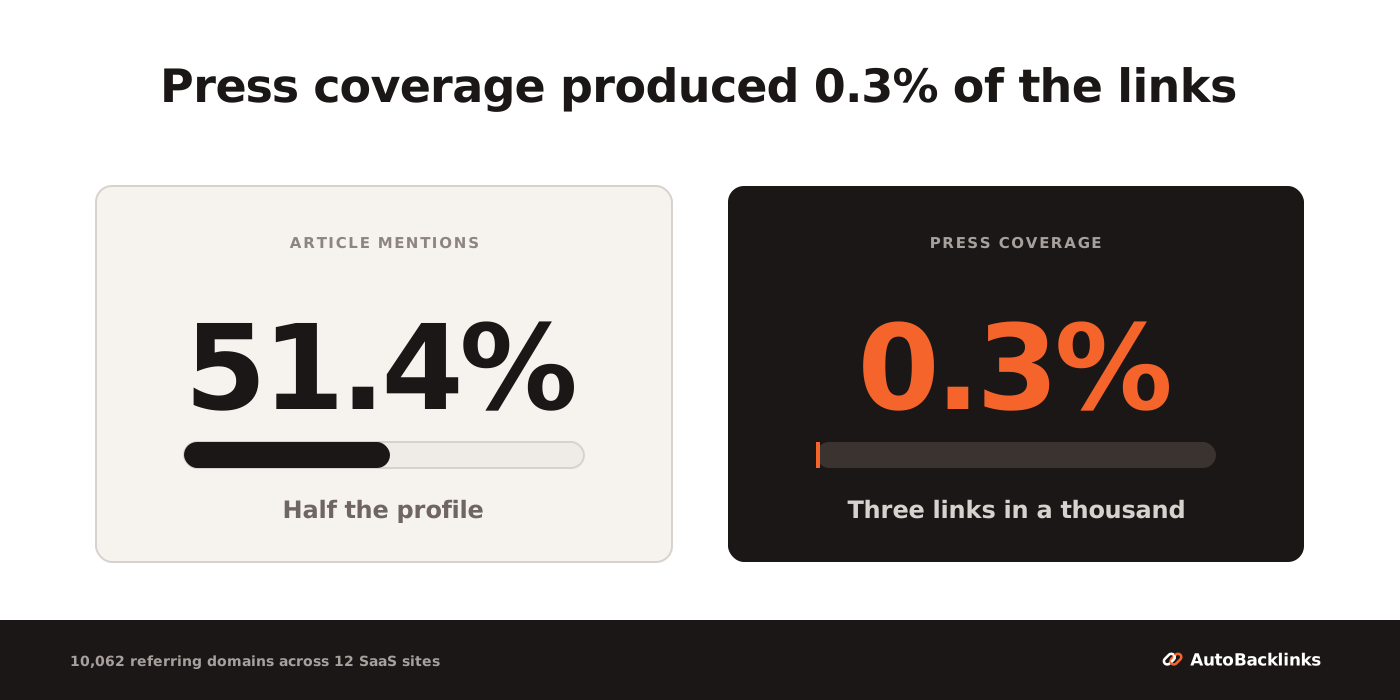
There are nine places a backlink can actually come from, and one of them produces half of them. To get backlinks you either publish something worth citing, ask a person to add your link to a page they already own, or fill in a form. Across 10,062 referring domains taken from twelve real SaaS sites, 51.4 percent of the links were ordinary in-content mentions inside articles, 12.4 percent came from roundup and alternatives pages, and 0.3 percent came from press coverage.
Press coverage gets its own numbered section in almost every guide to this subject, and never a number next to it.
That is the gap this article is for. The usual advice is not wrong, it is unranked. Nine or ten tactics get listed as nine or ten equal bullets, not one of them carries a yield, and you have no way to tell which is worth a Tuesday.
So I measured it.
What 10,062 real backlinks say about how to get backlinks
I pulled the live backlink profiles of twelve independent SaaS companies through DataForSEO, took the highest-authority 1,000 referring domains from each, and classified every one of them by the page the link sits on. One link per referring domain, so the count is votes, not repetitions of the same vote.
The twelve:
- usefathom.com, simpleanalytics.com, savvycal.com
- raycast.com, linear.app, lemlist.com
- testimonial.to, hypefury.com, userlist.com
- chartmogul.com, outseta.com, missiveapp.com
Eleven returned a full thousand. userlist.com has only 971 referring domains in total, so its entire profile is in the sample.
Then I threw away the junk before counting anything. 1,909 of those 11,971 domains, almost exactly one in six, carry a spam score of 30 or higher, and they are removed. That leaves 10,062 domains that a reasonable person would call links.
Classification after that is rule-based on the linking page's host, URL and title. A page on forum.ghost.org is a community link. A page titled "15 Best Google Analytics Competitors & Alternatives" is a roundup. A URL ending /privacy is a policy page.
Here is what the ten thousand look like.
| Where the link came from | Share | Dofollow | Median domain rank |
|---|---|---|---|
| In-content mention inside an article | 51.4% | 76.0% | 367 |
| Roundup, listicle or alternatives page | 12.4% | 69.7% | 364 |
| Directory or app marketplace | 5.4% | 61.8% | 438 |
| Privacy, cookie or terms page | 3.6% | 89.4% | 378 |
| Forum, Q&A or community thread | 3.6% | 28.9% | 480 |
| Resource or "tools we use" page | 2.5% | 68.0% | 349 |
| Docs or integration page | 2.4% | 70.0% | 443 |
| Job post | 0.8% | 69.7% | 419 |
| Press or news article | 0.3% | 41.9% | 590 |
| Rules did not fire | 17.6% | 71.0% | 371 |
Four things about this table before anyone quotes it.
It is one stated population, not an estimate of the whole web. These are the strongest thousand referring domains per site, chosen deliberately, because that is the part of a profile anyone would want to reproduce. It says nothing about the long tail below it. The twelve are all B2B SaaS, so a local business or a retailer will not have this mix.
The last row is missing data, not dead links. DataForSEO can tell me where on the page a link sits for most rows but not all, and 73.1 percent of that bottom row is simply a blank field. It means my rules did not fire, not that the link is bad.
The classifier is imperfect and I measured how imperfect. I drew 40 pages at random from the roundup bucket and read every one.
33 were genuinely pages listing products in a category. Seven were misfires: posts about best practices rather than best tools, a founder's origin story, one how-to. Read strictly, excluding single-product directory entries, precision drops to 70 percent. So the real roundup share is somewhere between 9 and 10 percent, not 12.4.
The top row is an upper bound. A guest post and an unprompted mention look identical from outside, so both land there, and this article does not pretend to split them. Two thirds of that row was identified by where the link sat rather than by what the page was, and 3.6 percent of it still carries link-farm language in the title after the spam filter.
The hand-review above covered the roundup bucket only, so 51.4 percent is uncorrected. Treat it as a ceiling.
One more view, because the bottom row distorts everything above it. Drop the 17.6 percent my rules could not place, and among the 8,291 domains that were classified, editorial mentions are 62.4 percent, roundups 15.0 percent, directories 6.6 percent and press 0.4 percent.
I ran it a second time on a different population. The most recently discovered referring domains across the same twelve sites, 4,970 after the same spam filter, ordered by when the crawler first saw them rather than by authority. Editorial mentions came out at 50.0 percent, roundups at 12.7 percent, press at one single domain. That is a robustness check rather than an independent replication, because roughly a third of the domains appear in both cuts, but the shape did not move.
The 9 backlink methods ranked by what they produce
Ranked by yield first, because a method that produces nothing is not a method. Cost sits beside it so you can see what the yield is bought with.
| # | Method | Type | Share of the 10,062 | What one link costs |
|---|---|---|---|---|
| 1 | Earn or place an in-content mention | Publish or ask | 51.4% | 23 to 113 emails, or about $295 |
| 2 | Get added to a roundup or alternatives page | Ask | 12.4% | One email per ask |
| 3 | Submit to directories and app marketplaces | Form | 5.4% | One form, once |
| 4 | Be the tool a site must name in its policy page | Neither | 3.6% | Nothing you can pitch for |
| 5 | Answer in forums and communities | Publish | 3.6% | Free, and 71 percent nofollow |
| 6 | Get onto resource and "tools we use" pages | Ask | 2.5% | One email per ask |
| 7 | Build an integration and get into the docs | Form | 2.4% | Engineering time |
| 8 | Hire in public | Publish | 0.8% | A job you were posting anyway |
| 9 | Digital PR and media requests | Publish then ask | 0.3% | A story worth covering |
Three of the nine are an ask, two are a form, and the rest start with publishing something. The email range in row 1 runs from a 17.1 percent reply rate down to 3.59 percent, and assumes roughly one reply in four becomes a live link, which is our own working assumption rather than a published benchmark. It applies to any outreach, so rows 2 and 6 convert on the same arithmetic. What makes them cheaper is that the ask is one paragraph and the page already exists.
One structural note before the sections below.
If you are working out how many of these you need before rankings move, the arithmetic on link counts is a separate question from which method to run, and worth settling first.
How to get backlinks from listicles and roundups
Roundups are the best yield-per-effort trade on the table: around one link in ten, from an ask small enough to fit in four sentences. The page is already written, already ranking, and the author's job is to keep the list current. You are not asking for a favour, you are offering maintenance.
It held for every site in the sample, from 6.4 percent of testimonial.to's strongest referring domains up to 22.6 percent of missiveapp.com's.
How to run it:
- Search your category the way a buyer would:
best [category] tools,[competitor] alternatives,top [category] software. - Take the first three pages of results. These are the pages with the authority worth having.
- Check each one for whether you are already listed. Many will list a competitor and not you.
- Email the author, not the generic inbox, with the one line that matters: what your product does that the other entries on their specific list do not.
- Offer the raw material. A logo, a one-paragraph description, a price. Authors add the entry that takes them two minutes.
The trap is relevance. A roundup with nothing to do with your category will still link, and it will be one of the 69.7 percent of roundup links that is dofollow and one of the many that is worthless, because what makes a backlink count is whether a reader would plausibly click it.
How to get backlinks with guest posts
A guest post is the deliberate version of row 1. You write the article, the link sits in the body, and the page looks exactly like an editorial mention because it is one.
Two prices exist, and they are not close. BuzzStream's June 2026 analysis of guest post costs covered 257,267 sites drawn from a link marketplace, and found a guest post costs $461 on average through a vendor, against $295 for the cheapest quote on the same site. BuzzStream uses that cheapest quote as its stand-in for the site owner's own price and says plainly that some markup is probably still baked into it, so read $295 as an approximate floor rather than a measured direct rate. The spread between the two is 56 percent by my arithmetic on their averages; they publish no markup figure of their own.
Price tracks authority steeply, from roughly $200 a placement at DR 0 to 9 up to roughly $3,000 at DR 80 and above.
BuzzStream is blunt about what is on sale:
96.2% of guest post sites are Low Quality. 39.6% of sites have an average monthly organic traffic of 0. Only 1.37% of guest post sites are High Quality or Top Tier.
Read that alongside the price and the conclusion is uncomfortable but simple. Most of what the guest-post market sells is a link on a page nobody reads.
The version that works is the unpaid one: pitch a publication that has actual readers, on a subject you can write about better than their staff can. The pitches that get replies are specific about the gap in their archive, not about you.
How to get backlinks with link insertions (niche edits)
A link insertion puts your link into an article that is already published and already pulling traffic. No writing, no waiting for publication, and the page has whatever authority it has accumulated since it was published.
It also lands in row 1 of the table, which is worth knowing: the half of a profile that matters most is reachable two different ways.
The ask is smaller than a guest post and the pitch is different. You are telling an author that a specific paragraph of theirs is missing a reference, and naming which one. The full step-by-step, including what the market charges, covers where this goes wrong, which is almost always relevance.
How to get backlinks from competitor backlinks
This is prospecting, not a link type, and it is the highest-signal prospecting there is. Every referring domain your competitor has is a site that has already proved two things: it publishes about your category, and it is willing to link out.
The method:
- Pull the referring domains of your three closest competitors.
- Drop the ones you cannot act on. Policy pages, docs and job posts are not opportunities, and they are 6.7 percent of a profile before you start.
- Sort what is left by what kind of page it is. Roundups, resource pages and directories go to the top, because those are the pages with a slot in them. On this sample that is 20.4 percent of a profile, so expect one prospect in five to have somewhere you could actually be added.
- Find the author and write about their page, not about your product.
Doing this by hand is a full day per competitor. Our competitor backlink analyzer runs the scan, filters for topical fit rather than authority alone, and hands back the subset that has a page you could plausibly be added to. If you would rather assemble the same thing from separate tools, the prospecting tools worth paying for are scored in their own piece.
How to get backlinks from resource pages and unlinked mentions
Resource pages are 2.5 percent of the sample and 68.0 percent dofollow. They are curated link lists, which means the whole page exists to point elsewhere, and adding one more entry costs the owner nothing.
Find them with the same footprints everyone uses: [topic] resources, [topic] tools, useful [topic] links. University, association and industry-body pages are the ones worth the effort.
Unlinked mentions and broken links feed the same two rows. Both are ways of arriving at the ask with something to offer:
- Unlinked mention. Someone already named you and did not link. You are asking for a correction, which is the easiest yes in link building.
- Broken link. A page points at something that is gone. Fixing it is the author's job, and you are handing them the fix.
Neither is a separate kind of backlink. Both end as a mention in a paragraph or an entry on a list.
How to get backlinks from directories and app marketplaces
Directories produced 5.4 percent of the cleaned referring domains, at 61.8 percent dofollow. That is more than press and less than roundups, and it is the only method on this list that is genuinely one-and-done: you fill in a form, and the link either exists forever or it does not.
The ones that showed up were not generic link directories. They were app marketplaces and integration listings: the Slack marketplace, the Shopify and Shopware stores, Drupal and WordPress project pages, Product Hunt, Zapier and G2. Places where a listing is a real product surface rather than a link farm.
How to get backlinks from the pages that have to name your tool
This one is not advice, it is an observation, and it is the highest-quality category in the study. Privacy, cookie and terms pages that name a tool were 89.4 percent dofollow, the highest share of any source measured here, comfortably above the 76.0 percent for ordinary article mentions.
The reason is mechanical. A site that installs analytics, a chat widget or a payment processor has to disclose it, and the disclosure names the vendor and links to it. Nobody pitched for those links, and nobody can.
Across all twelve sites it is only 3.6 percent, but that average hides the finding. It is 14.6 percent of usefathom.com's strongest referring domains and 16.5 percent of simpleanalytics.com's, and effectively zero for the other ten. Both of those are analytics products.
So the honest version is narrow: if your product is the kind of thing a customer has to declare, compliance pages are a top-three channel for you and irrelevant for everyone else. That covers analytics, tag managers, chat, payments, and anything touching personal data. The work is not outreach, it is making sure the vendor name you want linked is the one your customers paste into their policy.
How to get backlinks with digital PR and HARO
Press coverage was 31 domains out of 10,062. Three in a thousand. In the recency cut it was a single domain.
I want to be fair to the tactic rather than dismissive, because the quality is real: news outlets are the strongest domains in the whole sample, a median rank of 590 against 367 for an ordinary article mention. When digital PR lands, it lands on something big.
But two numbers sit against it. Only 13 of those 31 press links were dofollow, because newsrooms nofollow as policy. And BuzzStream's own outreach data, the same study behind the 3.59 percent average reply rate, reports that the digital PR dataset had a response rate of less than 1 percent. It is the lowest-yield method measured here on both sides of the exchange, and the one that needs something newsworthy before it needs an email.
If you have original data, a genuine milestone, or expertise a journalist is hunting for, run it. If you do not, rows 1 and 2 of the table will pay you sooner.
How to get backlinks for free, and what free actually returns
Free works. It just pays in a different currency than "free backlinks" usually implies.
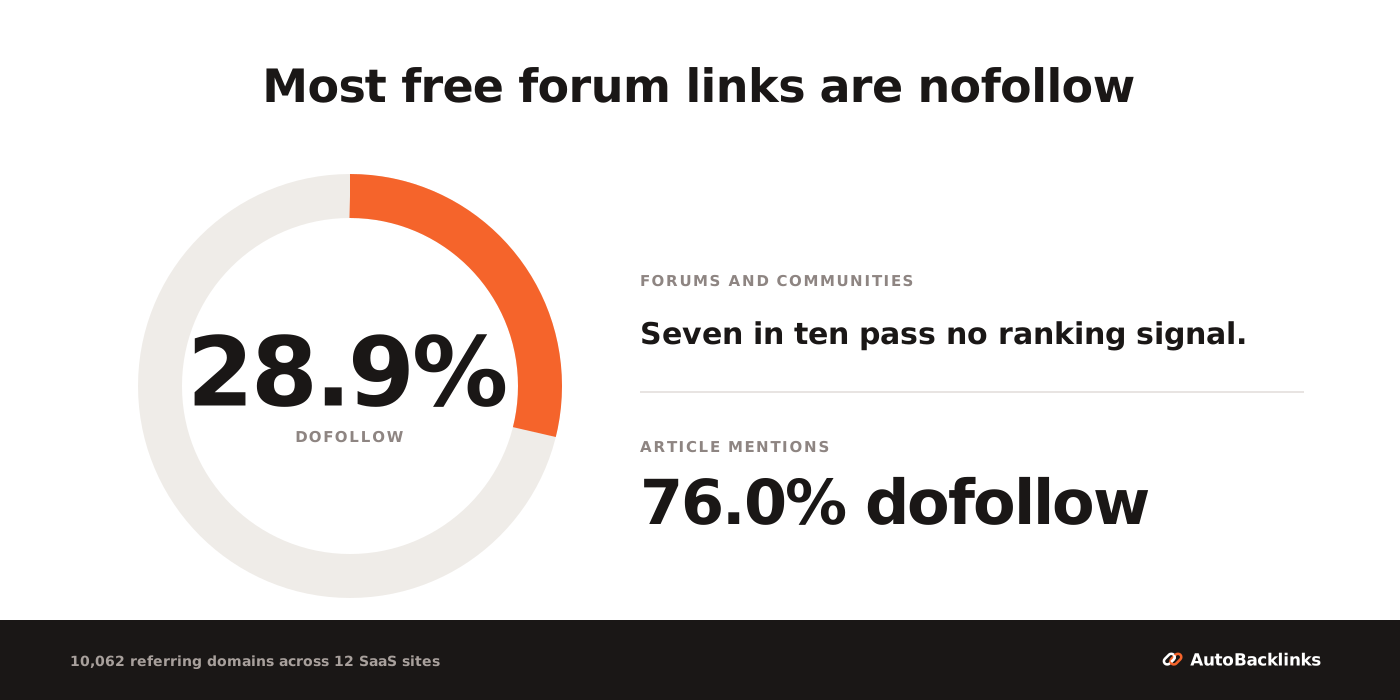
Roundup inclusion, resource pages, unlinked mentions and broken links all cost nothing but the email. The genuinely free-and-instant route, posting your link into forums and community threads, is the one with a catch: community and forum links in this sample were 28.9 percent dofollow, against 76.0 percent for editorial mentions and 89.4 percent for policy pages. Seven in ten pass no ranking signal at all.
That does not make Reddit or Stack Overflow worthless. Those domains have the second-highest median authority in the sample at 480, they send real referral traffic, and they are increasingly what gets a brand quoted by AI search. Just do not count them as a ranking play, and never post a link into a thread you would not have answered anyway.
The free method with the best measured return is the one from row 2: ask to be added to a list that already exists.
Link building strategies that stopped working
The clearest evidence in this study is the part I deleted. One referring domain in six, 1,909 of the 11,971 I started with, scored 30 or higher for spam and was thrown out before any counting began. These were among the highest-authority domains pointing at twelve real companies, and they are what the discredited methods leave behind:
- Scraped domain lists. Pages titled "few of top websites, page no. 432", generated in bulk, linking to thousands of sites at once.
- Redirect and tracker URLs. Click-through links from email and affiliate tooling that happen to get crawled.
- Expired-domain and PBN pages. Including several openly advertising link sales in their own page titles.
Three specific strategies belong in the same paragraph:
- Bulk directory submissions. The listing sites that are real number about twenty. The rest generate the first bullet.
- Comment and profile links. These land in the forum bucket, where fewer than a third are dofollow, and the ones from dedicated profile-spam sites land in the pile that got deleted.
- Volume for its own sake. A thousand links from one template placement is one vote repeated, which is why this study counts referring domains and not backlinks.
Honesty about my own filter: it is a threshold, not a verdict. A small residue of link-farm pages survived it and sits inside the 51.4 percent, which is part of why that number is a ceiling rather than a measurement.
What replaced all three is duller and works: fewer asks, aimed at pages that already exist and already rank.
How to get backlinks faster with AutoBacklinks
Every method above reduces to the same four jobs. Find pages that could link to you, work out which deserve the effort, find the person who can edit the page, and write an email about their page rather than your product.
Done by hand that is a day per twenty prospects. The reason we built AutoBacklinks is that three of those four jobs are mechanical:
- Discovery from web scans and competitor backlink scans, which is rows 1, 2 and 6 of the ranking above.
- Filtering on topical fit as well as DR, organic traffic and referring domains, because relevance is what decides the reply.
- Verified contacts before anything sends, with approval controls on the way out.
- A page-specific email per prospect, plus follow-ups, written from the paragraph you want to be in, not a template.
The judgment stays yours. We do not sell links, we do not place them, and nothing sends without approval.
One campaign of ours is the only send-to-link number I can show you end to end: a 17.1 percent reply rate across 187 sends. What earned it was row 1 and row 2 discipline, asking pages that were already written.
Against the 3.59 percent BuzzStream measured across more than 51 million outreach emails in May 2025, that is the gap between 113 emails per link and 23.
One campaign in one niche is a thin base to generalise from, and I would not read it as a benchmark. It is the number I have, published in full, rather than the number I would like.
If you would rather buy the placements than run the outreach, ten services priced at one DR band is the comparison to read instead. If you want to run it yourself, start here.
FAQ
How do I get backlinks for free?
Ask to be added to pages that already exist. Roundups, alternatives pages and resource lists cost nothing but an email, and roundups alone produced around one referring domain in ten in this study. Forum and community posting is also free, but only 28.9 percent of those links were dofollow, so treat them as referral traffic rather than a ranking method.
How much do backlinks cost?
A guest post averages $461 through a vendor, against $295 for the cheapest quote on the same site, across 257,267 sites in BuzzStream's June 2026 analysis. Price rises with authority, from roughly $200 at DR 0 to 9 up to roughly $3,000 at DR 80 and above. Agency retainers work out at $300 to $1,000 per link. The owner's own price is the floor.
How many emails does it take to get one backlink?
Between 23 and 113. Twenty-three assumes the 17.1 percent we measured on our own campaign, across 187 sends. One hundred and thirteen assumes the 3.59 percent average BuzzStream measured across more than 51 million outreach emails. Both assume roughly one reply in four becomes a live link, which is our own working assumption rather than a published benchmark.
What is the fastest way to get backlinks?
Getting added to a roundup or alternatives page. The page is already written and already ranks, the ask is one email long, and the author's incentive is to keep the list current. It produced 12.4 percent of the cleaned referring domains across the twelve sites measured here, second only to ordinary article mentions.
Do backlinks still matter in 2026?
Yes, and this study shows which ones. The in-content mention is 51.4 percent of a real profile and it is also the format an AI search engine can retrieve and attribute, so the same link does both jobs. What changed is the low-effort end: one in six of the strongest referring domains in this sample scored 30 or higher for spam, which is what bulk directories and comment links now produce.
About Rachid Idali
Founder & SEO Strategist
Rachid Idali has spent 10 years in SEO, running multi-six-figure SEO and link-building budgets across content, digital PR, and outreach programs. He writes about practical systems for finding relevant prospects, earning links, and turning SEO operations into repeatable pipelines.
More from Rachid Idali