

Link Exchanges in 2026: What Google Allows and How to Reply

by Rachid Idali
Last Updated: September 26, 2026
Google does not ban reciprocal links. Its policy names two narrower things: link exchanges that are excessive, and partner pages that exist only for the swap.
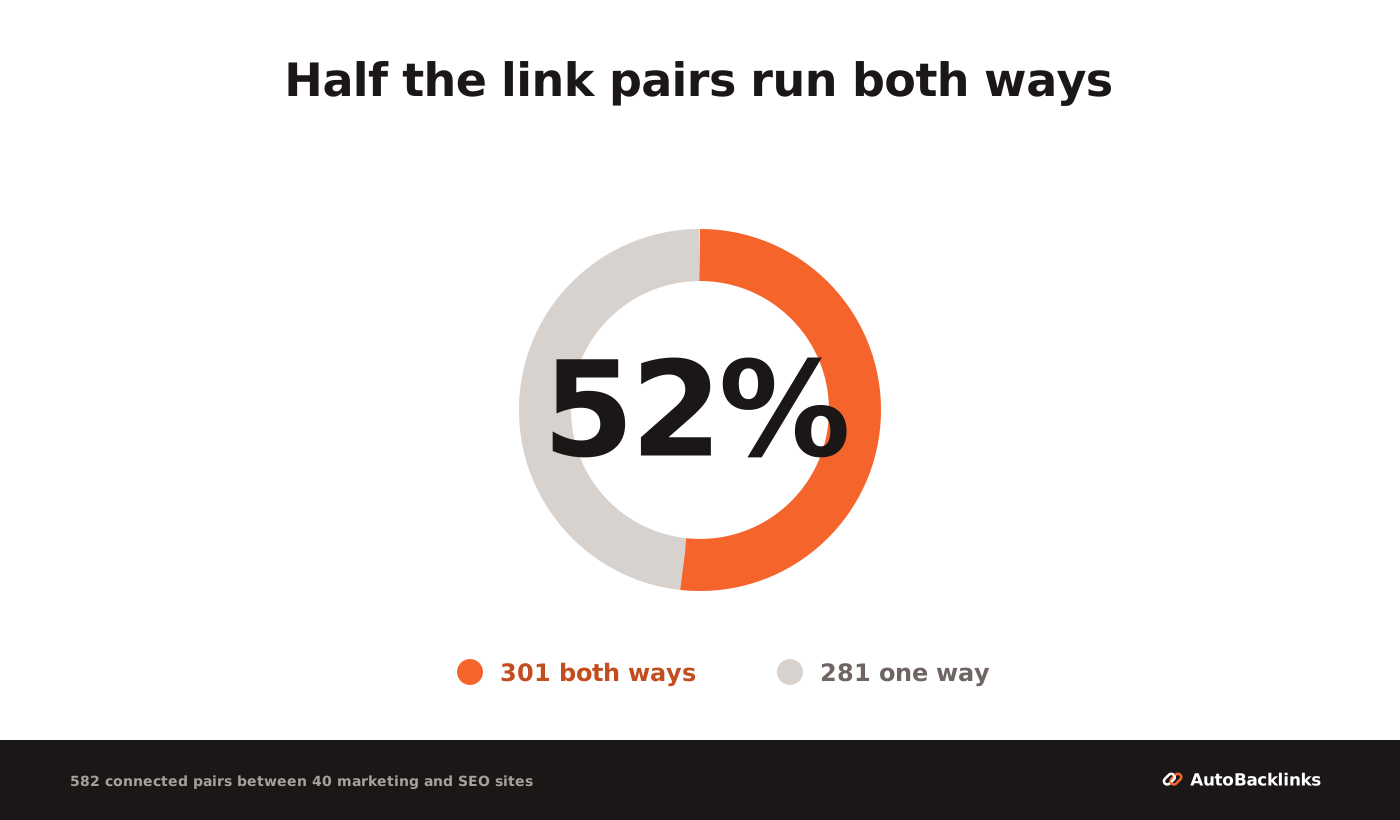
Reciprocity is ordinary between sites that write about the same things, and it is measurable. I took 40 well known marketing and SEO sites and checked every possible pair between them. 582 pairs have a link running in at least one direction. 301 of those, 51.7%, run in both.
So the question worth asking is not whether mutual links are allowed. It is where the line sits, and what you say when a prospect replies to your pitch asking for a link back.
What a link exchange is, and what reciprocal links are
A link exchange is two sites agreeing to link to each other. You will see the same arrangement called reciprocal linking, a link swap, link partners or link trading. The vocabulary changes; the mechanics do not.
It shows up in three shapes.
- Direct reciprocal. Site A links to site B, site B links back to site A. Usually in content, sometimes in a footer or sidebar.
- The partner page. One page on each site exists to hold outbound links to everyone in the arrangement. The classic "Links" or "Our Partners" page.
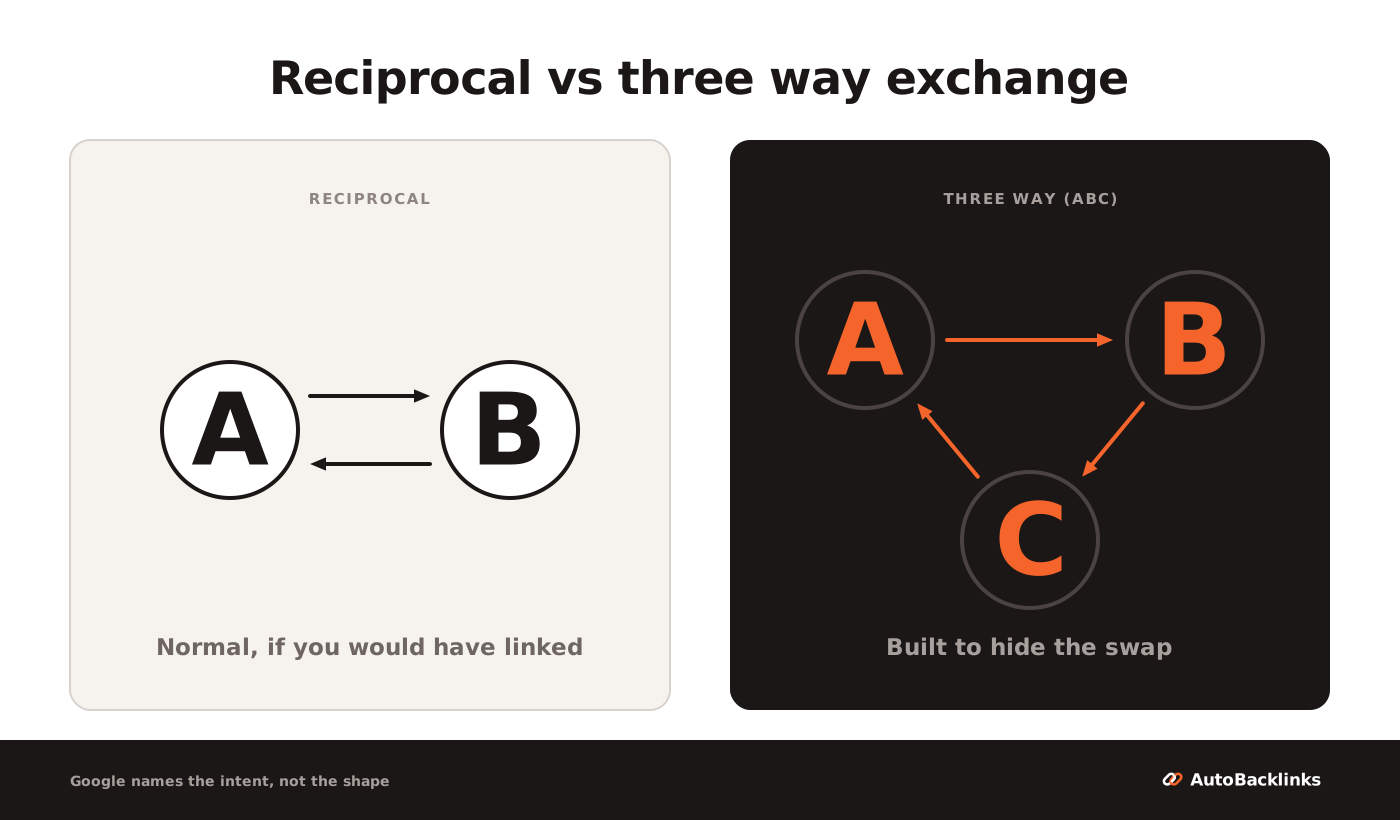
- Three way, also called an ABC exchange. A links to B, B links to C, C links back to A. No direct pair, so no obvious footprint.
A reciprocal link is just the outcome of the first shape. It is worth separating the two words, because a reciprocal link can happen with no agreement at all. Two sites in the same field cite each other over the years because each one wrote something the other needed. Nobody negotiated anything.
That distinction is the whole article. The link looks identical either way. What differs is why it exists.
What Google says about link exchanges
Google's spam policies, the part of Google Search Essentials that replaced the older link schemes guidance, name link exchanges once, in the link spam section. The wording carries two qualifiers that most summaries drop:
Excessive link exchanges ("Link to me and I'll link to you") or partner pages exclusively for the sake of cross-linking
Read the two words doing the work. Excessive. And exclusively.
Neither of them says mutual links are disallowed. They describe volume with no editorial reason behind it, and a page whose only job is to hold the trade. A single mutual link between two sites that each had a reason to link is not described anywhere on that page.
The broader definition at the top of the same section is the test that actually governs:
Link spam is the practice of creating links to or from a site primarily for the purpose of manipulating search rankings.
That is an intent test, and it is the one to apply to yourself. The policy text does not contain the word "reciprocal" anywhere. It does not mention three way or ABC exchanges either. Those are industry terms, not Google's.
There is also a documented escape hatch that almost nobody applies to exchanges. Google publishes three rel values for qualifying an outbound link, and the one that fits an arranged link is rel="nofollow", which Google describes as the value to use "when other values don't apply, and you'd rather Google not associate your site with, or crawl the linked page from, your site". rel="sponsored" is its value for advertisements and paid placements, so it belongs on a bought link rather than a traded one. The third value, rel="ugc", marks user generated content such as comments and forum posts, which is where a lot of low grade exchange links end up.
Google's own wording on all three is careful: links carrying them "will generally not be followed". Generally, not always. Still, if you want the referral traffic from a swap without the ranking claim, that is the mechanism, and the attributes are worked through in our guide to how backlinks actually work and which ones count.
How common reciprocal links are: 40 marketing sites measured
Everyone asserts that reciprocity is normal. Almost nobody publishes a current number, and the one study that does is from 2019 and reports a yes or no rather than a rate. So I measured it on a set you can check by name.
The method, so you can repeat it. For each of the 40 domains I called DataForSEO's backlinks/referring_domains/live, filtering referring domains to the other 39 plus their www. and blog. hosts. That returns, per pair, the link count, how many carry nofollow, and where on the page the links sit.
I count A as linking to B when at least one A to B link sits outside site furniture (nav, footer, header, aside) and at least one A to B link is followed. Those two conditions can be met by different links on the same pair. That is the loosest reading I was willing to take, and it counts borderline pairs in rather than out.
I can price that filter exactly. Together the two rules drop 39 of the 621 pairs that any link at all would connect. The furniture rule alone drops one, because sites that link to each other usually manage it in content at least once. The other 38 go because every link between them is nofollowed.
Placement still decides how to read a single relationship, even when it barely moves the total. One pair here carries 407,005 links, 405,158 of them in nav: one sitewide navigation link, not four hundred thousand decisions.
The 40 sites, so nothing here is hidden:
- SEO software: Ahrefs, Semrush, Moz, Majestic, Serpstat, Seobility, Screaming Frog, Surfer SEO, Rank Math, Yoast, Sitebulb, MarketMuse, Clearscope, seoClarity, Conductor.
- Link building and contacts: Pitchbox, BuzzStream, Respona, Postaga, LinkBuilder.io, Editorial.Link, uSERP, Hunter.
- Publishers: Backlinko, Search Engine Journal, Search Engine Land, Content Marketing Institute, Neal Schaffer, WPBeginner, Hobo Web.
- Marketing SaaS: HubSpot, Buffer, Hootsuite, Mailchimp, Zapier, Intercom, Unbounce, OptinMonster, ClickUp, Monday.com.
The findings. Of the 780 possible pairs, 582 are connected in at least one direction. 301 of those 582 run both ways, and 281 are one way only. That is 51.7% reciprocal.
Per site, the share of in set referrers that get a link back has a median of 65.3%, and a very wide spread. All 40, so nothing is cherry picked:
| Site | Linked to by | Links back to | Reciprocated |
|---|---|---|---|
| HubSpot | 36 | 35 | 97% |
| ClickUp | 19 | 18 | 95% |
| uSERP | 13 | 12 | 92% |
| Semrush | 36 | 33 | 92% |
| Search Engine Journal | 31 | 28 | 90% |
| Moz | 35 | 31 | 89% |
| MarketMuse | 13 | 11 | 85% |
| Content Marketing Institute | 29 | 24 | 83% |
| Unbounce | 23 | 19 | 83% |
| Backlinko | 34 | 28 | 82% |
| Ahrefs | 37 | 30 | 81% |
| Neal Schaffer | 9 | 7 | 78% |
| BuzzStream | 21 | 15 | 71% |
| Majestic | 27 | 19 | 70% |
| Buffer | 30 | 21 | 70% |
| Intercom | 16 | 11 | 69% |
| Clearscope | 19 | 13 | 68% |
| Hunter | 22 | 15 | 68% |
| Zapier | 28 | 19 | 68% |
| seoClarity | 18 | 12 | 67% |
| Surfer SEO | 25 | 16 | 64% |
| Editorial.Link | 8 | 5 | 63% |
| Conductor | 28 | 17 | 61% |
| LinkBuilder.io | 5 | 3 | 60% |
| OptinMonster | 25 | 15 | 60% |
| Search Engine Land | 32 | 19 | 59% |
| Serpstat | 17 | 10 | 59% |
| Yoast | 29 | 17 | 59% |
| Mailchimp | 29 | 17 | 59% |
| Respona | 14 | 8 | 57% |
| Rank Math | 16 | 9 | 56% |
| Sitebulb | 16 | 9 | 56% |
| Seobility | 9 | 5 | 56% |
| Postaga | 4 | 2 | 50% |
| Hootsuite | 28 | 14 | 50% |
| Monday.com | 23 | 11 | 48% |
| Hobo Web | 13 | 5 | 38% |
| Pitchbox | 15 | 5 | 33% |
| WPBeginner | 20 | 6 | 30% |
| Screaming Frog | 31 | 8 | 26% |
Screaming Frog is linked to by 31 of the other 39 and links back to 8. HubSpot is linked to by 36 and links back to 35. Both are among the most visible domains in the set. The spread tracks how freely a site links out, not how safe it is.
One worked example, because the abstraction hides how ordinary this is. Ahrefs and Semrush are direct competitors, and each links to the other. Semrush's post on Shopify SEO tools carries a followed body link to Ahrefs' backlink checker, anchored "Ahrefs Backlink Checker". Ahrefs' post on SEO APIs links out to Semrush's developer documentation with the anchor "backlinks report type", nofollowed, inside a sentence comparing 77 response fields on its own endpoint against 22 on Semrush's.
That pair is worth looking at closely, because it is the opposite of a swap. The two links have different anchors, different attributes and opposite intentions, and one of them is a competitive dig. Nobody negotiated either. They are mutual because two sites writing about the same subject eventually need to point at each other.
The robustness check. Drop both filters and count every link regardless of attribute or placement, and the set grows to 621 connected pairs with 340 of them mutual, or 54.8%. One alternative specification is not proof, but a 3.1 point move says the headline is not an artefact of where I drew the line.
Three limits worth stating. This is one industry, and an unusually link literate one. Forty domains is a small sample chosen for recognisability, not randomness. And like every study of sites that currently rank, it cannot see the sites that already got demoted.
What the Ahrefs reciprocal links study found
There is one prior study, and it is worth reading honestly rather than quoting selectively. Ahrefs published it in January 2019 and last revised it in March 2020. It took 140,592 domains with at least 10,000 monthly visits from Google and checked the overlap between who they link to and who links to them.
- 73.6% had at least some reciprocal links. 26.4% had none.
- 27.4%, almost a third, had at least a 15% overlap.
- Ahrefs' own blog came out at 19.25%.
- Across 112,440 top ranking pages, 43.7% had some reciprocal links.
One methodology note before those numbers get compared with mine. Ahrefs cross-checked dofollow outgoing links against dofollow incoming ones, and divided by the number of domains the target links out to. My per-site figure divides by the number of domains that link in. The two percentages answer different questions and should not be read against each other.
The post flags the weakness itself: the sample only includes domains with search traffic, so any site already penalised was filtered out before the study began. Survivorship bias is baked in, and the same caveat applies to my numbers.
The study also draws a line I agree with. It tells readers to stop sending "will you link to me if I link to you" emails, on the grounds that recipients dislike them.
Where it stops short is the part an operator needs. "73.6% of sites have at least one" answers whether reciprocity exists. It does not tell you how much of a relationship is normally mutual, it names no sites you can check, and the data is seven years old. That is the gap the 40 site census above fills.
Reciprocal vs three way (ABC) link exchanges
The three way exchange is sold as the safe version. A links to B, B links to C, C links to A. No direct pair means no obvious footprint.
Read the rationale that its advocates publish. Respona's explainer puts it plainly:
This indirect exchange can effectively pass PageRank and other SEO benefits because it does not follow the straightforward reciprocal linking pattern that Google is looking out for.
That sentence is an admission. The structure adds no value to any reader. Its entire purpose is that Google is looking for something and this shape is not it.
Now go back to the policy test: links created "primarily for the purpose of manipulating search rankings". A mutual link between two sites that genuinely cite each other has an editorial defence, and my census shows that half of all connected pairs look exactly like it. A three way chain has no such defence, because avoiding detection is the reason it was built.
The obvious objection is that a chain nobody detects costs nothing. That holds right up to the moment detection improves, or a person reads the thread rather than a machine. And note what the shape actually buys: the policy never names three way exchanges, so the chain wins on the wording while losing on the intent test underneath it, which is the clause that does the governing.
My position, stated plainly: on defensibility, ABC exchanges are worse than the reciprocal links they are sold as a fix for. Not worse in measured outcome, because no public data exists either way. Worse in the one sense you control.
Guest post swaps are the same trade with extra steps. You place a link to someone in a guest post on a third site, they place one to you elsewhere. The footprint is thinner. The intent is identical, and if guest posting is your channel, the honest version is covered in what actually gets a guest post pitch answered.
How to spot a link exchange network
Most exchange offers arrive from sites that are already in one. Four checks separate a real publisher from a swap operation, and all four take under a minute.
- Where do their outbound links sit? Open two or three of their articles. Links inside the prose, pointing at things the sentence needed, are editorial. Links clustered in a sidebar, a footer or a block at the end are furniture. A sitewide link in the navigation is a third thing again, usually ownership or a standing partnership rather than an exchange.
- Does a links page exist? Search their site for a page called Links, Partners, Resources or Friends that is nothing but outbound links with no commentary. Google's policy names this shape directly, and a page carrying 60 unrelated outbound links divides whatever value it has 60 ways.
- What is their ratio of outbound to inbound? A site linking out to far more domains than link to it is either unusually generous or keeping score. In my census the two sides are close to even, 21 of the 40 link out to fewer in set domains than link to them, and the biggest surpluses belong to the smallest sites: uSERP links out to 36 and is linked to by 13, LinkBuilder.io links out to 26 and is linked to by 5. That is what building a reputation looks like early on. It is also what trading looks like, which is why this check is a prompt to look closer rather than a verdict.
- Do they ever link out without asking for anything? Check whether the sites they link to link back. If almost every outbound link has a matching inbound one, that is not a publishing habit, it is a ledger.
One tell sits off the page entirely. Volume exchanges get coordinated in private Facebook groups and Slack channels, where members link to each other and get dropped for taking without giving. A stranger whose first email opens with a swap offer and an authority floor is working a list, not reading your site.
The same discipline applies when you are the one being evaluated, and it is the kind of check worth automating rather than eyeballing. Prospect qualification tooling exists for exactly this, and our own backlink outreach agent scores topical fit before a prospect reaches your queue, because a high authority site with no relevance to yours is a bad trade at any price.
On thresholds: LinkBuilder.io's guide recommends holding to no more than one exchanged link for every ten from other sources. It is a reasonable instinct, but it is one practitioner's rule of thumb and not a published Google threshold. No such threshold exists.
The same guide publishes a partner screen of DR above 40 and 5,000 monthly organic visitors. That sets a floor for authority and says nothing about topical fit, and fit is the half that decides whether the link is worth the one you give back. What matters more is the share of your whole profile, which is a better frame than a raw count, and that framing is worked through in how many backlinks you actually need.
How to answer a link exchange offer in outreach
Run outreach at any volume and the "happy to link, can you link back?" reply arrives. It is the counter offer I get most often, and most people either freeze or say yes reflexively.
There are four honest answers. Pick by one question: would I have linked to this page anyway?
1. Yes, and here is where. If their page genuinely fits something you have already published, say so and name the URL and the sentence. This is not a trade, it is two useful links that happen to point at each other. Place it in content, not on a links page, and place it because a reader benefits.
2. Yes, but not on that page. Often their ask is for a link from a specific page for a specific keyword, which is a placement request dressed as a swap. Counter with where it actually fits. If they only want the one page, the request was never editorial.
3. No, with a reason. "I don't have a page where that link would help a reader, so I'd rather not force it. Happy to link if that changes." Short, honest, and it keeps the relationship. In my experience this loses far fewer placements than people expect, because the person asking is usually working through a list and respects a clear answer.
4. Counter with something that is not a link. A quote for their next piece, data they can cite, a testimonial, an introduction. These are worth more to most publishers than a link and cost you nothing structurally.
What not to do: agree to a sitewide or footer link, agree to a links page placement, or agree to a three way chain. Those are the three shapes that turn a normal mutual link into the thing the policy describes.
It also helps to remember why the ask arrives at all. When we ran a 187 email outreach campaign in the education niche, 32 people replied for a 17.1% reply rate, and the thing that moved that number was prospect relevance, not email copy. Relevant prospects ask for fewer favours, because the link you are requesting already makes sense on their page. A weak prospect list is what generates exchange requests, and no reply template fixes that upstream.
Link exchanges vs guest posts and link insertions
An exchange costs no money and no content, which is the whole of its appeal. That is also its ceiling.
- Link exchange. Cost: a link from your site. Speed: fast. Ceiling: low, because your inventory of pages worth linking from is finite and the pool of willing partners is mostly other people doing the same thing.
- Guest post. Cost: an article. Speed: slow. Ceiling: high, and the placement is editorial by construction.
- Link insertion, also called a niche edit. Cost: money or a strong pitch. Speed: medium. The link lands in a page that already ranks.
- Paid placement. Cost: money, plus the same policy exposure as any arranged link unless it is qualified with the right attribute.
The honest ranking depends on what you are short of. Short of money, exchanges and guest posts are your routes. Short of time, insertions and paid placements are. If you want the full comparison of what each route actually yields, the nine acquisition methods ranked by output covers it with the numbers attached.
What I would not do is build a program on exchanges. They are a reasonable byproduct of knowing people in your field. As a primary strategy they produce exactly the pattern the policy describes, and they cap out early.
FAQ
What is a link exchange?
A link exchange is an arrangement where two sites agree to link to each other, also called reciprocal linking or a link swap. It takes three common shapes: a direct mutual link between two pages, a dedicated partner or links page holding many outbound links, and a three way chain where A links to B, B to C, and C back to A. The link itself looks the same as an editorial one; the difference is that it exists because of the agreement.
Are reciprocal links bad for SEO?
No, not on their own. Mutual links are ordinary between sites in the same field: across 40 well known marketing and SEO sites, 301 of the 582 connected pairs link in both directions, and the median site links back to 65% of the sites in the set that link to it. Ahrefs found the same pattern at web scale, with 73.6% of 140,592 traffic earning domains carrying at least some reciprocal links. What Google's policy names is excessive exchanges and pages that exist only for cross-linking, not reciprocity itself.
What does Google say about link exchanges?
Google's spam policies give one example of link spam that names it: excessive link exchanges ("Link to me and I'll link to you") or partner pages exclusively for the sake of cross-linking. The two qualifiers matter: excessive, and exclusively. The governing test is stated above that list, which defines link spam as creating links primarily to manipulate search rankings. The word "reciprocal" does not appear in the policy at all.
Are ABC or three way link exchanges safe?
They are less safe than they look. The published rationale for the three way shape is that it does not match the pattern Google looks for, which is an argument about evading detection rather than about serving a reader. Google's own definition of link spam turns on intent, so a structure built specifically to hide a trade supplies the evidence rather than removing it. A plain mutual link between two sites that genuinely cite each other has an editorial defence; a chain built to disguise a swap does not.
How many reciprocal links are too many?
There is no published threshold, and anyone quoting one is quoting a rule of thumb rather than Google. A better frame is share and placement: what proportion of your referring domains are exchanges, whether the links sit in content or in a dedicated links page, and whether you would have made each link without the trade. If you cannot answer that last question with a yes, the count is already beside the point. If you already have a pile of them, the proportionate fix is to remove or nofollow the ones on a dedicated links page and leave the in content ones alone, rather than disavowing a swathe of your profile.
How should I reply when someone asks for a link back?
Answer with one test: would you have linked to that page anyway? If yes, agree and name the exact page and sentence where it fits. If it fits somewhere other than the page they asked for, counter with that. If it fits nowhere, decline with a short reason and offer something else, like a quote, data or an introduction. Avoid sitewide links, links page placements and three way chains, which are the three shapes that turn an ordinary mutual link into the pattern the policy describes.
About Rachid Idali
Founder & SEO Strategist
Rachid Idali has spent 10 years in SEO, running multi-six-figure SEO and link-building budgets across content, digital PR, and outreach programs. He writes about practical systems for finding relevant prospects, earning links, and turning SEO operations into repeatable pipelines.
More from Rachid Idali