

Best Claude SEO Skills in 2026 (12 Tested)

by Rachid Idali
Last Updated: August 22, 2026
The best Claude SEO skill for most people is AgriciDaniel/claude-seo: MIT licensed, 33 skills, and it runs real Python and Chromium rather than just prompting the model. If your work runs wider than SEO, coreyhaines31/marketingskills covers 48 skills across CRO, pricing, PR and outreach, and it is the only pack in this category that ships evals.
I installed all twelve and ran them against a live site. Below is what each one actually measures, what it produces, and where it stops. Every star count, license and push date was pulled from the GitHub API on 27 July 2026.
What a Claude SEO skill actually is
A skill is a folder with a SKILL.md file in it. That file has YAML frontmatter with a name and a description, then instructions in markdown. When your request matches the description, Claude loads the instructions and follows them.
The value is not intelligence. It is repeatability. You write the workflow down once and get the same process every time instead of re-explaining it.
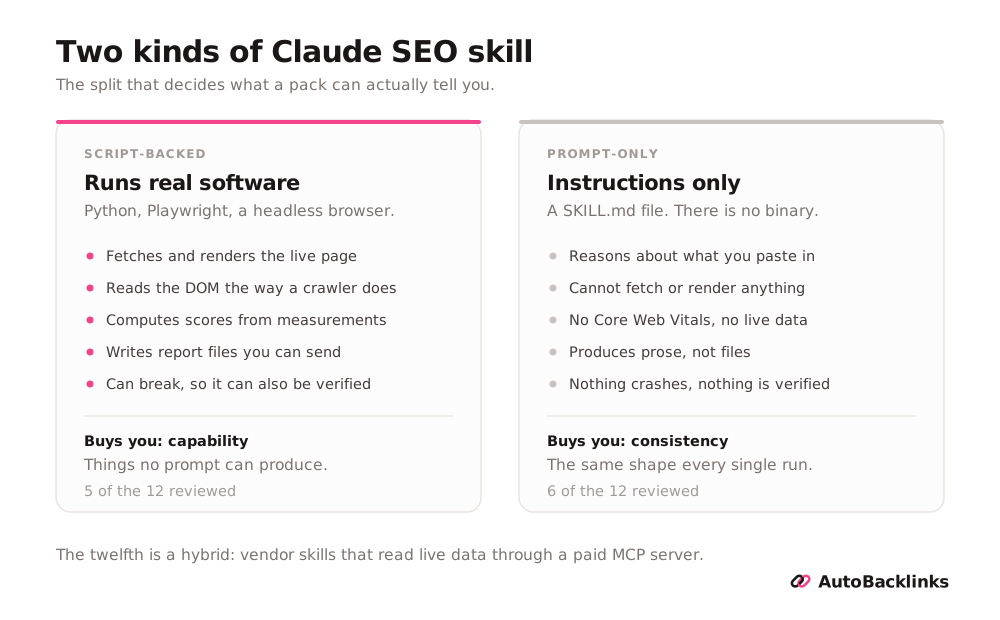
Some skills stop there. Others ship Python scripts, and the SKILL.md tells Claude when to run them. That split is the most useful way to think about this category, because the two types buy you completely different things.
Script-backed packs are real software. They fetch pages, render with Playwright, compute scores, and write report files. They can measure things the model cannot know.
Prompt-only packs are instructions. There is no binary. They can still reach a live page, but only through whatever tools the agent already has, and they cannot render JavaScript or compute a Core Web Vitals score.
Of the twelve here, five are script-backed, six are prompt-only, and one is a hybrid that pulls live data from a paid MCP server.
Worth setting expectations early: none of these replace a paid SEO suite. They sit alongside one, or they sit on top of the free tier of one. If budget is the reason you are here, the low cost SEO stacks piece covers what a working setup costs at $0, $42 and $150 a month.
Claude skills vs agents vs MCP vs plugins vs commands
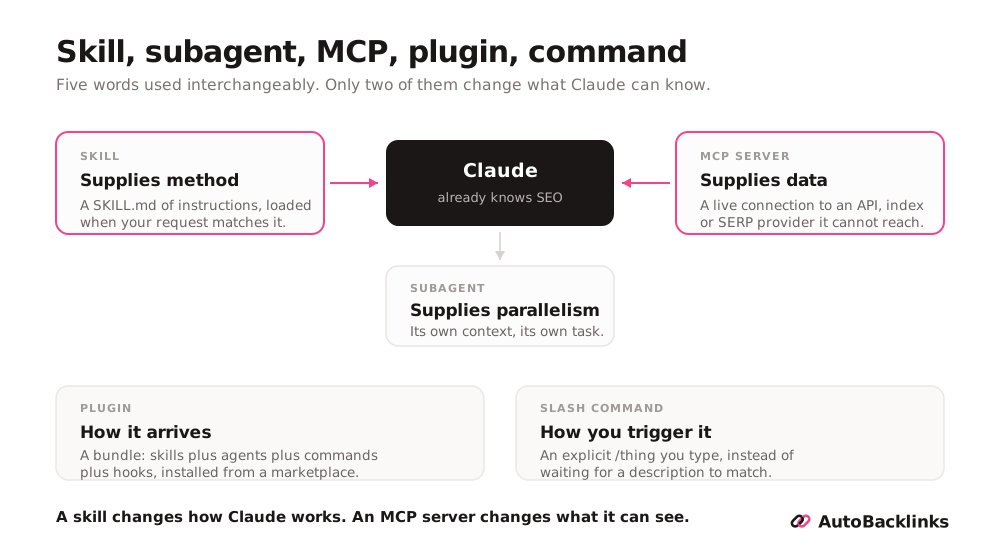
These five words get used interchangeably and they are not the same thing.
| Thing | What it is | Who runs it |
|---|---|---|
| Skill | A SKILL.md of instructions, loaded when your request matches its description | Claude, automatically |
| Subagent | A separate Claude instance with its own context window and its own task | Claude, spawned in parallel |
| MCP server | A connection to outside data or tools (an API, a database, a SERP provider) | An external process |
| Plugin | A distribution bundle: skills plus agents plus commands plus hooks | You, via the marketplace |
| Slash command | An explicit /thing you type to trigger something | You, deliberately |
The practical difference: a skill teaches Claude how to do something it could already attempt. An MCP server gives it data it could not otherwise reach. That is why the packs wired to DataForSEO, Ahrefs or SE Ranking behave differently from the pure-markdown ones. They are not better written. They can see live numbers.
The same split shows up on the server side, which is why I scored the MCP servers for link building separately: most of them stop once the data arrives.
Subagents matter for speed. claude-seo spawns up to fifteen in parallel during a full audit, which is how it covers so much ground in one run.
The 12 best Claude SEO skills for 2026, reviewed
1. AgriciDaniel/claude-seo Review
12,444 stars · MIT · 33 skills · pushed 2026-07-27 · script-backed
View AgriciDaniel/claude-seo on GitHub
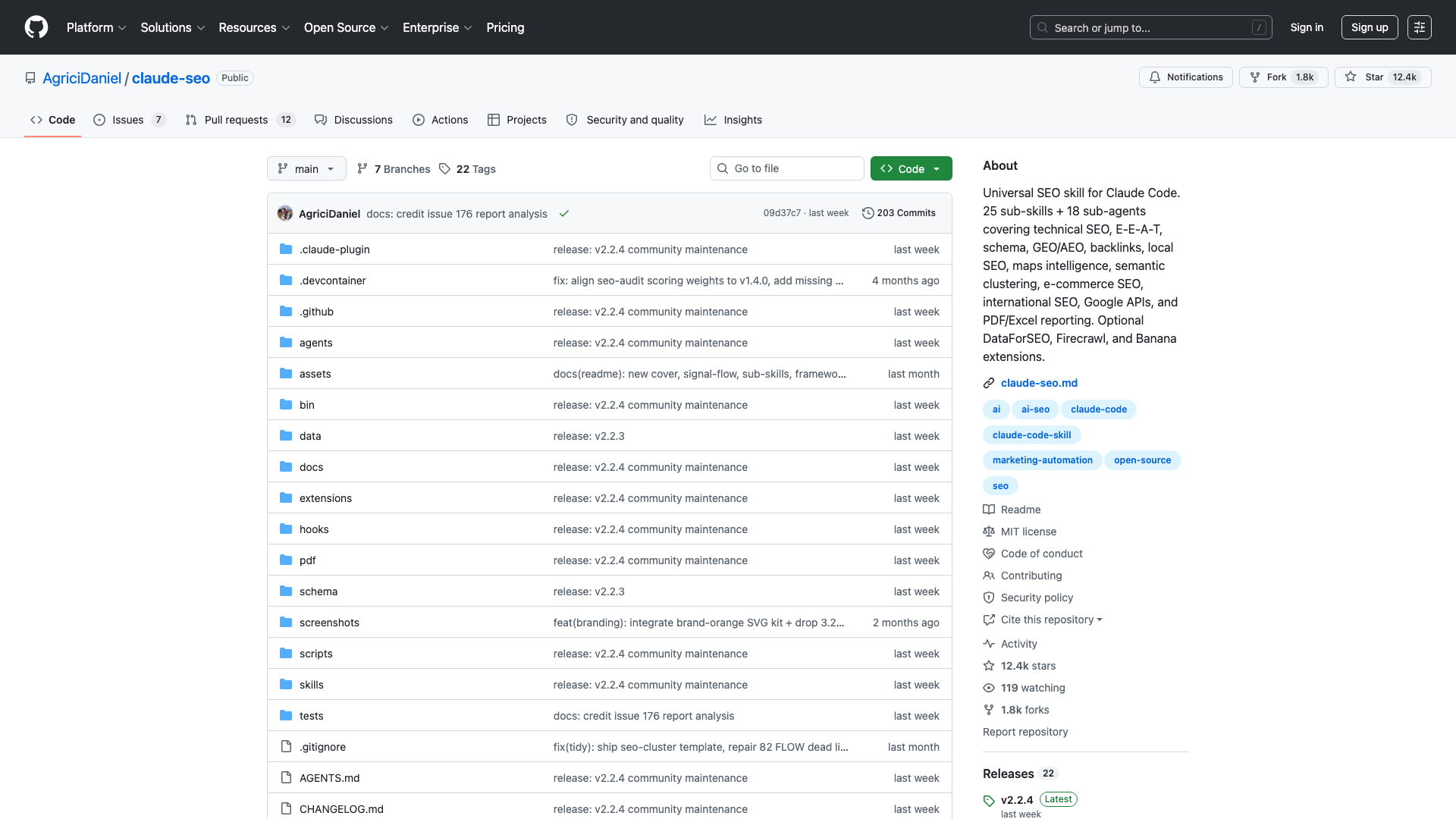
The most complete pack in the category. Installation builds an isolated Python runtime and its own Chromium, then /seo audit fans out across up to fifteen specialist subagents covering crawlability, Core Web Vitals, schema, E-E-A-T, GEO, local, hreflang and more.
Run against a live site it produced concrete, checkable findings in under four seconds per script: zero JSON-LD on the homepage, a preload score of 50/100 with no Speculation Rules and an unmarked LCP hero, and a canonical pointing at the www host while the audited URL was apex.
The finding that justified the install was subtler. It flagged an H1 reading "The FirstAI Agentfor Link Building Outreach." The words are run together because they are split across styled spans, so the rendered page looks correct and a crawler reads it broken. Three subheadings had the same defect. No amount of looking at the page in a browser would surface that.
Pros
- Fifteen parallel subagents cover technical, content, schema and GEO in one pass, so you get a whole-site picture rather than one dimension.
- Reads the DOM as a crawler does, which catches text defects that are invisible in a rendered browser view.
- Builds its own Python runtime and Chromium, so it never touches your system Python or existing packages.
- Drift monitoring keeps SQLite baselines, so you can diff a site against itself weeks later rather than re-auditing blind.
- Generates JSON-LD, not just validates it, including less common types like ProfilePage and OrderAction.
- Ships scanners nothing else here has: parasite-SEO risk, URL safety against SSRF, and a schema deprecation linter.
Cons
- Backlink analysis runs on Moz, Bing and Common Crawl, so it is far thinner than a real link index and will miss most of your profile.
- Eight of the 33 skills are inert without paid API keys (DataForSEO, Ahrefs, SE Ranking, Profound, Bing Webmaster, Firecrawl, Unlighthouse, Banana).
- Screenshot capture failed on 2 of 15 attempts and needed a retry each time, so unattended batch runs will drop images silently.
- File writes are refused outside your home or working directory, and the error names the violation without explaining the rule, which is confusing the first time you hit it.
- Sitemap discovery emits duplicate entries for the same URL, so counts from it need deduping before you trust them.
- Install takes around 70 seconds and pulls a full Chromium, which is heavy if you only want one check.
Best for: anyone who wants one pack that measures rather than opines.
2. coreyhaines31/marketingskills Review
41,886 stars · MIT · 48 skills · pushed 2026-07-23 · prompt-only
View coreyhaines31/marketingskills on GitHub
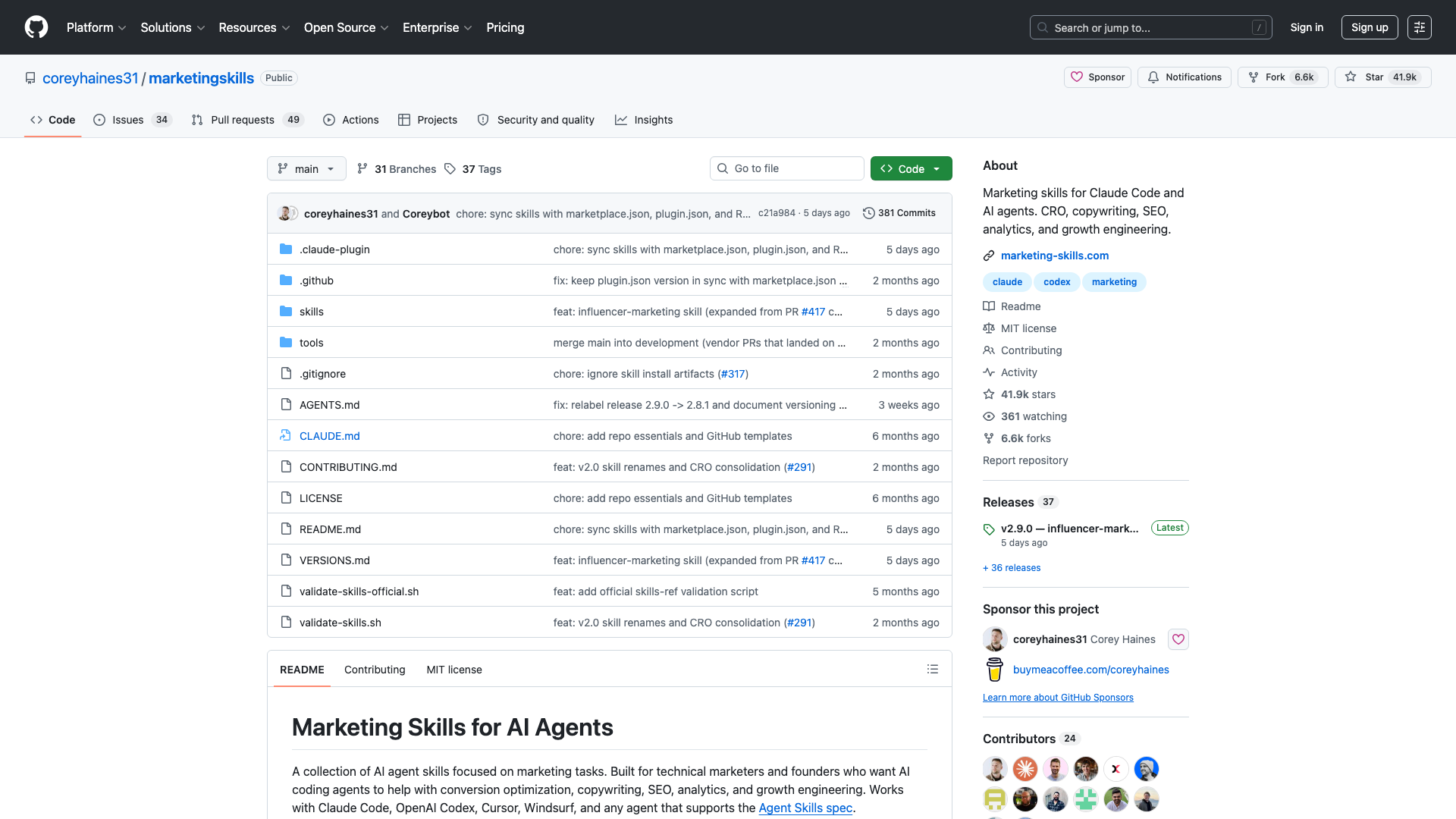
The largest marketing skill collection on GitHub, and the only one here where someone has tested whether the instructions actually produce the intended output. Forty-six of its 48 skills ship an evals/ directory and 40 carry references/. Average skill depth is 301 lines, the deepest of any prompt-only pack.
SEO coverage is ai-seo, seo-audit, programmatic-seo, site-architecture and schema. Around it sit cold-email, prospecting, directory-submissions, public-relations, cro, pricing and churn-prevention.
Pros
- Evals on 46 of 48 skills, so the instructions have been checked against expected output rather than written and abandoned.
- 301 lines per skill on average, deep enough to encode a real process instead of a paragraph of intent.
- Reaches well past SEO into CRO, pricing, onboarding and PR, so one install covers most of a marketing function.
- Frontmatter is valid across all 48 skills, so triggers fire reliably instead of silently failing to load.
Cons
- Ships no code of its own, so it can only do what the host agent's tools already allow. No JavaScript render, no Core Web Vitals, no measurement it controls.
- Produces no report file, no score and no table, so there is nothing to hand a client or diff over time.
- SEO is five of 48 skills, so technical depth is shallower than a dedicated SEO pack.
- Nothing in the pack verifies its own output, so accuracy depends entirely on what the agent fetched.
Best for: marketers who want breadth and want the instructions to have been tested.
3. zubair-trabzada/geo-seo-claude Review
9,129 stars · MIT · 16 skills · pushed 2026-05-27 · script-backed
View zubair-trabzada/geo-seo-claude on GitHub
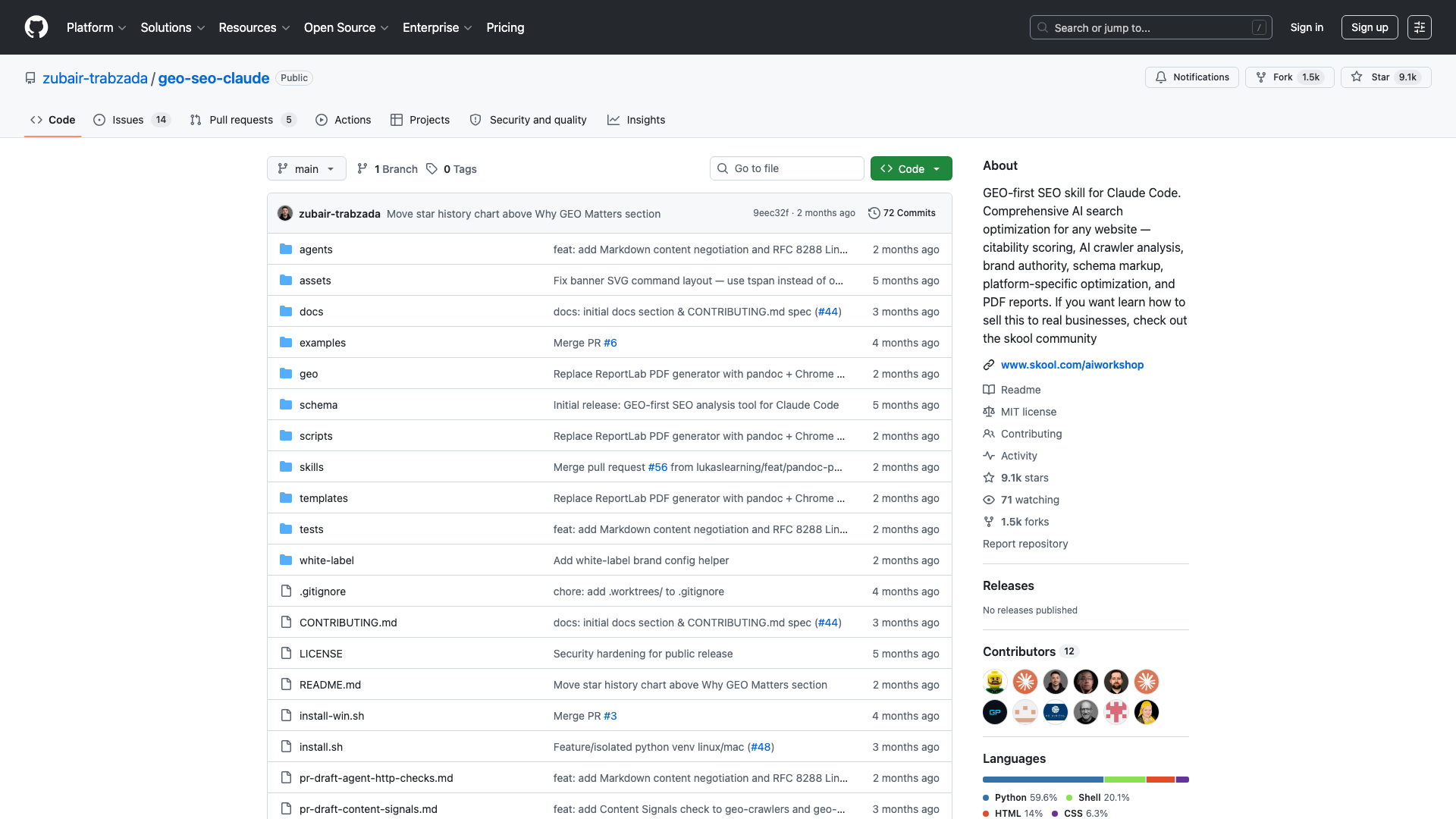
This one does not audit page health. It scores how quotable each passage is, which is a different and much harsher question.
On a live homepage it returned an average citability of 26.2/100 across eleven blocks, graded one C, one D and nine F, with zero passages at optimal length. The best block scored 58, broken down as 30 for answer-block quality, 14 for self-containment, 9 for structural readability, 5 for statistical density and 0 for uniqueness signals. It also confirmed both llms.txt and llms-full.txt were missing.
Pros
- Scores passages individually with a five-part breakdown, so you know which specific block to rewrite and why, not just that the page is weak.
- Checks
llms.txtandllms-full.txtand generates them, which most packs ignore entirely. - Returns a full citability pass in about two seconds, fast enough to run on every draft before publishing.
- Grades on a curve that assumes AI extraction, so it flags passages that pass a normal SEO audit and still will not be quoted.
Cons
- GEO only. It will not check crawlability, schema, Core Web Vitals or anything a traditional audit covers.
- Installs under the generic
/geocommand namespace, which collides with other GEO packs if you run more than one. - The scoring rubric is opinionated about passage length, so pages that answer well in shorter blocks get marked down.
- Needs its own Python virtual environment on top of whatever your other packs installed.
Best for: anyone optimising for AI Overviews, ChatGPT and Perplexity rather than blue links.
4. aaron-he-zhu/aaron-marketing-skills Review
2,465 stars · 120 skills · pushed 2026-07-27 · prompt-only
View aaron-he-zhu/aaron-marketing-skills on GitHub
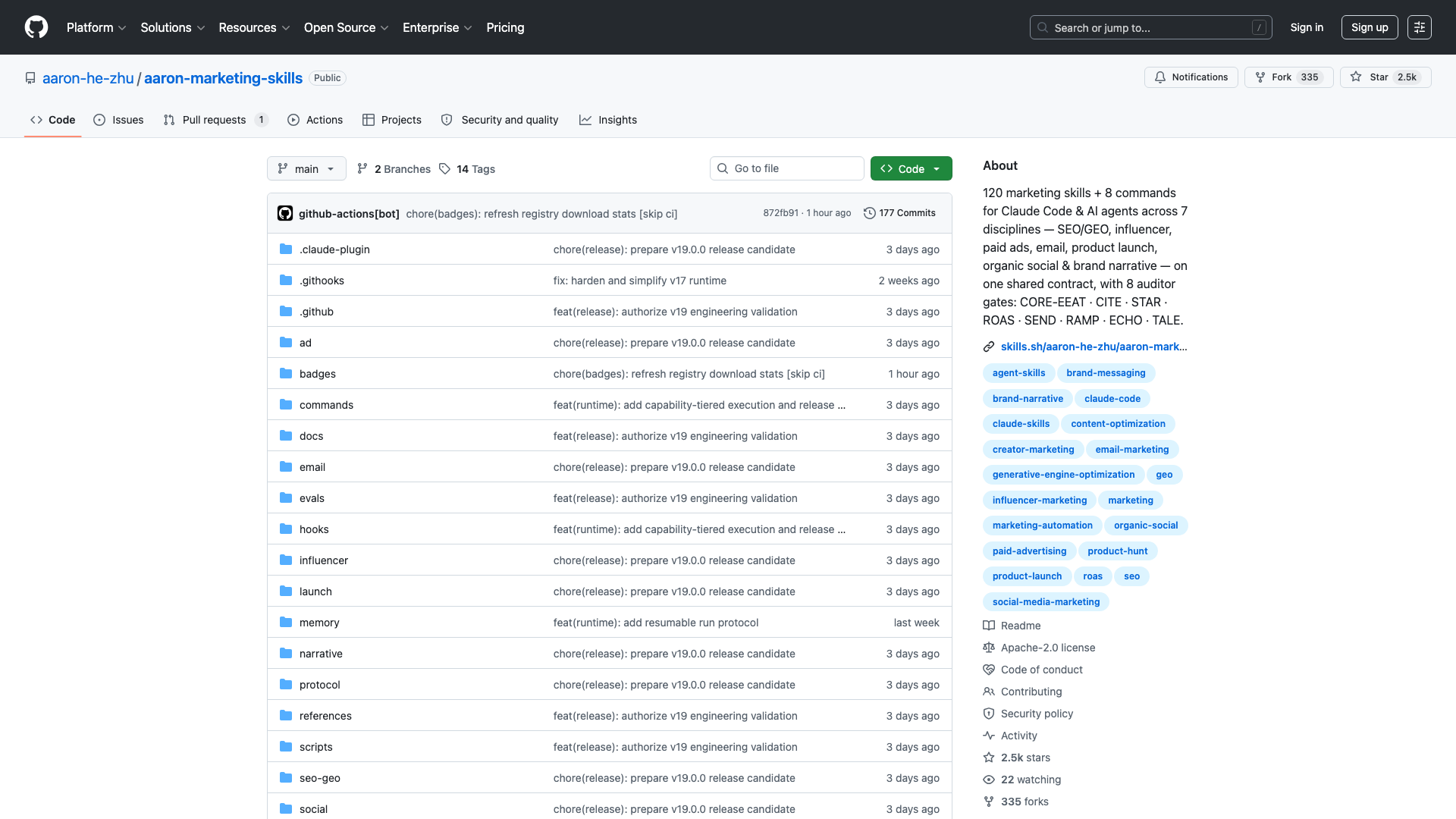
The broadest catalog here by skill count. The seo-geo/ tree holds on-page-seo-checker, technical-seo-checker, keyword-research, serp-analysis, content-gap-analysis, site-structure-optimizer and serp-markup-builder. Alongside it sit outreach-manager and offsite-signal-analyzer, which are close to the only off-page skills that exist anywhere in this category.
Pros
- 120 skills organised into a clear taxonomy, so finding the right one is a directory walk rather than a search.
- Includes
outreach-managerandoffsite-signal-analyzer, rare coverage of off-page work that nearly every other pack skips. - Split into narrow single-purpose skills, so Claude loads a focused instruction instead of a general one.
- Actively maintained, with pushes landing on the day of testing.
Cons
- Ships no code, so anything it reports is read from the page rather than measured against a threshold.
- 101 lines per skill on average, so individual skills are thinner than the depth-focused packs.
- No evals or reference files, so the instructions are unverified.
- Runs longer than the leaner packs for a comparable answer, at 70 seconds and 1,785 words on our live-page test.
Best for: teams who want one catalog covering marketing end to end, including off-page.
5. Bhanunamikaze/Agentic-SEO-Skill Review
791 stars · MIT · 100 Python scripts · pushed 2026-07-23 · script-backed
View Bhanunamikaze/Agentic-SEO-Skill on GitHub
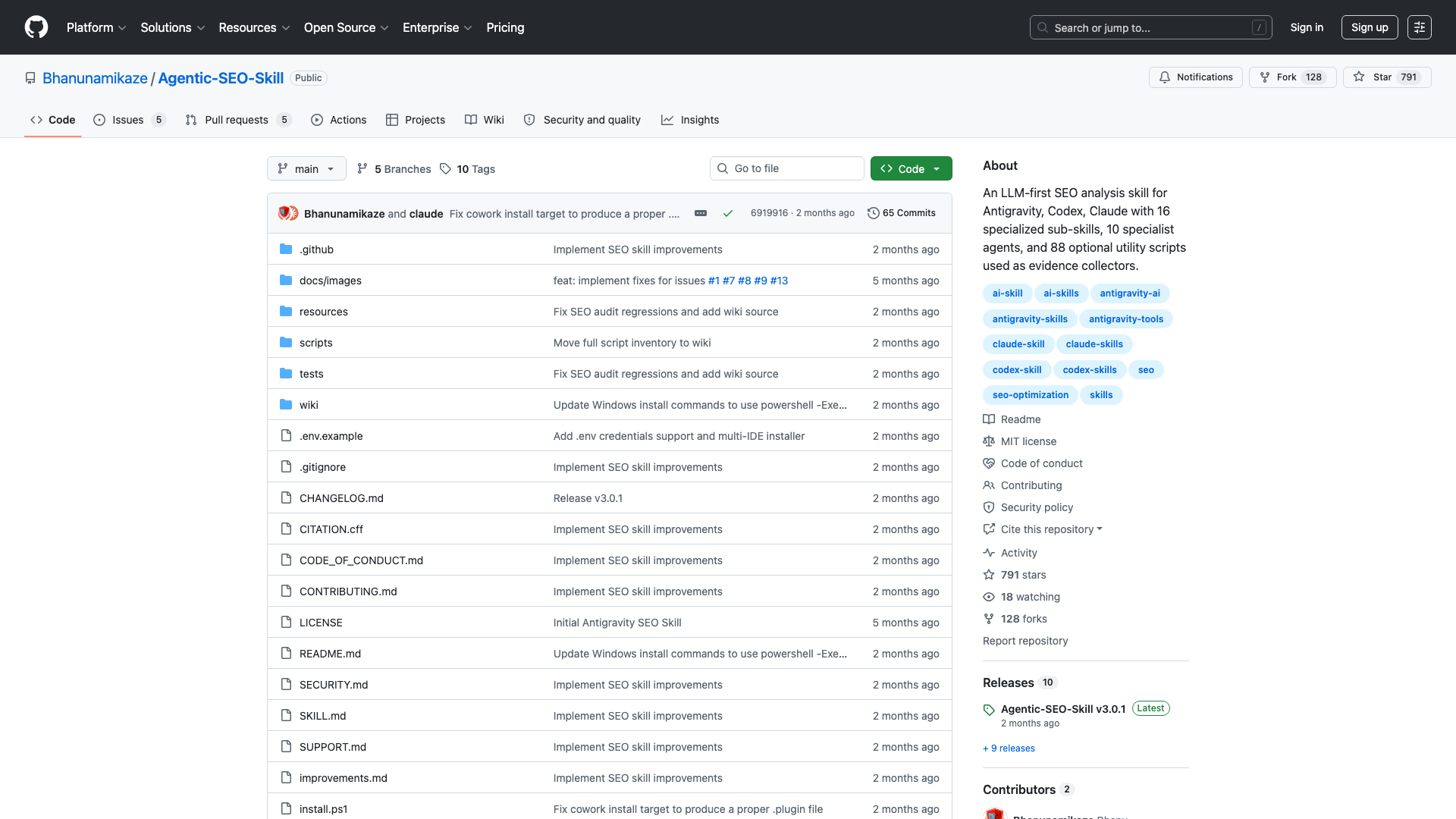
Built around a single idea: every claim in the output should trace back to something a script measured. One SKILL.md orchestrates 100 Python files acting as evidence collectors.
One thing to know before installing. It claims the skill name seo, which is the same path claude-seo uses. If you already have claude-seo, the installer stops rather than overwriting:
Warning: claude-global target already exists: ~/.claude/skills/seo
Use --force to overwrite.
Install it as bash install.sh --skill-name agentic-seo and both coexist cleanly.
Pros
- Every finding traces to a script that measured it, which makes the output defensible when a client pushes back.
- Runs on Codex and Antigravity as well as Claude, so the same setup follows you across tools.
- Audits a GitHub repository as well as a URL, useful for checking a site's source rather than only its output.
- 100 scripts give it real measurement coverage rather than reasoning about pasted text.
Cons
- Claims the generic
seoskill name, so it refuses to install alongside claude-seo unless you rename it, and the rename flag is not in the quickstart. - Everything lives in one
SKILL.md, so you cannot load just the piece you need and pay the full context cost every time. - Documentation assumes you already know which script does what, so discovery is by reading the tree.
Best for: audits that need to survive scrutiny, where "the script found it" matters.
6. kostja94/marketing-skills Review
760 stars · MIT · 172 skills · pushed 2026-06-09 · prompt-only
View kostja94/marketing-skills on GitHub
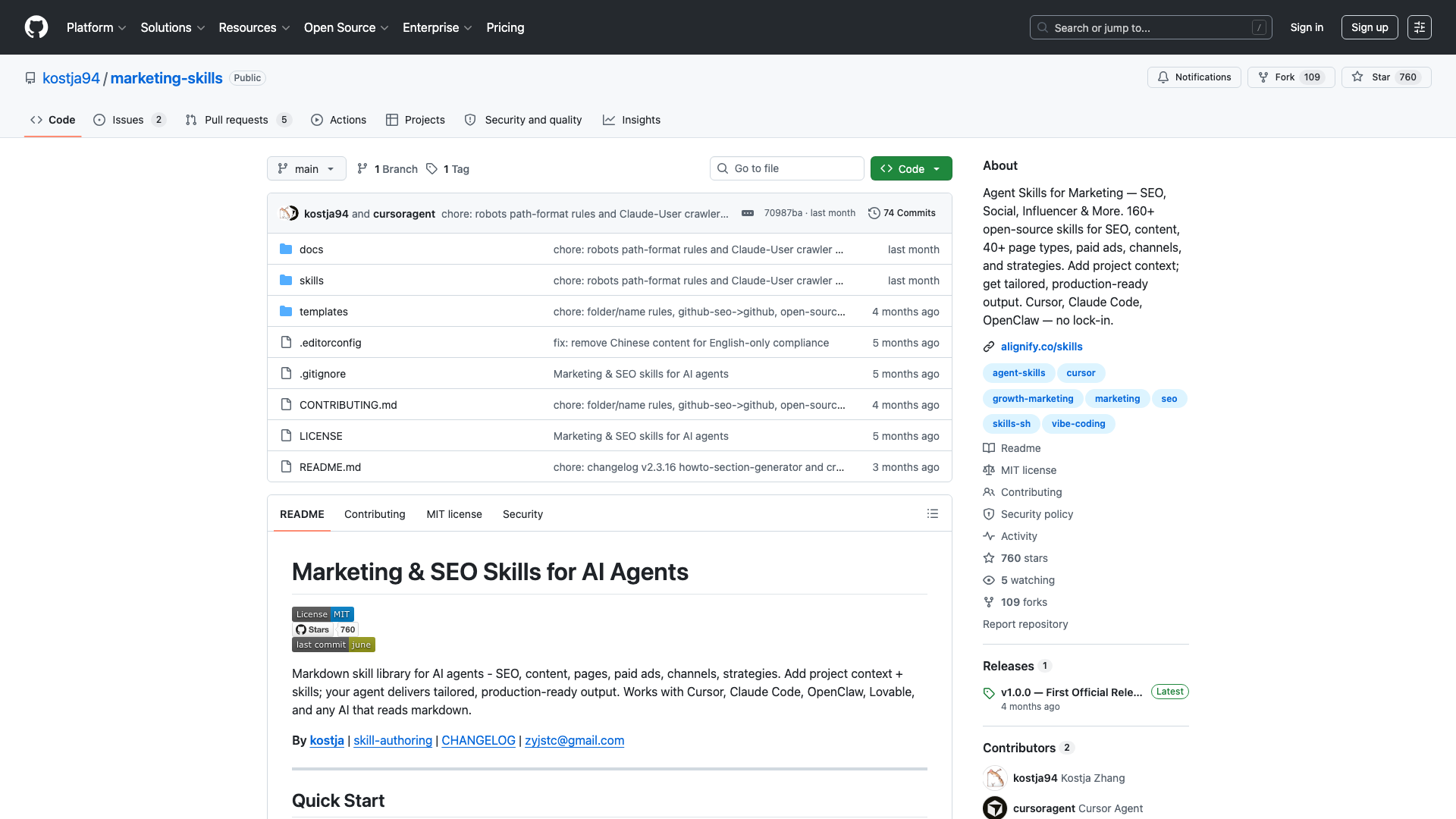
The most granular pack here. Its skills/seo/ tree splits into on-page, technical, content, entity-seo, local, off-page, programmatic-seo and parasite-seo, and on-page alone breaks into ten sub-skills covering title, description, heading, metadata, schema, internal links, Open Graph, image optimisation, featured snippets and SERP features.
That granularity cuts both ways. On our live-page test it found fewer surface defects than the broader packs, but made the sharpest structured-data observations of any run, catching a relative mainEntityOfPage path and breadcrumbs rendered in the interface with no matching BreadcrumbList markup.
Pros
- 172 narrowly scoped skills, so you load a small focused instruction rather than a general one and the answer stays on topic.
- On-page work splits into ten separate checks, letting you audit one dimension without triggering a full sweep.
- Includes
seo/off-page, one of very few off-page skills in existence. - Covers entity SEO and parasite SEO, which almost no other pack addresses.
- Went deeper on structured data than any other pack tested, catching markup errors the broader audits passed over.
- The most concise output of any pack on our live-page test, at 980 words with no invented findings.
Cons
- No scripts, so nothing is fetched, rendered or measured.
- 121 lines per skill on average, so any single skill is thin if you need depth on one topic.
- No evals and no reference files.
- Documentation is sparse, so the taxonomy is something you learn by browsing rather than reading.
Best for: getting a focused answer on one on-page dimension without a full audit.
7. Auriti-Labs/geo-optimizer-skill Review
622 stars · MIT · 182 Python files · pushed 2026-07-20 · script-backed
View Auriti-Labs/geo-optimizer-skill on GitHub
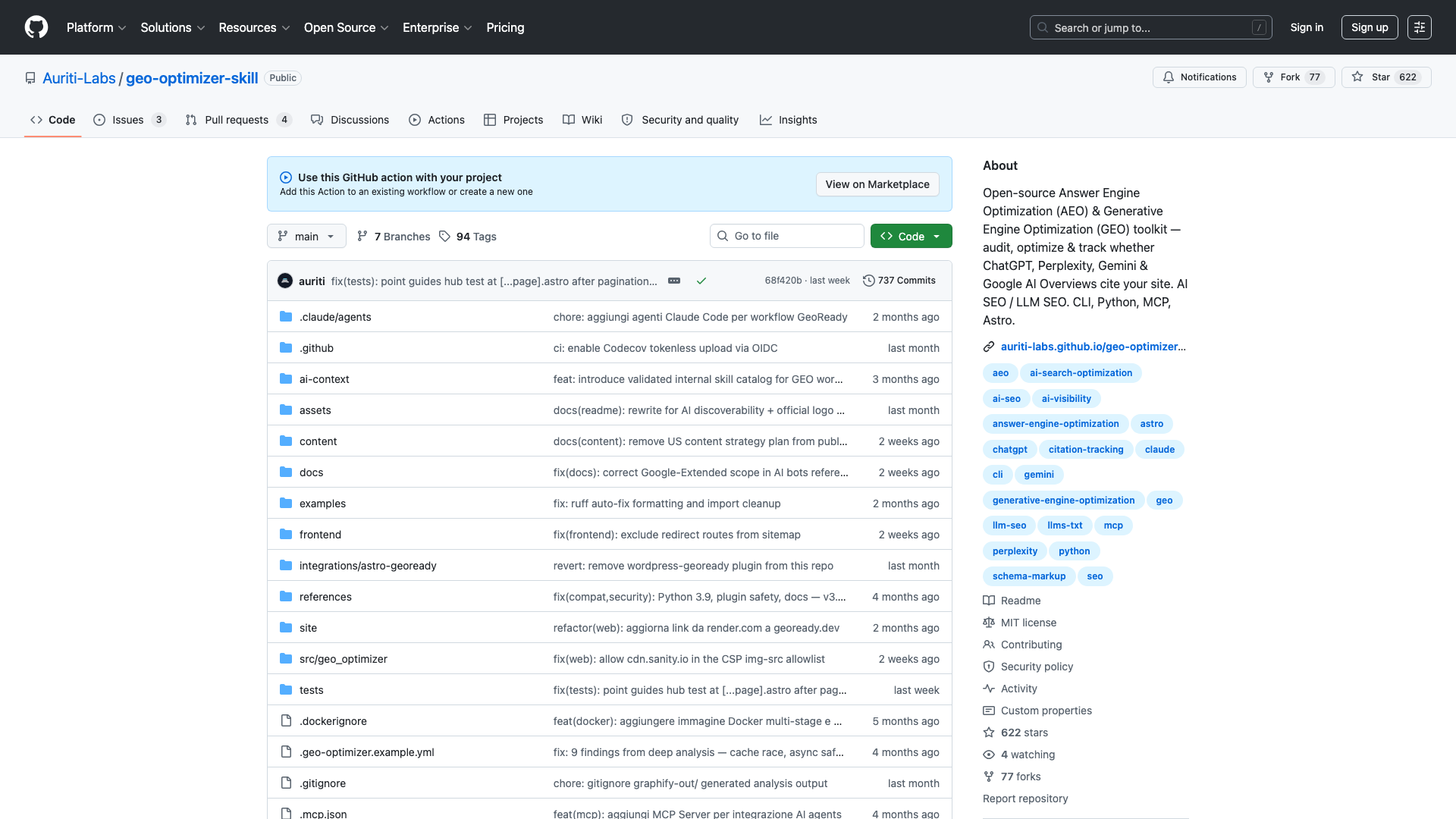
A Python GEO tool wearing a skill wrapper. It ships a Dockerfile, a GitHub Action and a written scoring rubric, which makes it the only pack here designed to run automatically rather than only when you ask.
Pros
- Ships a GitHub Action and Dockerfile, so GEO checks can gate a pull request instead of being a manual step.
- The scoring rubric is written down and versioned, so scores are explainable and stable between runs.
- Generates
llms.txtand schema alongside scoring, so it fixes as well as reports. - Runs identically on a laptop and in CI, so local and pipeline results agree.
Cons
- 63MB of download for a single skill, roughly 28 times the size of the median pack here.
- Requires a separate
pip installfrom PyPI after the skill install, so there are two things to keep in sync. - One
SKILL.mdover 182 Python files, so it behaves like a CLI you invoke rather than skills Claude composes. - GEO only, with no traditional SEO coverage.
Best for: teams who want AI-search checks running in CI on every deploy.
8. BrianRWagner/ai-marketing-claude-code-skills Review
377 stars · no license · 23 skills · pushed 2026-03-19 · prompt-only
View BrianRWagner/ai-marketing-claude-code-skills on GitHub
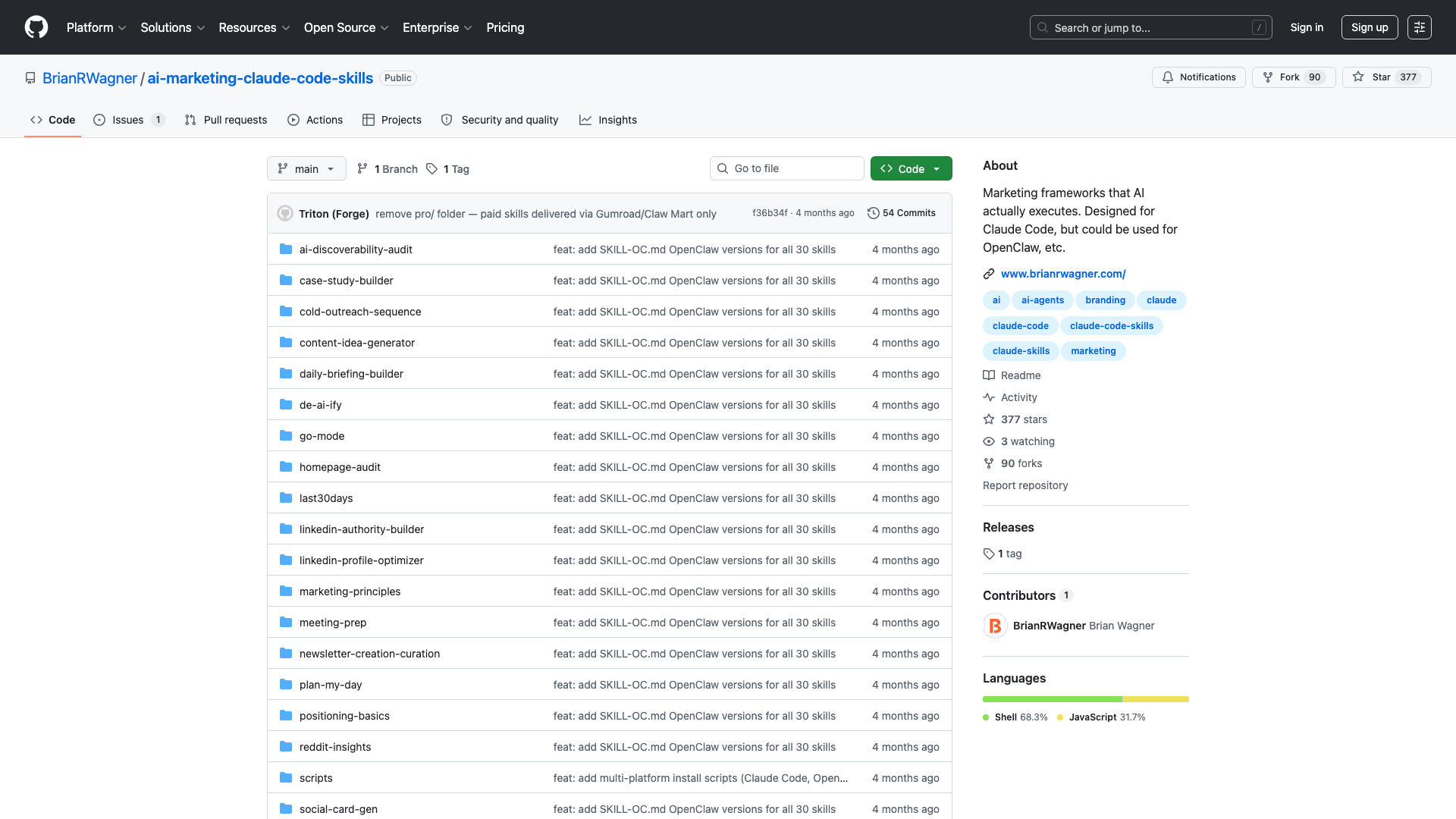
Marketing-wide rather than SEO-specific: homepage-audit, ai-discoverability-audit, cold-outreach-sequence, linkedin-authority-builder and case-study-builder.
Pros
- The only pack with a
--dry-runflag, so you can see exactly what it will write before it writes anything. - 268 lines per skill, deeper than most prompt-only packs of comparable size.
- Covers conversion and distribution work like homepage audits and outreach sequences, not just search.
Cons
- Ships no license at all, which leaves commercial and client use legally undefined. This is the blocker for agency work.
- No scripts, so audits are reasoning over what you provide.
- Its
homepage-auditskill is a conversion audit, not an SEO one. The pack has no on-page SEO skill at all, so it could not be included in our on-page comparison. - Four months since the last push, the longest gap of any pack here.
Best for: solo operators on personal projects who want a preview before anything is written.
9. inhouseseo/superseo-skills Review
232 stars · Apache-2.0 · 11 skills · pushed 2026-05-12 · prompt-only
View inhouseseo/superseo-skills on GitHub
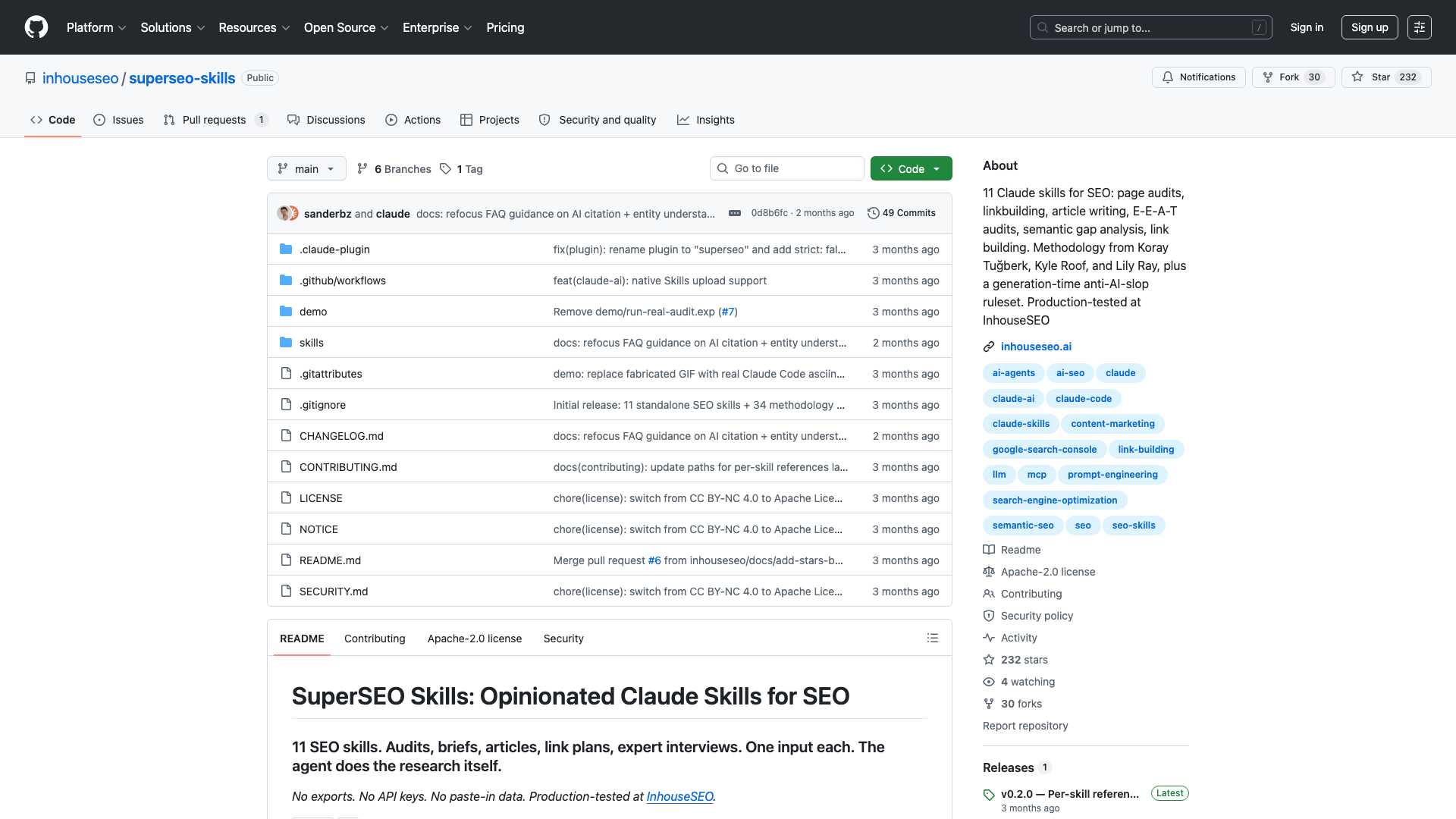
Eleven skills built around named practitioner methodologies, each with its own references/ directory. Its page-audit skill does not just read your page: it identifies the primary keyword, runs a Google search, and reads the top three competitors before saying anything.
That is exactly what it did on our live-page test. Four fetches, seven Google searches, and 4,103 words, most of them comparing the page against the three pages outranking it on trust signals, reviewer metadata and content breadth. It found the fewest on-page defects of any pack, because finding them was not what it was doing.
Pros
- The only pack that reads the actual competition before auditing, so the output is positional rather than a checklist.
- Produces a client-ready document with tables, effort estimates and a score, rather than a list of observations.
- States what it could not verify instead of asserting it, which is the behaviour you want from anything calling itself an audit.
- Every skill carries a
references/directory, so the reasoning behind each check is inspectable. - Apache-2.0 licensed, which is unambiguous for commercial and client work.
Cons
- By far the most expensive pack to run: 235 seconds and roughly twenty times the input tokens of any other pack on the same task, because the competitor reads dominate the budget.
- Weakest at plain defect detection. If you want to know what is broken on the page, it is the wrong tool.
- Needs enough turns to finish. Cut it short and it returns nothing at all rather than a partial audit.
- Only 11 skills, so coverage outside page and content auditing is thin.
- Opinionated toward specific named methodologies, which is a poor fit if you work differently.
Best for: producing a document a client will read, when runtime and token cost do not matter.
10. seranking/seo-skills Review
100 stars · MIT · 32 skills · pushed 2026-06-25 · hybrid
View seranking/seo-skills on GitHub
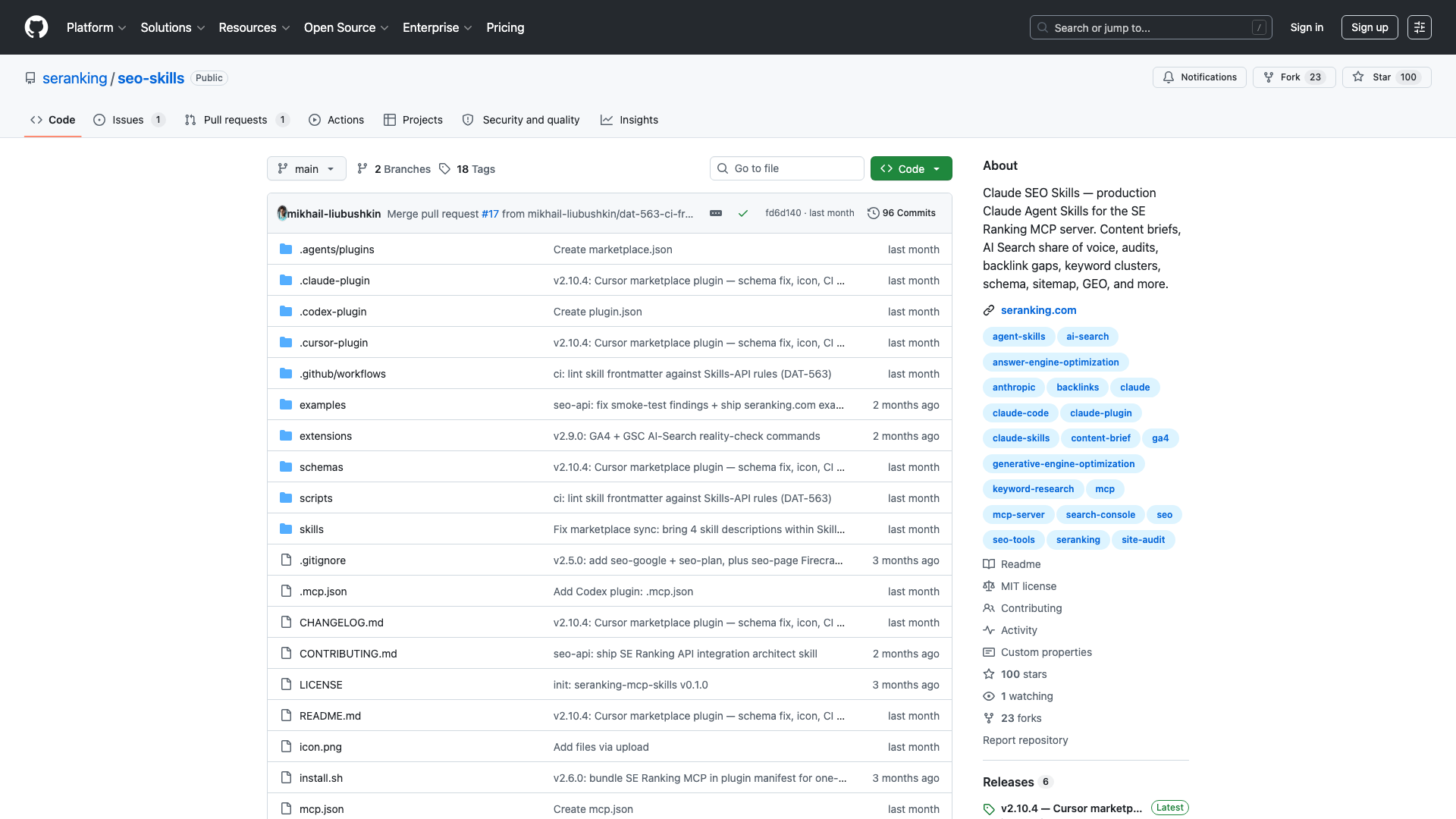
The only pack built by a data vendor. Its skills (Content Brief, AI Search Visibility, Backlink Gap Analysis, Ads Intelligence) run through the SE Ranking MCP server, which reaches more than 180 tools of live data.
That dependency is the whole proposition. Without an SE Ranking account the skills have nothing to read.
Pros
- Reads live keyword, backlink and SERP data rather than reasoning from the model's recollection.
- Backlink gap analysis runs against a real link index, which is the one thing the free packs genuinely cannot do.
- Tracks AI search visibility across five engines, including who is being cited instead of you.
- Respects a settings-file override instead of hardcoding your config path, so it fits an existing setup cleanly.
Cons
- Requires a paid SE Ranking subscription. Without it every skill is inert.
- Ties your workflow to one vendor's data, so switching providers means replacing the pack.
- Coverage follows what SE Ranking's API exposes rather than what an audit needs.
Best for: teams already paying for SE Ranking who want that data inside Claude.
11. garrettjsmith/localseoskills Review
66 stars · MIT · 39 skills · pushed 2026-06-22 · prompt-only
View garrettjsmith/localseoskills on GitHub
Local SEO specifically: Google Business Profile, citations, NAP consistency and review handling, with adapters for DataForSEO and Semrush.
Pros
- The only pack built for local work rather than bolting a local section onto a general audit.
- Ships DataForSEO and Semrush adapters, so it can reach live local data if you have keys.
- Sets up a persistent client brief and asks scoping questions first, which suits repeat work on the same location.
- The uninstaller backs up your saved briefs before removing anything, the only pack here that protects your work on removal.
Cons
- Useless outside local SEO. There is no general audit path.
- No scripts, so GBP and citation findings are reasoning rather than measurement unless you supply the adapters with keys.
- No evals or reference files.
- Small community, so problems you hit are likely unreported.
Best for: agencies running multi-location or Google Business Profile work.
12. mykpono/ultimate-seo-geo Review
61 stars · MIT · 35 scripts · v1.9.0 · script-backed
View mykpono/ultimate-seo-geo on GitHub
The smallest pack here by stars and one of the more capable by output. Thirty-five scripts covering technical health, JSON-LD, E-E-A-T and AI search visibility, producing HTML, XLSX and PDF reports.
Install it through the plugin marketplace with /plugin marketplace add mykpono/ultimate-seo-geo. The shell script in the repository root is a maintainer helper, not the install path.
Pros
- Produces HTML, Excel and PDF files, so the output is something you send rather than something you copy out of a chat.
- Caps crawl scope by default with an explicit
--crawl-deepopt-in, so a first run cannot hammer a site by accident. - Explicitly LLM-agnostic, so the same audits run outside Claude.
- Optional Firecrawl and DataForSEO extensions add live data without being required to start.
Cons
- The obvious-looking script in the repo root is not the installer, so the first attempt usually goes wrong.
- Only two
SKILL.mdfiles over 35 scripts, so most behaviour is opaque until you read the Python. - Default capped crawl means the first report understates site-wide issues until you rerun deeper.
- Very small community, so you are likely the first to hit any given bug.
Best for: consultants who need a deliverable file at the end of the audit.
All 12 Claude SEO skills compared
| Skill | Stars | License | Skills | Type | Needs paid data | Output |
|---|---|---|---|---|---|---|
| AgriciDaniel/claude-seo | 12,444 | MIT | 33 | script | for 8 of 33 | scores, reports |
| coreyhaines31/marketingskills | 41,886 | MIT | 48 | prompt | no | prose |
| zubair-trabzada/geo-seo-claude | 9,129 | MIT | 16 | script | no | scores, llms.txt |
| aaron-he-zhu/aaron-marketing-skills | 2,465 | Apache-2.0 | 120 | prompt | no | prose |
| Bhanunamikaze/Agentic-SEO-Skill | 791 | MIT | 1 | script | no | evidence-backed audit |
| kostja94/marketing-skills | 760 | MIT | 172 | prompt | no | prose |
| Auriti-Labs/geo-optimizer-skill | 622 | MIT | 1 | script | no | scores, CI checks |
| BrianRWagner/ai-marketing-…skills | 377 | none | 23 | prompt | no | prose |
| inhouseseo/superseo-skills | 232 | Apache-2.0 | 11 | prompt | no | structured document |
| seranking/seo-skills | 100 | MIT | 32 | hybrid | yes | live data analysis |
| garrettjsmith/localseoskills | 66 | MIT | 39 | prompt | optional | prose, client briefs |
| mykpono/ultimate-seo-geo | 61 | MIT | 2 | script | optional | HTML, XLSX, PDF |
Star counts, licenses and push dates verified via the GitHub API on 27 July 2026.
Testing four Claude SEO skill packs on a live page
Prompt-only packs are the ones people ask about most, because it is not obvious what a markdown file adds to a model that already knows SEO. So we tested it.
What we tested. Each pack was pointed at one live URL, our AI link building guide, and asked a single question: audit the on-page SEO of this page and report your findings. Nothing was pre-extracted for them. Each pack got the same two tools, one to fetch any URL and one to run a Google search, so packs designed to read competitors could actually do it. Each pack ran on the same model with the same tools, and the only thing that changed between runs was the pack's own skill file.
We used each pack's real entry point, the skill its own description nominates for auditing a page: seo-audit for coreyhaines31, strategies/structure/seo-audit for kostja94, page-audit for superseo, and on-page-seo-checker for aaron-marketing-skills. BrianRWagner's pack sat this one out because its homepage-audit skill is a conversion audit ("you are a conversion expert"), not an SEO one, so there is nothing comparable to run.
We also ran the same task with no skill loaded at all, as a baseline.
Then we scored the results against defects confirmed independently beforehand by the script-backed tools: images with empty alt text, images with no lazy loading, a canonical pointing at the www host, an unmarked LCP hero, and absent hreflang. We also watched for the opposite failure, inventing problems that are not there. That page carries valid FAQPage, HowTo and BlogPosting markup, so any pack claiming the schema was missing would be marking itself wrong.
The results
| Pack | Real defects found | Invented defects | Words | Fetches | Searches | Time |
|---|---|---|---|---|---|---|
| coreyhaines31/marketingskills | 4 of 5 | 0 | 1,230 | 1 | 0 | 51s |
| aaron-he-zhu/aaron-marketing-skills | 4 of 5 | 0 | 1,785 | 1 | 0 | 70s |
| No skill at all | 4 of 5 | 0 | 1,029 | 1 | 0 | 43s |
| kostja94/marketing-skills | 3 of 5 | 0 | 980 | 1 | 0 | 54s |
| inhouseseo/superseo-skills | 2 of 5 | 0 | 4,103 | 4 | 7 | 235s |
Two things stand out.
Nothing hallucinated. Given a real page and the ability to fetch it, all five read the structured data correctly and none invented a defect. That is worth stating plainly, because reasoning over a pasted summary is where these tools get things wrong, and fetching the page removes most of that risk.
Asking with no skill at all still matched the best packs on defect detection, in the fewest words and the least time. On raw "what is broken on this page," the skill file did not add accuracy.
What each one actually produced
The scoreboard hides the more useful difference, which is that the packs were not trying to do the same job.
coreyhaines31/marketingskills produced the most balanced audit: it caught the alt text and lazy loading gaps, then went past them to note the BlogPosting markup was missing a publisher and used a relative mainEntityOfPage, and recommended adding breadcrumb markup. Tight, prioritised, no padding.
kostja94/marketing-skills found the fewest surface defects but made the sharpest structured-data observations of any run, including that BlogPosting.mainEntityOfPage uses a relative path where an absolute URL belongs, and that breadcrumbs appear in the interface with no matching BreadcrumbList markup. Its granular skills push it toward depth on a narrow dimension rather than breadth.
aaron-he-zhu/aaron-marketing-skills was the only run to catch the missing hreflang, and the only one to return numeric scores per dimension, marking page-level tags and structured data 10 out of 10 and flagging the accessibility issues as P0. It also inferred a target keyword without being given one.
inhouseseo/superseo-skills did something else entirely. It made four fetches and seven Google searches, pulled the three top-ranking competitors, and spent most of its 4,103 words comparing this page against them on trust signals, reviewer metadata and content breadth. It found the fewest on-page defects because it was not really looking for them. It was doing a competitive positioning audit, which is what its skill description promises. It also cost by far the most: 235 seconds and roughly twenty times the input tokens of any other run.
What this actually tells you
For finding what is broken on a page, a prompt-only skill adds nothing a clear request does not already get you. The model knows on-page SEO.
What the skill file changes is scope and shape. superseo went and read the competition because its skill told it to. aaron returned scored dimensions because its skill defines them. kostja94 drilled into structured data because that is what its narrow skills do. The unskilled run was good, but it was good by accident, and nothing guarantees the next one has the same shape or covers the same ground.
That is the real purchase: not a smarter answer, but a decision made once about what an audit should cover, applied the same way every time. If you audit one page a month, skip them. If you audit forty and need to compare them, or you need a junior to produce what you would have produced, they earn their place.
Script-backed packs are a different proposition. No prompt gets you a Playwright render, a passage-level citability score, or a Core Web Vitals reading. That is added capability rather than added consistency, and it is why the split at the top of this article matters more than the star counts.
What Claude SEO skills don't do: build links
Every pack here analyses links. None of them build links.
- claude-seo analyses your existing profile through Moz, Bing and Common Crawl. It reads links. It does not find prospects.
- coreyhaines31/marketingskills, 48 skills including
cold-email,prospectinganddirectory-submissions, has no link-building skill. - SE Ranking finds domains linking to competitors but not you, then hands you the list. That gap analysis is genuinely useful, and it is the same starting point our own competitor backlink analyzer works from.
- aaron-marketing-skills gets closest with
outreach-managerandoffsite-signal-analyzer. - kostja94 has
seo/off-page, one of the only skills framed that way.
They all stop at the prospect list, which is the cheap half of the job.
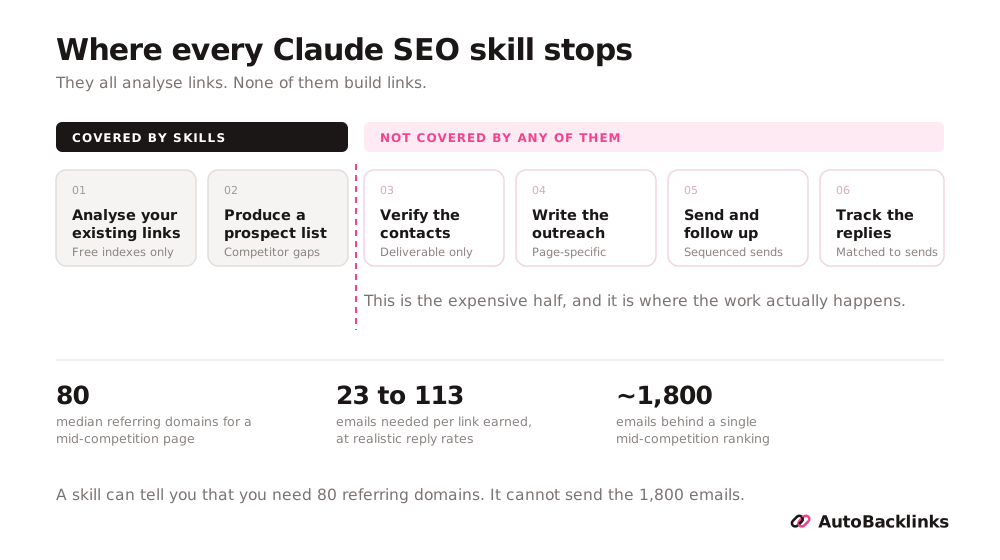
The expensive half has numbers on it. Our study of referring domains puts a mid-competition page at a median of 80 referring domains. At realistic reply rates that is somewhere between 23 and 113 emails per link earned. Our own published campaign hit a 17.1% reply rate across 187 sends, and what drove it was prospecting quality rather than email copy.
A skill can tell you that you need 80 referring domains. It cannot find the prospects, verify the contacts, write 1,800 personalised emails, send them and track the replies. That is a different kind of tool, which is the honest reason AutoBacklinks is a product and not a Claude skill. The product now has an MCP server, so Claude can run that outreach workflow instead of a skill pretending to, one backlink type at a time: we wrote up how to build backlinks with Claude as a prompt per link type. For what AI can and cannot do across that whole workflow, see how AI link building actually works, and for the tooling landscape, best AI link building tools.
How to install Claude SEO skills
Two paths. The marketplace is cleaner:
claude
/plugin marketplace add AgriciDaniel/claude-seo
/plugin install claude-seo@agricidaniel-claude-seo
/seo setup
Or clone and run the installer:
git clone --depth 1 https://github.com/AgriciDaniel/claude-seo.git
bash claude-seo/install.sh
Two things worth knowing before you install a second pack.
Check the skill name first. Both claude-seo and Agentic-SEO-Skill claim ~/.claude/skills/seo, and geo-seo-claude and geo-optimizer both want /geo. Install the second one with a rename flag rather than forcing it, or you will silently overwrite the first.
Read the install script. These are shell scripts writing into your Claude configuration, and thirty seconds of reading is cheap insurance. If you plan to try several, point $HOME at a scratch directory first and everything lands there instead of your real config.
Which Claude SEO skill to pick
If you install exactly one: claude-seo. Widest coverage, real measurement, actively maintained.
If your work is wider than SEO: add coreyhaines31/marketingskills.
If you care about AI search: zubair-trabzada/geo-seo-claude for passage scoring, or Auriti-Labs if you want it in CI.
If you want the leanest useful answer: kostja94/marketing-skills.
If you do local SEO: garrettjsmith/localseoskills.
If you already pay for SE Ranking: their official pack, for the live data.
If you need a file to send a client: mykpono/ultimate-seo-geo or inhouseseo/superseo-skills.
If you do agency work: avoid BrianRWagner's pack until it ships a license.
If you need to build links rather than audit them: none of these.
FAQ
Are Claude SEO skills free?
Most are. Eleven of the twelve here are MIT or Apache-2.0 and cost nothing. One ships no license at all, which is not the same as free and creates real ambiguity for commercial use. The paid edges are the data connections: eight of claude-seo's skills need paid API keys, and SE Ranking's pack needs a subscription. The skills are free. The live data usually is not.
What is the best free Claude SEO skill?
AgriciDaniel/claude-seo. MIT licensed, 33 skills, and the 25 core skills run without any paid API key. It reads pages the way a crawler does, which is how it catches things a browser view hides.
Do Claude SEO skills replace Ahrefs or Semrush?
No. Skills are instructions and scripts. They have no backlink index and no keyword database. What they can do is fetch and analyse pages, score structure, validate schema and read Core Web Vitals. For volume, difficulty and backlink data they either connect to a paid provider through MCP or fall back on free sources like Common Crawl, Moz and Bing, which are much thinner. Treat them as an analysis layer on your data, not a replacement for it.
Do they work in Claude Desktop or only Claude Code?
Both, but not equally. Prompt-only packs work anywhere Claude reads a SKILL.md, including Desktop. Script-backed packs need a terminal, Python and often Playwright, so they are effectively Claude Code. Every pack that produced a real measurement in testing was in the second group.
Is there a Claude skill for link building?
Not really. Every major SEO pack analyses your existing backlinks and stops at a prospect list. The closest are outreach-manager in aaron-marketing-skills and seo/off-page in kostja94's repo. None of them find contacts, write the outreach, send it, or track replies.
Do Claude SEO skills need API keys?
The core skills mostly do not. claude-seo's 25 core skills run on Python and Chromium alone. Keys become necessary for live data: DataForSEO, Firecrawl, Ahrefs, SE Ranking, Bing Webmaster, or Google APIs for Search Console and PageSpeed. SE Ranking's official pack needs a paid account to do anything at all.
Can you install more than one Claude SEO skill?
Yes, but check the skill names first. claude-seo and Agentic-SEO-Skill both install to ~/.claude/skills/seo, so the second one either stops or, if you force it, overwrites the first. Use the rename flag instead. The same applies to the /geo namespace across the two GEO packs.
Which Claude SEO skill is best for technical SEO?
claude-seo. It covers crawlability, indexation, JavaScript rendering, Core Web Vitals including INP, security headers, hreflang and schema generation, and it runs the checks rather than reasoning about them. Agentic-SEO-Skill is the alternative if you want every finding tied to a specific script that produced it.
About Rachid Idali
Founder & SEO Strategist
Rachid Idali has spent 10 years in SEO, running multi-six-figure SEO and link-building budgets across content, digital PR, and outreach programs. He writes about practical systems for finding relevant prospects, earning links, and turning SEO operations into repeatable pipelines.
More from Rachid Idali