

How to Build Backlinks With Claude in 2026: 7 Link Types

by Rachid Idali
Last Updated: September 14, 2026
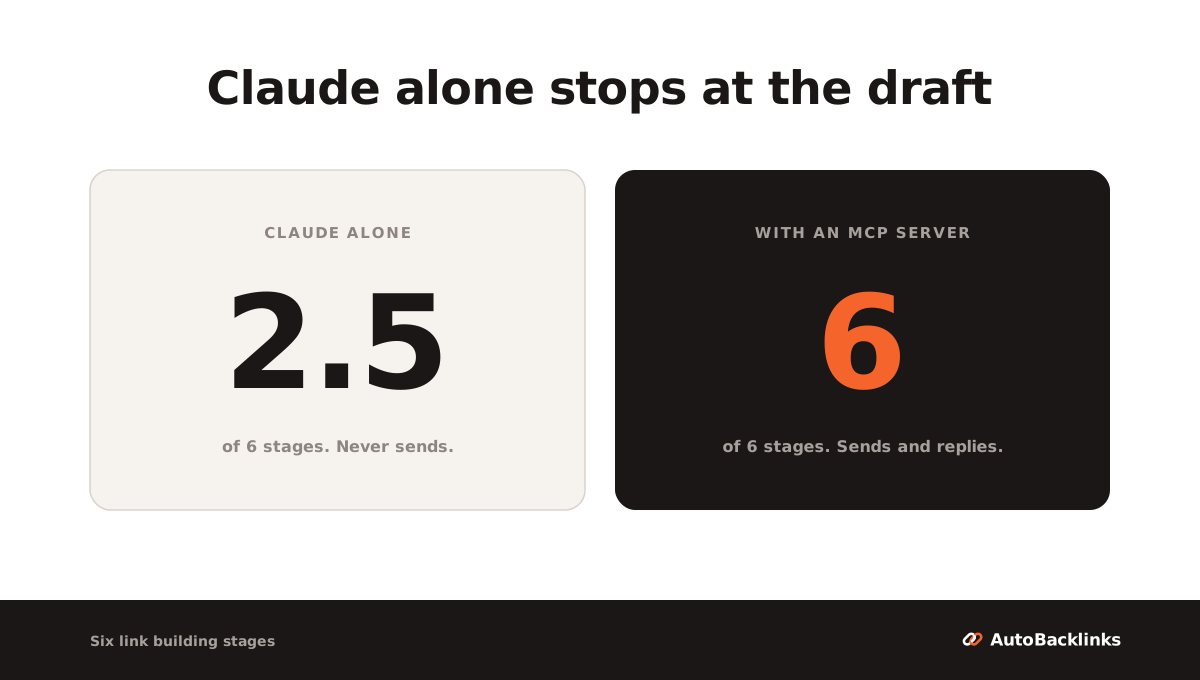
A link building campaign has six stages, and Claude on its own gets through about two and a half of them before it stops. To build backlinks with Claude you connect it to an MCP server that holds live metrics, verifies the contact, sends from your mailbox and reads the replies, then run each backlink type as a prompt. Everything below is the second half of that sentence.
Six steps, start to finish:
- Connect the server. Add
https://mcp.autobacklinks.aias a custom connector in the Claude apps, or run oneclaude mcp addcommand in Claude Code, then sign in with OAuth. - Verify it. Ask Claude to call
list_websitesand name your sites. Reads cost no credits, so this proves the connection before any spend. - Pick the backlink type. Guest posts, listicle placements, link insertions, product reviews, pages ChatGPT cites, competitor backlinks, or your own list of URLs.
- Approve the credit quote. Claude estimates the cost and waits. One prospect found, qualified, contacted and written costs 5.5 credits, or 6.5 with the default follow-up.
- Review the drafts. New campaigns hold every draft. Read them in chat, edit subjects, and cut bad fits before anything sends.
- Send, then handle replies. Confirm the send, then read and answer replies in the same chat and track each yes as an opportunity.
Can Claude build backlinks on its own?
No, and it is worth being exact about where it stops rather than vague about what it can do.
Here are the six stages a campaign passes through, the same six I used to score MCP servers for link building, with Claude on its own in one column.
| Stage | Claude alone, no server | With the AutoBacklinks MCP |
|---|---|---|
| 1. Find prospects | Half. Web search surfaces pages, but there is no backlink index behind it, so "who links to my competitor" is out of reach | Yes |
| 2. Qualify | Half. It can read a page and judge the fit. It cannot tell you the site's Domain Rating, traffic or spam score | Yes |
| 3. Verified contact | Half. It can find a published contributions address on a contact page. It cannot check that the address still resolves | Yes |
| 4. Pitch from the page | Yes. The one stage a language model is genuinely good at | Yes |
| 5. Send and follow up | No. No mailbox, no schedule | Yes |
| 6. Replies and placement | No. It never sees your inbox | Yes |
The right-hand column is our own server, not MCP servers in general. When I scored ten of them, six never got past stage two and exactly one covered all six, so do not read that column as what any connector gives you.
Claude scores about 2.5 of 6 on its own, and the only full point is the writing. That is not a criticism of the model. Writing a relevant pitch from a page you hand it is exactly what it should be good at, and it is good at it.
I want to be careful with those three halves, because the temptation is to round them down and make the gap look wider than it is. Claude with web search really can find a "write for us" page, read it, and tell you whether your product belongs there. What it cannot do is put a number on the site or confirm the address works.
One scoring difference from that other piece, stated plainly because it changes the total. There, stage four asks whether a server writes the pitch in a single call against campaign state that persists between prospects, and by that test a chat window scores zero. Here I am scoring what the model can produce, and a model handed a page writes an excellent pitch. Score it the stricter way and Claude alone is 1.5 of 6 rather than 2.5. Either number tells you the same thing about where it stops.
The last two stages are the hard stop. Sending and reading replies need a mailbox and a schedule, which are account-level things a chat window does not have.
There is a second limit that no server removes. Claude cannot place a link on somebody else's site. A publisher has to agree to it, which is why this is outreach and not generation.
That distinction is also where Google draws its line. Google Search Central's link spam policy gives this as an example of link spam:
Using automated programs or services to create links to your site
It sits in the same bulleted list as buying and selling links for ranking purposes. Automating the labor of outreach is a different thing from automating the link: in the first, a human editor still decides, and in the second nobody does.
Two more lines from that page matter here, and both are usually left out of articles like this one.
The first names guest posts directly, which is the first link type below:
Advertorials or native advertising where payment is received for articles that include links that pass ranking credit, or links with optimized anchor text in articles, guest posts, or press releases distributed on other sites
Read it carefully, because it is narrower than it looks. What the bullet catches is paid placement that passes credit. An unpaid contributed article that a publisher accepted on merit is not in the list. Pay for a guest post and the link needs qualifying.
The second is the part people quote as though Google banned paying at all:
Google does understand that buying and selling links is a normal part of the economy of the web for advertising and sponsorship purposes
Which is the actual rule. Paying for advertising or sponsorship is allowed, as long as the link is qualified with rel="nofollow" or rel="sponsored". Passing ranking credit for the payment is not.
How to connect the AutoBacklinks MCP to Claude
MCP is the Model Context Protocol, the open standard an AI client uses to call another product's tools. This is our own server, so every number below comes out of the repository rather than a marketing page, and you can check each one against the tool list on our MCP page.
Four things have to be true before the first prompt works, and three of them are easy to miss:
- A Claude plan that allows custom connectors. Not every tier does. If Settings has no Connectors section, that is the reason.
- An active AutoBacklinks plan or trial. Without one the sign-in succeeds and the tools still fail.
- At least one website added to your account. The verify prompt below asks Claude to name your sites, and a new account has none to name.
- A mailbox connected in the dashboard, if you intend to send.
get_mailbox_connect_linkreturns the link, and the password is typed in your browser, never in the chat.
The server is at mcp.autobacklinks.ai. Sign-in is OAuth, so there is no API key to paste anywhere.
Claude web, desktop and mobile
- Open Settings, then Connectors.
- Choose Add custom connector.
- Name it AutoBacklinks and paste
https://mcp.autobacklinks.ai. - Click Connect, then Sign in with AutoBacklinks.
- Start a chat and turn the AutoBacklinks connector on.
Step five is the one people miss. Connectors are added in Settings but switched on inside each conversation, so a chat where Claude says it has no AutoBacklinks tools is usually a chat with the connector off rather than a broken setup.
Claude Code
One command in your terminal, then sign in from inside a session:
claude mcp add --transport http autobacklinks https://mcp.autobacklinks.ai
Run /mcp, pick AutoBacklinks, and finish the sign-in in the browser. Cursor, Codex, Gemini CLI, Hermes and OpenClaw each have their own one-line equivalent.
Then prove it works before you spend anything:
Use the AutoBacklinks MCP server and call list_websites.
Then name my sites and tell me if AutoBacklinks is connected and ready.
If not, tell me what failed.
If tools you read about here are missing, the client is holding a cached tool list. Disconnect and reconnect, or start a new session.
What building backlinks with Claude costs in credits
Reads cost no credits. Of the 57 tools the server publishes, 48 cost nothing to call, 7 spend credits and 2 send email. So Claude can read every site, scan, prospect, draft and reply thread in your account before anything is billable. Answering a reply is not a read: reply_to_thread sends.
Spends work as a quote and a yes. Claude calls an estimate tool first, estimate_campaign before a campaign exists or get_campaign_run_estimate for one more run, tells you the number, and waits. In Claude Code and other clients that support it, the server raises the confirmation itself and Claude cannot answer it on your behalf. Everywhere else it passes the approved amount with the call. The server refuses anything where the approval is missing, or lower than its own live estimate.
Every charge started from a chat shows on your usage page with a "via MCP" label, so the spend is auditable after the fact as well as before it.
One thing to understand before the prompts, because it shapes all of them. Qualification and contact finding happen inside a campaign run, not as point-and-shoot lookups. There is no tool that answers "what is example.com's Domain Rating" for a domain your account has never scanned, and no standalone "find me this site's editor" call. Claude gets both, but it gets them by running a campaign, not by asking a question. Sending also needs a mailbox connected in the dashboard first.
The prices are the same as the dashboard:
- Find a prospect: 1 credit each
- SEO metrics (Domain Rating, organic traffic): 1 credit per 2 domains
- Verified email: 3 credits
- Generated outreach email: 1 credit per email in the sequence
- Competitor backlink scan: 5 credits per scan, plus 10 per 100 new backlinks, capped at 105
- Evaluate a backlink offer: 10 credits
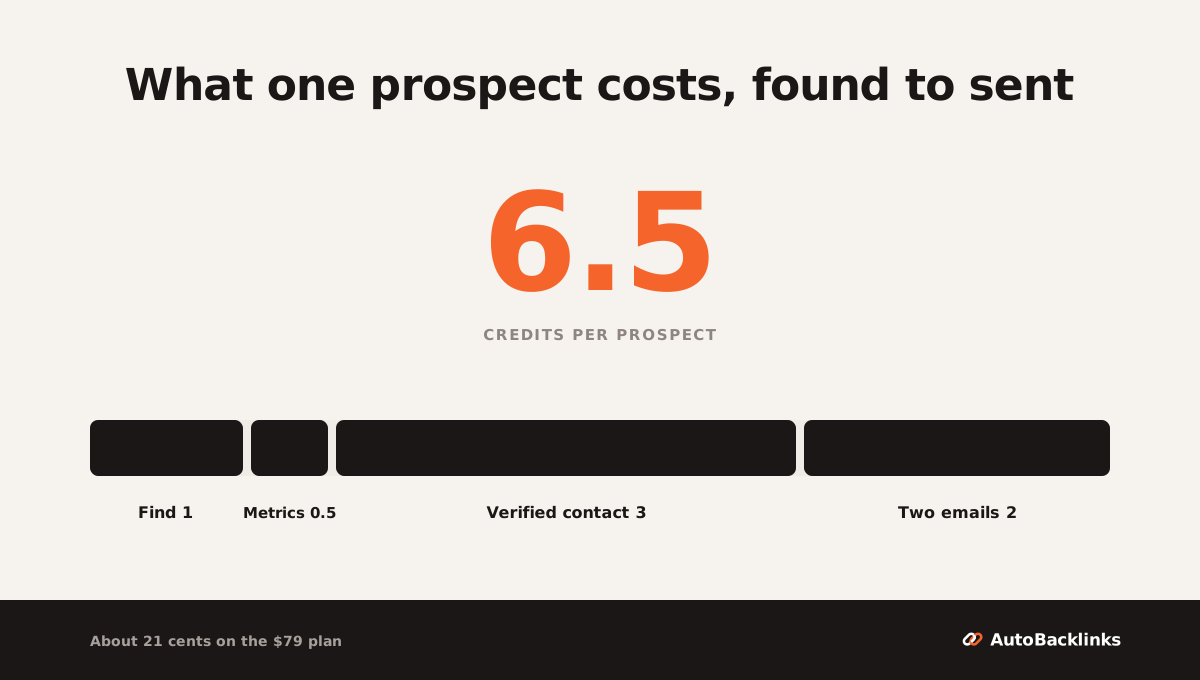
Add the first four and one prospect goes from found to written for 5.5 credits at volume, about 17 cents on the $79 plan's 2,500 credits, because SEO metrics packs two domains into a credit. A sequence defaults to two emails, the first and one follow-up, so a prospect you contact and then chase costs 6.5 credits, about 21 cents.
Two things that number leaves out, both worth knowing before you plan a budget:
- It is the price of a prospect that survives. You still pay the find and the metrics on domains that then fail your own quality filters, so the blended cost per prospect that reaches a send is higher than 6.5. Discovery settles per relevant prospect found, and an unverifiable email is refunded rather than charged, so the leakage is narrower than it could be. It is not zero.
- Scans and valuations sit outside it. A competitor backlink scan and a backlink offer valuation are separate line items, priced below.
Two ceilings sit on every connection, meaning one sign-in on one client, by default: 120 requests a minute, and 1,000 credits a day counted when a spend is authorized rather than settled, resetting at midnight UTC. At 6.5 credits a prospect that is roughly 150 prospects a day from chat. The dashboard is not subject to it. Plans run $79, $179 and $399 a month at 2,500, 7,500 and 20,000 credits, and the trial is 7 days and 120 credits with a card.
The 7 backlink types Claude can run, and what each one calls
Before the prompts, one note on what the seven are, because they are not seven of the same kind of thing. Four are discovery playbooks in the product: guest posts, listicles, product reviews and pages ChatGPT cites. Link insertions is the campaign engine that two of those four run on, and it is listed separately because you can also point it at ordinary articles through web search. Competitor backlinks and your own list are ways of feeding any of them rather than types in their own right. Seven prompts, five shapes.
The tool names below come from the server's published catalogue and the call order from what the tool descriptions instruct, not from a transcript of a live session. Costs are labelled the way the catalogue labels them: free, credits, or sends.
Guest post backlinks with Claude
The oldest link type and still the one with the most room, because it trades a link for work the publisher wanted anyway.
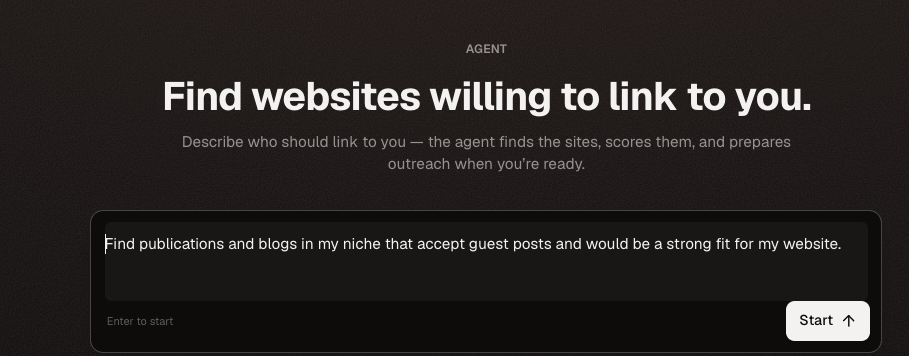
Paste this:
Start a guest post campaign for example.com.
Find 50 publications in my niche that accept contributed articles,
drop anything that is not a real editorial site,
and hold every draft for my review.
The chain is the same for every campaign type, so it is worth reading once here. get_campaign_setup_options (free) reads the real menu of mailboxes, competitors and cadences. create_campaign (credits) starts the run. list_campaign_prospects (free) shows you who it found, and disqualify_prospects (free) cuts the misses. generate_drafts (credits) writes the pitches, and send_drafts (sends) queues them.
create_campaign and generate_drafts are the two that spend, so both get quoted before they run. A 50-prospect run at 6.5 credits each is about 325 credits, which is 13 percent of a month on the $79 plan.
What to watch: relevance beats Domain Rating here. On our published campaign, 187 emails produced 32 replies, a 17.1 percent reply rate, and the thing that moved it was prospecting quality, not the copy. Ask Claude to drop off-topic domains before it writes anything, because a draft written to a bad fit still costs two credits at the default two-email sequence.
If you want to see what a good pitch looks like before you approve 50 of them, our guest post pitch examples are the ones these drafts are modeled on.
Listicle backlinks with Claude: best-of and alternatives pages
Listicle backlinks come from pages that already rank for "best X" or "X alternatives" and already list products like yours. You are asking to be added to a list that exists, which is a much smaller ask than a new article.
Find listicle and alternatives pages in my category where my product
could be added, 50 of them, and show me the ones that already rank
for my main keyword before you write anything.
Tools: create_campaign (credits) with the listicles playbook, then list_campaign_prospects (free), disqualify_prospects (free), generate_drafts (credits) and send_drafts (sends). A 50-prospect listicle run is about 325 credits, the same arithmetic as a guest post run, because the stages are identical and only the search queries differ.
The listicle playbook carries its own angle. A prospect found through an "alternatives" query gets a draft that references that specific alternatives page and pitches your product as another option, rather than a generic mention request.
What to watch: pages that still get updated. A best-of post from four years ago with no revision history is unlikely to be edited for you.
Link insertions with Claude
A link insertion, also called a niche edit, adds your link into an article that is already published and already ranking. It is the same ask as a listicle placement, applied to prose instead of a list.
Start a link insertion campaign for example.com using web search.
Target articles that rank for my topic and already link out to tools.
Approach: simple fit request, no payment offer.
Tools: the same chain, create_campaign (credits) with the link insertion goal and web search as the source, then list_campaign_prospects (free), generate_drafts (credits), send_drafts (sends). add_campaign_source (free) bolts a second source onto a campaign that already exists, which is how you widen a run without starting over. Cost is the same 6.5 credits a prospect, about 325 for 50.
There are two campaign goals: link insertions and guest posts. The goal changes how every draft gets written. An insertion pitch references the topic of their page and asks whether they would add the product, instead of proposing an article.
What to watch: the price conversation. Some publishers will quote you a fee, and a paid placement is a different thing with different rules. The full ladder of what insertions cost direct, through a marketplace and through an agency is in our guide to link insertions and niche edits.
Product review backlinks with Claude
Product review backlinks come from sites that review products in your category, which have both the audience and the format. This one depends on an accurate competitor list, because the search works backwards from who has reviewed your rivals.
Find independent blogs and publications that review products like mine.
Use my saved competitors. 50 sites. Show me who they have reviewed
recently before drafting.
Tools: list_competitors (free) to check the list the search works from, add_competitor (free) to fix it, then the usual create_campaign (credits), list_campaign_prospects (free), generate_drafts (credits), send_drafts (sends). Again about 325 credits for 50 prospects.
Prospects from a review scan get the review-request angle automatically: each draft references the competitor they reviewed and asks them to look at yours.
What to watch: have something to give. Reviewers need access, so decide in advance whether you are offering a free account, a demo, or a longer trial, and put that in the campaign approach so every draft says the same thing.
Backlinks from pages ChatGPT cites, run from Claude
Prospecting the pages ChatGPT cites is three years old at most. The tactic is to find the source pages ChatGPT quotes when it answers questions in your market, then get mentioned on those pages, so the AI answer eventually carries you too.
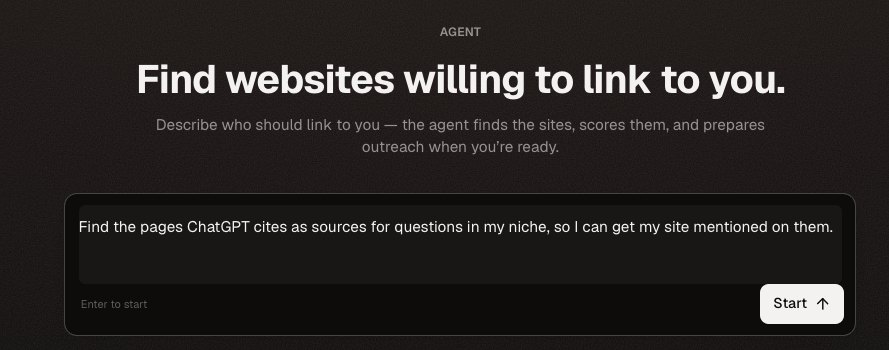
Find the pages ChatGPT cites when people ask about my category,
then start a campaign to get my product mentioned on them.
50 pages to start.
Tools: create_campaign (credits) with the ChatGPT sources playbook, or add_campaign_source (free) to add it to a campaign you already run, then list_campaign_prospects (free), generate_drafts (credits), send_drafts (sends). Same 6.5 credits a prospect.
Drafts from this scan open by noting that ChatGPT cites their page for the question that surfaced it, then ask to be added. That opener works, because you are telling a publisher something true and useful about their own traffic.
What to watch: this source attaches to link insertion campaigns, not guest post ones, and it becomes available after the trial. A trial account is limited to web search or competitor backlinks, one of the two, at up to 50 prospects. The broader strategy, and the evidence behind it, is in link building for AI search.
Copying competitor backlinks with Claude
A competitor's backlink profile is the highest-confidence prospect list there is, because every site on it has already linked to a business like yours.
Scan competitor.com's backlinks and show me the strongest
opportunities I could replicate. Skip anything my site already has.
Claude calls start_competitor_scan (credits). It costs 5 credits per scan plus 10 per 100 new backlinks, capped at 105 for up to 1,000 backlinks. It classifies how each backlink was acquired, so you can tell a guest post from a paid placement from a genuine editorial mention before you decide which ones are winnable. The same engine sits behind our competitor backlinks analyzer.
What to watch: a competitor's link is evidence, not a promise. The ones worth pitching are the pages where a real editor chose to link, not the directory bulk.
Building backlinks from your own list of prospects in Claude
If you already have a prospect list, add it to a campaign and skip discovery entirely.
Add these 40 URLs to a new campaign for example.com,
qualify them, find contacts, and draft the outreach.
Hold everything for review.
Tools: add_prospects (free) takes your own URLs into a campaign or starts a new one from them, and a CSV import does the same at larger volume. Then list_campaign_prospects (free), generate_drafts (credits) and send_drafts (sends) as usual. The find credit is not spent, because you did the finding, so a prospect costs 5.5 rather than 6.5. You still pay for metrics, contacts and both drafts.
What to watch: lists age. Run the qualification step even on a list you trust, because the contact who accepted guest posts two years ago may not be there.
Claude link building tactics that raise the reply rate
Those seven prompts get you campaigns and scans. These are the things that change what comes back.
Pick the approach deliberately. Three approaches reach the email writer, and they produce visibly different emails: simple fit request (no payment angle at all), offer something in return (a newsletter mention, an affiliate setup, promotion), and pay for placement (blunt, asks for the rate card). Say which one you want in the prompt. create_campaign will not choose for you: it is built to stop and ask, so leaving it out costs you a round trip.
Disqualify before drafting, not after. disqualify_prospects and stop_lead cost no credits. A generated draft costs two credits at the default two-email sequence. Ask Claude to show you the prospect list and cut the obvious misses first, every time.
Rewrite unsent drafts instead of starting over. If the angle is wrong, change_campaign_approach changes it and rewrites everything not yet sent. That costs credits, but less than a new campaign.
Get a paid offer valued before you answer it. When a publisher quotes a price, evaluate_opportunity_backlink pulls backlink, keyword, traffic-location and pricing signals and estimates what the link is actually worth, for 10 credits. And if you do pay, the placement needs rel="sponsored", which Google asks for on advertisements and paid placements. A paid link that passes ranking credit is the thing the spam policy is about.
Turn replies into tracked opportunities. list_threads and reply_to_thread keep the conversation in chat, and list_opportunities is where a yes becomes something with a status and a next step instead of a lost email.
Building backlinks with Claude and an SEO MCP you already pay for
If you already pay for Ahrefs, Semrush, SE Ranking or DataForSEO, each of them publishes an MCP server, and connecting one to Claude is a real upgrade over Claude on its own. Be clear about what it buys you, though.
A data MCP takes stages one and two to a full point and touches nothing after that. It gives Claude a live backlink index, so "show me who links to competitor.com and rank them by Domain Rating" finally works, and it gives real metrics to filter on. Then it stops. None of the four returns an email address, and none of them sends anything, because they are read-only data products by design.
So a Claude stack built on a data MCP leaves you four manual jobs: find the right person at each domain, verify the address works, paste each page into Claude to get the pitch written, and send and chase from your own inbox. That is workable at ten prospects and miserable at two hundred. Which server does what, scored stage by stage, is the whole of our MCP server roundup.
When Claude cannot see the AutoBacklinks tools
Nearly every failure is one of five things, and none of them needs support.
- Claude says it has no AutoBacklinks tools. The connector is off in this chat. Connectors are per conversation, so turn it on from the tools menu.
- A tool you read about here is missing. The client cached an old tool list. Remove the connector, add it again, and start a new chat, or a new session in a CLI client.
- Sign-in worked, then the connection is refused with
subscription_required. The account has no active plan or trial. Canceled and past-due plans are refused the same way. - A call is refused with
approval_required. No approval was passed, or the live estimate grew after the quote. Claude should quote the new number and ask again. If it keeps failing, say the number yourself: approve 300 credits. - A call is refused with
rate_limited. The connection hit 120 requests a minute or 1,000 credits a day. The error says when to retry, and the dashboard can still run the same action.
Claude prompts for link building without an MCP server
Some of this works with no server at all, and it is worth knowing which part.
Claude can write the pitch if you paste the prospect's page into the conversation. It can turn a rough angle into three subject lines. It can plan a linkable asset, read a page and tell you honestly whether your product belongs on it, and draft the follow-up sequence. That is real value. It is the stage a model is for.
That is the same boundary AI link building runs into across every tool in the category, and the same one that separates an assistant from an agent that acts on its own. What it cannot do without live data is anything that needs a fact about a domain. It has no Domain Rating, no organic traffic figure, no referring domain count and no way to confirm an email address resolves. Ask it for a prospect list from memory and you will get plausible domains, some of which do not exist.
The skills ecosystem is the middle ground, and mostly points the same way: the backlink skills in the directories are analyzers, grading a profile you already have on anchor text and toxic links. Useful, and a different job from getting a new link. We reviewed that whole category in Claude SEO skills.
FAQ
Can Claude build backlinks automatically?
Claude can run every step up to the send: finding prospects, qualifying them, getting a verified contact, writing the pitch and following up, once it is connected to a server that holds live data and your mailbox. It cannot place a link on another site, because a publisher has to agree to publish one. Google's link spam policy names "using automated programs or services to create links to your site" as an example of link spam, so anything promising automatic backlinks is describing the pattern the policy is about.
How do I connect Claude to AutoBacklinks?
In the Claude apps, open Settings, then Connectors, choose Add custom connector, paste https://mcp.autobacklinks.ai, click Connect and sign in. In Claude Code, run claude mcp add --transport http autobacklinks https://mcp.autobacklinks.ai, then /mcp to sign in. Sign-in is OAuth with no API key, and an active plan or trial is required or the connection is refused after sign-in.
What can Claude do for link building without an MCP server?
It can write the outreach pitch from a page you paste in, draft follow-ups, suggest subject lines, plan linkable assets, and judge whether your product genuinely belongs on a given page. What it cannot do is anything requiring a live fact: no Domain Rating, no organic traffic, no referring domains, no verified email address, no sending. A prospect list produced from memory will contain domains that do not exist.
Does Claude spend credits or send emails without asking?
No. Credit spends are quoted before the call and wait for your yes, and the server refuses a call where the approval is missing or lower than its own live estimate. New campaigns hold every draft, and sending and replying are separate tools that need explicit confirmation. Each connected app also carries a ceiling of 120 requests a minute and 1,000 credits a day by default.
Can I do SEO with Claude?
For the parts that are reading, judging and writing, yes. Claude can audit a page against a keyword, draft the content, write the outreach pitch and tell you whether your product genuinely belongs on someone else's list. For the parts that need a live index, no: it holds no rank data, no backlink graph and no traffic figures unless you connect a server that has them. Link building sits across both halves, which is why the answer here is a connector rather than a prompt.
Can Claude Code open URLs?
Yes. Claude Code fetches a URL and reads the page, which is what makes it useful for the pitch: it can read a prospect's article and write an email about that specific article. Fetching a page is not the same as having a backlink index, though. It can read the page in front of it and still cannot tell you the site's Domain Rating, its organic traffic, or who else links to it.
About Rachid Idali
Founder & SEO Strategist
Rachid Idali has spent 10 years in SEO, running multi-six-figure SEO and link-building budgets across content, digital PR, and outreach programs. He writes about practical systems for finding relevant prospects, earning links, and turning SEO operations into repeatable pipelines.
More from Rachid Idali