

Best Email Outreach Tools for Link Building in 2026

by Rachid Idali
Last Updated: October 18, 2026
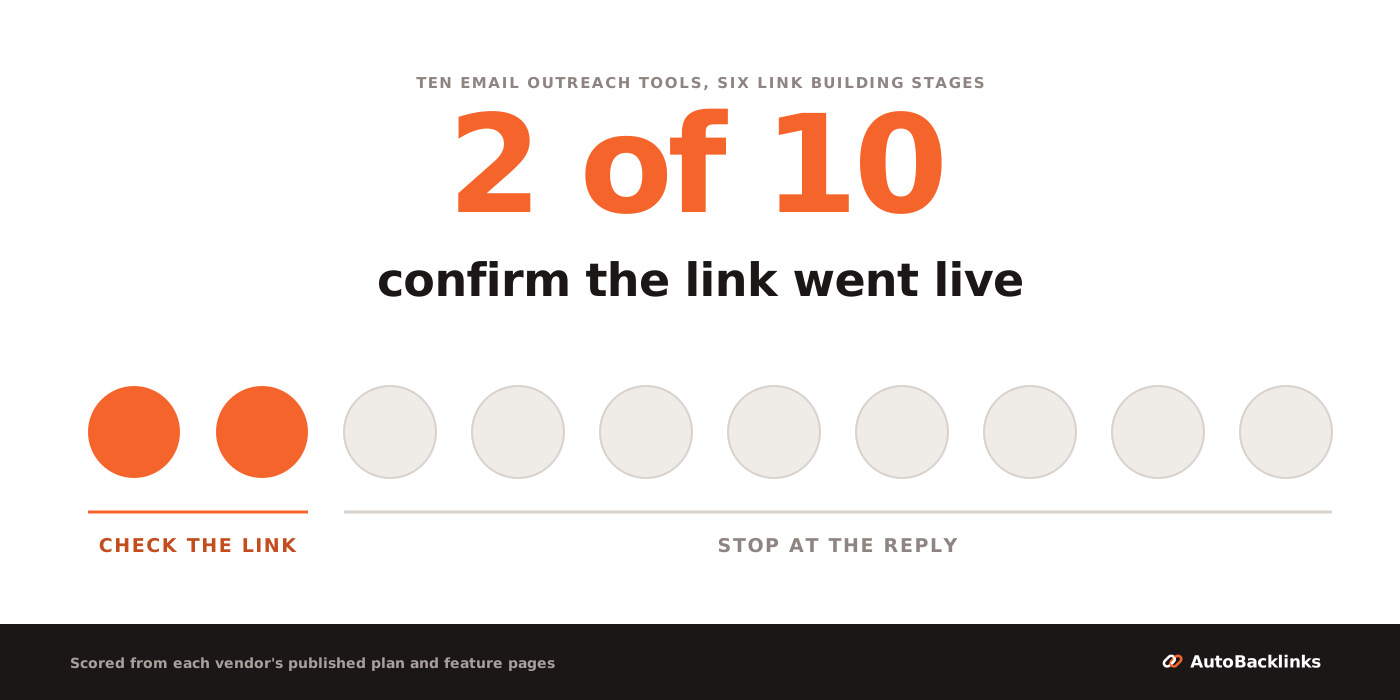
Most tools sold as an email outreach tool are cold email sales tools. They send to a list you already have, and they stop the moment someone replies, which is where link building has barely started. I scored ten of them on the six stages a link building campaign actually needs. Exactly two confirm the link went live: Pitchbox and BuzzStream. Our own tool is the only other one that checks at all, and it checks at the profile level rather than per link, which is not the same thing.
Only Pitchbox covers all six stages. Four of the ten cover two or fewer, and those four are good at the one stage that was never the hard part.
Here is how the ten were picked and scored. I took the tools that a link builder actually ends up choosing between: the three outreach platforms built for this job (Pitchbox, BuzzStream, Respona), the two agents that prospect as well as send (AutoBacklinks, Linkee), the four sales sequencers people press into service (Instantly, Smartlead, lemlist, Woodpecker), and Hunter, which sells the contact stage on its own. Pure sales platforms with no link building story, Apollo and Reply.io among them, are left out on purpose, and so is Postaga, whose site now returns a 404.
Then I read every vendor's live plan and feature pages, marked each of the six stages covered or not covered, and converted each plan's binding limit into one unit: cost per 100 prospects contacted in a month. Where a vendor publishes no rate that makes the conversion possible, the table says so rather than guessing.
What an email outreach tool needs for link building
Six stages, in the order a campaign runs them:
- Source the prospects. Find the pages worth pitching: competitor backlinks, resource pages, listicles that already cover your category. A B2B company database is not this, and the difference matters more than any other line in this article.
- Find and verify the contact for that specific site.
- Write the pitch from the prospect's own page, not merge fields dropped into a template.
- Send from your own mailbox, warmed, at a human pace.
- Handle the replies somewhere you can actually work them.
- Confirm the link went live and stays live.
Stage six is where the two categories separate, and the reason is structural rather than a missing feature. A sales tool's success metric is a reply, so nothing downstream of the reply exists in the product. A link builder's success metric is a published link 30 days later, so everything downstream of the reply is the job.
Stage one splits them just as cleanly. Instantly, lemlist and Woodpecker all ship lead databases, and those databases are built to answer "which companies match this firmographic profile". Link building asks a different question: "which pages already link out to things like mine". Those are not the same index, and no amount of filtering turns one into the other.
Email outreach tools for link building, scored on six stages
Scored from each vendor's published plan and feature pages, on the cheapest plan that could run a real campaign. One rule, applied without exceptions: a stage counts only when the vendor publishes the capability outright. Partial, add-on, higher-tier and not-published all score zero, which is why some scores sit lower than a feature list would suggest.
| Tool | Source prospects | Find contacts | Per-page pitch | Send with warmup | Reply inbox | Confirm the link | Stages |
|---|---|---|---|---|---|---|---|
| Pitchbox | Yes | Yes | Yes | Yes | Yes | Yes | 6 |
| AutoBacklinks | Yes | Yes | Yes | Yes | Yes | Partial | 5 |
| Linkee | Yes | Yes | Yes | Yes | Yes | No | 5 |
| BuzzStream | Yes | Yes | No | Partial | Yes | Yes | 4 |
| Respona | Yes | Yes | Pro tier only | Not published | Yes | Marked "Soon" | 3 |
| lemlist | Companies only | Add-on | Partial | Yes | Yes | No | 2 |
| Instantly | Companies only | Yes | Partial | Yes | Not at entry | No | 2 |
| Woodpecker | Companies only | Add-on | No | Yes | Yes | No | 2 |
| Smartlead | No | Add-on | No | Yes | Yes | No | 2 |
| Hunter | Companies only | Yes | No | Sequences, no warmup | Not published | No | 1 |
Exactly two of the ten confirm the link went live: Pitchbox and BuzzStream, both of which monitor individual links. A third, ours, checks at the profile level rather than per link, which is why the table says Partial and not Yes, and I set out exactly what that does and does not cover in its section below. Respona's own comparison table marks link monitoring "Soon" across all three of its tiers, and the four sales sequencers do not have the feature at all.
A note on "Companies only" in the first column. Instantly's 450M record database, lemlist's 650M, and Hunter's Discover are all real and all large. They are indexes of businesses and the people who work there. The question a link builder asks, which pages in my category already link out, is a backlink and SERP question, and none of those three answers it.
What 100 prospects cost on each email outreach tool
The ten tools meter in five different units: contacts stored, prospects contacted, emails sent, credits, and placements. Converting each vendor's binding limit into one unit is the only way to put them on a shelf together.
Three rules, applied to every row without exception, because a number you cannot reproduce is not evidence.
- Three touches per prospect. An opener and two follow-ups. The same assumption for every tool, including ours.
- The binding limit is whichever runs out first: stored contacts, emails divided by three, or credits.
- The plan has to be able to run the month. Where a vendor's entry tier cannot send follow-ups, the row prices the tier that can.
- A row pays only for the stages it is credited with. Instantly's lead database scores zero in the grid, so its row prices the sending plan alone rather than the bundle.
| Tool | Plan | Monthly | Binding limit | Prospects it carries | Per 100 | Stages |
|---|---|---|---|---|---|---|
| lemlist | $69 | 50,000 emails | 16,666 | $0.41 | 2 | |
| BuzzStream | Growth | $174 | 25,000 contacts | 25,000 | $0.70 | 4 |
| Smartlead | Base | $39 | 2,000 contacts | 2,000 | $1.95 | 2 |
| Instantly | Outreach Growth | $47 | 1,000 uploaded contacts | 1,000 | $4.70 | 2 |
| Woodpecker | entry tier | $35 | 500 contacted prospects | 500 | $7.00 | 2 |
| AutoBacklinks | Starter | $49 | 2,500 credits | 333 | $14.71 | 5 |
| Pitchbox | Pro | $300 | 2,000 outreach emails | 666 | $45.05 | 6 |
| Linkee | Essential | $97 | 10,000 credits, no rate published | not derivable | not derivable | 5 |
| Respona | DIY Starter | $198 | 10,000 data credits, no rate published | not derivable | not derivable | 3 |
| Hunter | Starter | $49 | 2,000 credits | contact lookups only | $2.45 per 100 lookups | 1 |
Hunter sits outside the main column on purpose. It finds addresses, so its credits buy lookups rather than contacted prospects, and pretending otherwise would put two different things in one column.
Now look at the stage column next to the price column, because the result is not the one I expected when I started. The ladder does not sort by coverage. Two things in the table say so.
Four tools cover exactly two stages, and they run from 41 cents to $7.00: lemlist, Smartlead, Instantly, Woodpecker. That is a 17 times spread between tools doing identical work. And BuzzStream covers four stages at 70 cents, undercutting three of those four. Our own tool covers five stages and is the second most expensive row in the column.
What the number actually measures is the metering unit. Tools that meter emails or stored contacts look cheap per prospect, because those allowances are enormous and have nothing to do with work done. Tools that meter credits or contacted prospects look expensive, because they charge per prospect for the labour of finding and qualifying it. lemlist's 50,000 emails cost it almost nothing to grant. Our 2,500 credits buy 333 prospects because each one is researched, scored and written to.
That cuts both ways, and the cheap rows are the ones to read carefully. Nobody contacts 25,000 prospects a month on three BuzzStream seats with 250 prospecting searches, and nobody sends 50,000 lemlist emails to a list they did not pay to build. A generous allowance you cannot fill is not a low price per prospect, it is a high ceiling.
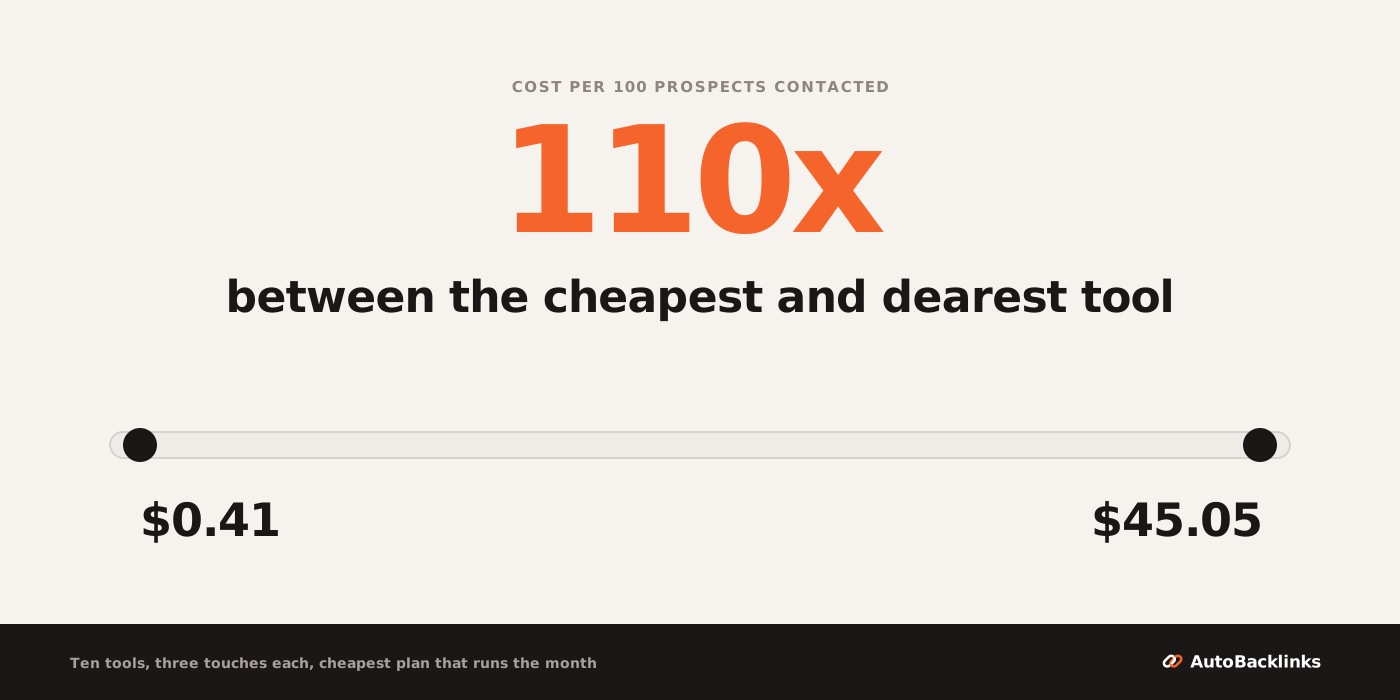
So read the per-prospect column as a question about billing design rather than value. The spread from 41 cents to $45.05 is about 110 times, and no tool on this list is 110 times better than another.
Two cells need their arithmetic shown.
Pitchbox Pro includes 2,000 outreach emails a month. At three touches that is 666 prospects, and $300 across 666 prospects is $45.05 per hundred.
AutoBacklinks Starter includes 2,500 credits, and every rate is published: 1 credit per prospect found, 0.5 per site for domain rating and organic traffic, 3 per verified email, 1 per AI email step. Three touches makes 7.5 credits a prospect, so the plan carries 333 prospects, and $49 across 333 is $14.71 per hundred. On two touches it would read $12.76, which is the number I would have quoted if I had given us a shorter sequence than I gave Pitchbox.
Pitchbox: all six stages, on a one-year commitment
Pitchbox is the complete answer to this article's question, and it is priced like one.
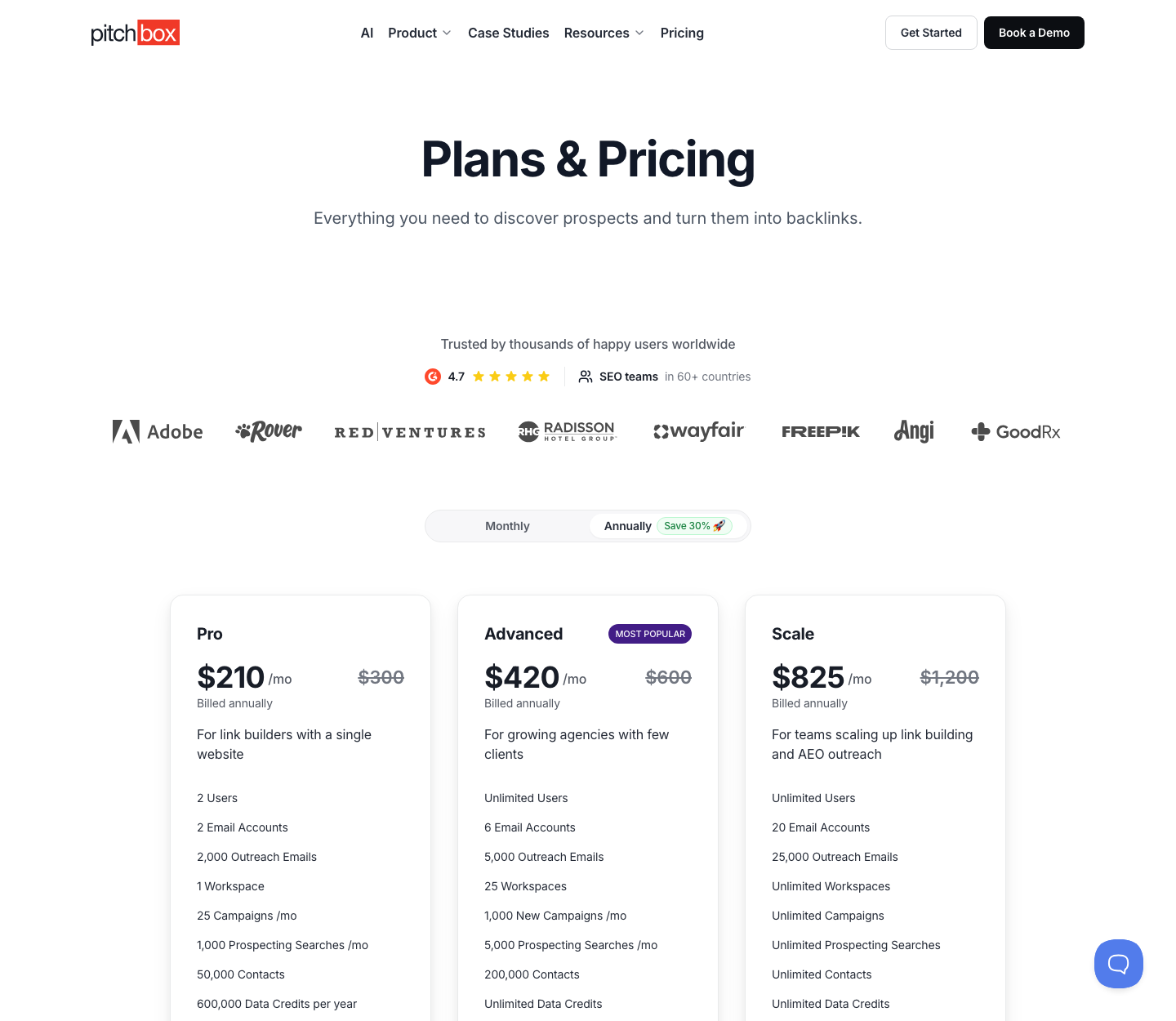
Pro is $300 a month on monthly billing, $210 a month on annual, and all plans require a one-year commitment regardless of which billing option you pick. That puts the year-one floor at $2,520 on annual billing, and $3,600 if you pick monthly, which buys you a payment schedule rather than the freedom to leave. Plan against the year, not the headline monthly figure.
What Pro includes:
- 2 users and 2 email accounts
- 2,000 outreach emails a month
- 1,000 prospecting searches a month
- 50,000 contacts
- SEO metrics from Ahrefs, Semrush, Moz or Majestic
- AI campaign assistance, AI personalization and an AI reply agent, all at the entry tier rather than held back
The link monitoring is the part no sales tool has. Pro watches 1,000 links for health, keeps a backlink change log, and monitors both ends of the link, checking that the source page is still live and that your destination still resolves.
What Pro cannot do: Google index checks on your won links are not included at this tier, nor is email rotation, nor the role-based workflow that makes the tool make sense for a team. Those sit on Advanced at $600 a month. If you are one person, you are buying a platform designed for an outreach department and paying for the parts you will not staff.
AutoBacklinks: prospecting through replies, with one stage missing
This one is ours, scored the same way as the rest, including the stage we do not cover.
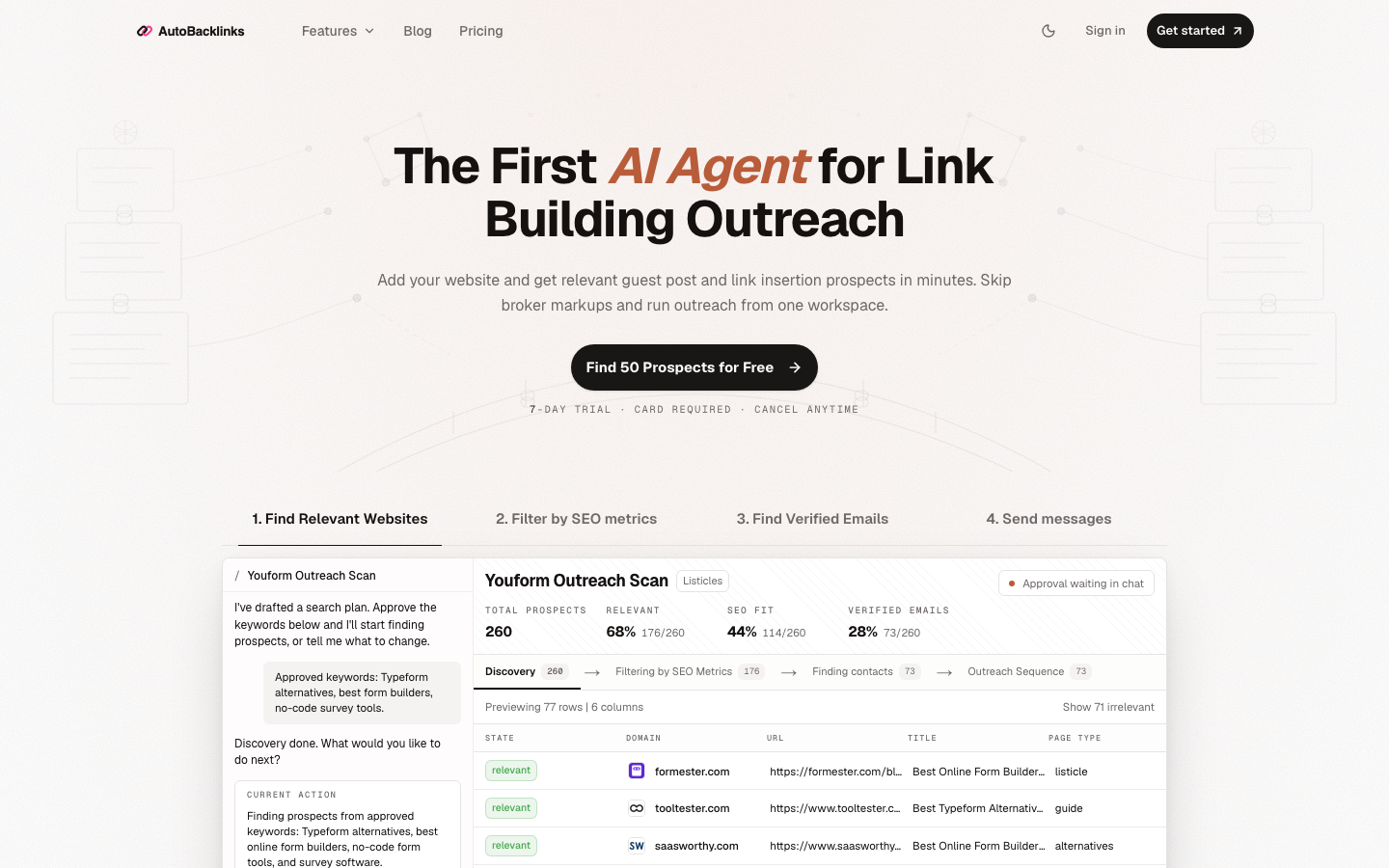
AutoBacklinks runs stages one through five:
- finds prospects from competitor backlink scans and web scans
- filters them on domain rating, organic traffic, referring domains and topical relevance
- finds and verifies the contact
- writes each email and every follow-up from the prospect's own page
- sends from your warmed mailbox and tracks the replies
The same actions run over our outreach agent.
Starter is $49 a month under the current launch offer, list price $79, with 2,500 credits and a 7-day, 120-credit trial that requires a card. Every per-action rate is on the pricing page, which is what makes the $14.71 per hundred above reproducible before you sign up rather than after.
Now the gap. We do not monitor individual links for health the way Pitchbox and BuzzStream do. What we do is refresh your own referring-domain profile on a 14-day window, so a site that linked to you last week is skipped rather than pitched again. That catches a won link within a fortnight, which is useful, and it is not a per-link health monitor. If your reporting needs a change log per link, that is a real reason to look at Pitchbox.
Two more honest boundaries. We are not an SEO suite, so rank tracking and site audits stay with your data provider. And we do not write the guest posts, only the outreach.
Prospecting is where the money goes. Our published campaign sent 187 emails and got 32 replies, 17.1%, and the lever was the prospect list rather than the subject line.
Linkee: five of six stages, one unpublished number
Linkee is the closest thing to a direct peer, an AI campaign tool that sources prospects, qualifies sites, finds contacts and sends.
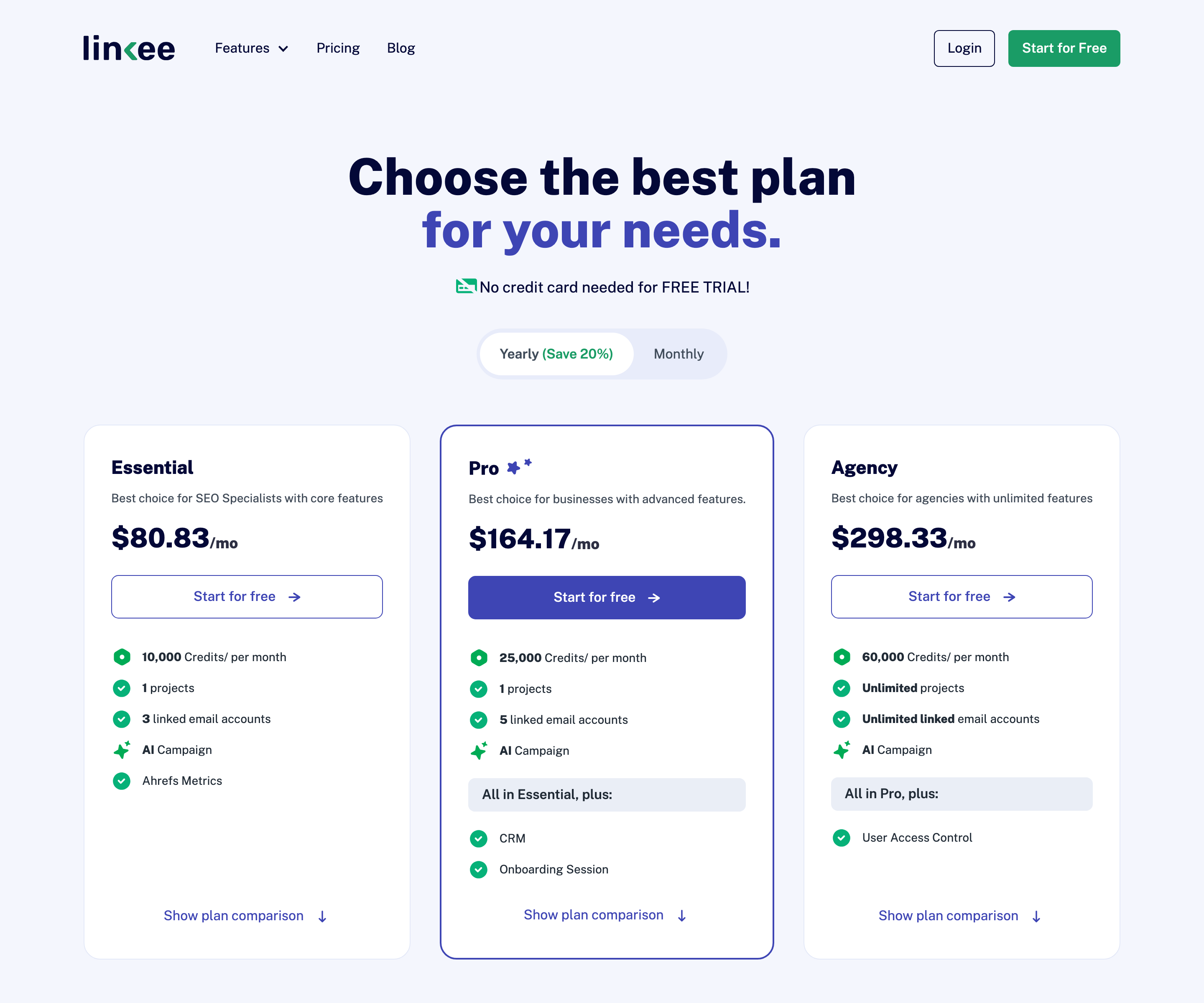
Essential is $97 a month on monthly billing, dropping to $80.83 if you prepay a year. Pro is $197 and Agency $358, or $164.17 and $298.33 prepaid. The pricing page opens on the annual view, so the lower set is the one you see first.
Essential includes:
- 10,000 credits a month
- 1 project
- 3 linked email accounts
- AI campaign generation
- Ahrefs metrics
The limitation is in the pricing page rather than the product. Linkee publishes a credit allowance but no per-action credit rate, so there is no way to work out what a campaign costs before you run one. A prospect found, a contact lookup and a generated email all draw credits at rates you discover by watching the meter. That is why the cost column above says "not derivable" rather than carrying a number.
It also does not confirm whether the link went live, which keeps it at five of six.
BuzzStream: link monitoring at the lowest price in the category
BuzzStream is the veteran outreach CRM, and it does the thing the sales tools do not: it watches the links.
Starter is $49 a month for 1 user, 500 contacts, 30 prospecting searches and link monitoring on 1,000 links, with contact info discovery included.
Read that tier carefully, because bulk email send and automated follow-ups are not in Starter. Both arrive at Growth:
- $174 a month, 3 users, extra seats $58
- 25,000 contacts
- 250 prospecting searches
- link monitoring on 25,000 links
Since follow-ups are where most link building replies come from, the honest entry price for running campaigns on BuzzStream is $174, not $49, which is why the cost table above prices Growth.
The second gap is personalization. BuzzStream's plan pages list templates and custom fields, and no AI personalization row of the kind Pitchbox and Respona publish, so writing a pitch from the page you are pitching stays your job. At 500 prospects that is the largest line item in your week.
Respona: software you have to go looking for
Respona is still sold two ways, and the confusing part is a navigation choice rather than a shutdown.
The pricing page linked from Respona's own menu sells placements, not software. The ladder runs by publisher quality:

| Tier | Publisher DR | Publisher monthly traffic | Price per placement |
|---|---|---|---|
| Starter | 20+ | 100 to 5K | $100 |
| Standard | 30+ | 100 to 10K | $160 |
| Authority | 40+ | 500 to 20K | $240 |
| Power | 50+ | 1K to 30K | $400 |
| Elite | 60+ | 1K to 100K | $500 |
A placement includes the content, the outreach and the publishing. Standard turnaround is 28 days, with 14 days available for a fee, and bulk discounts start at 10% for $3,000 a month.
The self-serve software is still on sale, on a second pricing page that nothing links to. Starter is $198 a month billed monthly for 2 email accounts, 10,000 data credits, unlimited emails and campaigns and 30,000 active contacts. Pro is $495 and Unlimited is $799 billed annually. Extra email accounts are $49 each, extra credits a cent apiece. That page carries a noindex tag and sits outside the site's sitemap, so it will not turn up in a search and it is not reachable from the menu. It is a strange way to sell a $198 product, and it is why Respona is easy to mistake for a tool that has left the category.
What Starter cannot do matters more than the price. AI email personalization is not included until Pro at $495, so the cheapest Respona plan sends sequences with custom variables rather than a pitch written from the prospect's page. No warmup is published at any tier. And the feature table marks link monitoring "Soon" across Starter, Pro and Unlimited, which is a vendor saying plainly that stage six is not built yet.
Cost per prospect is not derivable here either. Respona meters data credits without publishing what an action costs, so 10,000 credits is a number you can only calibrate by spending it.
I scored the same shift from the automation angle in the link building automation tools, and if you came here for software rather than placements, the other Respona alternatives are the shelf to compare against. If the placements are what tempt you, price them against the managed options in what link building costs per link rather than against a monthly subscription, because they are not the same purchase.
Instantly, Smartlead, lemlist and Woodpecker for link building
These four belong in one section because they fail and succeed in the same places. All four send well. Not one of them confirms a link, and not one sources a link building prospect.
Instantly
The $47 a month figure on Instantly's page is the Outreach plan on its own: unlimited email accounts, unlimited warmup, 1,000 uploaded contacts, 5,000 emails a month. The lead database is a separate $47 a month for Growth Credits, 1,500 credits and access to the 450M record index. The entry bundle is $94 a month, not $47, if you want the database. The cost table above prices Instantly at $47, because the grid scores that database zero for link building and a row should not pay for a stage it is not credited with. Worth knowing before you commit: full Unibox replies and the AI reply agent arrive on the $194 Scale bundle, and the entry tier gets a preview-only inbox, so $94 sends well and gives you nowhere good to work the answers.
Smartlead
Base is $39 a month monthly, $32 annual, for 2,000 contacts and 6,000 email sends, which is exactly three touches each, with warmup and a unified master inbox included.
Smartlead makes no prospecting claim at all, which I would rather have than a lead database dressed up as one. At $1.95 per hundred prospects it is a sending layer, bought knowingly. Buying it does not make the other four stages go away.
lemlist
The Email plan is $69 a month monthly, $55 annual: unlimited users and senders, 50,000 emails a month, the 650M lead database, warm-up, and an email and phone finder. Treat that last one carefully, because the finder is included while the finding is metered: enrichment credits are a separate $20 a month for 2,000, which lemlist's own page translates as 400 emails or 100 phone numbers. The $69 also sits at one position of a volume selector, so it moves with your sending. The personalization is template variables and AI snippets rather than a read of the prospect's page.
That huge email allowance is what makes lemlist the cheapest row in the cost table at 41 cents per hundred prospects. It is cheap per email, not cheap per link. And because the finder bills separately, lemlist scores the contact stage the same way Woodpecker does, as an add-on rather than an included capability, which puts it on two stages rather than three.
Woodpecker
Woodpecker is the only vendor here that meters the thing this article measures, and publishes the rate outright: $7.00 per 100 contacted prospects, with the slider floor at 500 prospects for $35 a month. Every other vendor made me derive that number.
One warning from its own FAQ is worth repeating, because link builders hit it harder than sales teams do: the same prospect added to five campaigns counts as five contacted prospects. Run a guest post campaign and a link insertion campaign over an overlapping list and you pay twice. Lead Finder credits are a separate add-on from 500 for $10.
What all four share is the shape of the gap. You arrive with a list, they send it well, and when someone writes back saying yes, the tool's job is finished and yours is not. Pair any of them with a prospecting source and you have rebuilt a link building platform out of two subscriptions, which is a real strategy priced properly in the tools that automate each stage.
Hunter: the contact stage, priced honestly
Hunter does one stage of the six, and does it better and more cheaply than anything else here.

Starter is $49 a month monthly, $34 annual, for 2,000 credits used across Email Finder, Email Verifier and Domain Search. On the monthly plan those credits reset and do not roll over; pay annually and all 24,000 arrive upfront. There is a no-cost tier at 50 credits a month, which is a tester rather than a plan, since 50 lookups will not survive one campaign's contact stage.
Read the credit unit before you budget against it, because a credit is not always a lookup. Verification costs half a credit, and a bulk domain search spends one credit per batch of up to ten addresses. So 2,000 credits buys somewhere between 2,000 and rather more than 2,000 results depending on which tool you use, and the $2.45 per hundred above is the conservative reading.
Hunter does send. The product is now called Sequences, and the pricing page publishes recipient limits rather than monthly volume: 2,500 recipients per sequence at Starter, with 3 connected email accounts. What it does not publish anywhere is mailbox warmup, which is why stage four scores zero here under the rule I set at the top rather than because the tool cannot send.
So: one stage of six, done well and cheaply, and the natural companion to a tool that sends but cannot find addresses.
How to choose an email outreach tool for link building
Four situations, four answers.
You have a list and a deliverability problem. Smartlead at $39. Do not pay for a database you will not query.
You have no list and one person running outreach. You need stages one through five in one place, which means AutoBacklinks at $49 or Linkee at $97, and the deciding question is whether you want published per-action rates or are happy to calibrate during a trial.
You have a team and a year of budget. Pitchbox at $2,520 for year one, and the one-year commitment is the real decision rather than the monthly figure. If that commitment is what stops you, the Pitchbox alternatives are priced side by side.
Reporting on live links is what you are judged on. BuzzStream Growth at $174, or Pitchbox, and accept that you will write the emails. The BuzzStream alternatives cover the switchers' usual reasons.
One rule cuts across all four. In the campaign I measured for how a link building campaign actually runs, 2,674 discovered domains produced 305 mailboxes, which is 11.4%. A tool that charges you nothing for prospecting because it does not do any, and so finds none of those 305, is not the cheap option.
If sourcing is the stage you want solved first, the prospecting tools scored on what they return is the companion to this list, and the pitch itself is the part no tool hands you finished.
For the reply rate you should expect once the list is right: Backlinko, using Pitchbox data, analyzed 12 million outreach emails in a 2019 study and found 8.5% get a response. Ours ran at 17.1% across 187 sends, on a list built relevance-first. The difference between those two numbers is prospecting, which is stage one, which is the stage most of these tools do not have.
If you want to see where your own prospect list thins out, you can start a trial and run the six stages against your site.
FAQ
What is the best email outreach tool for link building?
It depends on which of the six stages you still want to own. Pitchbox is the only tool that covers all six, at $300 a month monthly or $210 annual, both on a one-year commitment that makes year one $3,600 or $2,520. AutoBacklinks covers five at $49 a month. BuzzStream covers four and is the cheapest tool that monitors links, though campaign features start at $174 rather than $49. If you already have a prospect list, Smartlead at $39 sends it well and does nothing else.
Can you use a cold email tool like Instantly or Smartlead for link building?
Yes for sending, no for the campaign. Both are strong at warmup, deliverability and inbox management, and both expect you to arrive with the list. Their lead databases index companies and the people who work there, not pages that already link out, so the prospecting stage stays yours. Neither checks whether a link went live, because a sales tool's job ends at the reply.
How much does an email outreach tool cost for link building?
Entry plans run $35 to $300 a month. On one basis, cost per 100 prospects contacted at three touches each, the range is 41 cents on lemlist to $45.05 on Pitchbox Pro, a spread of about 110 times. That number does not track how much the tool does: it tracks what the vendor meters. Tools that meter emails or stored contacts look cheap per prospect because those allowances are vast, while tools that meter credits or contacted prospects charge for the work of finding each one.
Do email outreach tools find the link building prospects for you?
Five of the ten do: Pitchbox, AutoBacklinks, Linkee, BuzzStream and Respona. The rest ship B2B lead databases, which answer a firmographic question rather than a backlink one. If a tool's prospecting pitch talks about job titles and company headcount, it is a sales database, whatever the marketing page calls it.
Which email outreach tools check whether the link went live?
Two of the ten: Pitchbox, which monitors 1,000 links at Pro with a backlink change log, and BuzzStream, which monitors 1,000 links on its $49 Starter tier and 25,000 at Growth. AutoBacklinks refreshes your referring-domain profile on a 14-day window, which catches a won link at the profile level rather than per link. Respona's own feature table marks link monitoring "Soon", and none of the sales sequencers has the feature at all, because their success metric is a reply rather than a published link.
What is a good reply rate for link building outreach?
8.5% is the broad baseline, from Backlinko's 2019 analysis of 12 million outreach emails using Pitchbox data. Our own campaign ran at 17.1%. If yours sits below the baseline, audit the prospect list before rewriting the email, because relevance moves that number far more than copy does.
About Rachid Idali
Founder & SEO Strategist
Rachid Idali has spent 10 years in SEO, running multi-six-figure SEO and link-building budgets across content, digital PR, and outreach programs. He writes about practical systems for finding relevant prospects, earning links, and turning SEO operations into repeatable pipelines.
More from Rachid Idali