

Link Building Cost in 2026: $70 to $456 per Link

by Rachid Idali
Last Updated: October 16, 2026
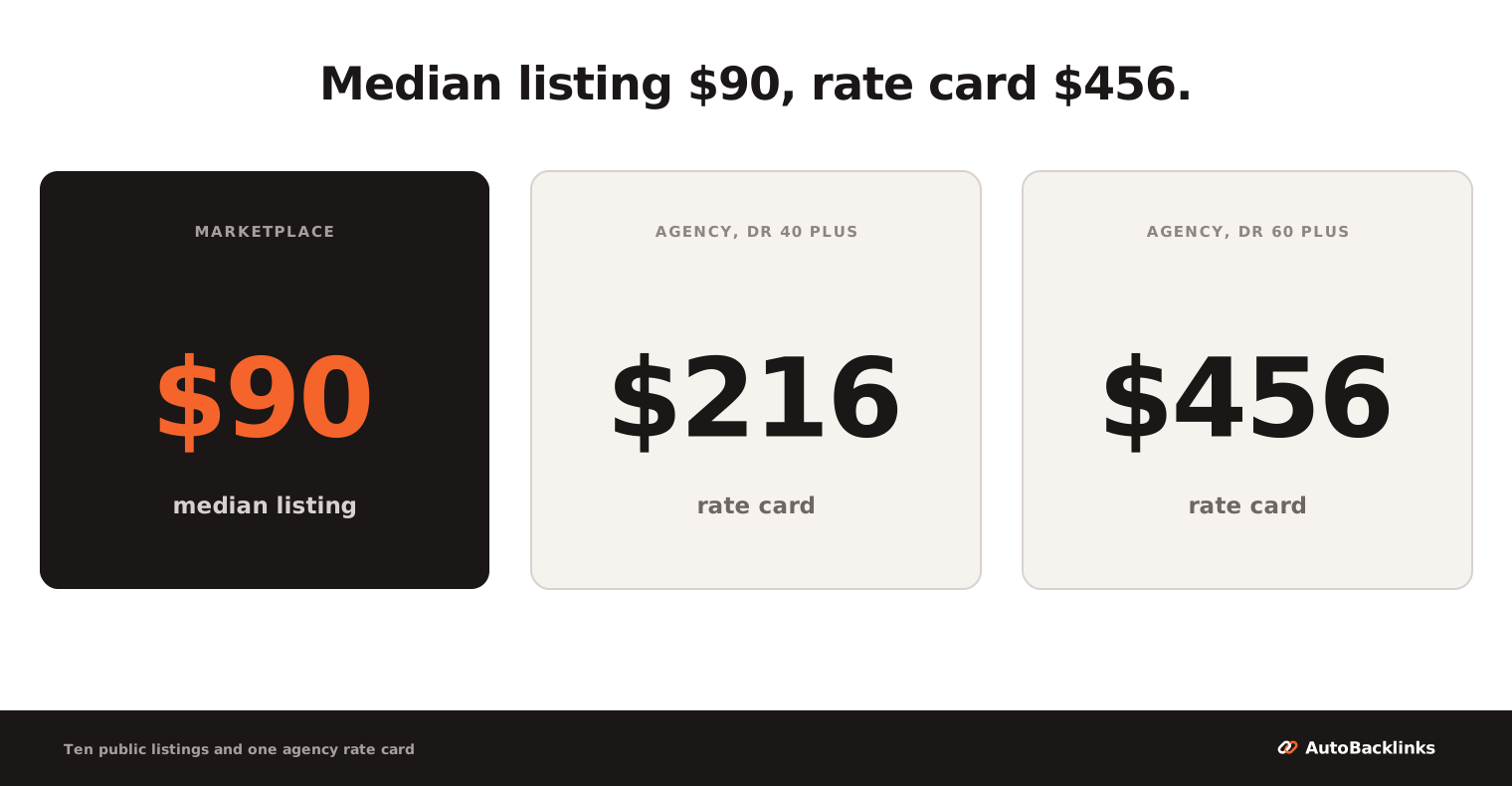
One backlink costs between $70 and $456 in 2026 if you are buying a placement. The low end is a live marketplace listing, the high end is a published agency rate card for a DR 60 site, and the median listing I found sits at $89.80. Advertised "from" prices start lower, a link you earn by asking has no placement price at all, and a digital PR campaign runs well above the top of that range. The span only means something once you fix what it is being quoted against.
So I fixed it. I pulled the prices I could read without a sales call, starting with the ten website listings one guest post marketplace shows publicly, the six-tier rate card an agency publishes, and the per-link price inside three package sizes. Then I normalized all of it to the thing you are actually buying, which is search traffic on someone else's page, not a two-digit authority score.
The normalization is where the answer lives. Priced against the organic search traffic each listing reports, the cost of reaching 1,000 monthly visitors ran from $0.43 to $179.00, a 417x spread across ten listings on one screen. Domain Rating explained almost none of it, and the cheapest listing on that basis was not the cheapest price tag.
How much does link building cost in 2026?
Here is the measured range, every number read off a public page.
| Route | Price for one link | What that price is quoted against |
|---|---|---|
| Direct from the site owner | The owner's own fee, or nothing when they link on merit | One named site, no middleman |
| Guest post marketplace | $70.00 to $176.51, median $89.80 | A named DR value and a total traffic figure |
| Agency rate card | $216 at DR 40+, $336 at DR 50+, $456 at DR 60+ | A DR floor plus a traffic band |
| Agency package | $375 for one, $350 each at five, $300 each at twenty | An average DR range across the pack |
Four things have to be pinned down before any of those numbers compares to any other one:
- The authority band. DR 40+ and DR 60+ are different products on one published rate card, and the gap between them is 111%.
- The traffic behind it. Domain Rating and Moz's Domain Authority are both link-graph scores, computed from the referring domains pointing at a site. Neither is an audience.
- How many hands the deal passes through. The site owner sets a floor. A marketplace resells above it. An agency resells above that.
- Whether you are paying per placement or per attempt. A bought link has a price. An earned link has a cost per try and a success rate, which is a different kind of number entirely.
Miss any of the four and you will compare a $90 listing to a $456 rate card and conclude the agency is robbing you, or compare a $79 subscription to a $300 placement and conclude the opposite. Both conclusions are wrong for the same reason.
What your niche does to the backlink cost
There is a fifth lever, and it is the one that catches people out after they have budgeted. The same placement costs more in a money niche. PressWhizz's pricing report, built on 22,703 completed orders, puts the average guest post at $164 and insertions at $112, but casino placements at $252 and finance at $221.
Link type moves it too. Rhino Rank prices guest posts from $75 and listicle placements from $135, which is the same company charging 80% more for a different slot on a comparable site.
So a finance buyer who takes the $89.80 median off this page and budgets against it will be wrong by more than double. Price your own vertical before you commit to a number.
Why Domain Rating does not price a backlink
Collaborator shows ten website listings in its public catalog without a login, out of the 44,899 it says are inside. Each one carries a category, a monthly traffic figure with its traffic-source split, a DR value, and a price. The domains are hidden until you sign up, and the same ten come back on the country view, so this is a fixed shop window rather than a random draw. It is still ten real prices against ten real traffic figures, which is enough to test whether DR prices anything.
It does not.
Each listing reports total visits and the share of them that comes from search, so both bases are in the table.
| DR | Total visits | From search | Organic visits | Price | Per 1,000 total | Per 1,000 organic |
|---|---|---|---|---|---|---|
| 29 | 211,760 | 88% | 186,349 | $80.00 | $0.38 | $0.43 |
| 42 | 87,880 | 56% | 49,213 | $95.00 | $1.08 | $1.93 |
| 45 | 1,580 | 32% | 506 | $90.50 | $57.28 | $179.00 |
| 50 | 493,580 | 10% | 49,358 | $176.51 | $0.36 | $3.58 |
| 60 | 242,670 | 10% | 24,267 | $89.10 | $0.37 | $3.67 |
| 63 | 66,130 | 68% | 44,968 | $80.10 | $1.21 | $1.78 |
| 69 | 227,970 | 62% | 141,341 | $89.10 | $0.39 | $0.63 |
| 71 | 95,270 | 9% | 8,574 | $100.00 | $1.05 | $11.66 |
| 71 | 92,530 | 12% | 11,104 | $104.85 | $1.13 | $9.44 |
| 72 | 108,680 | 68% | 73,902 | $70.00 | $0.64 | $0.95 |
Read the first and third rows together. A DR 29 site with 186,349 organic visits costs $80.00. A DR 45 site with 506 organic visits costs $90.50. You pay 13% more for 16 points of Domain Rating and get 368 times less search traffic.
Then read the last row. The highest DR on the screen is the cheapest listing on it.
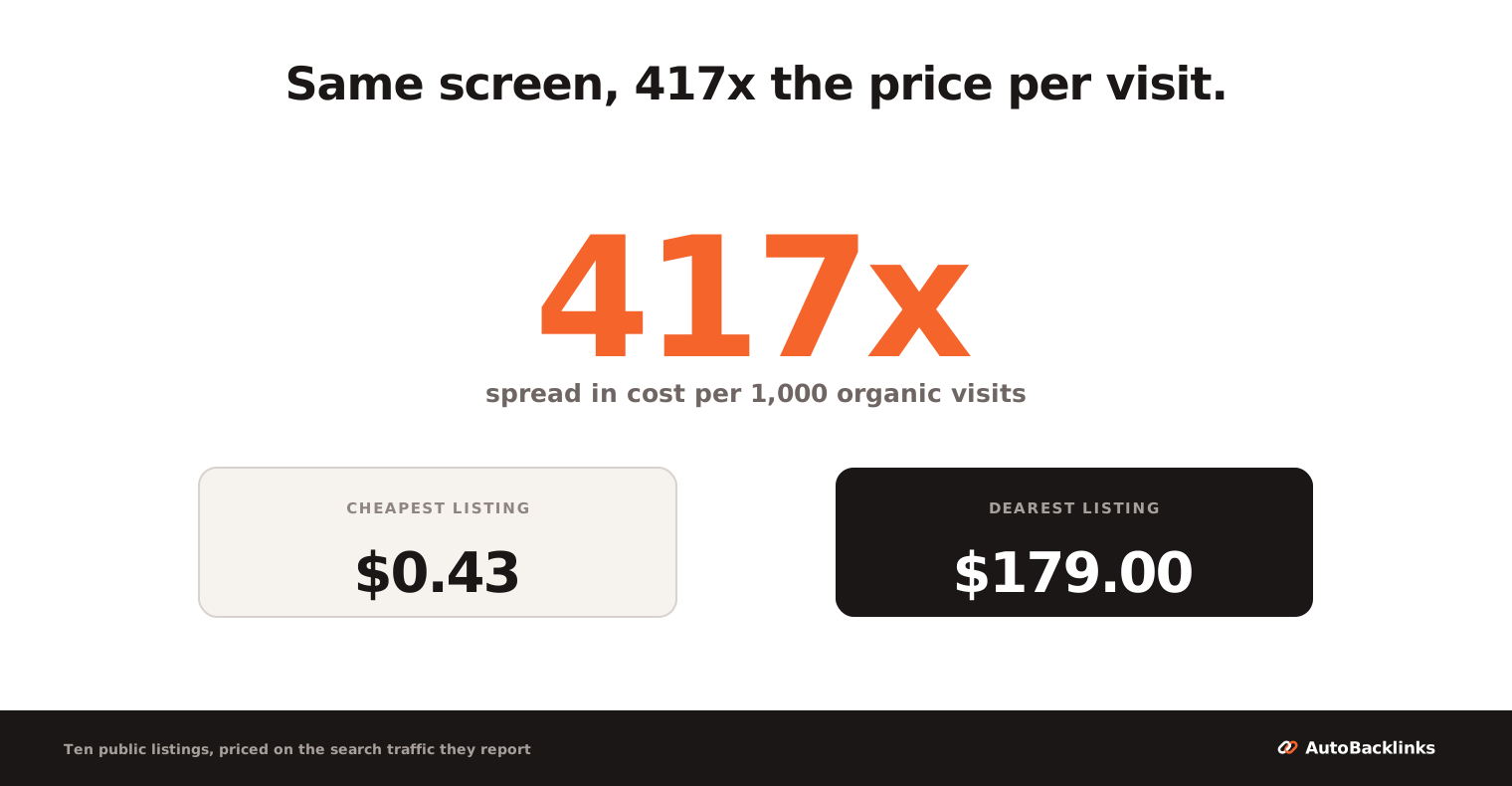
Now watch the basis change the answer. On total visits the ten run from $0.36 to $57.28, a 160x spread, and the cheapest reach on the screen is the DR 50 listing, which is also the most expensive price tag in the set at $176.51.
Switch to search traffic and that listing drops to sixth. It reports 493,580 visits with 10% from search, so the audience you are actually buying is about 49,000 a month, not 494,000. The DR 29 listing reports 88% from search, which is roughly 186,000 organic visits for the second cheapest price on the screen.
On the search basis the spread widens to 417x and the ranking reshuffles. Same ten listings, same ten prices, a different winner.
That split runs from 9% search to 88% search across the ten, and a site where nine tenths of the traffic arrives direct is not selling you search reach, whatever its DR says.
One caveat on these numbers that applies to every cheap marketplace listing, not just these. A sub-$100 asking price buys cheap inventory: sites that sell placements openly, carry other people's paid links, and have already said yes to anyone who asked. That is a different product from a placement on a site you had to persuade, and the price gap is partly the inventory, not only the middleman.
If the authority scores themselves are the part you are unsure about, what backlinks are and which ones count covers what DR does and does not measure.
What a link building rate card hides inside one DR tier
Published rate cards are better than a quote request, because you can do arithmetic on them. FATJOE publishes six tiers for blogger outreach, and each tier names both a DR floor and a traffic band:
| Tier | Traffic band | Price per placement |
|---|---|---|
| DR 10+ | 0 to 1,000 | $72 |
| DR 20+ | 0 to 5,000 | $96 |
| DR 30+ | 100 to 10,000 | $120 |
| DR 40+ | 500 to 20,000 | $216 |
| DR 50+ | 1,000 to 30,000 | $336 |
| DR 60+ | 1,000 to 60,000 | $456 |
Two things about that table before the arithmetic. The underlying list is in pounds, £60 through £380, and the dollar figures are FATJOE's own fixed conversion rather than a live rate. And they are rack rates: the page offers 10% off to buyers who subscribe to a monthly spend.
The same six prices apply to the company's niche edits, where no article gets written. Identical price, and a writer on only one of them. The usual defence is that insertion inventory is thinner, because far fewer sites will edit a live page than will accept a new one.
Now run the band. The DR 40+ tier costs $216 whether the site at the other end has 500 monthly visits or 20,000. At the floor of that band you are paying $432 per 1,000 monthly visits. At the ceiling you are paying $10.80. One tier, one price, a 40x range in what arrives.
The DR 50+ tier does the same thing between $336 and $11.20. The DR 60+ tier spans $456 down to $7.60.
Put the extremes side by side and the tier ladder inverts. A DR 40+ placement at the top of its traffic band costs $10.80 per 1,000 visits. A DR 60+ placement at the bottom of its band costs $456 per 1,000 visits. The cheaper tier can deliver traffic 42 times more cheaply than the expensive one, and the rate card cannot tell you which you are getting.
The steps between tiers are worth seeing too, because they are not linear: DR 30+ to DR 40+ is a +80% jump, DR 40+ to DR 50+ is +55.6%, DR 50+ to DR 60+ is +35.7%. The expensive move on this ladder is the one into DR 40, not the one into DR 60.
Backlink cost by route: direct, marketplace, agency
Every link you pay for passes through a chain, and each hand in it adds margin. For one site, the order of those layers holds.
Direct from the owner is the floor by definition. There is no one between you and the person who owns the page, so you pay what they ask, which for many sites is nothing at all when the pitch genuinely fits their page. The catch is that you do the work: finding the site, checking its traffic is real, finding a contact, writing the pitch, following up.
A marketplace resells that same inventory with a catalog, an escrow and a support desk wrapped around it, and prices accordingly. The ten listings above are the live version of that layer: $70.00 to $176.51, median $89.80. Guest post marketplaces compared goes through what each one verifies before it lists a site.
An agency sits above both, because you are also buying vetting, a content writer, project management and usually a replacement guarantee. That is what the $216 to $456 ladder pays for, and for teams without an outreach function it is a fair trade.
The size of the spread between those layers is documented from both ends. BuzzStream's analysis puts the same placement at $295 direct versus $461 through a vendor, which is 56% on top. A link seller in an r/SEO thread described charging $90 for DR 30 to 59 placements and $140 at DR 60, while resellers moved the same tiers at $200 to $500. I went through both sources in detail in buying backlinks.
That ordering holds for one site. Across different sites it tells you nothing, which is why an agency's entry tier can undercut a marketplace's cheapest listing: those are two different sites, not the same link sold twice.
Below the ladder there is a floor worth naming. Under roughly $50 a link you have usually stopped buying placements: Legiit and Fiverr list backlink gigs from about $6, and at that price you are buying automated pages and blast output rather than a spot on a site anyone reads. Buying backlinks covers what that end of the market actually ships.
Digital PR sits outside this ladder entirely, because you are buying a campaign rather than a placement. What one digital PR link costs runs $367 to $1,200 on the agencies that publish enough to calculate it, and those are not comparable to a $90 listing in either direction: a national news link and a guest post on a trade blog are different products with different prices.
Link building retainers versus per-link pricing
Above about $1,000 a month, most agencies stop selling you placements and start selling you a retainer. The rate card is still on the website, but the deal is a monthly fee with a link count attached.
Traditional retainers run $3,000 to $10,000 a month. At the ten placements a month those deals typically carry, that is roughly $300 to $1,000 per link depending on the quality of the sites, which straddles the rate-card ladder rather than sitting above it: $300 undercuts the DR 50+ tier, and $1,000 is more than double the DR 60+ one. What the extra buys at the top end is not the placement. It is strategy, content production, a named team, reporting, and the agency's existing publisher relationships.
Three questions decide whether a retainer beats buying per link at the same budget:
- Is there a contracted link minimum, or just a target? A target is not a deliverable. Without a minimum you are paying for effort.
- Is there a DR floor, or an average? An average lets a thin month be padded with weak sites. A floor cannot be.
- What happens to a month you do not use? Rollover, forfeit and credit are three very different products at the same price.
If the answer is that you want the function rather than the links, outsourcing versus in-house takes that model apart line by line.
Link building software cost per contacted prospect
The fourth route is the direct one, run at volume by software instead of by hand. AutoBacklinks is our own product, so treat this section as a spec sheet with the arithmetic shown rather than a review.
The unit here is not a link. It is a contacted prospect. Our outreach agent charges credits per action:
- Find a relevant prospect: 1 credit
- SEO metrics (DR, organic traffic): 1 credit per 2 domains, so 0.5 each
- Find and verify a deliverable email: 3 credits
- Write the email: 1 credit, and 1 more for each follow-up
That is about 5.5 credits to research and contact one prospect once, or 7.5 with two follow-ups. The "about" is load bearing: SEO metrics are charged per pair of domains and rounded up, so the half credit only averages out across a run. Credits come from the plan: Starter is $79 a month for 2,500, Growth $179 for 7,500, Scale $399 for 20,000.
| Plan | Price per credit | One prospect, two follow-ups | Prospects per month |
|---|---|---|---|
| Starter, $79 | $0.0316 | $0.24 | 333 |
| Growth, $179 | $0.0239 | $0.18 | 1,000 |
| Scale, $399 | $0.0200 | $0.15 | 2,666 |
Every figure in this section uses the $79 list price, which is the conservative version: a launch offer takes $30 a month off Starter for first-time accounts, which cuts the two Starter prices in that table by 38%.
What that price does not include is the part worth saying plainly. It leaves out your review time, because every send waits for approval, and it leaves out an article if the site wants a guest post. It also leaves out whatever the site owner asks for, which on some sites will be their direct fee.
Software removes the middleman's spread and the manual labour. It does not remove the owner's price.
Cost per attempt versus cost per won link
Cost per placement and cost per attempt are not the same unit, and almost every argument about link building cost comes from putting them next to each other anyway. A $216 placement buys a certainty. A $0.24 prospect buys a try.
To compare them you need a conversion rate. Mine is published: on one documented campaign I sent 187 emails, 155 were opened, 32 replied and 6 bounced, for a 17.1% reply rate.
Replies are not links, and the share of replies that becomes a live link depends on your niche, your offer and what you are asking for. I am not going to pretend to a number I have not published. So here is the table with the reply-to-link rate as the dial, costed at the Starter rate of $0.237 per contacted prospect:
| Replies needed per link | Link rate | Prospects per link | Credits | Your time | All in |
|---|---|---|---|---|---|
| 1 in 4 | 4.3% | 23 | $5.54 | 46 min | $44 |
| 1 in 6 | 2.9% | 35 | $8.31 | 70 min | $67 |
| 1 in 10 | 1.7% | 58 | $13.85 | 116 min | $111 |
The time column is the part the software cost hides, and leaving it out is how every tool vendor makes this comparison look better than it is. Every send waits for your approval, so budget two minutes a prospect to read the draft and decide. At a loaded rate of $50 an hour that is the "all in" column, and it is the column that belongs next to a placement price.
Swap in your own rate and the shape holds. Starter's 2,500 credits fund about 333 contacted prospects a month, which is roughly 6 to 14 won links across the three lines above, and about 10 on the middle one. The cash is small; the time is the real price, and it rises exactly as fast as your reply-to-link rate falls.
There is one comparison this table cannot make, and it is the one everybody wants. A link you win through outreach lands wherever the site that said yes happens to sit. It does not arrive with a DR floor and a traffic band attached, so it is not a DR 40+ link until you check what you actually got. Putting $8 next to $216 compares a known product against an unknown one, which is the same error this page spends its first half taking apart.
One thing the "all in" column still leaves out: if the site wants a guest post, somebody writes it. The $216 rate card includes that writer. The $67 does not, so add your content cost before you treat the gap as money saved.
For most teams the answer flips on volume. One link this week is cheaper to buy. Ten links a month, every month, is cheaper to earn, and how many you need per month depends on the size of the profile you already have.
Link building packages and what happens to the per-link price
The word "package" tells you nothing about the per-link price, which is the opposite of what buyers assume. Across the vendors who publish pack pricing, the per-link number moves in all three directions as the pack grows: it falls at some, stays flat at others, and rises at a few.
Editorial.Link is the falling case. Its base rate is $375 per backlink, dropping to $350 each in a five-link pack and $300 each in a twenty-link pack, so twenty links save $1,500 against the base rate, a 20% cut. Elsewhere the per-link price climbs with the pack, because the bigger pack contains better sites rather than more of the same ones.
So "is the package cheaper" is the wrong question. Divide the pack price by the link count, then ask what changed about the links.
What a discount never changes is the basis. Editorial.Link describes the links in those packs as averaging DR 50 to 90, which is a 40-point range on a logarithmic scale, and an average is not a floor: a pack can hit its average while half of it sits in the fifties. Rhino Rank starts curated links at $60, below anything measured on the marketplace listings above, but "from" is a floor rather than a quote and its ladders are keyed to Moz Domain Authority (DA) rather than Ahrefs DR, so the two numbers do not line up without converting first.
The ten link building services priced per link runs that division vendor by vendor, including the ones where the per-link price goes up.
Link building costs that sit outside the per-link price
Five costs change what a link really costs you. Some vendors price them, most do not, and none of them appears in a headline rate.
The article. A guest post is an article somebody has to write to the host's standard. If the vendor writes it, it is inside the price. If you buy a link insertion instead there is no article at all, which is worth remembering when a rate card charges the same for both.
The link that never indexes. A placement Google has not indexed passes nothing. It is the one cost with a 100% loss rate attached, nobody prices it, and no vendor I read guarantees indexation. Check the placement is in the index a few weeks after it lands, and treat an unindexed link as money spent rather than a link bought.
The wait. A marketplace placement can go live within days of payment, because the inventory has already agreed to sell. Outreach runs on the publisher's schedule instead, so a campaign starting cold spends its early weeks filling the pipeline rather than landing links. That is my experience of it rather than a measured figure, but budget the calendar either way.
The links that go stale. Links get removed, pages get rewritten and sites go dark. A link acquired today is not a permanent asset, which is why the better vendors sell replacement cover: Rhino Rank publishes 12 months on every delivered link. A cost-per-link figure should really be a cost per link per year.
The links you should not buy at all. Google's link spam policies treat exchanging money for links that pass ranking signals as a link scheme, and the way to stay inside the rules on a paid placement is rel="sponsored" or rel="nofollow". A seller who will not discuss the attribute is selling you a risk alongside the link.
Link building pricing mistakes that cost the most
Four ways to overpay, in rough order of how much they cost.
Buying on Domain Rating alone. The ten listings above price a DR 45 site with 506 organic visits above a DR 29 site with 186,349. Filtering on DR is fine. Paying on it is how you buy the first one.
Paying placement prices for links you could have earned. A site that would have said yes to a good pitch costs the same as one that would not, once you buy through a catalog. The only way to know which you are dealing with is to ask before you pay.
Accepting an average instead of a floor. "Average DR 50 to 90" and "DR 50 minimum" are different products that cost about the same. Only one of them can be held to anything.
Ignoring anchor text and attribution on a paid placement. A bought link with an exact-match commercial anchor and no rel="sponsored" is the version of this that costs more than money. Agree both before the article goes live, not after.
Which link building budget fits which route
Four budgets, four answers.
- Under $200 a month. Earn them. Software-assisted outreach at $79 to $179 funds hundreds of contacted prospects, and a won link costs roughly $44 to $111 once your review time is counted. Expect single-figure link counts in month one while the pipeline fills.
- $200 to $1,000 a month. Mix. Buy two or three marketplace placements at the $90 median for coverage this month, and run outreach underneath for the links you would rather not pay per unit for. Judge it on referring domains gained, not placements bought.
- $1,000 to $5,000 a month. This is where agency rate cards and retainers earn their margin, if you have no outreach function. At $216 to $456 a placement you are buying 2 to 23 links a month, fully managed. Insist on the traffic band, not just the DR floor, and on a contracted link minimum if it is a retainer.
- Above $5,000 a month. Build the function. At this level the agency margin exceeds the cost of running outreach in-house with software, and outsourcing versus in-house is a staffing question rather than a pricing one.
You can start a trial and price the earned route against your own numbers before committing. It runs 7 days on 120 credits with a card on file, which is about 16 contacted prospects, and it is a trial rather than a free plan.
FAQ
How much does link building cost in 2026?
There is no single price, because the number depends on the basis. For a paid placement, $70 to $456: the ten public listings I priced on one guest post marketplace ran $70.00 to $176.51 with a median of $89.80, and a published agency rate card charges $216 at DR 40+, $336 at DR 50+ and $456 at DR 60+. Retainers at $3,000 to $10,000 a month work out around $300 to $1,000 a link, which straddles that band rather than sitting above it, and digital PR runs $367 to $1,200. Below it, a link you earn by asking has no placement price at all.
How much do backlinks cost on average?
An average is the least useful form of this answer, because the spread is the finding. The median listing in the sample I priced was $89.80, but priced against the organic search traffic those same ten listings report, the cost of reaching 1,000 visitors ran from $0.43 to $179.00. Price the traffic rather than the link and the average stops mattering.
Why do backlinks at the same Domain Rating cost such different amounts?
Because DR is a link-graph score and has almost no relationship to the audience you are buying. In the live listings I priced, a DR 29 site with 186,349 organic visits cost $80.00 while a DR 45 site with 506 organic visits cost $90.50. Price also depends on your niche, on the link type, and on how many resellers sit between you and the site owner, which can double or triple the same placement.
Are link building packages cheaper per link?
Sometimes, and the word package does not tell you which. At Editorial.Link the per-link price falls by roughly 20% at volume, from a $375 base rate to $350 each in a five-link pack and $300 each in a twenty-link pack. At other vendors it stays flat as the pack grows, and at a few it rises, because the bigger pack holds better sites. Divide the pack price by the link count and ask what changed about the links.
Is it cheaper to build links yourself than to buy them?
Per link, usually yes, as long as you have volume and count your own time. At the 17.1% reply rate from my published campaign and a reply-to-link rate you have to supply yourself, one link per six replies works out at about $8 of credits plus roughly 70 minutes of review, so about $67 at a $50 hourly rate, plus the cost of an article if the host wants a guest post. A DR 40+ placement on a published rate card is $216 and includes the writer. The earned link also arrives in weeks rather than days and at whatever authority said yes, so a single urgent link at a known band is still cheaper to buy.
How much should I budget for link building a month?
Budget by route rather than by link count. Under $200 a month, earn links with outreach software and supply the review time yourself, at roughly $44 to $111 a link all in. Between $1,000 and $5,000, an agency rate card at $216 to $456 a placement buys 2 to 23 managed links; above $3,000 a retainer becomes an option instead, at roughly $300 to $1,000 a link. Above $5,000, the agency margin usually exceeds the cost of running that function in-house.
About Rachid Idali
Founder & SEO Strategist
Rachid Idali has spent 10 years in SEO, running multi-six-figure SEO and link-building budgets across content, digital PR, and outreach programs. He writes about practical systems for finding relevant prospects, earning links, and turning SEO operations into repeatable pipelines.
More from Rachid Idali