

How Many Backlinks Per Month Is Safe? 15 Sites Measured

by Rachid Idali
Last Updated: October 15, 2026
There is no safe number of backlinks per month, because the number scales with the profile you already have. Across 15 sites ranking for commercial keywords in three niches, new referring domains in a typical month ran from 3 to 1,020. Measured as a share of the links each site already had, those same typical months clustered between 1.6% and 6.3%, with a median of 2.5%.
That is the useful form of the answer: a share, not a count. I pulled a year of referring-domain history for all 15 sites, 180 site-months in total, because the prescriptions on this question are absolute counts and the sites applying them are not the same size.
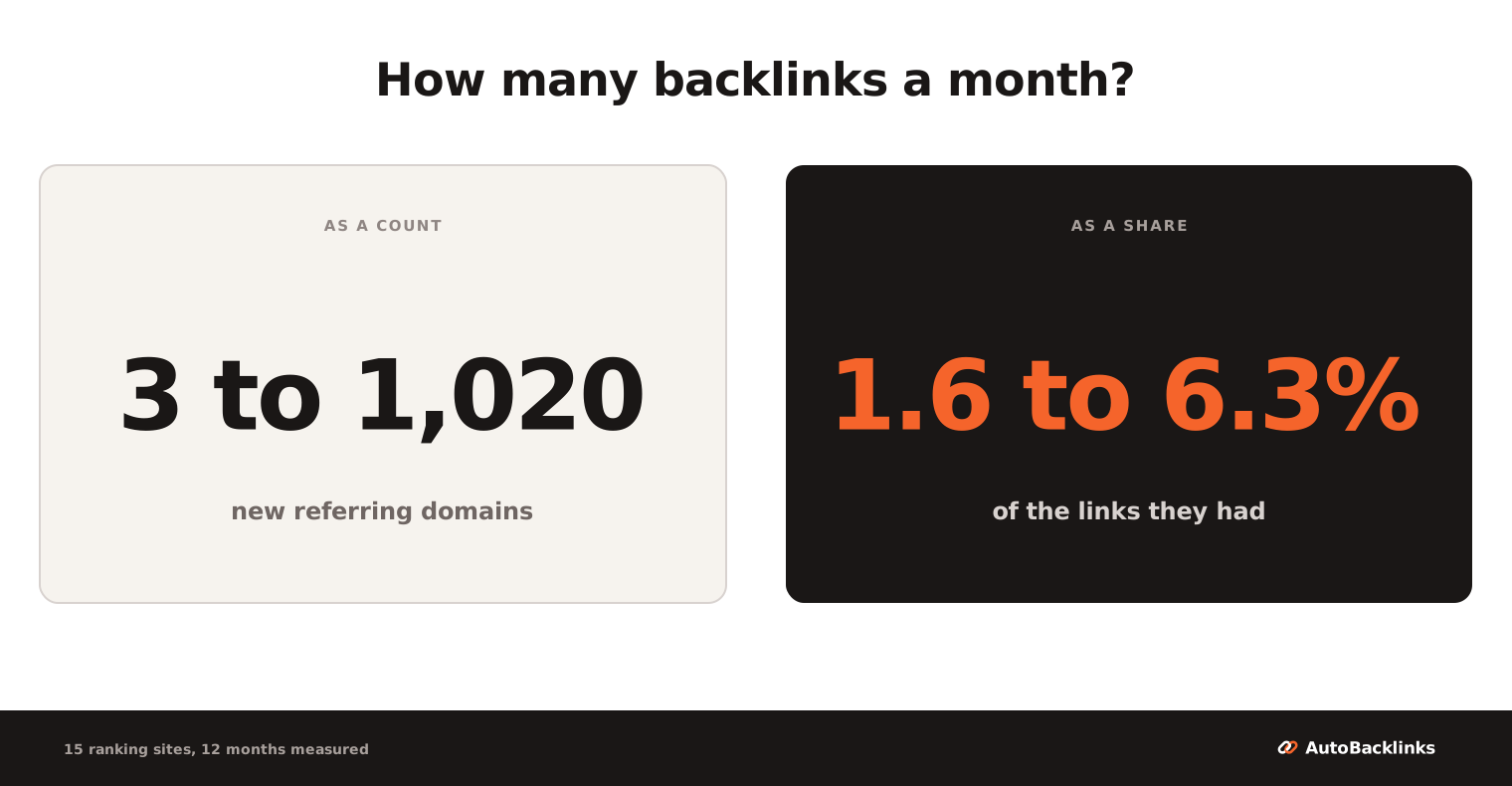
Two things fall out that the usual advice gets wrong. A monthly count copied from an article is meaningless unless the site it came from is your size. And 45% of those site-months lost more referring domains than they gained, so a target that does not cover decay buys nothing.
What link velocity means, and why referring domains are the unit
Link velocity is the rate at which a site gains backlinks over a period, usually counted per month. It is an SEO community term rather than a metric Google publishes.
The unit matters more than most discussions admit. A backlink is one link on one page. A referring domain is one website that links to you, however many times it does it. One blog that mentions you in forty posts is forty backlinks and one referring domain.
Counting raw backlinks makes velocity look dramatic for no reason, because a single site-wide footer link can add thousands overnight. Every figure here counts referring domains unless it says otherwise. If you want the attributes behind those links first, what backlinks are and which ones count covers the ground this article builds on.
How many backlinks per month ranking sites actually gain
I took three niches with different economics: B2B SaaS (sites ranking for "project management software"), consumer review (sites ranking for "best running shoes") and local professional services (law firms ranking for "personal injury lawyer chicago"). Five ranking sites from each, then twelve months of referring-domain history for every one.
The spread is the finding. In a typical month, the slowest site picked up 3 new referring domains and the fastest picked up 1,020, a factor of 340 between two sites that both rank.
| Niche | Typical month, median of the five sites | Range across the five |
|---|---|---|
| Local professional services | 13.5 | 3 to 104.5 |
| B2B SaaS | 251 | 87 to 558 |
| Consumer review | 327 | 24 to 1,020.5 |
Now set that against the prescriptions, and watch the unit. Mavlers opens by saying there is no golden number and that anyone offering a hard number without context is oversimplifying or selling something, then suggests "2-3 quality backlinks per day" and "10-30 backlinks a month" for a new site, conditioned on the links being legitimate. Buzz Marketing suggests "10-20 high-quality backlinks per month" under a year old and "30-50+" once established.
Both figures are in backlinks, not referring domains. Converted to that unit, not one of the 15 sites lands in the 10-to-30 range. The slowest, a Chicago law firm, picks up about 50 new backlinks in a typical month. The fastest picks up more than 30,000.
The conditioning in that advice is right: whether the links are legitimate is what matters. Neither figure is tied to the size of the site applying it.
Link velocity as a share of the backlinks you already have
Normalise by the profile each site already had, and the 340x spread collapses to about 4x.
| Site | Referring domains | Typical month | As a share |
|---|---|---|---|
| Runner's World | 62,489 | 1,020.5 | 1.6% |
| RTINGS | 33,499 | 599 | 1.8% |
| Teamwork | 9,909 | 251 | 2.5% |
| Ankin Law | 1,573 | 41.5 | 2.6% |
| The Run Testers | 430 | 24 | 5.6% |
| Gordon Injury Lawyers | 48 | 3 | 6.3% |
All 15 sites landed between 1.6% and 6.3%, median 2.5%. The compression is not an accident of arithmetic: shuffle which profile size is paired with which monthly gain and the band blows out by three orders of magnitude.
Three honest limits before you use it.
- The share drifts with size. The five sites under 2,000 referring domains ran at a median of 3.4% a month, the five over 10,000 at 1.8%. Use the figure for your own size, not the single median.
- Individual months are far wilder than the band. These are each site's typical month. Month to month, the same sites swing from zero to several times that.
- It is 15 sites, not a law. The 6.3% ceiling rests on one law firm with 48 referring domains, where one extra link in a typical month moves the figure by two points.
A much larger study points the same way with a different basis. Ahrefs analysed 200,000 top-ranking pages across 10,000 keywords and found pages in position #1 gaining referring domains at +5% to +14.5% a month. That is page level where mine is domain level, and a single page starts from a far smaller base than a whole site, so pages grow faster in percentage terms. The agreement that matters is structural: both measurements express velocity as a share, and neither produces a count.
Why ranking sites lose backlinks every month
Here is the part that changes how a target should be set. Backlinks are not a balance that only goes up.
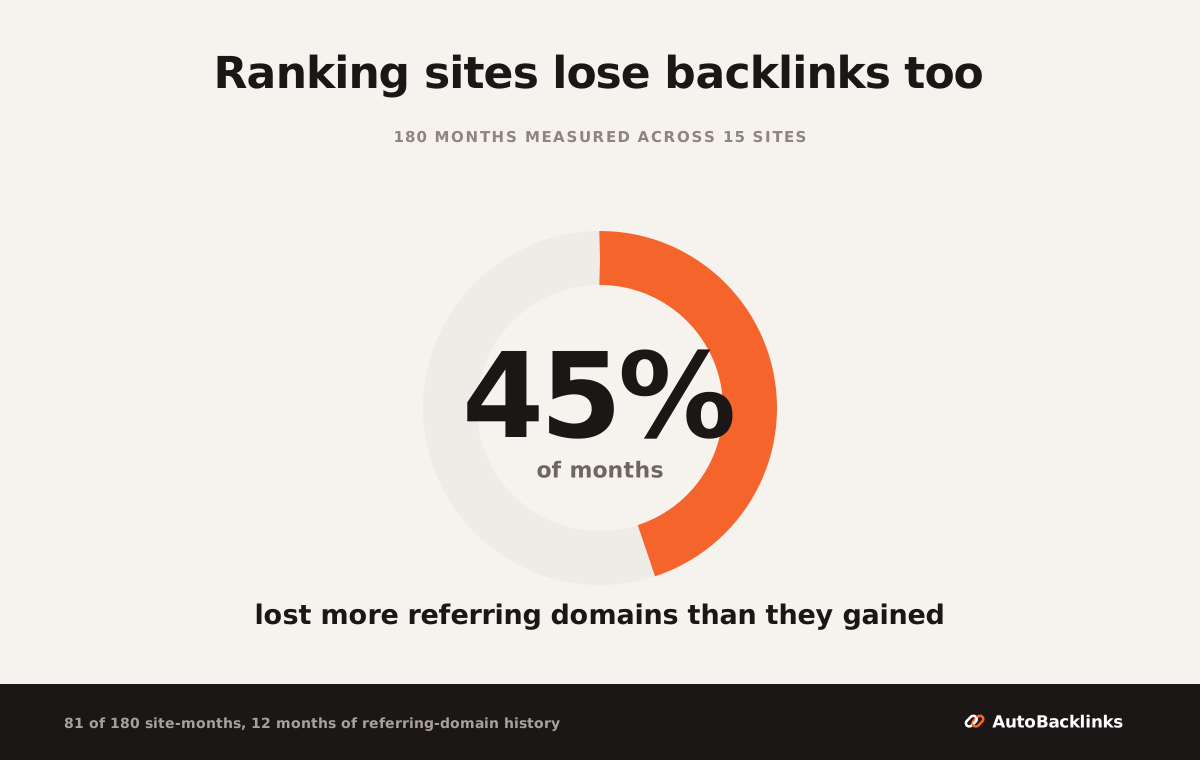
Across the 180 site-months, 81 of them, 45%, ended with more referring domains lost than gained. Fourteen of the 15 had at least one losing month, and 11 of the 15 finished the year with a smaller referring-domain profile than they started, while still ranking in the top 20.
That is why the 2.5% above is an acquisition rate and not a growth rate. The median site loses 2.35% of its referring domains a month and acquires 2.5%, netting 0.17%. Seven of the 15 had a negative typical month. These sites are mostly running to stand still.
Pages get deleted, sites get redesigned, articles get rewritten without the link, domains expire. Most of it is neither a penalty nor anything you did, though migrations without redirects are on you.
What Google says about link velocity
Google has never published a link velocity threshold. Its spam policies list 11 kinds of link spam:
- Buying or selling links for ranking purposes
- Excessive link exchanges
- Using automated programs or services to create links
- Requiring a link as part of a contract or terms of service
- Text advertisements or text links that do not block ranking credit
- Advertorials or native advertising that pass ranking credit
- Low-quality directory or bookmark links
- Links embedded in widgets distributed across sites
- Widely distributed links in footers or templates
- Forum comments with optimized links in the post or signature
- Creating low-value content primarily to manipulate linking signals
Nine of the eleven turn on how a link was obtained. The other two describe markup and content. None of them mentions a rate, a speed, or a monthly ceiling.
The same page also carves out paid links that are declared:
Google does understand that buying and selling links is a normal part of the economy of the web for advertising and sponsorship purposes. It's not a violation of our policies to have such links as long as they are qualified with a
rel="nofollow"orrel="sponsored"attribute value.
Asked whether building 200 backlinks in two days after years of nothing would trigger a penalty, Google's John Mueller first questioned the premise, saying that sounds a lot like links that were bought rather than earned. On velocity itself he said:
So it's not so much a matter of how many links you get in which time period. It's really just... if these are links that are unnatural or from our point of view problematic then they would be problematic. It's like it doesn't really matter how many or in which time.
So where did the idea come from? One Google patent, Information Retrieval Based on Historical Data, filed on the last day of 2003 and now expired:
A typical, "legitimate" document attracts back links slowly. A large spike in the quantity of back links may signal a topical phenomenon (e.g., the CDC web site may develop many links quickly after an outbreak, such as SARS), or signal attempts to spam a search engine.
Two things about that patent rarely travel with the quote. It never uses the word "velocity", not once. And it treats fast link growth as a reason to rank a page higher as well, giving the example of a day-old document with 10 backlinks scoring above a ten-year-old document with 100, "because the rate of link growth for the former is relatively higher". The same paragraph then says a spiky growth rate may also signal spam and the score may be lowered, so the patent genuinely points both ways.
It does carve out an exception for spikes, but only for documents it already treats as authoritative, naming government documents and web directories. That will not cover your site. An expired patent from 2003 that never names the concept is a thin foundation for a monthly cap either way.
When a backlink spike is a problem
Spikes are normal. The median site's biggest month was 1.9 times its own typical month, and 7 of the 15 had a month at double their usual rate or more.
What separates a safe spike from a dangerous one is not the size. It is where the links came from and whether they look coordinated.
- A launch, a study, a funding round or a news cycle produces a spike from many unrelated editors who each decided independently. That is the "topical phenomenon" the patent describes.
- A batch bought from one vendor produces a spike from pages built on the same template, from the same few networks, pointing at you with the same commercial anchor text.
Anchor text is the measurable tell, and the patent says so directly: synthetic link graphs come from "coordinated decisions", which show up as a spiky growth profile in the anchor words themselves. Fifty new links carrying fifty different natural anchors look nothing like fifty links all reading "cheap running shoes". The distribution gives it away, not the count.
Fifty links from fifty editors is a good month. Fifty links from one seller is a purchase, whether you spread it over a day or a year, and the remedy there is the rel="sponsored" attribute above rather than a slower calendar. If you are weighing that route, the economics of buying backlinks covers what it costs and what it risks, and backlink generators covers the automated end of the same idea.
One of those 11 bullets is worth reading closely if you use software for this, including ours: "using automated programs or services to create links to your site". The line it draws is about who creates the link. A generator that posts links on your behalf creates them. Software that finds prospects, verifies a contact and drafts an email does not, because an editor still decides. Automate the labour, not the decision.
How to set your own monthly backlink target
Four steps: count your base, measure your decay, add the growth you want, then check it against the competitors you are chasing.
- Count your referring domains, not your backlinks. Ahrefs, Semrush or the DataForSEO API will give you the figure. Google Search Console will not, because it reports your own property only and caps its tables.
- Measure your decay rate. Take the last six months of lost referring domains and divide by your base. Across these 15 sites that ran at a median of 2.35% a month, with a range of 1.7% to 4.2%. Use your own if you have it.
- Add the net growth you want on top of the decay. This is the step the rules of thumb skip. The measured sites acquire 2.5% and lose 2.35%, so matching them holds you flat; a real growth target is decay plus whatever you want to net.
- Check it against the competitors you are trying to pass. Their monthly gain is the pace you have to beat to close a gap rather than hold position. A backlink gap analysis gives you both their number and the domains already linking to them.
A worked example. A B2B SaaS site with 600 referring domains: decay at the measured median of 2.35% is about 14 a month, and netting 1% growth needs another 6, so the target is 20 new referring domains a month. At a 10% placement rate that is roughly 200 pitches a month, which is the real planning constraint. How many backlinks you need to rank handles where the total should land, and the nine ways to earn them covers where they come from.
New sites are the exception. At 50 referring domains a percentage target is noise, and the two smallest sites here added 3 and 10 a month while ranking. Count links, not percentages, until you are past about 100 referring domains.
How to pace link building outreach to that target
A monthly target is only useful if something holds you to it, and the hard part is that outreach volume and links landed are different things.
You control how many relevant prospects you find, how many you contact, and how evenly that work is spread. You do not control whether an editor says yes.
So pace the half you own. Convert the monthly referring-domain target into a weekly prospect quota using your own reply and placement rates, run it continuously rather than in batches, and stop when you hit the target instead of burning the list. Carrying the worked example through: 20 referring domains a month at a 10% placement rate is about 200 pitches, or 50 a week.
This is our product, so treat the next line as a spec rather than a review. Our outreach agent runs that loop: it finds and verifies prospects, drafts the email from the target page, and waits for your approval before anything sends.
The reason to run it steadily is not fear of a velocity penalty. It is that a batch-and-silence pattern wastes prospects and leaves the decay above unreplaced.
The 15 sites, measured
Twelve months of history per site, from the DataForSEO backlink index, covering September 2025 through August 2026. Referring domains are counted at the start of the window; "typical month" is that site's median month.
| Site | Referring domains | Typical month, new | Typical month, lost | Net |
|---|---|---|---|---|
| runnersworld.com | 62,489 | 1,020.5 | 1,055.5 | -73.5 |
| rtings.com | 33,499 | 599 | 643 | -185 |
| wrike.com | 24,554 | 558 | 518.5 | +41.5 |
| runrepeat.com | 17,761 | 327 | 400 | -195 |
| projectmanager.com | 15,324 | 305.5 | 317.5 | -3.5 |
| teamwork.com | 9,909 | 251 | 233 | +22.5 |
| thedigitalprojectmanager.com | 7,688 | 219.5 | 159.5 | +35 |
| believeintherun.com | 5,146 | 96.5 | 161 | -101.5 |
| paymoapp.com | 3,618 | 87 | 87 | +7 |
| sokolovelaw.com | 2,425 | 104.5 | 57 | +38 |
| ankinlaw.com | 1,573 | 41.5 | 45 | -3.5 |
| phillipslawoffices.com | 516 | 13.5 | 13 | +1.5 |
| theruntesters.com | 430 | 24 | 13 | +10 |
| attorneysofchicago.com | 294 | 10 | 12 | -1 |
| gordoninjurylawyers.com | 48 | 3 | 2 | +1.5 |
Three caveats on the method. The five sites per niche are the ranking sites excluding marketplaces, encyclopedias, retailers and forums, because those profiles are driven by things no site can replicate. The most recent month in the index is excluded from every figure: in it the smallest sites showed new-link counts 15 to 60 times their own typical month while losses stayed normal, the signature of the crawl catching up rather than links arriving, and including it would push eight of the fifteen above the band. And 15 sites in three niches, one of them a single city, is a sample rather than a population.
FAQ
How many backlinks per month is safe?
There is no safe count, because the figure depends on the size of the profile you already have. Across 15 sites ranking for commercial keywords, new referring domains in a typical month ranged from 3 to 1,020, but as a share of existing referring domains those months clustered between 1.6% and 6.3%, with a median of 2.5%. Apply the share for your own size rather than copying a number from a site that is not your size.
How many backlinks per day is safe?
The same answer divided by thirty, which for most sites is less than one a day. A site with 500 referring domains acquiring at the measured median of 2.5% is looking at about 13 new referring domains in a month. The daily framing is where the question goes wrong, because nobody earns links at a constant daily rate.
Can you get penalized for building backlinks too fast?
Not for the speed itself. Google's spam policies name 11 kinds of link spam, and none of them mentions a rate or a monthly ceiling. John Mueller has put it plainly: it does not really matter how many links you get or in which time period, it matters whether they are natural.
Is link velocity a Google ranking factor?
It is an SEO community term, not a documented Google metric. The idea traces to a Google patent filed in 2003 that has since expired, never uses the word "velocity", and in places describes fast link growth as a reason to rank a page higher. Treat it as the origin of a myth rather than a rule.
Why am I losing backlinks every month?
Because everyone is. Across 180 months measured on 15 ranking sites, 45% ended with a net loss of referring domains, and 11 of the 15 finished the year smaller than they started while still ranking. The median site loses about 2.35% of its referring domains a month. Build that replacement rate into your target instead of treating it as a problem to diagnose.
About Rachid Idali
Founder & SEO Strategist
Rachid Idali has spent 10 years in SEO, running multi-six-figure SEO and link-building budgets across content, digital PR, and outreach programs. He writes about practical systems for finding relevant prospects, earning links, and turning SEO operations into repeatable pipelines.
More from Rachid Idali