

Best AI SEO Agents in 2026: 12 Scored, 6 Pass

by Rachid Idali
Last Updated: September 12, 2026
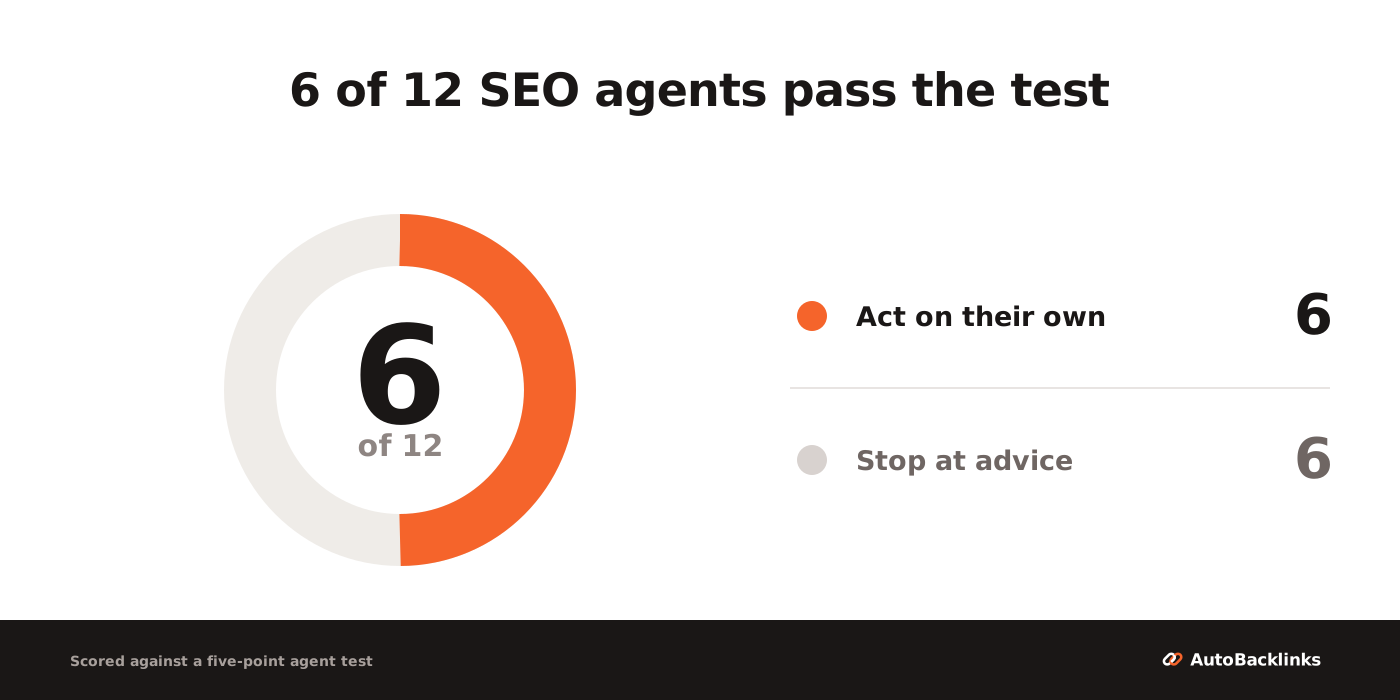
An AI SEO agent is software that takes a goal, plans the steps itself, calls live tools to do them, and keeps going without a new instruction for each step. Twelve products sell themselves under that name. Six of them actually behave that way, and five of those six are pointed at a job the day you buy them.
Four more get everything right except the last part: they decide what should change, then hand it back to you.
That gap is the whole buying decision, so I wrote down a five-point test and scored every product against its own published claims.
What an AI SEO agent is, and what an AI-powered tool is
The category agrees on the definition. An agent plans and executes multi-step work, connects to real data sources like Search Console or your CMS, decides what to do next, and finishes the job.
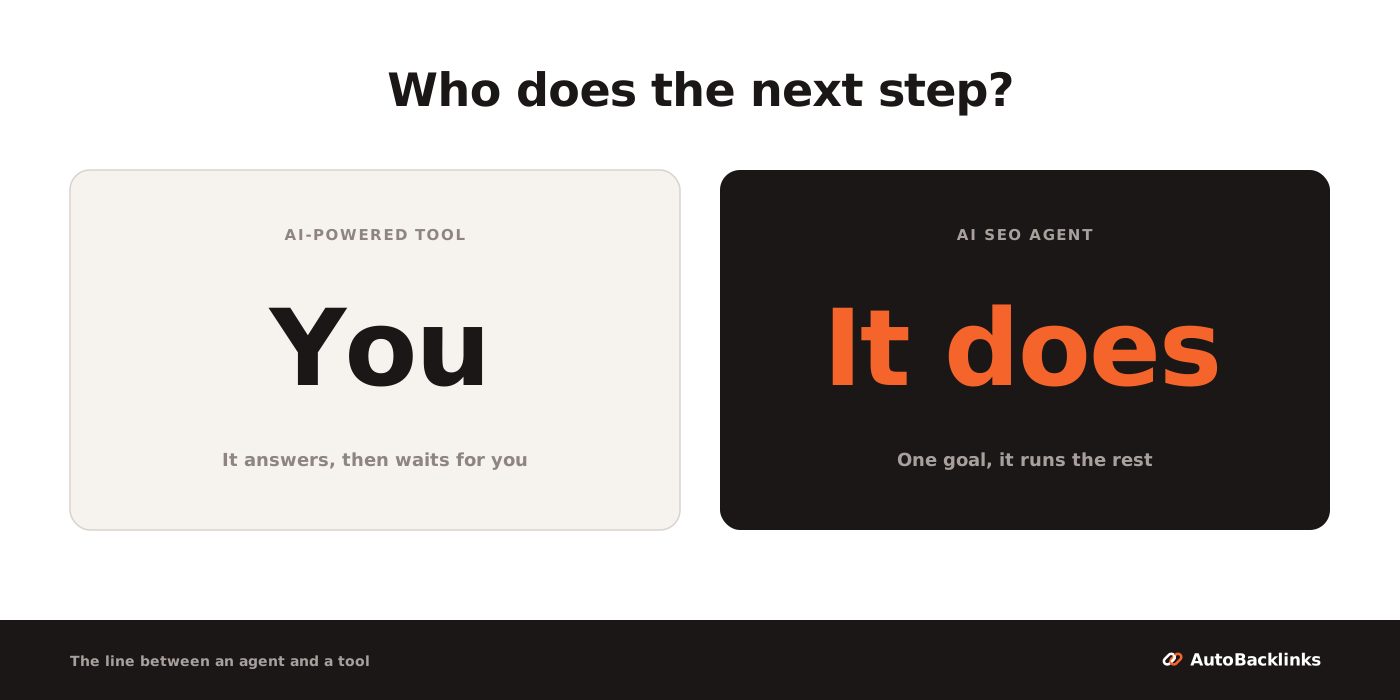
An AI-powered tool does one step and hands it back.
Both use the same models. The difference is not intelligence, it is who holds the next step.
Ahrefs makes a further split worth borrowing, because it prevents most of the confusion in this category:
Agent platforms: the underlying systems you build on. The SEO AI agent itself: the configured workflows you build to carry out a specific job. Skills, prompts, and data connections: the components that go into the agent.
So a platform is not an agent. It is the place you build one. One of the six that pass is a platform, which matters a lot if you were expecting to buy something that works on Monday.
The five-point test I scored every AI SEO agent against
Five questions, each a yes or no. I scored them from what each vendor publishes on its own live pages, so you can check any answer yourself.
- Goal, not steps. You state an outcome and it decides the sequence.
- Live data through tools. It reads your real site, index or search data, not just its training set.
- It changes something, by a named route. The vendor says how the change reaches the live system: a pixel, a CMS connection, a publishing integration, a mailbox.
- It continues without a new prompt. One instruction produces many steps.
- It starts work you did not trigger. A schedule or a watch, not only a button.
Here is the part most scoring frameworks hide. Four of those five points are cheap. Every product below passes point two, and ten of the twelve pass one, four and five. Point three is the only one that separates anything, so the honest description of this test is one hard question with four sanity checks around it.
The wording of point three is deliberate too. Every vendor here uses action verbs. Far fewer name the route by which anything actually changes, and a claim without a route is a claim you cannot check. So I scored the route, not the verb, and where a product claims to act without naming a route I say so in its section rather than quietly marking it down.
That produces three groups rather than a ranking: agents that finish the job, agents that stop at a recommendation, and tools that were never agents.
The 12 AI SEO agents, scored
| Product | Job | Goal | Tools | Acts | Loops | Self-starts | Score |
|---|---|---|---|---|---|---|---|
| OTTO SEO (Search Atlas) | Technical and on-page | Yes | Yes | Yes, pixel | Yes | Yes | 5 |
| Frase | Content | Yes | Yes | Yes, CMS | Yes | Yes | 5 |
| SEO.AI | Content | Yes | Yes | Yes, CMS | Yes | Yes | 5 |
| The SEO Agent | Content | Yes | Yes | Yes, CMS | Yes | Yes | 5 |
| AutoBacklinks | Link building | Yes | Yes | Yes, mailbox | Yes | Yes | 5 |
| Letaido (Ahrefs) | Platform | Yes | Yes | Yes, your tools | Yes | Yes | 5 |
| Sedestral | Several jobs | Yes | Yes | No route named | Yes | Yes | 4 |
| Nightwatch (NightOwl) | Monitoring | Yes | Yes | No route named | Yes | Yes | 4 |
| Relevance AI | Platform | Yes | Yes | Drafts only | Yes | Yes | 4 |
| Writesonic | AI visibility | Yes | Yes | Recommends only | Yes | Yes | 4 |
| Surfer | Optimization | No | Yes | Not yet shipped | No | No | 1 |
| Semrush | Suite | No | Yes | No route named | No | No | 1 |
Six pass. Five of those six are pointed at a named job the day you buy them, and the sixth is a platform you build on.
Best AI SEO agent for technical SEO: OTTO by Search Atlas
OTTO is the most literal reading of the word agent in this set. Search Atlas describes it plainly:
OTTO SEO scans your site and deploys fixes in real time.
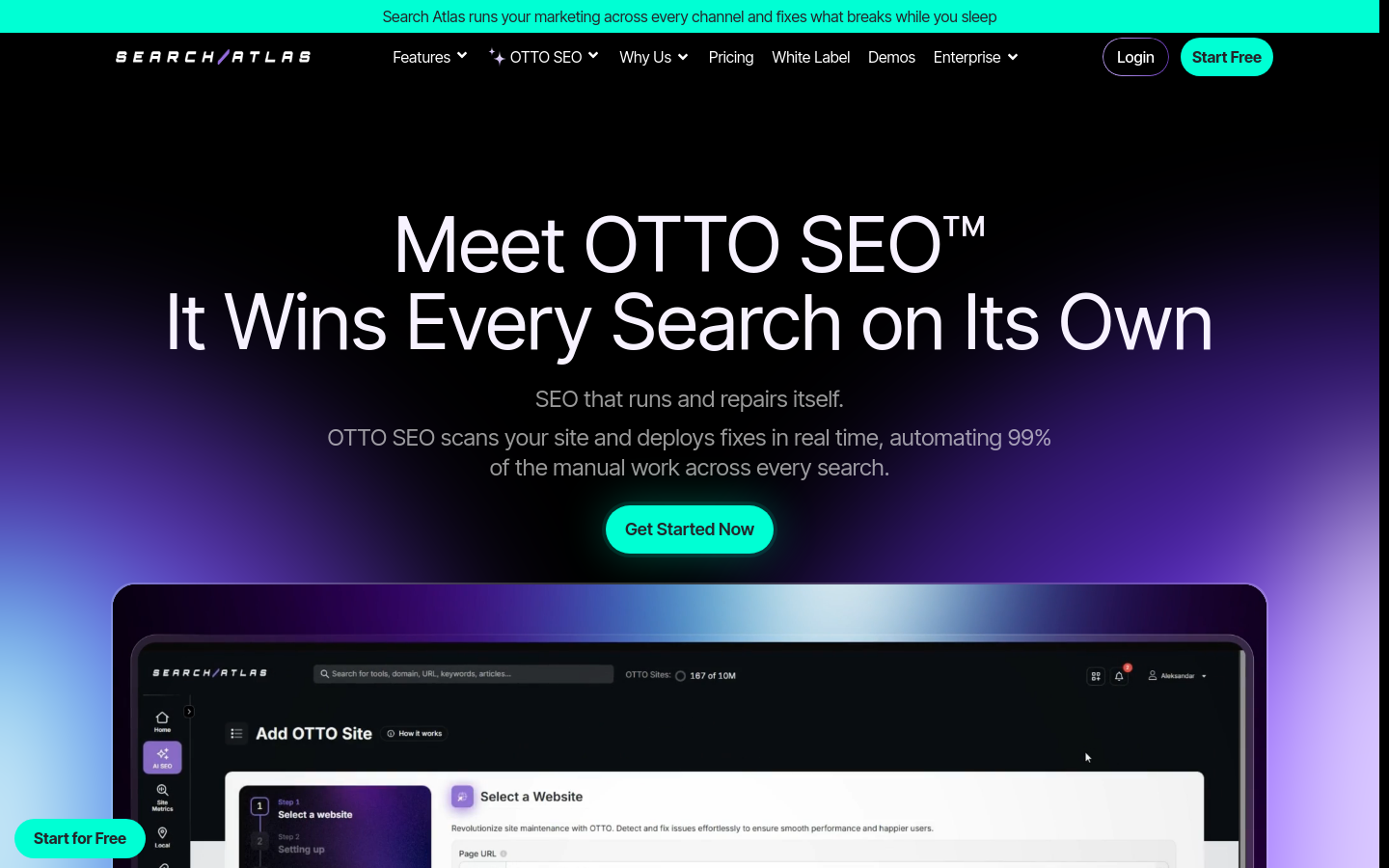
You install a pixel, and OTTO writes changes to the live site: titles, schema, canonicals, broken and redirect links, open graph tags, headings, meta tags, alt text and internal links. It also covers indexing, local profiles and off-page work.
The autonomy is real and it is the default. Approval mode exists, but it is something you turn on:
OTTO SEO runs on autopilot and deploys optimizations on its own. Want to sign off first? Turn on approval mode to review each change.
Plans are $99, $199 and $399 month to month, dropping to $79, $159 and $319 if you prepay for a year, with an agency and enterprise tier from $999. OTTO sits inside the account rather than being sold separately, so you are buying the suite and getting the agent.
What you cannot do at this price: run it on a site you are not willing to let software edit. A pixel that rewrites live pages is a big trust decision, and rolling back is a feature you will use.
Best AI SEO agents for content: Frase, SEO.AI and The SEO Agent
Three products run the content pipeline end to end, and all three publish.
Frase
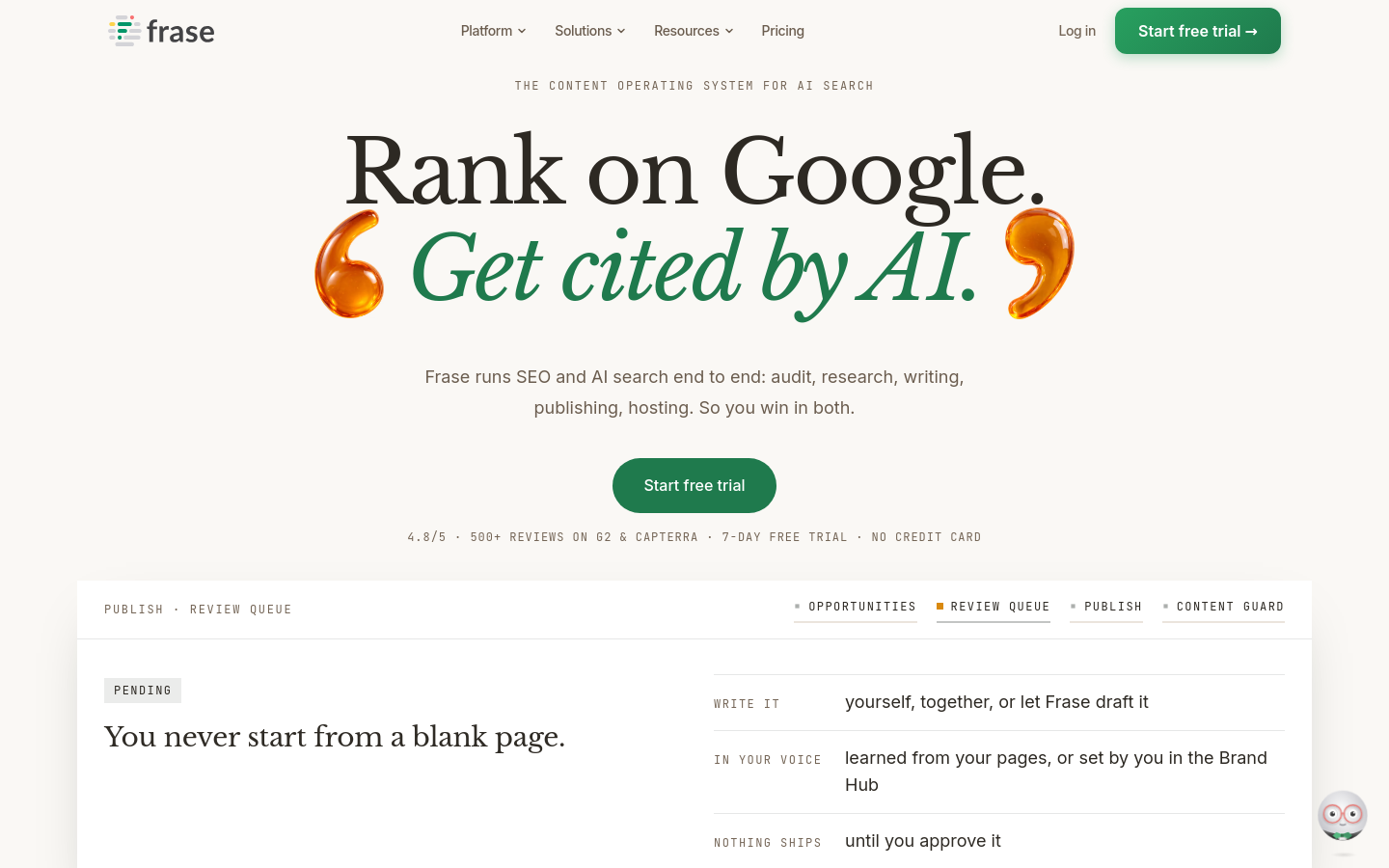
Frase is the one I expected to fail this test and did not. It is best known as a content optimization tool, and the current product runs "SEO and AI search end to end: audit, research, writing, publishing, hosting."
The route is named, and so is the dial:
Let Frase publish on its own, keep every page under review, or anywhere in between. You set the dial.
It publishes to WordPress, Webflow, Sanity and Wix, or hosts the page itself, scheduled and with schema attached. It also checks rankings and AI mentions daily and writes the fix when a page slips, which is what earns point five.
At $49 a month month to month, or $39 billed yearly, it is the cheapest product that passes. Professional is $129 and Scale is $299.
What you cannot do at this price: treat the autonomy dial as set-and-forget on a site with real commercial risk. Frase writes fixes to pages that already rank, and a fix is a rewrite.
SEO.AI
SEO.AI describes an agent that "creates ranking content, publishes it to your website, builds relevant backlinks, and keeps your visibility growing". The publishing route is explicit:
Publish straight to your website. New articles go live automatically.
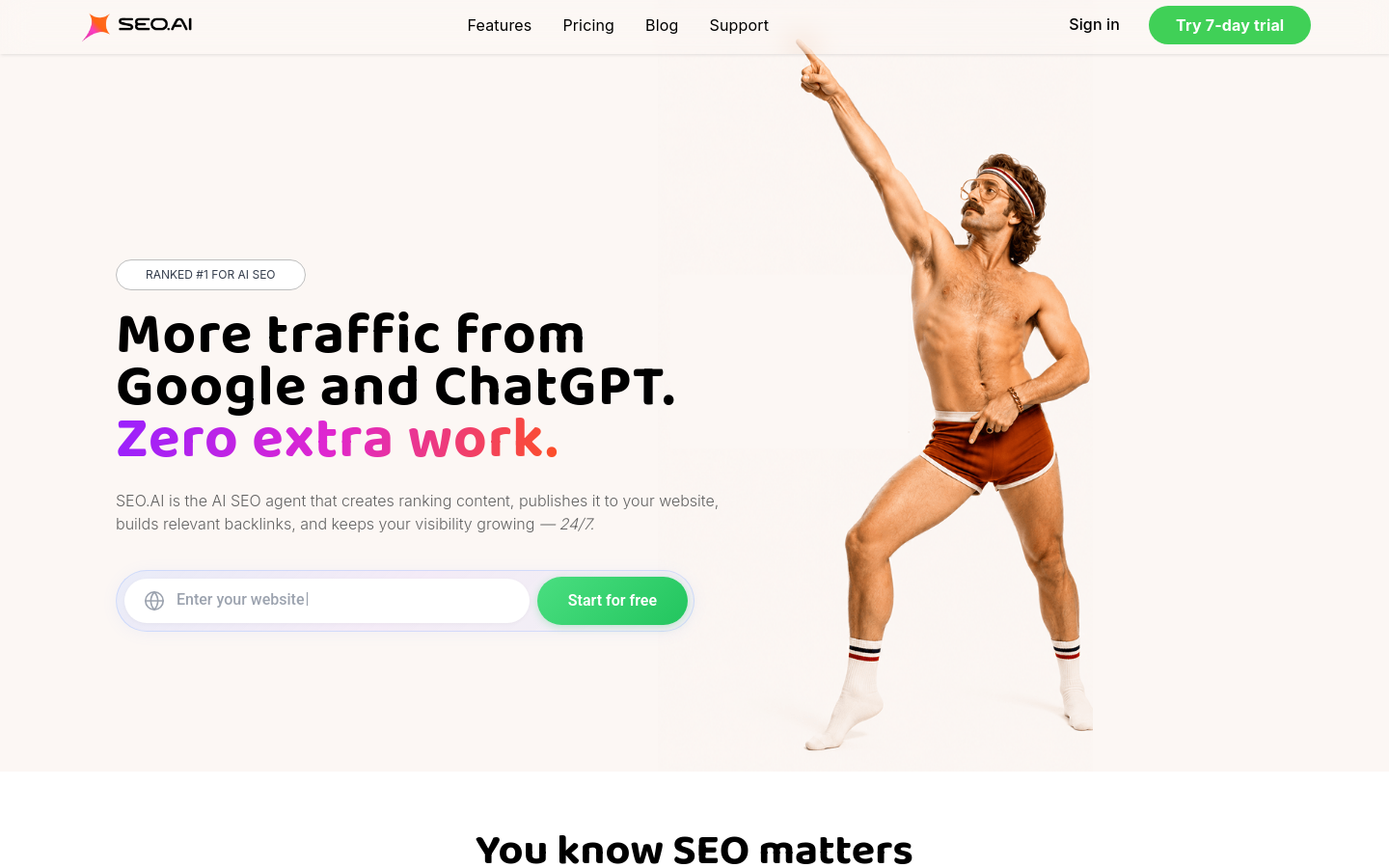
Review is available, as an option rather than a requirement. It connects to WordPress, Webflow, Wix, Squarespace, Shopify and Magento among others.
Single Site is $149 a month, covering one website in one language and excluding VAT. Multi Site is $299.
One feature deserves a flag, and I come back to it below: SEO.AI lists automatic link exchange alongside content publishing. That is a different kind of automation from writing articles, and it carries a different kind of risk.
The SEO Agent
The SEO Agent is $99 a month for one site and 30 articles, with additional sites at $79. You can "try it for $1" first.
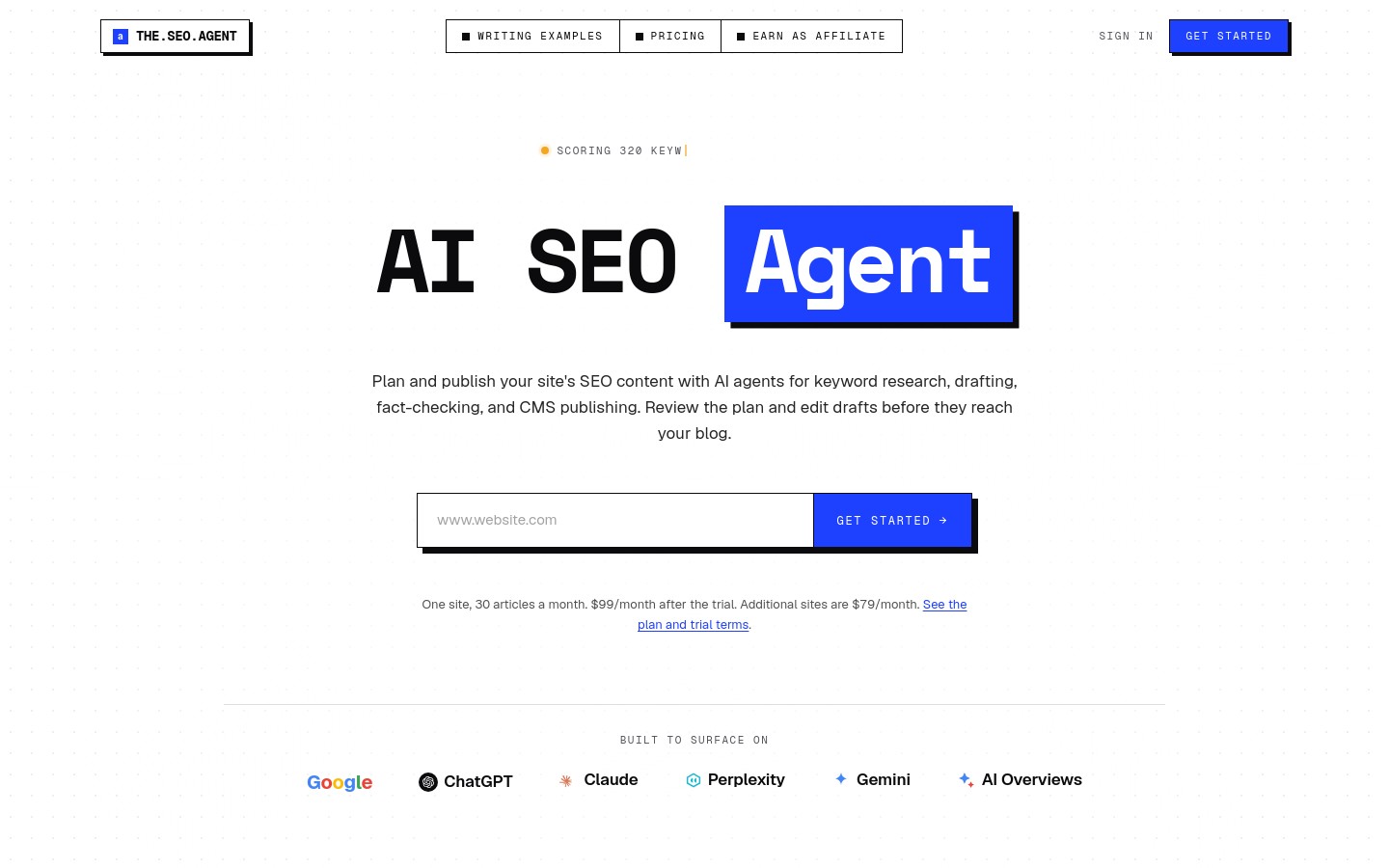
Its pipeline is keyword research, briefs, drafting with citations, a quality check, images, then publishing to your CMS. The approval step sits on the plan rather than on each article:
The SEO Agent is an AI SEO agent built so you approve the plan and it handles the rest.
The plan is built from your real pages, queries, clicks and impressions, which is what earns it point two.
What you cannot do at any of these three prices: expect the content to carry first-hand experience it does not have. All three write from what is already published. If your topic needs original data or a named expert, you are supplying that part.
Best AI SEO agent for link building: AutoBacklinks
This one is ours, so read it as a spec sheet rather than a review. What I can offer here is not objectivity, it is the source code.
Our AI backlink outreach agent has 32 tools. Thirteen are read-only: list scans, campaign stats, mailbox health, credit balance, page and domain enrichment. Nineteen act: run a web scan, scan a competitor's backlinks, apply SEO filters, find contacts, generate drafts, start outreach, schedule a recurring run.
Seventeen of those nineteen stop at an approval card every time. One stops only when it cannot tell which scan you meant. One, which suggests competitors to consider, does not stop at all.
That is the honest boundary, down to the exception. The agent plans the campaign, finds the prospects, filters them on DR, traffic and referring domains, verifies contacts, and writes each email from the prospect's own page. Then it asks.
Which raises a fair objection to my own scoring: an approval click is a new instruction, so in chat the agent is a 4 on point four, not a 5. What earns the fifth point is the scheduled automation, where the same pipeline runs discovery, SEO filter, contacts, enrollment and drafts without anyone clicking anything. Each run plans fresh keywords and skips what the site has already searched, so it does not pitch the same people twice.
Where a run ends is your choice. The default parks the drafts in a review queue. Switch it to automatic and each run sends its own batch, paced to the mailbox's daily cap.
I would not recommend starting on automatic. On one campaign I sent 187 emails and got 32 replies, a 17.1 percent reply rate, with 155 opens and 6 bounces. The copy was not what did it. The prospecting was, and prospecting is exactly the stage where a human glance catches the site that is technically relevant and obviously wrong.
Plans are $79, $179 and $399 a month on credits. The trial is 7 days and 120 credits, with a card.
What you cannot do at this price: buy placements. This finds prospects and runs the asking. Nobody is obliged to say yes, which is the difference between earning links and buying them.
Letaido: Ahrefs' agentic SEO platform
Letaido passes all five points and still will not do anything on day one, because you build the agent.
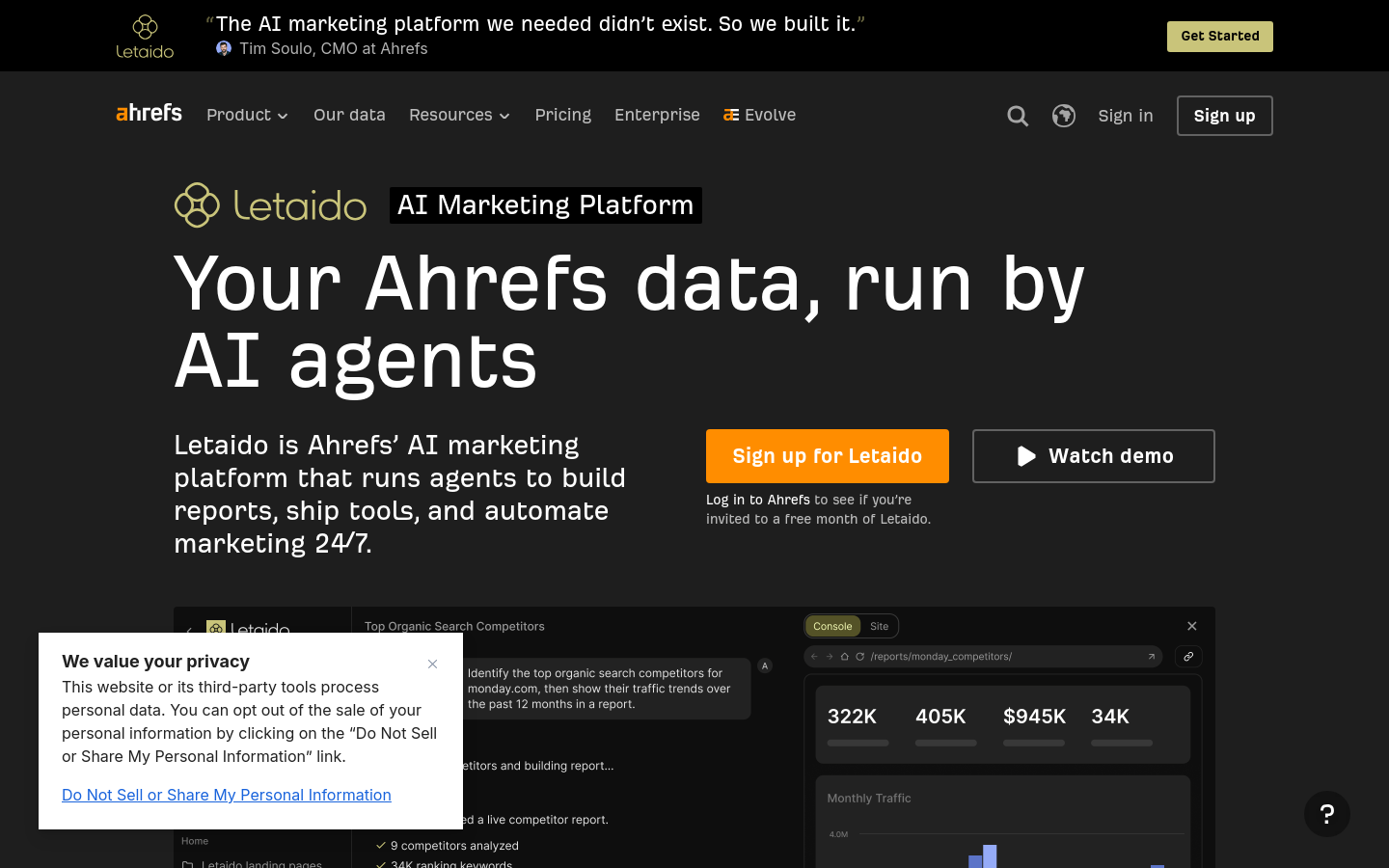
It is where Agent A went: ahrefs.com/agent-a now resolves to ahrefs.com/letaido. The pitch is "describe the report, dashboard, or automation you need, and Letaido's agents build it", running reports and automations around the clock.
The line that earns it point three:
Agents read from and write to your existing tools, so output lands where the work happens.
It works on the domains, keywords and competitors you already track in Ahrefs, which removes most of the setup cost. What it does not remove is the build, and the honest version of this recommendation is that a platform is a project with a start date. Budget the build, not just the subscription.
If you want the build-it-yourself route without a vendor at all, the Claude SEO skills worth installing cover a lot of the same ground.
The AI SEO agents that stop one step short
Four products plan, loop and run on their own, then stop at a recommendation. One of them is the most interesting entry in this whole piece.
Nightwatch brands its agent NightOwl, and its claims are not shy. The hero promises to automate "SEO research, technical audits, SEO tasks, site changes, and rank tracking". The feature strip reads Auto-Execute and Instant Fixes. A section is headed Autonomous Execution, under a pull quote saying the system "implements optimizations automatically".
Then look for how. There is no CMS connection, no plugin, no pixel, nothing named that reaches your site. The product surface around the agent is rank tracking, keyword research, site audit, a content writer, Looker Studio and an MCP server, which all read and report.
So Nightwatch keeps point three as claimed and loses it as demonstrated, and I scored the demonstrated version. If its agent does write to your pages, the mechanism is the thing to ask a salesperson about, because it is the single most valuable detail on the page and it is the one detail missing. Plans are 79, 159 and 399 euros a month, metered at 100, 1,000 and 5,000 agent credits, with a custom enterprise tier above that.
Sedestral has the same problem in a friendlier package. It splits the work across named agents: Alya for the blog, Rémi for optimization, Maya for backlinks, Nox for indexing, Marc for competitors, Louise for creative. The site's own title says five, the navigation lists six, which tells you how fast this is being built. The agents are sold as working through to publication, but no CMS, plugin or pixel is named anywhere, so by the rule I set it scores the way NightOwl does.
I also cannot tell you what it costs. The pricing page is a configurator that renders every tier at zero euros until you move its sliders, and the only fixed number on it is a 19 euro monthly add-on per local business location. Treat any figure quoted elsewhere as unconfirmed, including mine.
Relevance AI ships prebuilt SEO templates on a general agent platform. Give it your domain and one to three competitors and it handles the research. One template finds link prospects and drafts personalized outreach emails, which puts it in our lane. A draft is not a send, so it scores four on the templates as published. The platform can be wired further, but that wiring is your build, not the product.
Writesonic sells "real-time data, actionable insights, and automated optimization" and then describes the deliverable as "instant insights and actionable recommendations". The product has moved toward tracking visibility across AI platforms, and its own framing is that you fix things from the same dashboard. It is $99 a month month to month, $79 prepaid annually, on a plan that is really the AI-visibility product rather than an agent sold on its own.
The SEO tools that are not agents at all
Two entries score one point, and both earn it honestly by being good at something else.
Surfer is a content optimization tool with an MCP server, which lets Claude or ChatGPT call Surfer as a tool. That is the inverse of an agent: Surfer is the thing an agent uses. It has announced Surfy Agent, which would write, optimize and publish, but it is marked as coming rather than shipped, so it does not earn point three today.
Semrush ships AI across the suite rather than as one agent, and the output lands in Semrush's own dashboards. There is no published route by which it writes to your site, and no single product that takes a goal and runs it to completion. It reads your data and stops, which is what a suite is for.
If either ships a named publishing or deployment route, that flips point three and the score with it, and I would want to be told.
None of this makes them bad buys. It makes them tools, and tools are priced and staffed differently from agents. Our roundup of AI link building tools covers the same distinction on the link side.
What Google's link spam policy says about automated backlink agents
Three of the products here automate backlink acquisition, ours included, and this is where autonomy gets expensive.
SEO.AI lists automatic link exchange as a feature. Sedestral's backlink agent is titled Automated Backlink Acquisition and sold as authority built without outreach. Ours runs outreach.
Google's spam policies name two patterns:
Excessive link exchanges ("Link to me and I'll link to you") or partner pages exclusively for the sake of cross-linking
And, in the same list:
Using automated programs or services to create links to your site
The second line is the one people quote at any automated tool, so it is worth being precise about what it covers. Creating links to your site is not the same activity as asking a person whether they would like to link to you. Automating a pitch leaves the decision with an editor who can say no. Automating an exchange removes that decision, which is the thing the policy is describing.
That is also why our own agent stops at an approval card on seventeen of its nineteen acting tools. An email is not reversible.
So a five on this test is not an endorsement. It measures how far a product goes on its own, not whether you should let it, and on backlinks specifically those two things pull in opposite directions.
Paid links are not automatically a violation either, as long as they are qualified:
It's not a violation of our policies to have such links as long as they are qualified with a rel="nofollow" or rel="sponsored" attribute value.
How to choose an AI SEO agent for your site
Pick by job, then by how much control you are willing to hand over.
- Technical and on-page, and you can let software edit live pages: OTTO by Search Atlas, from $99 a month.
- Content volume on a thin site: Frase at $49 a month is the cheapest way in, The SEO Agent at $99 for 30 articles on one site, SEO.AI at $149 for the widest publishing integrations.
- Link building you want to keep owning: AutoBacklinks, from $79 a month. Start in review mode.
- You already live in Ahrefs and have an engineer: Letaido.
- You want continuous monitoring and will do the fixing: Nightwatch.
Two rules that will save you money. Run any agent in review mode for the first month, because the failure mode is not a bad decision, it is a fast one repeated 200 times. And do not buy an agent for a stage you have not yet done by hand, because you will not recognize a bad output.
If you are earlier than that, the AI link building workflow is worth reading before you buy anything, and our link building automation tools roundup scores which stages can actually be automated. When you are ready to try the outreach side, start a trial.
FAQ
What is an AI SEO agent?
An AI SEO agent is software that takes a goal, plans the steps itself, calls live tools to carry them out, and continues without a new instruction for each step. It differs from an AI-powered SEO tool in one way that matters: the agent takes the next step, while the tool returns an answer and waits for you. The strongest ones also start work you did not trigger, on a schedule or a watch, and name the route by which a change reaches your site.
Can AI agents do SEO?
Yes, for the parts of SEO that are sequential, high in volume and dependent on data: keyword research and clustering, technical audits and fixes, content drafting and publishing, internal linking and prospect research. Of twelve products scored here, six plan and act on their own, and four more plan and decide but hand the change back to you. What still needs a person is judgment about relevance, anything irreversible like sending an email, and supplying the first-hand experience or original data that decides whether a page ranks at all.
Which AI agent is best for SEO?
It depends on the job. For technical and on-page work, OTTO by Search Atlas deploys changes to live pages by default. For content, Frase, SEO.AI and The SEO Agent all plan, write and publish to your CMS. For link building, AutoBacklinks runs prospecting, filtering, contact finding and outreach, with an approval step before anything sends. There is no single agent that does all three jobs well.
How much does an AI SEO agent cost?
Four of the six that pass publish a price. Frase starts at $49 a month, The SEO Agent is $99 for one site, Search Atlas is $99 month to month or $79 prepaid annually with agency tiers from $999, SEO.AI is $149 for a single site, and AutoBacklinks runs $79 to $399 on credits. Sedestral publishes no flat price, and agent platforms price the subscription separately from the build effort, which is the larger cost. Metered pricing is common, so check what one agent run consumes before you compare headline numbers.
Are automated backlink agents safe?
It depends entirely on how the link gets created. Google's spam policies name excessive link exchanges and using automated programs to create links to your site as link spam. An agent that automates outreach leaves the decision with an editor who can decline, which is a different activity from an agent that exchanges or generates links on your behalf. Ask any backlink agent where the link comes from, and treat authority built without outreach as a description of the risk rather than a feature.
About Rachid Idali
Founder & SEO Strategist
Rachid Idali has spent 10 years in SEO, running multi-six-figure SEO and link-building budgets across content, digital PR, and outreach programs. He writes about practical systems for finding relevant prospects, earning links, and turning SEO operations into repeatable pipelines.
More from Rachid Idali