

Best Digital PR Agencies in 2026: What One Link Costs

by Rachid Idali
Last Updated: September 18, 2026
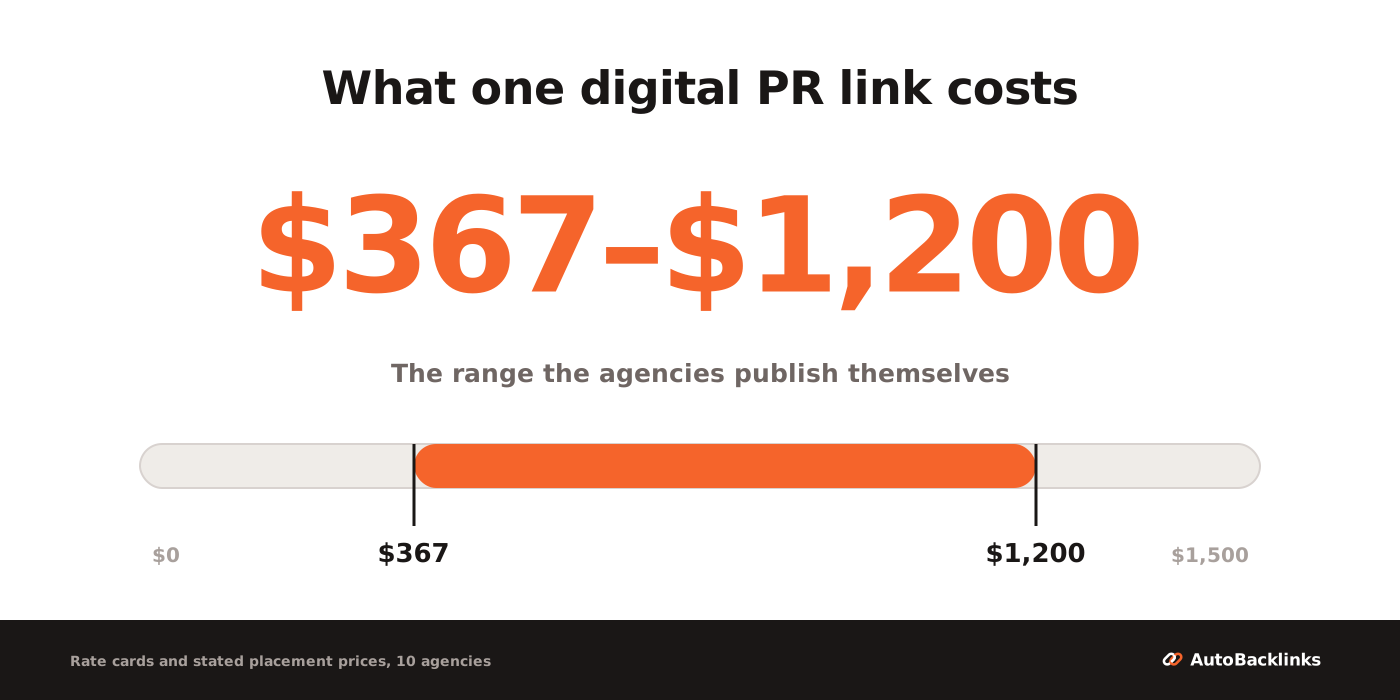
uSERP is the best digital PR agency on this list, because it is the only one of the ten that publishes both a monthly fee and a monthly link count, which means you can price what you are buying before you speak to anyone. On the prices the agencies publish themselves, one earned link runs $367 to $1,200. Divide a mid-market retainer by the campaign output the agencies state, and the same link works out at $1,690 to $3,169.
Digital PR is sold by the month and bought by the link, and almost nobody selling it will divide one by the other for you.
So this list is ranked by what you can check before you sign, not by how good the case studies look. I will say plainly where that criterion runs out.
I have bought digital PR inside multi-six-figure link-building budgets, across ten years of running them, and not once was I handed that division without asking for it.
What a digital PR agency actually sells
A digital PR agency earns coverage in publications and takes the links that come with it. The pitch goes to a journalist or an editor, not to a site owner, and what you are buying is a story good enough that someone writes about it.
That is the whole difference from ordinary link building. In link building outreach you ask a person to add a link to a page they already own. In digital PR you give a person a reason to write a new page.
Three consequences follow, and every price on this page comes out of them.
- You cannot ask for the link. It is a byproduct of the coverage, so nobody can promise you a specific placement.
- The unit being billed is a month, not a link. Almost every agency here sells a retainer, and the link count that comes out of it is an outcome, not a deliverable.
- A large share of those links will be nofollow. Newsrooms apply
rel="nofollow"as policy. In the twelve-site study I ran for how backlinks are actually acquired, only 13 of 31 press links were dofollow. JBH publishes 58 percent dofollow on its own flagship campaign. Nobody quotes you a price per dofollow link, and that is the price that matters.
What digital PR agencies cost per earned link
Three prices exist in public and they do not agree with each other. On published rate cards and stated placement prices, one link runs $367 to $1,200. The disagreement underneath that band is the most useful thing on this page.
One: an agency that publishes a rate card. uSERP prints three tiers, each with a monthly fee and a monthly link count, so the division is done in public.
| uSERP tier | Fee | Links per month | Blended cost per link |
|---|---|---|---|
| Launch | $5,500 | 5 at DR 60+, 10 at DR 20 to 59 | $367 |
| Accelerate | $10,000 | 11 at DR 60+, 8 at DR 20 to 59 | $526 |
| Dominate | $15,000 | 16 at DR 60+, 12 at DR 20 to 59 | $536 |
Those are blends, not prices for a thing you can buy. Two thirds of what the cheapest tier delivers sits in the DR 20 to 59 band, which is why it looks cheapest. So do not compare $367 against anyone's price for a national news link. They are different products.
uSERP also prices the two bands separately, at $600 to $900 for a DR 60+ link and $250 to $375 below it, which lets you back out something it does not print: what each retainer implicitly charges for the authority links inside it. Price the DR 20 to 59 links at the midpoint of uSERP's own card, subtract them, and divide the rest by the DR 60+ count.
| uSERP tier | Fee less the mid-tier links | DR 60+ links | Implied price of one authority link |
|---|---|---|---|
| Launch | $5,500 less $3,125 | 5 | $475 |
| Accelerate | $10,000 less $2,500 | 11 | $682 |
| Dominate | $15,000 less $3,750 | 16 | $703 |
That inverts the usual assumption. The cheapest tier buys authority links at a discount to uSERP's own card, and the implied unit price of an authority link goes up as you spend more. Paying more buys more of them, not better value on each one. I have not seen another page in this category run that subtraction, and it takes ten seconds once you have both numbers on the same screen.
Two: the figure the category quotes for one placement. Siege Media publishes it and attributes it to the industry rather than to its own rate card: a high-quality news placement lands between $800 and $1,200 to generate. It adds that the $300 to $600 outcome only happens when an asset goes close to viral, and should not be planned for.
Three: a retainer divided by what a campaign actually produces. This is where it gets expensive. Go Fish Digital publishes an average of 14.2 backlinks per campaign, three of them from DA 70+ sites, and says on the same page that a campaign takes about twelve weeks. Digital Third Coast publishes that mid-market retainers start between $8,000 and $15,000 a month. Three months of that, divided by 14.2 links, is $1,690 to $3,169 a link, and because the source says "start", read that as a floor.
That last one mixes two firms' numbers, so read it as the shape of the retainer model rather than either agency's economics.
Line the three up at the same quality tier and the picture is tighter than the headline band suggests:
| One link at this quality | What it costs | Source |
|---|---|---|
| DR 20 to 59 | $250 to $375 | uSERP's published card |
| DR 60+ | $475 to $900 | uSERP's card, and its retainers back-solved |
| A high-quality news placement | $800 to $1,200 | Siege Media, quoting the industry standard |
| Whatever a retainer produces | $1,690 to $3,169 | A mid-market retainer over one 12-week campaign |
One consequence of my own rule, applied to my own arithmetic: every figure above is a cost per link. The cost per referring domain is higher, and at a campaign that lands several links on one publisher group, materially higher. Nobody publishes that number, including me.
How I priced these digital PR agencies
Everything above came off the agencies' own sites, except Fractl's hourly band, which is third-party data and labelled as such wherever it appears. I want the method visible because three things in this category are easy to get wrong.
A link, a placement and a referring domain are three different counts. Rise at Seven publishes a campaign that earned 143 links from 152 separate media placements, so more outlets covered it than linked. JBH publishes one that earned 205 links at an average DA of 69, of which 58 percent were dofollow, leaving about 119 that pass anything. The SEO value accrues per referring domain, which is smaller again. Ask for all three, plus the dofollow share.
The minimum-versus-average trap costs more here than anywhere else. It is the same trap that breaks a link building services comparison, but at $1,000 a link rather than $300, the gap between "DR 60 minimum" and "average DR 60" is a five-figure difference across one campaign. Go Fish's 14.2 is explicitly an average, and only three of those links carry a stated DA 70+ floor, so I have not attached a per-link price to that entry.
The ten were chosen for what they publish, not for fame. Agencies that put a fee, a link count or a campaign length in public are the ones this method can say anything useful about. That is a real bias and it excludes well-known shops. I have said so in the also-considered note rather than pretending the ten are the category's top ten by output.
AutoBacklinks is not in the list. We are software you operate, not a done-for-you agency, and putting our own product in a ranking of agencies would be the kind of thing this page exists to catch. It gets its own comparison further down.
The 10 best digital PR agencies in 2026
Ranked by what you can verify before you sign. The criterion runs out below position six, where nothing decisive is published and the ordering becomes a judgement about fit rather than evidence.
| # | Agency | Published fee | Published volume | Cost per link | Market | Best for |
|---|---|---|---|---|---|---|
| 1 | uSERP | $5,500 to $15,000/mo | 15 to 28 links/mo | $367 to $536 blended | US, SaaS and B2B | The unit price in writing |
| 2 | Siege Media | $5,000 to $15,000/mo | No | $800 to $1,200 a placement | US, content-led | Brands with a story already in the business |
| 3 | Go Fish Digital | No | 14.2 links per 12-week campaign | Not computable | US, SEO-integrated | Quantified volume promises |
| 4 | Rise at Seven | $6.8K to $100K+/mo | Case-study counts only | Not computable | UK and US, consumer | Creative campaigns with a big swing |
| 5 | Digital Third Coast | From $8,000 to $15,000/mo | No | Not computable | US, mid-market | Teams that already report on links |
| 6 | JBH | No | 205 links, 58% dofollow, DA 69 | Not computable | UK | Links to commercial pages |
| 7 | Fractl | $100 to $149/hr (Clutch) | No | Not computable | US, research-led | Companies with proprietary data |
| 8 | 5WPR | Budget brackets only | No | Not computable | US, full-service PR | Buying PR, not only links |
| 9 | Page One Power | Gated pricing sheet | No | Not computable | US, manual link building | Volume over coverage |
| 10 | PureLinq | No | No | Not computable | US, SaaS | A senior person on a small account |
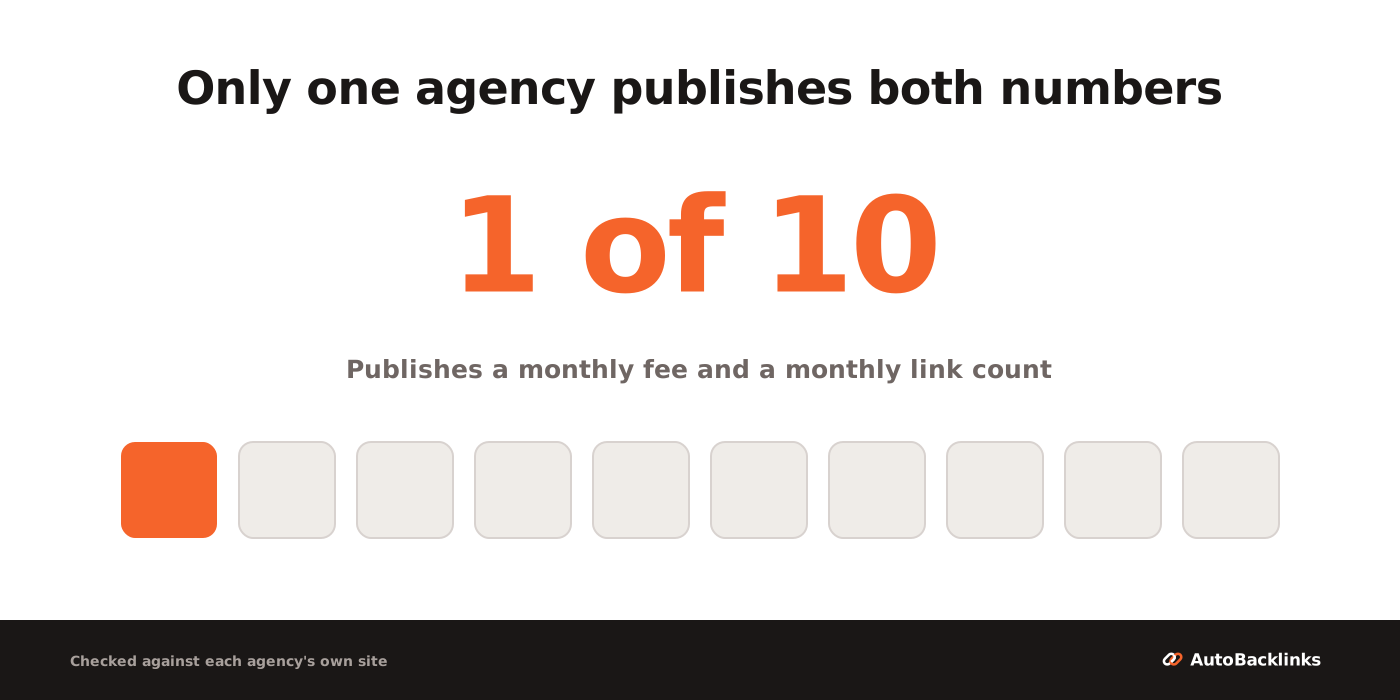
1. uSERP: $5,500 to $15,000 a month, $367 to $536 a link
uSERP is the only agency here that publishes a fee and a link count in the same table, which makes it the only one you can price before a call. Three tiers, Launch, Accelerate and Dominate, each with a stated split between DR 60+ and DR 20 to 59 placements, plus per-link values for both bands. Engagements start at three months and roll monthly after that with 30 days' notice, and twelve-month commitments cut the monthly rate.

What you cannot do: buy one link. The floor is $5,500 and a three-month term. You also cannot take the headline per-link figures at face value, because they are blends and the cheapest one is two thirds mid-tier links. Back-solved, an authority link inside Launch is $475 and inside Dominate it is $703, so the tier that looks most expensive per month is also the worst value per authority link. Price the tier on the DR 60+ count.
2. Siege Media: $5,000 to $15,000 a month, $800 to $1,200 a placement
Siege Media runs content-led digital PR, and is the only agency in this set that publishes what one placement costs to generate rather than only what a month costs to buy. It frames that figure as the industry standard rather than its own rate, which is the more useful way to read it. Its own services start around $15,000 a month, and it recommends committing $10,000 or more a month across at least four months before judging results, because newsworthy content is inconsistent by nature.
That last point is the most useful thing any agency on this list publishes. One campaign is a coin flip. Four is a sample.
It is also the part buyers underfund most often. A budget that covers one campaign is buying a lottery ticket and calling it a channel, and the shortfall only becomes obvious after the money is spent. Siege is right about the sample size, and four campaigns at its own recommended rate is $40,000 before you know anything.
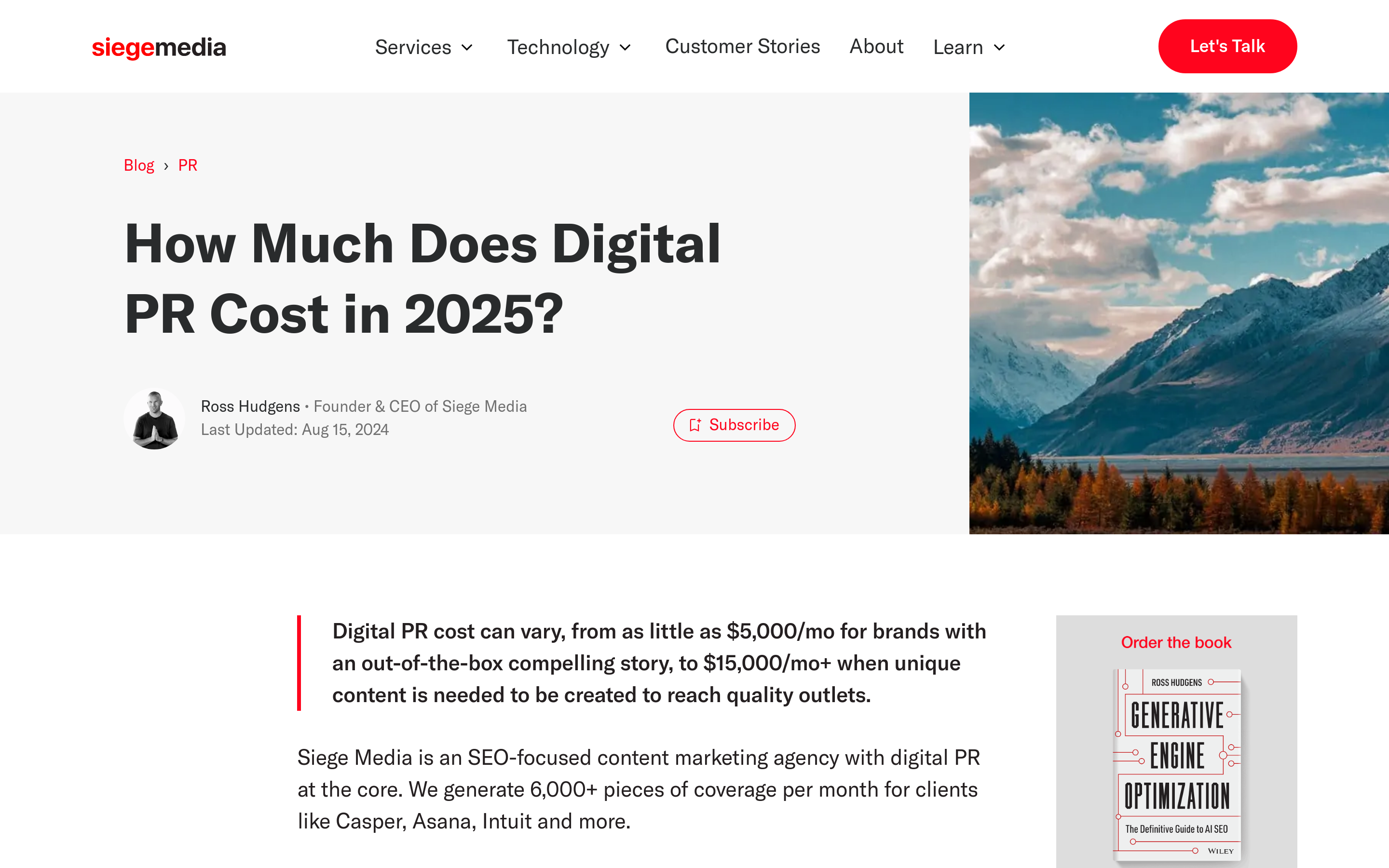
What you cannot do: tie the $800 to $1,200 to Siege's own output. It publishes no link volume, so that figure stays a category benchmark rather than a promise about your campaign.
3. Go Fish Digital: 14.2 backlinks per campaign, fee on request
Go Fish Digital publishes the numbers almost nobody else does: an average of 14.2 high-quality backlinks per campaign, three of them from DA 70+ sites, an average gain of three Domain Rating points a year per campaign, and the campaign length, about twelve weeks. That last figure is the one that changes the arithmetic, and it is why a retainer costs several times a rate card per link.
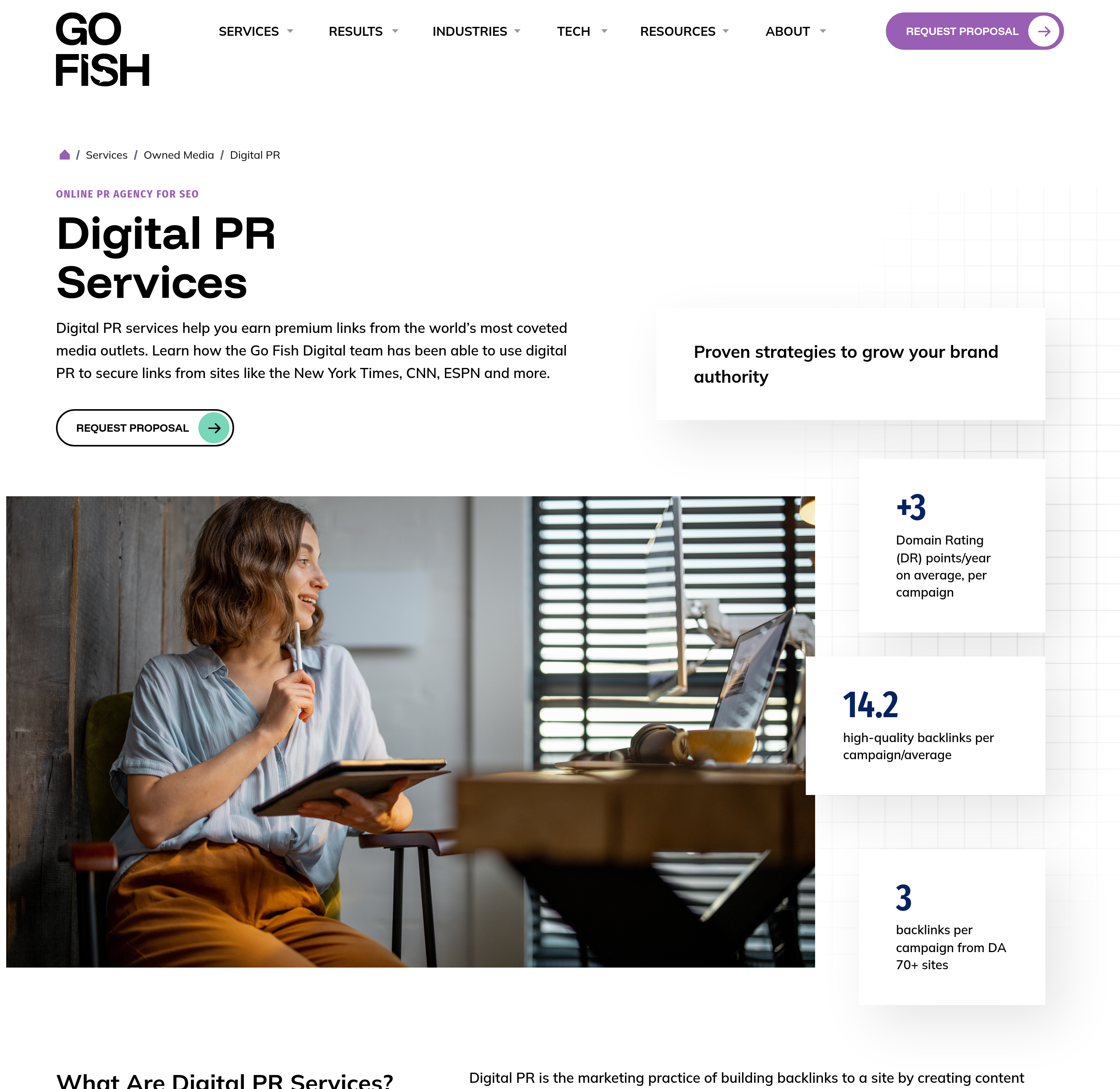
What you cannot do: work out a price. There is no fee anywhere on the site, and 14.2 is an average with a quality floor stated for only three of the links.
4. Rise at Seven: $6.8K to $100K+ a month
Rise at Seven publishes its range openly, and in both currencies: £5K, or $6.8K, a month at the entry point, up to £70K and $100K and above for category-leader programs. Case studies carry link counts, including one campaign, BetUS Rat Roster, reported at 152 media placements and 143 links.
What you cannot do: plan on the case study. There is no links-per-month average, so the per-link figure depends entirely on which campaign you compare against. A viral hit is not a plan, and the campaign above produced fewer links than placements.
5. Digital Third Coast: from $8,000 to $15,000 a month
Digital Third Coast states in its own FAQ that mid-market retainers start between $8,000 and $15,000 a month, and warns that a much lower quote is worth questioning. Note the verb: that is a floor, not a ceiling. Data-led campaigns aimed at SEO outcomes rather than coverage volume.
What you cannot do: finish the arithmetic. There is no published link count, so the division needs a number from a sales call, and the fee you divide is a floor.
6. JBH: 205 links at 58 percent dofollow, no published fee
JBH is a UK agency that makes a specific and unusual promise: links to your money pages rather than your homepage or your blog. That is genuinely harder to earn and worth more when it lands. Its Neem Tree case study publishes 205 links at an average DA of 69, and unusually it publishes the dofollow share too, at 58 percent, which is the only agency on this page to do so.
What you cannot do: price it. Neither a fee nor a per-campaign average appears anywhere on the site.
7. Fractl: research-first campaigns, no published rate card
Fractl runs data studies designed to be covered, which is the original digital PR model and still the one that produces the biggest placements. It publishes no rate card. The $100 to $149 an hour band on its Clutch profile is the only public figure, and it is third-party category data, not a quote.
What you cannot do: convert an hourly rate into a cost per link. You are buying research time with an uncertain output, and nobody will tell you in advance how many placements a study will earn.
8. 5WPR: no published price, budget brackets on the enquiry form
5WPR is the largest operation here and the most traditional PR in its DNA, with digital PR as one practice among many. The only pricing signal it gives is the budget selector on its own enquiry form, which starts at under $15,000 a month and runs past $100,000. That is what the agency expects buyers to declare, not what it charges, so treat it as a hint about who it works with rather than a floor.
Reputation work, media relations and crisis sit alongside the link-earning side.
What you cannot do: get a price, or a link count, from anything 5WPR publishes.
9. Page One Power: link building with a PR overlap
Page One Power has done manual link building since 2010, with resource-page work, guest posts and unlinked mentions alongside the earned-media side. Closer to a link building service than a pure digital PR shop, which matters if what you actually want is volume at a stated DR band.
What you cannot do: see the rate card without giving up an email address. The pricing sheet is gated, and no per-campaign average is published anywhere.
10. PureLinq: small, SaaS-focused, quote only
PureLinq is a small team doing relationship-led placements for software brands. It has the smallest backlink profile of any agency measured here, 288 referring domains against a set median above 1,900, which is not a mark against the work but does mean there is less public evidence to read.
What you cannot do: check anything. Nothing is published on price or volume, and there is less third-party evidence here than for any of the other nine.
Also considered, and why the famous names are missing
Eight more agencies were read for this ranking and left out of it:
- Zen Media, Ideagrove and PRLab, all running credible B2B and tech practices
- Green Flag Digital, the smallest, and closest to a link building shop
- Brave Bison, Power Digital and Ignite Visibility, larger and more full-service
- Matter, the most traditional PR of the group
None of the eight publishes a fee or a link volume either, which takes the real count to one agency in eighteen that lets you price what you are buying.
Beyond those eighteen sit the shops that largely built the UK campaign format, Stellar, Digitaloft, Aira, Kaizen, NeoMam, Propellernet and Verve Search, plus the holding-company tier and the big independents. None of them publishes a checkable number either.
If your shortlist is built on reputation and referrals rather than published pricing, that is a legitimate way to buy digital PR, and it may be the better one. This page is just not the one to build it from.
What the digital PR agencies' own backlinks show
I pulled the backlink profiles of fourteen digital PR agencies through DataForSEO in September 2026, using backlinks/referring_domains/live. The fourteen: Fractl, Siege Media, Go Fish Digital, uSERP, Digital Third Coast, Rise at Seven, JBH, PureLinq, 5WPR, PRLab, Page One Power, Zen Media, Green Flag Digital and Ideagrove. I took the highest-ranked 1,000 referring domains from each, 12,329 in total, then dropped every domain scoring 30 or higher for spam.
Two numbers came out of that, and the first one surprised me more than the second.
3,900 of the 12,329 domains, 31.6 percent, scored 30 or higher for spam. In the twelve-site SaaS study I ran for the backlinks piece, the same filter removed 15.9 percent. The agencies' own profiles are twice as noisy as the software companies' were.
That is not an accusation, and it is the single best argument for the caveat below. Any site that ranks for link-building terms becomes a target for every link seller with a scraper, and an agency's inbound is not curated. It does mean you should judge an agency on client results, never on its own backlink profile.
Then, on the 8,429 domains that survived the filter, I counted how many are named news, business or tech outlets against a fixed list.
34 of 8,429. Four tenths of one percent.
| Sample | Referring domains after cleaning | From named outlets | Share |
|---|---|---|---|
| All fourteen agencies | 8,429 | 34 | 0.4% |
| Highest single agency, JBH | 395 | 10 | 2.5% |
| Digital Third Coast, Page One Power and Green Flag Digital | 2,041 | 0 | 0% |
One caveat matters more than the number, so take it first. An agency pitches its clients' stories, not its own. This is not a scorecard of their work, and I am not presenting it as one. It also cannot tell you how hard a news link is to earn when someone is actually pitching for it, because nobody here was.
What it is, is a base rate, and it agrees with the one I already had. Across twelve SaaS companies in the study of where backlinks come from, press and news domains were 31 of 10,062 referring domains, 0.3 percent. Two unrelated populations, neither professionally pitched, both landing near four in a thousand. That is the honest case for the $800 to $1,200 price tag: without a campaign behind it, a named outlet essentially does not link to you.
I tried to break the number from both sides before publishing it. Adding every outlet my list had missed takes it to 44, or 0.52 percent. Stripping out the marketing and business trade press and counting only unambiguous national news takes it to 33, or 0.39 percent. It moves by a tenth of a percentage point under every rule I could justify. One bias runs the other way and is worth stating: taking the top 1,000 domains by rank favours strong domains, so if anything 0.4 percent is an upper bound.
Digital PR vs link building outreach: reply rates and cost per attempt
The two methods are not substitutes, and I would rather say that plainly than sell you a false choice. But the cost per attempt is so different that it changes what you should run first.
BuzzStream measured more than 51 million outreach emails and split them by what the sender was doing:
In this analysis, the overall reply rate for link builders is 3.59%, meaning almost 1 in 28 emails gets a reply. The digital PR dataset had a response rate of less than 1%.
Journalists get pitched more than anyone, and they answer less. Our own campaign in the education niche ran at 17.1 percent across 187 sends, which is what happens when the prospecting is tight and the ask is small.
Put a price on the attempt and the gap becomes concrete. On the AutoBacklinks Growth plan at $179 a month, one prospect taken from discovery through SEO metrics, a verified contact and a written first-touch pitch costs six credits, about 14 cents. At reply rates between 17.1 and 3.59 percent, and assuming roughly one reply in four becomes a live link, which is our own working assumption rather than a measured benchmark, the software bill behind an earned link is $3 to $16 in credits.
Those are not the same kind of number, so the table below keeps them in separate columns rather than pretending they are comparable.
| What you buy | Cost per attempt | Software bill per earned link | Delivered price per earned link | |
|---|---|---|---|---|
| Run outreach yourself | Software, your own labor | About $0.14 | $3 to $16 | Your team's time, uncosted here |
| Per-placement rate card | One placement at a stated DR band | Not applicable | Not applicable | $250 to $900 |
| Digital PR retainer | A month of an agency, labor included | Not disclosed | Not applicable | $367 to $1,200 published, $1,690 to $3,169 derived |
The right-hand column is the only like-for-like comparison, and the first row deliberately has no number in it. An agency retainer buys the labor, the relationships and the newsroom contacts. The honest comparison is a month of your team's attention against a month of theirs, and I cannot price yours.
If you are weighing an agency against building the function in-house, the outsourcing arithmetic is a separate decision from which agency to pick. Our own AI backlink outreach agent covers the ask-driven half:
- finding pages that already rank and already link out
- verifying the contact before anything sends
- writing the pitch from that page's own context
It does not pitch journalists, and it will not get you into a national outlet.
How to brief a digital PR agency
Seven questions make any two quotes comparable. Ask them in this order, before you hear a single case study.
- What is the monthly fee and what is the minimum term? Three months is the shortest anyone here offers. Twelve is where the discounts live.
- How long is a campaign? Go Fish publishes twelve weeks. If a retainer is monthly and a campaign is quarterly, your cost per link is three times what the monthly fee suggests.
- How many links, how many placements, and how many referring domains? The third number is the one that matters and the one they will have to work out.
- What share of them will be dofollow? One agency in this set publishes that figure. Ask every other one for it.
- Is the DR or DA figure a guaranteed minimum or an average? This single question changes the price of the product by more than any negotiation will.
- How many campaigns before we judge it? Anyone who says one is selling you a coin flip. Four is the number Siege publishes.
- What happens to the fee if a campaign lands nothing? Digital PR sometimes returns zero. Find out who carries that risk now.
If nobody in the room can convert the retainer into a cost per referring domain, you are not ready to sign.
Does the location of a digital PR agency matter?
The city does not. The media market does, and they are not the same question.
A UK agency's journalist relationships get you into UK nationals and UK regionals. A US agency's get you into US outlets. That is the constraint worth caring about, because a link from a British regional paper does very little for a company selling in Texas, and the agency's own office address tells you nothing about which newsrooms answer its emails.
Two of the ten here are UK-first, Rise at Seven and JBH. The rest work primarily US media. Ask which outlets an agency has landed in the last quarter for a client like you, in the market where your buyers are. The answer to that is worth more than any proximity.
When digital PR is the wrong first campaign
Digital PR needs three things that most companies do not have on day one: a story, a dataset or an opinion worth covering, and enough budget to run it four times before the average means anything. At $10,000 a month across four months, that is $40,000 before you know whether it works for you.
If you have those three, you are buying links that cannot be bought any other way, at a median domain rank of 590 against 367 for an ordinary article mention. Outreach does not reach that band.
If you do not, there are two cheaper rungs.
Journalist-request services, the HARO successors like Qwoted and Featured, put you in front of reporters for a few hundred dollars a month instead of several thousand, at the cost of doing the pitching yourself.
Below that, start where the yield is. Roundup and resource pages were 14.9 percent of the 10,062 referring domains I measured for the backlinks study, and the ask is one paragraph on a page that already exists. Buying a placement outright is a different transaction again, with its own rules, and worth understanding before anyone pitches you a hybrid of the two.
Which digital PR agency should you pick
- Pick uSERP if you want the unit price in writing and your buying process needs a number before a call. Price it on the DR 60+ count, not the blend.
- Pick Siege Media if the story already exists inside your business and you want the content-led model from the firm that publishes the most about how it prices.
- Pick Go Fish Digital if you want the volume promise quantified before you commit, and you are willing to ask for the fee.
- Pick Rise at Seven if you sell to consumers and can take a creative swing, with the variance that comes with it.
- Pick Digital Third Coast if you are mid-market, already report on links, and want a retainer floor stated up front.
- Pick JBH if you are a UK brand and you need links pointing at commercial pages rather than your blog.
- Pick Fractl if you are sitting on proprietary data and want research built around it.
- Pick 5WPR if you are buying reputation and media relations, and links are one outcome among several.
- Wait if you have no story yet. Run the ask-driven half first, build something worth covering, and come back. If you want that running this week, start a trial and point it at the pages already linking to your competitors.
FAQ
What does a digital PR agency do?
A digital PR agency earns editorial coverage in publications and the links that come with that coverage. The pitch goes to journalists and editors rather than to site owners, so the link is a byproduct of a story rather than something you can request directly. That is the structural difference from link building outreach, and it is why nobody in the category promises a specific placement.
How much do digital PR agencies cost?
Retainers commonly run $5,000 to $15,000 a month, with the largest firms starting above $15,000 and category-leader programs passing $100,000. On published prices, one earned link works out at $367 to $1,200: uSERP's rate card gives $367 to $536 blended, and Siege Media puts a high-quality news placement at $800 to $1,200 to generate. Divide a mid-market retainer by a twelve-week campaign's published output and the same link costs $1,690 to $3,169.
Which digital PR agency is the best?
uSERP, if the test is what you can verify before signing, because it is the only one of ten that publishes both a monthly fee and a monthly link count. Siege Media publishes a cost per placement, and Go Fish Digital publishes an average of 14.2 backlinks per twelve-week campaign. The other seven make you ask, and so do the eight further agencies considered for this ranking.
Is digital PR worth it for SEO?
For authority you cannot obtain by asking, yes. News domains carry the highest median domain rank in a typical profile and the smallest share of it: across twelve SaaS companies, press and news domains were 31 of 10,062 referring domains, and the same base rate holds on a second unpitched sample. The catch is yield, because BuzzStream measured a response rate of under 1 percent on digital PR outreach against 3.59 percent for link building, and a large share of news links are nofollow.
What are the big 4 PR agencies?
The phrase usually means the four holding companies that own most of the world's PR firms: WPP (Burson, Hill and Knowlton, Ogilvy PR), Omnicom (FleishmanHillard, Ketchum, Porter Novelli), Publicis (MSL) and Interpublic (Weber Shandwick, Golin). Edelman is the largest agency that is not owned by one of them. None of these is a digital PR specialist in the link-earning sense, and none publishes a fee or a link volume.
What is the difference between digital PR and link building outreach?
Who you pitch and what you pitch them. Digital PR pitches a story to a journalist; link building outreach asks a site owner to add a link to a page that already exists. The cost per attempt differs by orders of magnitude, around 14 cents for a fully worked outreach prospect on AutoBacklinks' Growth plan against a monthly retainer for digital PR. They answer different problems and the best programs run both.
About Rachid Idali
Founder & SEO Strategist
Rachid Idali has spent 10 years in SEO, running multi-six-figure SEO and link-building budgets across content, digital PR, and outreach programs. He writes about practical systems for finding relevant prospects, earning links, and turning SEO operations into repeatable pipelines.
More from Rachid Idali