

Best Link Building Services in 2026: 10 Compared per Link

by Rachid Idali
Last Updated: September 15, 2026
A link building service earns or places backlinks on other people's sites for you, and it sells that work in five different shapes: a managed retainer, a monthly package, a per-placement rate card, a white label resale, or self-serve software you run yourself. Among the services that publish a price, a placement with a guaranteed DR or DA of 50 or better costs between $300 and $405.
That band is the only place where enough vendors overlap to compare them honestly.
Everywhere else the category prices five different units and calls them all "link building services". A retainer bills a month. A rate card bills a placement. A package bills a month with a link count attached, and software bills an attempt.
None of those numbers can be ranked against each other until you reduce them to the same denominator.
So I did the reduction, and the most useful thing it turned up was not the cheapest vendor. It was what happens when you divide a package by the links it promises.
What a link building service actually sells
Five models sit behind the phrase, and each one prices a different unit.
- Managed retainer. A month of an agency's labor and access to its publisher network. The unit is a month.
- Monthly package. A promised number of links per month at a stated quality band. The unit is a month with a link count attached.
- Per-placement rate card. One placement at a named authority tier. The unit is a placement.
- White label resale. The same placements, unbranded, so an agency can resell them. The unit is a placement at wholesale.
- Self-serve software. The labor of the outreach loop, run by you. The unit is an attempt: one prospect found, qualified, contacted and pitched.
Two authority scores get used interchangeably and should not be. Domain Rating (DR) is Ahrefs' score out of 100. Domain Authority (DA) is Moz's. Vendors quote whichever one flatters their inventory, and at least one prices by Majestic referring domains instead, which is a third scale again.
That matters for a price comparison. A "$300 DA50+ link" and a "$300 DR50+ link" are not the same product, and this page names the metric every time it names a band.
How much link building services cost per link
One caution before the numbers, because it is the thing that makes most comparisons in this category worthless. A guaranteed minimum and a stated average are not the same promise. "DA 50+" means every site clears 50. "Average DR 50 to 90" means the average does, and some sites will sit below it. Those two products should never share a column, so here they do not.
Services that guarantee a minimum DR or DA of 50:
| Service | One placement | Metric | Basis |
|---|---|---|---|
| Rhino Rank | $300 | Moz DA 50+ | published rate card |
| The HOTH, Platinum | $375 | DR 50+ | published rate card |
| The HOTH, Link Outreach | $405 | DA or DR 50+ | published rate card |
Services that quote an average DR in the 50s or above:
| Service | Per link | Metric | Basis |
|---|---|---|---|
| Editorial.Link, 20-link package | $300 | Avg DR 50 to 90 | derived: $6,000 divided by 20 |
| Editorial.Link, 5-link package | $350 | Avg DR 50 to 90 | derived: $1,750 divided by 5 |
| Editorial.Link, single link | $375 | Avg DR 50 to 90 | published base rate |
| LinkBuilder.io, Startup | $375 | Avg DR 50 to 90 | derived: $2,999 divided by 8 |
| uSERP, Launch | $367 | DR 20 to 59 and DR 60+ mixed | derived: $5,500 divided by 15 |
Services with no DR 50 tier, or no price at all:
| Service | What is published | Basis |
|---|---|---|
| Authority Builders | $300 at minimum DR 30, $450 at minimum DR 60 | published rate card |
| Loganix | from $200 at DR/DA 30+, from $400 at average DR/DA 40+ | published rate card |
| Siege Media | no rate card; claims an effective cost per link around $250 | quote only |
| Page One Power | no per-link price; campaigns from $3,700 a month | quote only |
| Sure Oak | nothing | quote only |
Every figure marked derived is my division, not the vendor's price. Outreach Monks, LinkBuilder.io, uSERP, Page One Power and Siege Media all sell a month, not a link, so any per-link number for them is arithmetic on their published totals rather than something you can order at.
Three things fall out of those tables.
With a guaranteed DR 50 floor, the range is $300 to $405. That is a 35 percent spread for nominally the same promise, and Rhino Rank's $300 is the cheapest published price in the category that guarantees the band rather than averaging it.
Three publish nothing at all. Siege Media, Page One Power and Sure Oak route you to a call. Page One Power is the only one of the three that names a floor, and it names it per month.
Watch the metric, not just the number. Rhino Rank tiers on Moz DA, most of the rest on Ahrefs DR, The HOTH accepts either, Loganix quotes them interchangeably, and Rhino Rank's link insertions are priced on Majestic referring domains, a third scale entirely. A table that merges those silently is comparing four measurements and calling it one.
Order matters when you compare these. The owner's own price for a link on their site is always the floor, a marketplace adds a spread on top, and an agency adds more again. I took that ladder apart with live numbers in the 2026 backlink price ladder, and nothing here contradicts it: every figure above is a reseller price, because every vendor above is a reseller of someone else's page.
How I priced these link building services
Five questions, asked of all ten, answered only from each vendor's own pages.
- Which of the five models is it, and what unit does it price?
- What does one placement cost at a named DR or DA band, and which metric is the band in?
- What is the minimum commitment: minimum order, minimum term, contract length?
- Who builds the prospect list, and can you approve sites before placement?
- Is the content included in the price, or billed separately?
Questions 1 and 3 every vendor answers. Question 2 is where four of them stop. Question 4 splits the field more sharply than price does, and question 5 is where two packages that look identical stop being identical.
On ordering: entries 2 through 10 run from the most price-transparent to the least, starting with the services that publish a full per-link rate card and ending with the one that publishes no per-link figure at all. That gradient matters more than a strict price sort here, because a cheap number you cannot verify is worth less than a dearer one you can. AutoBacklinks sits at the top as entry 1 and is deliberately outside the ranking, because we do not sell placements and it would be dishonest to enter a per-link contest we are not in. Read it as a spec sheet, not a review.
A marketplace is also not a service. Collaborator, PressWhizz and the rest sell catalog access and leave the choosing to you, which is a different purchase priced a different way. Those are compared separately in the guest post and link building marketplaces roundup.
FATJOE gets the same treatment for a different reason. Its tier ladder and the traffic floor it attaches to each tier are broken out in the FATJOE alternatives comparison, so it is not re-reviewed here.
The 10 best link building services, priced per link
1. AutoBacklinks: $79 to $399 a month, priced per attempt
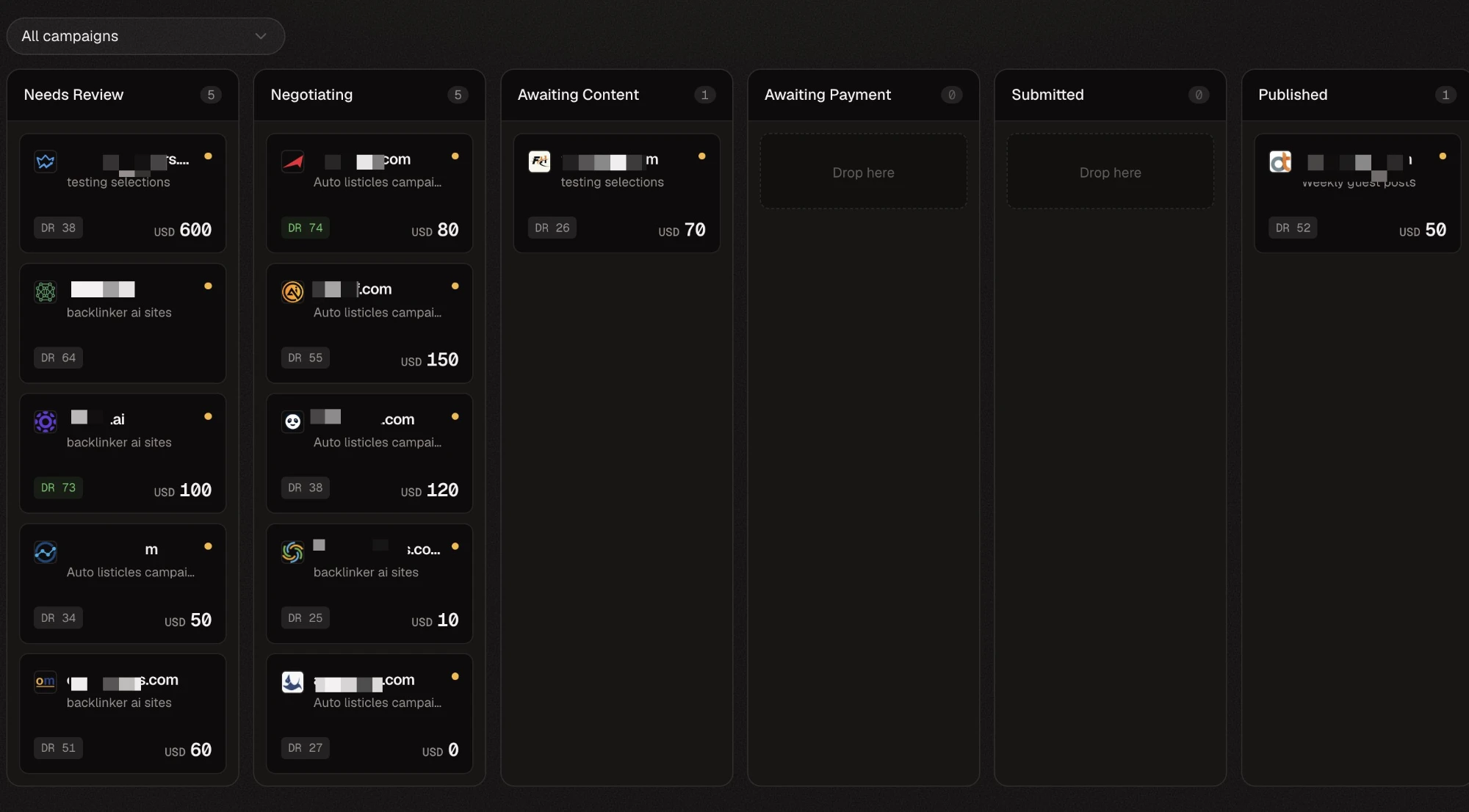
This one is ours, so read it as a spec sheet rather than a review.
We sell software, not placements. The agent runs the outreach loop and you approve what it sends:
- Scans the web and competitors' backlink profiles for pages worth pitching.
- Scores each prospect on topical fit, not DR alone, so a high-authority site with no relevance does not make the campaign.
- Filters on DR, organic traffic, referring domains and backlinks.
- Finds a verified contact, then writes the pitch and the follow-ups from the prospect's own page.
- Sends from your mailbox and tracks opens, replies and bounces.
The product page for the outreach agent walks through each of those stages.
Three plans: Starter at $79 a month for 2,500 credits, Growth at $179 for 7,500, Scale at $399 for 20,000. Yearly billing is eleven months for twelve. There is no permanent free plan, and the trial is seven days with 120 credits and a card required, so nobody should call this free.
The credits are what make the unit comparable. Finding a prospect costs 1 credit, its SEO metrics 1, a verified email 3, and each generated email 1. One prospect taken from discovery to a written first-touch pitch is therefore 6 credits, or 8 with two follow-ups drafted.
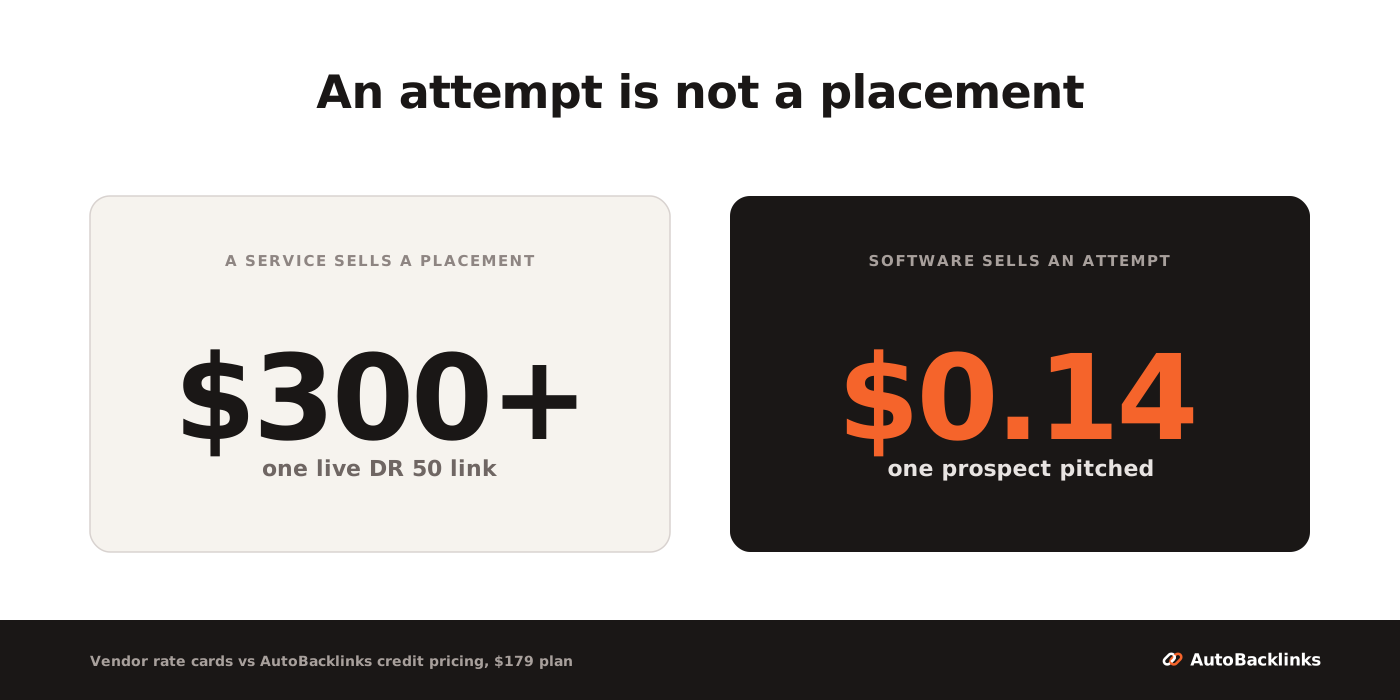
On Growth, a credit is $179 divided by 7,500, which is $0.0239. Six credits is about $0.14.
So $179 here buys roughly 1,250 fully worked prospects. Elsewhere it is about 60 percent of one $300 placement, and those are attempts rather than the link that placement delivers.
That comparison is honest only if you keep the units straight, and this is the important caveat on the whole page: an attempt is not a placement. Fourteen cents buys a prospect found, qualified, contacted and pitched. It does not buy a live link. A site owner still has to say yes.
What we can say about the yes rate is what we published: one campaign sent 187 emails and got 32 replies, a 17.1 percent reply rate, with 155 opens and 6 bounces. Prospecting drove that, not the copy. How many replies become links depends on your niche and your offer, which is why there is no cost-per-link figure in this entry.
What you cannot do here: buy a placement. If you want someone else to own the outreach and hand you finished links, every other entry on this page is a better fit than ours.
2. Rhino Rank: $300 per DA 50+ guest post
Rhino Rank publishes the clearest per-placement rate card in the set, and it is the cheapest published price in the DR/DA 50 band.
Guest posts, tiered by Moz DA:
- DA 10+: $75
- DA 20+: $95
- DA 30+: $130
- DA 40+: $200
- DA 50+: $300
- DA 60+: $400
Each includes the article of 750 words or more, the outreach, and twelve-month replacement cover, with a 7 to 14 day target. The higher tiers attach traffic floors: 500 monthly visits at DA 40+, 1,000 at DA 50+, 3,000 at DA 60+.
Its curated links, which are link insertions into existing articles, are priced on a different scale entirely: Majestic referring domains rather than DA. That ladder runs $60 for 20 to 100 referring domains up to $210 for 1,000 or more. Do not read those against a DA tier; they are not the same measure. The mechanics of that product are in how link insertions actually work.
No contracts, cancel anytime, and no minimum order. White label is offered explicitly, with reports exported unbranded.
What you cannot do: approve the specific site before you order. You choose the target URL, anchor and DA tier at checkout, and Rhino Rank picks the site.
3. Editorial.Link: $375 a link, $300 in the 20-pack

Editorial.Link is the one service here that publishes both a per-link rate and the packages that discount it, which makes it the cleanest demonstration of the division this page is built on.
Its stated base rate is $375 per backlink. The Startup package is $1,750 for five permanent dofollow editorial links, which is $350 each. The Growth package is $6,000 for twenty, which is $300 each. Both quote an average DR of 50 to 90 and a 5,000-plus traffic floor, and both include pre-approval of sites.
Buying twenty at once therefore takes 20 percent off its own base rate. That is a real volume discount, and as the next entries show, it is not the norm.
There is no minimum: you can order a single link in a month, and the packages can be recomposed if you want a guest post swapped in. A bespoke tier quotes an average DR of 60 to 95 and no published price.
What is not published: whether content is included in the price. The pricing page does not say, which is worth settling before you order given that one competitor bills writing separately at $100 an article.
4. Outreach Monks: $599 to $5,999 a month, and the mix is the catch

Outreach Monks sells five managed packages and, unusually, publishes the DR mix inside each one. That disclosure is genuinely useful, and it is also where the arithmetic gets interesting.
- Regular, $599 a month: 5 links, two at DR 20 to 29, two at DR 30 to 39, one at DR 40 to 49
- Booster, $1,099 a month: 10 links, five at DR 20 to 29, four at DR 30 to 39, one at DR 40 to 49
- Champion, $1,999 a month: 14 links, and the first tier to include DR 50 to 59, two of them
- Supreme, $3,299 a month: 20 links, adding two at DR 60 to 69
- Majestic, $5,999 a month: 30 links, topping out with one at DR 70 to 79
Divide each by its link count and the per-link price runs $119.80, $109.90, $142.79, $164.95 and $199.97. It falls once, then climbs for the rest of the ladder, because the mix keeps shifting upward. You are buying better links at the top, not more links cheaply.
Now read the first two tiers again. Regular promises exactly one DR 40 to 49 link. So does Booster. Spending an extra $500 a month buys five more links and not one additional link above DR 40.
That is not hidden. It is printed on their own page, in a table most buyers skim past because the headline compares $599 to $1,099 and 5 links to 10.
The terms are stated plainly, and they are the most buyer-friendly on this page:
- Zero minimum contract commitment, month to month, no cancellation fee.
- Content written by in-house writers, with two editorial review rounds.
- A six-month link replacement guarantee on every plan.
- Prospecting is theirs, drawn from a stated pool of 12,000-plus vetted publishers and reviewed monthly.
What you cannot do: see or approve the sites before placement. No approval step is published.
5. The HOTH: $175 to $405 a link by tier

The HOTH runs the most productized catalog here, with per-link prices published against tiers that accept either DA or DR.
Link Outreach, per link: $175 at 20+, $225 at 30+, $345 at 40+, $405 at 50+. Each includes the content at 500 to 2,000 words. Link insertions are priced separately at $200 for DR 20+, $250 for DR 45+ and $450 for DR 60+.
One caution before you order. Its Platinum Links product is listed at $375 per link on its own page and $405 per link in the main service catalog, both for DR 50+. Settle which product and which price you are buying before you pay, because the same band carries two figures.
Turnaround on Link Outreach is stated at around 30 days, and The HOTH is explicit about why: the process is manual. Press releases are $150, content syndication $99 a campaign, exclusive media links $450, and the managed HOTH X tier starts at $1,000 a month with no rate card.
Prospecting is theirs. On commitment, Link Outreach is ordered a link at a time with no minimum and no contract published, which makes it the easiest entry on this page to test with a single purchase.
What you cannot do, stated in their own words, is approve the placement first: The HOTH does not allow approval before posting on this product. That is the clearest no on this page, and it is worth respecting as a disclosure rather than a flaw.
6. Loganix: $200 to $400 a link, or $99 unvetted

Loganix ranks first for this keyword on its own brand, and its pricing is split into two products that should not be confused.
The vetted side is tiered and includes content. Guest posts: Essential Links from $200 on multi-topic sites at DR/DA 30+ with 100 to 500 monthly visits, and Authority Links from $400 on niche-specific sites averaging DR/DA 40+ with a 1,000-visit floor. Niche edits run $200 for a multi-topic edit and $400 for a niche-matched one, both at DR/DA 30+. Delivery is about three weeks from the date you approve the site list.
The self-serve side is a 25,000-site marketplace with links from $99, and Loganix labels that inventory unvetted in its own copy, telling you to do your own quality control. That is an honest label on a cheaper product, and it is the reason the $99 figure does not belong in the comparison table above: it is a different thing from a $400 vetted placement.
Two premium products, Premium Editorial at DR 70+ and Brand Mentions at DR 50+, publish no price.
The strongest thing here is question 4. Loganix sends a shortlist of hand-picked sites for your review, and you approve or replace before anything goes live. Prospecting is theirs, and it is one placement with no minimum.
What you cannot do is buy a high-authority guaranteed placement off the rate card. The published tiers stop at an average DR/DA of 40+, and the two products above that line carry no price. Its own pages also describe the inventory two ways, a 25,000-site unvetted list on one and a pre-vetted database of 10,000-plus on another, so ask which pool your shortlist is drawn from.
7. Authority Builders: $300 at DR 30, $450 at DR 60
Authority Builders prices per link against a minimum DR and a minimum traffic figure, which is a stricter promise than a DR band alone.
Its High Authority Links come in two grades. Silver is $300 a link at a minimum DR 30 and 1,000 monthly organic visits, at roughly 500 words. Gold is $450 a link at a minimum DR 60 and 10,000 monthly visits, at 750 to 1,000 words. Guest posts start at $160 a link, priced site by site from an inventory you browse.
There is no DR 50 tier, which is why the comparison table records its floors instead. Note what the Silver price means against the rest of this page: $300 buys a DR 50+ placement at Rhino Rank and a DR 30 placement here, and the difference is the traffic floor and the word count Authority Builders attaches.
Its Gold Subscription is $2,000 a month for five links, which works out to $400 each against the $450 list price, an 11 percent volume discount. Managed ABC Plus tiers start at $1,000 a month. Off subscription there is no minimum order: the rate card sells a single link.
Site selection works both ways, which is rare. You can pick the sites and have them confirm placement before invoicing, or hand the selection to them. Guest post orders complete in 7 to 10 days, premium editorial in 4 to 6 weeks, and turnaround is explicitly not guaranteed.
8. LinkBuilder.io: $2,999 to $19,999 a month at a flat $375 a link
LinkBuilder.io sells four monthly packages at an average DR of 50 to 90, and dividing them produces the flattest line of any vendor on this page.
- Startup, $2,999 a month: 8 links, $374.88 each
- Pro, $5,999 a month: 16 or more links, $374.94 each
- Growth, $9,999 a month: 26 or more links, $384.58 each
- Enterprise, $19,999 a month: 53 or more links, $377.34 each
Across a range where the monthly spend multiplies almost sevenfold, the per-link price moves by 2.6 percent. These are not volume tiers. They are the same price per link sold in four sizes, which is worth knowing before you negotiate upward expecting a break.
The commitment is the firmest here: a six-month contract with a 90-day opt-out window. Content is not included in the link packages; blog writing is an add-on at $100 an article, with technical SEO at $1,000 and earned media at $3,500 a month.
What is not published: any per-link price for a named band, or whether you can approve sites. Reporting is a shared tracking file updated through the month.
9. uSERP: $5,500 to $15,000 a month, $367 to $536 a link

uSERP is the retainer end of this page, and it publishes enough detail to divide.
Launch is $5,500 a month for 15 links, five at DR 60+ and ten at DR 20 to 59. Accelerate is $10,000 for 19 links, eleven of them DR 60+. Dominate is $15,000 for 28 links, sixteen DR 60+. A fourth tier, Market Leader, carries no published price.
Divided out, that is $367, $526 and $536 a link. The entry tier is the cheapest per link by a wide margin, and the ladder gets more expensive per unit as the mix moves to DR 60+.
uSERP also prints what it reckons those links are worth: DR 60+ at $600 to $900 each and DR 20 to 59 at $250 to $375. Read that as a vendor valuing its own inventory, not as an independent benchmark, though it is the only service here that publishes the number at all.
Prospecting is theirs, and no site approval step is published.
The commitment needs care, because the page contradicts itself. The pricing table footnote describes a three-month initial engagement rolling month to month with a 30-day out, while an FAQ on the same page describes a six-month initial term with 60 days' written notice. Get the term you are agreeing to in writing.
A twelve-month prepay reduces the monthly rate, saving $5,500 a year on Launch and $15,000 on Dominate. Content is not itemized. Lost links are replaced within six months at equal or better metrics.
10. Page One Power: quote only, from $3,700 a month

Page One Power sells custom manual link building and publishes no rate card, but it does something the other quote-only services do not: it names a floor.
Its own wording is that a typical link building campaign starts at $3,700 per month, that each campaign is custom, and that agency pricing is available. There is no per-link price, no DR band pricing and no tier table, and its link building services page carries no figures at all.
Results are framed at three to six months. Prospecting is theirs, run through an assigned project manager, and no site approval step is published. Whether content sits inside that monthly figure is not specified.
At $3,700 a month against the $300 to $405 band above, the floor implies roughly nine to twelve placements a month before it beats a rate card, and nothing on the page promises a volume. That is the trade a retainer asks you to accept.
Also considered: Siege Media, Sure Oak and the rest
Three more services belong in the conversation without earning a priced entry.
Siege Media sells a content-led retainer and publishes no rate card. It states an outcome instead: an effective cost per link it says often lands around $250, against a Domain Rating average of 40 or higher. It also declines to promise a volume, on the grounds that the links are naturally generated, and says first links typically appear in month four. That $250 is a campaign average the vendor reports, not a price you can order at, so it does not belong beside a rate card.
Sure Oak publishes no figures on its link building service page and routes you to a strategy call. One caution: the page it serves at its pricing URL is an article about SEO costs generally, which says about a third of all businesses pay between $1,000 and $5,000 a month for SEO. That is industry commentary, not Sure Oak's rate for a link, and it should not be read as a quote.
FATJOE and Stan Ventures both run published tier ladders, and neither publishes a figure this page can stand behind. FATJOE's ladder and the traffic floor it attaches to each tier are broken out in the FATJOE alternatives comparison.
Link building packages: what the package price hides
This is the part worth taking away, and it takes one division to see.
Every package on this page advertises a monthly price and a link count. Divide the first by the second and the per-link price moves in three different directions depending on the vendor.
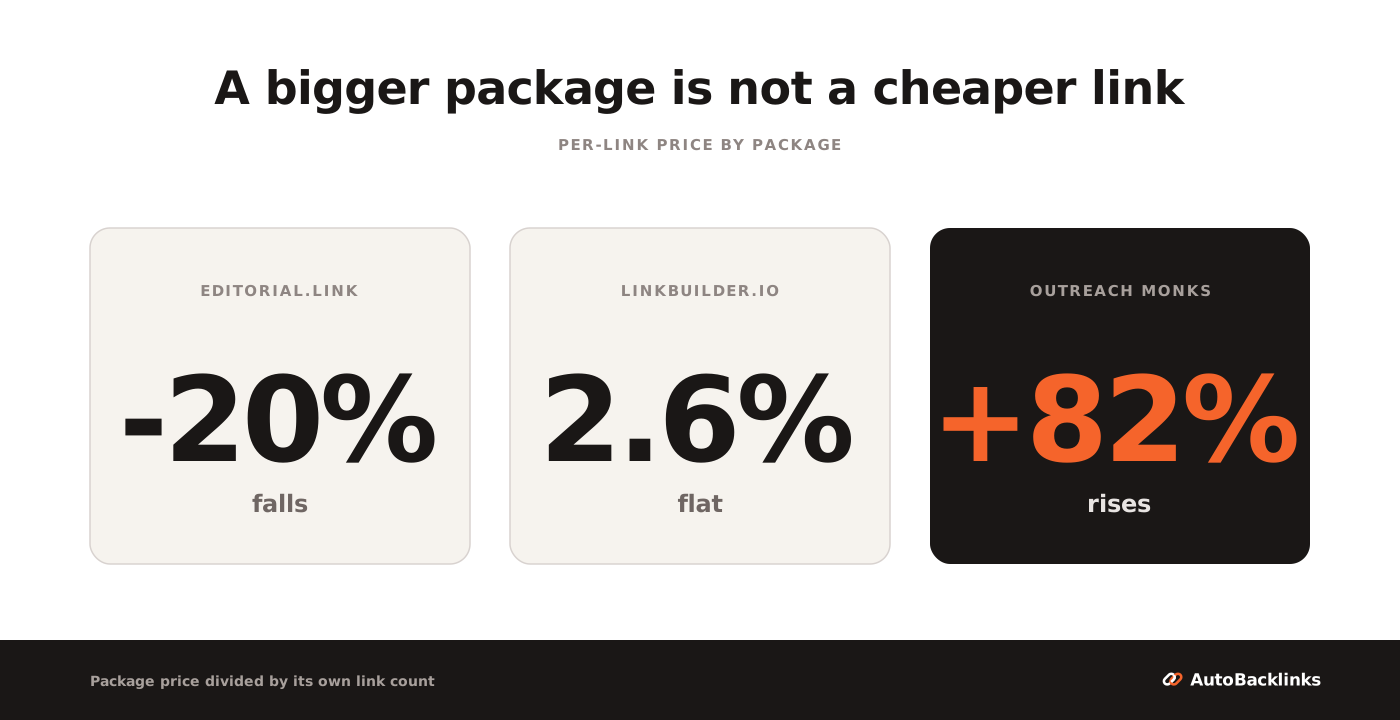
It falls at two. Editorial.Link goes from a $375 base rate to $350 in the five-pack and $300 in the twenty-pack, a 20 percent cut. Authority Builders goes from $450 a link to $400 in its $2,000 subscription, an 11 percent cut.
It stays flat at one. LinkBuilder.io's four tiers land at $374.88, $374.94, $384.58 and $377.34. Spend seven times more and the per-link price moves 2.6 percent.
It rises at two. Outreach Monks climbs from $109.90 a link at ten links to $199.97 at thirty, which is 82 percent more per link for the larger commitment. uSERP climbs from $367 at fifteen links to $536 at twenty-eight.
The two that rise have a legitimate reason, and it is the reason the whole exercise matters: their bigger packages contain better links. Outreach Monks adds DR 50 to 79 inventory as you climb, and uSERP shifts the ratio toward DR 60+. You are paying more per link because you are buying a different link.
Which is exactly the point. "Package" tells you nothing about price per link, and neither does the link count. Only the price divided by the count, read against the published DR mix, tells you anything at all. Two of the five vendors here publish that mix. Three do not, and for those three the per-link figure is an average across inventory you cannot see.
The Outreach Monks pair is the cleanest illustration in the set. Regular at $599 and Booster at $1,099 each promise exactly one link above DR 40. The extra $500 buys five links, all of them below that line.
White label link building services for agencies
White label link building is the same placement sold to an agency with the provider's name stripped off the report, so the agency can resell it under its own brand.
Nobody publishes a wholesale rate, so here is the bound you can actually reason to. The retail rate card is the ceiling, because no provider sells to resellers above its own list price, which puts a DR 50 wholesale placement at or under $300. The floor is roughly $250, the bottom of what uSERP says the DR 20 to 59 links inside its own retainers are worth. So the usable wholesale window for a mid-authority link is somewhere between $250 and $300, and any quote above the published retail price is not a wholesale quote.
That bound is derived, not published. Six of the services here offer white label, and between them they publish exactly zero rates: Rhino Rank names a white label pricing page, Authority Builders asks you to email sales, Editorial.Link offers "special pricing for backlinks" with unbranded reporting, and Loganix, Page One Power and Sure Oak list it in a nav menu.
The margin an agency adds on top is its own business, and it is real work: client management, reporting, strategy. Just be clear about which side of the trade you are on. If you are buying white label, you are buying at a spread above the site owner's price and reselling at a spread above that, and there are now three margins stacked between the publisher and your client.
Two specifics worth asking any white label provider, because none of the six publishes them: whether the same domain can be sold to another agency's client in your niche, and whether the report is genuinely unbranded or merely logo-free.
What Google's link spam policy says about paid link building services
Google's spam policies define link spam as "the practice of creating links to or from a site primarily for the purpose of manipulating search rankings", and the list of examples opens with buying links.
Under that heading it names both "Exchanging money for links, or posts that contain links" and the exact format most services on this page sell:
Advertorials or native advertising where payment is received for articles that include links that pass ranking credit, or links with optimized anchor text in articles, guest posts, or press releases distributed on other sites.
Then it offers a way out, and the way out is the half buyers skip:
Google does understand that buying and selling links is a normal part of the economy of the web for advertising and sponsorship purposes. It's not a violation of our policies to have such links as long as they are qualified with a rel="nofollow" or rel="sponsored" attribute value to the a tag.
Read those together and the tension is plain. A paid placement that passes ranking credit sits inside the policy's own definition of link spam. Qualify it with rel="sponsored" and it becomes compliant, but the attribute removes the ranking credit that was the reason for buying it. You can read the full text in Google's spam policies.
That is not an argument against every service here. It is the reason the model matters more than the price.
A service that pitches editors and earns an unpaid editorial link is doing something the policy does not address. A service that pays for placement is doing something it addresses directly, and the exposure sits on your domain, not the vendor's. Most of the vendors above describe manual outreach; none of them publishes whether money changes hands with the publisher at the end of it.
This is also where the cheap end of the market earns its caution. The bargain tiers that advertise bulk links for double digits are not a discount on the products above, they are a different product: unvetted inventory, sold to everyone, on pages that exist to carry links. Loganix labels its own $99 marketplace unvetted and tells you to do your own quality control, which is the honest version. Treat anything cheaper than that as buying the risk rather than the link.
Ask. The answer determines which of those two paragraphs you are in, and the attribute on the finished link tells you whether you got what you paid for. What backlinks are and which ones count covers how follow status changes a link's value.
How to choose a link building service
Match the model to the constraint that actually binds you.
- You want the cheapest published DR 50 link. Rhino Rank at $300, or Editorial.Link at $300 if you can commit to twenty.
- You must approve every domain before it goes live. Loganix or Editorial.Link. The HOTH explicitly does not allow it.
- You want the DR mix disclosed before you pay. Outreach Monks publishes it per tier. Most do not.
- You want a traffic floor written into the price. Authority Builders attaches one to both grades.
- You want DR 60+ inventory and zero involvement. uSERP, starting at $5,500 a month, and note the entry tier is its best value per link.
- You want a guaranteed monthly volume. LinkBuilder.io, if a six-month contract is acceptable.
- You want strategy and a named project manager. Page One Power, from $3,700 a month.
- You want the prospect list and the relationships to stay yours. Software, ours or someone else's.
That last one is the field none of these services publishes, and it is worth more than the per-link price. Cancel a managed service and you keep the links, because they live on other people's sites. You do not keep the prospect list, the publisher contacts, the record of who said no, or the relationships, because all of it was built in the vendor's system on the vendor's sending domain. I worked through that trade in detail in what you keep when you leave an outreach agency.
If the answer is that you would rather own the pipeline, the arithmetic at the top of this page is the whole argument: a month of software costs less than one DR 50 placement, and it buys attempts by the thousand instead of links by the handful. The case for and against doing it yourself is in the honest cost of outsourcing link building, and you can start a trial if you want to see the prospecting side before committing.
Just do not confuse the two units. Services sell you links. Software sells you attempts. Which one is cheaper depends entirely on how many attempts it takes you to earn a link, and that number is yours, not the vendor's.
FAQ
What is a link building service?
A link building service earns or places backlinks on other websites for you. It sells that work in five shapes: a managed retainer billing a month of labor, a monthly package billing a month with a link count attached, a per-placement rate card billing one link at a named DR or DA tier, a white label resale to agencies, or self-serve software that bills you for running the outreach yourself.
How much do link building services cost?
A placement with a guaranteed DR or DA of 50 or better costs $300 to $405. Rhino Rank is $300 at Moz DA 50+, and The HOTH runs $375 to $405 at DR 50+. Vendors quoting an average DR of 50 to 90 rather than a floor work out at $300 to $375 a link. Retainers start higher: uSERP from $5,500 a month, Page One Power from $3,700.
Are link building packages worth it?
It depends on the vendor, and one division tells you. Editorial.Link's twenty-link package is $300 a link against a $375 base rate, a 20 percent discount, and Authority Builders' subscription is $400 against $450. LinkBuilder.io's four packages all land near $375, so scaling changes nothing. Outreach Monks and uSERP get dearer per link as the package grows, because the bigger tiers hold higher-DR inventory. Divide the price by the link count, then ask for the DR mix.
How much does white label link building cost?
No provider publishes a wholesale rate. Six services here offer white label, including Rhino Rank, Loganix, Authority Builders and Editorial.Link, and all six put the price behind a sales conversation. You can still bound it. Retail is the ceiling, so a DR 50 wholesale placement sits at or under $300, and roughly $250 is the floor, the bottom of what uSERP values its own mid-authority links at.
Is it cheaper to run link building yourself?
It costs less per attempt, and the per-link answer depends on your reply rate. On our Growth plan at $179 a month, one fully worked prospect costs about 14 cents in credits, so the plan covers roughly 1,250 of them. That is a price per attempt, not per link, because a site owner still has to agree. Our published campaign hit a 17.1 percent reply rate on 187 sends, and your own conversion rate decides the rest.
About Rachid Idali
Founder & SEO Strategist
Rachid Idali has spent 10 years in SEO, running multi-six-figure SEO and link-building budgets across content, digital PR, and outreach programs. He writes about practical systems for finding relevant prospects, earning links, and turning SEO operations into repeatable pipelines.
More from Rachid Idali