

HARO Alternatives in 2026: 8 Platforms, Priced and Counted

by Rachid Idali
Last Updated: September 25, 2026
Use Qwoted if you want a self-serve feed with a published pitch limit, Source of Sources if you want the free query email that HARO's own founder now runs, and Featured if you want the revived HARO brand itself. Connectively is shut down, and Help a B2B Writer now redirects to a platform that has not opened yet.
Two numbers decide whether this channel is worth your week.
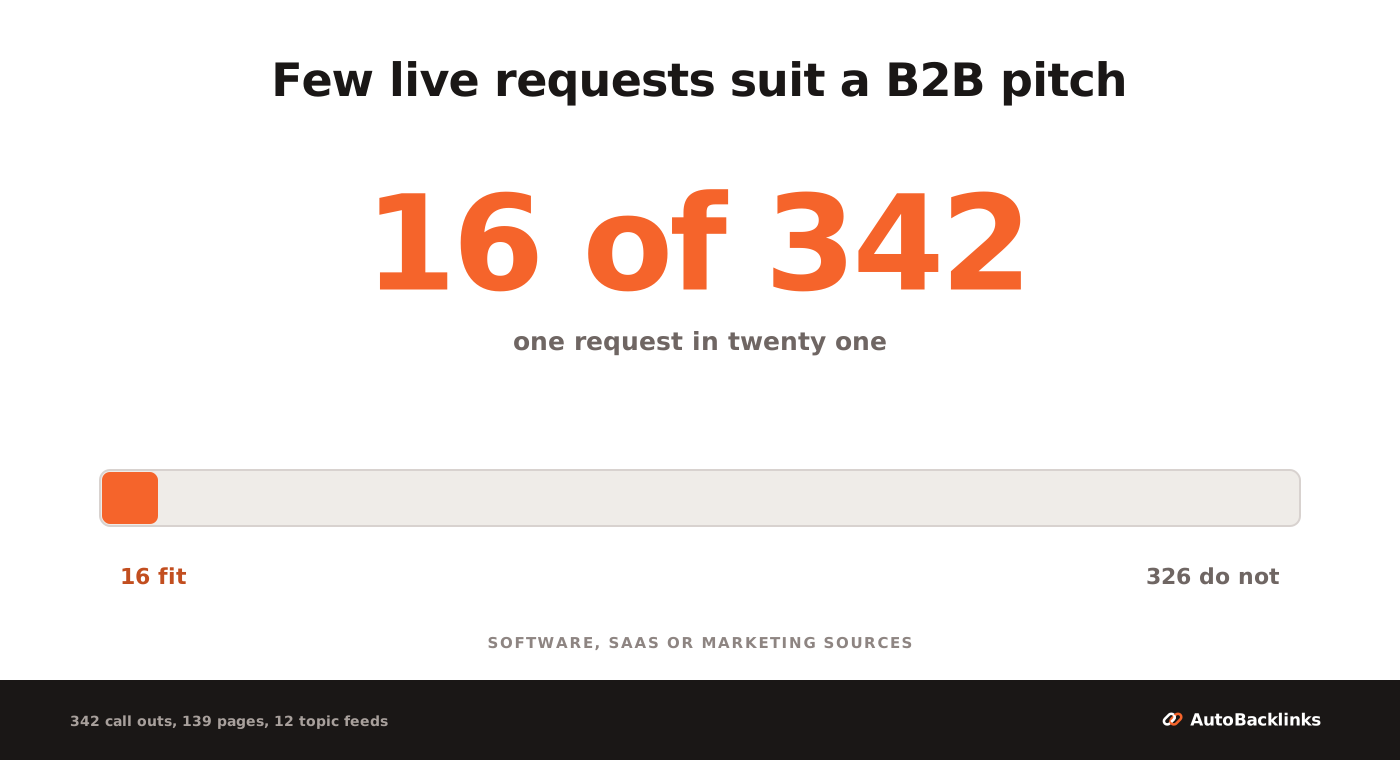
Qwoted charges $149 a month for 35 pitches, which is $4.26 a pitch, the only figure in the category you can derive from a vendor's own published cap. And of the 342 live requests I counted on the one request feed you can read without an account, 16 were ones a software, SaaS or marketing company could answer.
What happened to HARO and Connectively
Help a Reporter Out ran for over a decade as a plain email: journalists posted what they needed, sources replied, and some of those replies became quotes and links. The ownership trail matters, because the names changed more often than the product did.
- Peter Shankman founded HARO in 2008.
- Vocus acquired it in June 2010, and Vocus merged with Cision in 2014, which is how Cision came to own it.
- Cision rebranded the service as Connectively in 2024.
- Cision discontinued it permanently on 9 December 2024.
- Featured.com acquired the HARO brand from Cision in April 2025 and restarted it at helpareporter.com.
Cision's own notice is the primary record of the closure:
As of December 9, 2024, the Connectively (HARO) platform has been permanently discontinued.
Terkel, another name from this category, is gone the same way: terkel.io now returns a 301 redirect to featured.com, because Featured was built out of it.
The dead brand still absorbs the demand. Connectively's domain draws an estimated 5,624 US organic visits a month across 3,594 keywords, on DataForSEO's US estimates pulled for this piece, despite the service being closed for about 21 months. People are still searching for a product that does not exist.
HARO alternatives compared on price and pitch cap
Eight platforms, with the three things that decide whether one belongs in your week: can you get in, what a month costs, and how many pitches that buys.
| Platform | Status | Monthly price | Pitch cap | Cost per pitch |
|---|---|---|---|---|
| Qwoted | Open | Free, or $149 Pro | 2/mo free, 35/mo Pro | $4.26 on Pro |
| Featured | Open | Free, $39 Lite, $99 Pro | none published | not derivable |
| HARO (helpareporter.com) | Live, account needed to see | see Featured | none published | not derivable |
| Source of Sources | Open | Free, no paid tier | none | free |
| SourceBottle | Open | Free to pitch yourself | none on the free plan | free |
| Editorielle | Open | £10 individual, £15 team | unlimited | fractions of a pound |
| MentionMatch | Not open yet | not published | none | not applicable |
| #journorequest | Open | Free | none | free |
Two clarifications that the table cannot carry on its own.
Featured's prices are not what its pricing page shows first. The page opens on annual billing, where Lite reads $29 and Pro reads $79. Billed monthly they are $39 and $99, with a Pro+ tier at $299 and team plans from $199 to $1,499 a month. The annual figures are real but they commit you to $348 or $948 up front.
SourceBottle's paid plans do not buy you pitches. Every plan, including the free one, lets you respond to call-outs yourself as often as you like. What $25 per pitch, $65 a month or $130 a month buys is SourceBottle's own team pitching your expert profile for you:
We've shifted from a purely automated pitching service to a hands-on, human-driven pitching service.
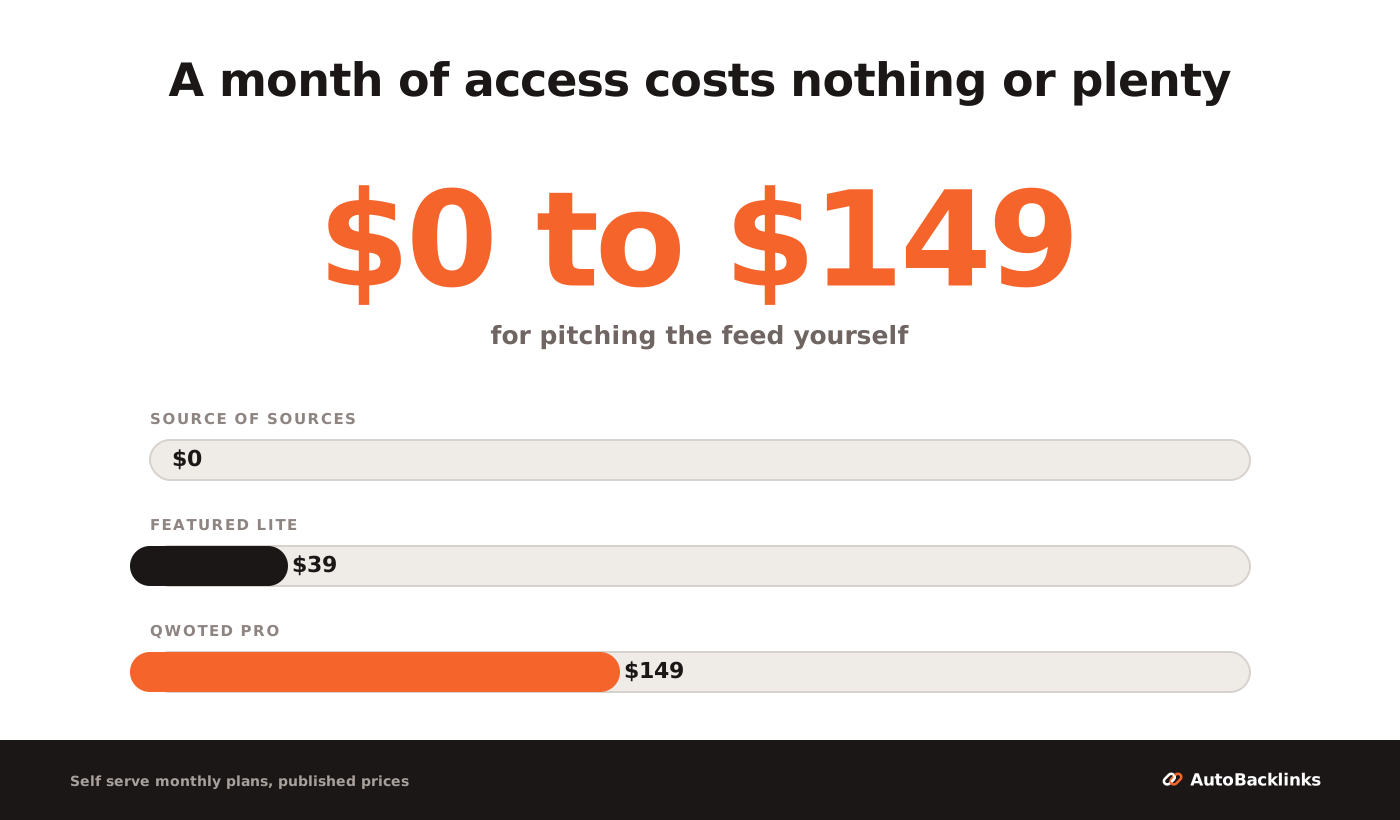
So the honest same-basis comparison is not cost per pitch at all. It is what a month of self-serve access costs, and on that basis the range runs from nothing to $149.
Free HARO alternatives and what free actually covers
Four routes cost nothing, and they are not equally useful.
Source of Sources is free with no paid tier to upgrade to. Peter Shankman rebuilt the original format under his own name, and the site sets one rule in blunt terms:
If you pitch a reporter off topic even once, and it gets back to me, you're gone. No exceptions, no appeals.
It is not quite a daily email either. The site says you get queries up to three times a day.
SourceBottle's free plan covers the part that matters: an expert profile, a directory listing, call-outs delivered to your inbox, up to 10 keywords for matching, and unlimited self-serve responses. Its public call-out feed is readable without an account at all.
Qwoted's Basic tier is free but capped hard. Two pitches a month, and each request is held back from you by a two-hour delay while paying users see it immediately. On a feed where speed decides who gets quoted, that delay is the product working as designed. Basic tells you whether the requests suit you; it does not run a campaign.
The hashtags cost nothing and have no gatekeeper. #journorequest, #prrequest, #mediarequest and #bloggerrequest on X and Bluesky are journalists posting in public. BuzzStream scraped 4,000 of those posts and found 78.5% came from UK-based accounts against 11.6% from the US, so the geography narrows the pool sharply if you sell to Americans.
What a journalist request feed actually contains
Descriptions of these feeds are easy to find. Counts are not. SourceBottle's feed is the one in this category readable without an account, so I counted all of it.
The method, so you can repeat it. SourceBottle publishes 12 public topic feeds at sourcebottle.com/industry-list-results.asp?iid=N for the ids 54 and 61 through 71. Each page shows 12 call-outs and prints its own total, and pages are addressed with &p=2 and upward. I fetched all 139 pages, extracted every call-out, and deduplicated on the request id in the URL. That gives 1,598 feed rows resolving to 342 unique live call-outs.
Three limits worth stating before the findings. The country selector defaults to Australia and I left it there, so this is the feed a new visitor sees rather than a global view. The classification below is mine. And it is one platform, not the category.
Finding one: the topic filters barely filter. 300 of the 342 call-outs (87.7%) appear under more than one topic, and one appears under 11 of the 12. A category page showing 70 results is not offering 70 distinct opportunities, it is showing you most of the same pool through a different label. Browsing "Technology" surfaces requests about rate rises, renovations and near-death ordeals.
Finding two: most journalists here want a person, not an expert. I hand-labelled a seeded random sample of 100 of the 342 against three rules. A request is a personal story if the journalist wants a private individual talking about their own life, an expert or business source if they want someone speaking in a professional capacity, and a product or sponsorship if they want goods, samples or prizes rather than words. The split:
- 66 of 100 personal story.
- 26 of 100 expert or business source.
- 8 of 100 product or sponsorship.
At n=100 the 95% confidence interval on that expert share runs roughly 17% to 35%, so read it as "about a quarter", not as a precise figure.
Finding three, the one that decides it for a SaaS marketer. I went through all 342 rather than the sample for this, because it is the number that matters most. Counting every request a software, SaaS or marketing company could answer as an expert source or contributor, I found 16 of 342, about one in 21. Stretching the definition to include general business-leadership requests takes it to 21 of 342.
They are real, and they are specific:
- Tech and entertainment experts for a piece on streaming trends, wanting digital marketers and app reviewers.
- Businesses and marketers contributing posts to a digital marketing blog.
- Entries for the TechFinitive Awards, open to B2B enterprise technology providers.
- AI experts on the use of AI in coercive control, and separately on AI in agriculture.
- Founders and marketers sharing real growth experiments, with the money spent.
- A consumer cybersecurity expert on digital safety while travelling.
Finding four: geography and timing thin it further. 99 of the 342 (28.9%) carry an explicit Australia or New Zealand token, the outlet logos on the site run heavily to AFR, the Sydney Morning Herald, Nine, The Australian and Domain among 23 named mastheads, and 14 call-outs had a deadline that had already passed while a further 59 closed the day I read them.
None of that makes SourceBottle a bad platform. It makes it an Australian publicity platform that is excellent for consumer brands and lifestyle experts, and thin for B2B software.
The eight HARO alternatives, reviewed
Qwoted
The closest thing to a straight HARO replacement with a real product around it. Journalists post requests, you pitch, the platform tracks it.
What you can do at this price. On Pro at $149 a month you get:
- 35 pitches a month.
- No response delay, so you see requests when paying users do.
- An events and awards database.
- What Qwoted calls pitch intelligence and opportunity research.
- A listing in the reporter-facing expert database.
What you cannot. Run volume: 35 pitches a month is about eight a week, a considered-pitch cadence rather than a campaign. Team functionality, white labelling, profile view alerts and weekly activity reports all sit behind Teams pricing that is quoted on request, so an agency cannot budget from the public page.
Featured (featured.com)
Featured owns the HARO brand and has repositioned well beyond journalist requests. It grew out of Terkel, and requests are now one feature among podcast pitching, speaking slots, awards, media monitoring and AI search visibility tracking.
What you can do at this price. Every plan includes every feature, including the free one. Lite is $39 a month and Pro is $99 a month billed monthly, or $29 and $79 if you commit annually at $348 and $948. Above them sit Pro+ at $299 and team plans running to $1,499 a month for up to 25 seats.
What you cannot. Know what you are buying in pitch terms. The tiers differ in daily AI usage, not in pitches, and no pitch quota is published on the pricing page. Usage resets daily, so a heavy week stalls until the next reset. If your question is "how many journalists can I reach for $99", the page does not answer it.
HARO (helpareporter.com)
The name is back, under Featured, and the domain is live. It is also the biggest search presence in the category, at an estimated 18,777 US organic visits a month across 11,326 keywords against Featured's own 15,235, which is legacy authority rather than a measure of how many journalists post there now.
What I could not do: see it. helpareporter.com returns HTTP 429 with a Vercel bot challenge to any automated client, including a headless browser, so the current request volume is not readable from outside and I am not going to guess at it. Creating an account is the only way to check, and that is worth knowing before you plan around the brand.
Source of Sources
The purist's option, and where I would start if you are testing whether this channel works for you at all.
What you can do at this price. Nothing costs anything, and there is no upgrade path to be pushed toward. You get media queries by email up to three times a day, run by the person who invented the format, with an explicit one-strike ban for off-topic pitching that keeps the quality up.
What you cannot. Filter, track or measure. There is no dashboard, no niche targeting beyond reading the email, no record of what you sent and no analytics on what worked. At an estimated 476 US organic visits a month its web presence is a fraction of Qwoted's 7,048, though for an email product that undercounts the real reach considerably.
SourceBottle
The platform I counted above, and the most transparent one in the category, because you can read the whole feed before deciding.
What you can do at this price. The free plan gives you an expert profile, a directory listing, call-outs by email, 10 keywords and unlimited self-serve pitching. Paid plans buy human pitching on your behalf:
- $25 per pitch, where their team pitches you to up to three matching call-outs a month, with 20 keywords.
- $65 a month or $650 a year for unlimited pitching of your profile and unlimited keywords.
- $130 a month or $1,300 a year for an agency running up to five expert profiles.
The page does not state a currency, and SourceBottle is an Australian company, so confirm before you subscribe.
What you cannot. Expect B2B or software requests. On the 342 live call-outs I counted, 16 suited a software, SaaS or marketing source, and the feed leans heavily Australian and consumer.
MentionMatch, formerly Help a B2B Writer
Help a B2B Writer was the sharpest fit in this category for anyone selling software, because the requests came from B2B content teams rather than national newspapers. Its domain now 301-redirects to MentionMatch, a rebuild by Superpath.
What you can do. Register as a source, and buy API access, both of which are live. The listed expertise areas are exactly the ones a SaaS marketer wants: SaaS, SEO, content marketing, CRO, analytics, ecommerce.
What you cannot. Browse or answer requests. The site carries a launching-soon banner and its "Today's Requests" page renders nothing at all, so there is no public feed. Requests reach registered sources by email instead. The homepage claims 9,000-plus B2B sources while the page description still says 8,000-plus, which is the kind of detail that suggests a product mid-launch.
Editorielle
The cheapest serious option here, and a UK one.
What you can do at this price. £10 a month for an individual or £15 for a team of two, with £5 per additional member, all excluding VAT. That buys unlimited pitches to journalists and a weekday newsletter of fresh press opportunities, with an optional £5 per instant category for faster alerts. At unlimited pitching, a per-pitch cost falls to pennies at any real volume.
What you cannot. Reach US journalists reliably. Editorielle's orientation is British publications, and its own search footprint is negligible, so you are buying the newsletter rather than a large marketplace.
#journorequest on X and Bluesky
No platform, no fee, no gatekeeper. Journalists post what they need with a hashtag and you reply.
What you can do at this price. Monitor #journorequest, #prrequest, #mediarequest and #bloggerrequest, and narrow with your own keywords. There is no delay tier, because there are no tiers, and you see a request the moment it posts.
What you cannot. Escape the noise or the geography. BuzzStream's scrape of 4,000 of these posts put 78.5% with UK accounts and only 11.6% with US ones, and the hashtags carry a heavy load of PR spam alongside the genuine requests.
Which HARO alternative to pick for your situation
Three questions, in this order, answer it faster than any feature table.
- Can you get in today? MentionMatch cannot take a pitch, and HARO needs an account before you can see anything. Everything else is open.
- What does a month of self-serve access cost? Nothing for Source of Sources, SourceBottle and the hashtags. £10 for Editorielle, $39 for Featured Lite, $149 for Qwoted Pro.
- Are the requests in your niche? This is the one nobody checks, and it decides the outcome.
Mapped to who you are:
- US B2B SaaS or marketing. Start free with Source of Sources, monitor #journorequest with keyword filters, and register with MentionMatch for when it opens. Add Qwoted Pro only once free routes prove the channel converts for you.
- Consumer brand or lifestyle expert, especially in Australia. SourceBottle, free first. Its $65 a month unlimited done-for-you tier is the best value in this roundup if you would rather not watch a feed.
- UK business of any kind. Editorielle at £10, plus the hashtags, which skew British anyway.
- A full PR programme, not just links. Featured, for the podcast, speaking and awards surfaces alongside requests.
How to pitch a journalist request and get quoted
The mechanics are simple and almost all the advantage is in the first hour.
- Reply fast. Journalists working to a same-day deadline take the first usable answer. A two-hour delay on a free tier exists precisely because speed is the product. In my count, 59 of 342 call-outs closed the day I read them.
- Answer the question asked. Not the one you wish they had asked. One tight paragraph that could be pasted into the piece as written.
- Put the credential in one line. Name, title, company, and why you specifically can answer this. Save the company story for your own site.
- Give them something checkable. A number, a date, a concrete example. A specific figure you can stand behind travels further than a polished sentence, which is the same thing that decided our own outreach case study.
- Ask for the credit once, plainly. "Happy to be credited as Rachid Idali, Founder of AutoBacklinks, autobacklinks.ai" is enough. Nothing obliges a journalist to link you, and pushing harder loses the quote.
Picking the right requests to answer beats polishing the answer to the wrong ones, which is the lesson that runs through every guest post pitch we have tested.
When link insertion outreach beats a journalist request
Here is the part the pitch decks skip. A journalist request buys you a quote. Whether that quote carries a link, and whether the link is a followed, or dofollow, link rather than a plain mention, is entirely the journalist's call.
We classified where backlinks actually come from across 11,971 referring domains on 12 mid-size SaaS sites. After cleaning, press and news accounted for 31 of 10,062 referring domains, 0.3%, the thinnest of the nine sources we ranked. Editorial in-content mentions were 51.4%, and that figure is a ceiling rather than a precise measurement. The full breakdown is in how to get backlinks.
That does not make journalist requests worthless. A national masthead quote is worth more than its link and compounds into credibility you use elsewhere. It does mean digital PR should not be the load-bearing part of a link-building plan.
The higher-yield work is asking editors to add your link to pages that already exist and already rank, which is what link insertions and niche edits are. That is where most of the backlinks that actually count come from.
AutoBacklinks is our own tool, so here is the spec sheet rather than a review. It scans for relevant prospects, filters them on DR, organic traffic and referring domains, finds verified contacts, writes a page-specific email for each one and tracks replies, from the dashboard or from Claude and ChatGPT over MCP through the outreach agent. Pricing is credit-metered:
- Starter $79 a month, 2,500 credits.
- Growth $179 a month, 7,500 credits.
- Scale $399 a month, 20,000 credits.
What you cannot do here: buy a placement. Credits pay for prospecting, contact lookup and email generation, and an attempt is not a link. There is no permanent free plan either, just a seven-day trial with 120 credits and a card required, so nobody should call it free. You can see the prospect list before committing.
For the done-for-you end of the same job, the digital PR agencies we priced charge between $367 and $1,200 per earned link, which is the honest benchmark against your own hours spent answering journalist requests.
FAQ
What is Help a Reporter Out (HARO)?
HARO is a service that connects journalists with expert sources. Reporters post what they need for a story, subscribers read those queries by email or in a dashboard, and anyone who can genuinely answer pitches the reporter directly. Peter Shankman founded it in 2008 and it became the default route for small companies to get quoted in national media without a PR agency.
Does HARO still exist?
Yes, as a name. The Cision-era service, renamed Connectively, was permanently discontinued on 9 December 2024. Featured.com acquired the HARO brand from Cision in April 2025 and restarted it at helpareporter.com. So the brand is back, but a different company runs a different product behind it.
What happened to Help a Reporter Out?
Vocus bought HARO from Peter Shankman in June 2010, and Vocus merged with Cision in 2014, which is how Cision came to own it. Cision rebranded it as Connectively in 2024 and shut it down that December as part of a shift toward its CisionOne platform. Shankman had already launched Source of Sources as a free query email in the original format.
Is there a free HARO alternative?
Source of Sources is free with no paid tier at all and sends queries up to three times a day. SourceBottle's free plan gives you an expert profile, call-outs by email, 10 keywords and unlimited self-serve pitching, and its feed is readable without an account. Qwoted has a free tier, but two pitches a month with a two-hour delay makes it a tester rather than a working plan. The #journorequest hashtags on X and Bluesky cost nothing either.
What happened to Help a B2B Writer?
Its domain now redirects to MentionMatch, a rebuild by Superpath, which has not opened yet. The site shows a launching-soon banner and its requests page lists nothing, so there is no public feed to browse. Registration and API access are live, and requests reach registered sources by email, so it is worth signing up if B2B software is your niche.
Do journalist requests give you a followed backlink?
No platform can promise one. You are pitching a quote, and whether the journalist links you, and whether that link is dofollow rather than a plain text mention, is their decision and their publication's policy. When we classified 10,062 referring domains across 12 SaaS sites, press and news accounted for 31 of them, 0.3%, the smallest of the nine sources measured. Treat coverage as the payoff and the link as a bonus.
About Rachid Idali
Founder & SEO Strategist
Rachid Idali has spent 10 years in SEO, running multi-six-figure SEO and link-building budgets across content, digital PR, and outreach programs. He writes about practical systems for finding relevant prospects, earning links, and turning SEO operations into repeatable pipelines.
More from Rachid Idali