

B2B Link Building in 2026: Where the Links Come From

by Rachid Idali
Last Updated: October 24, 2026
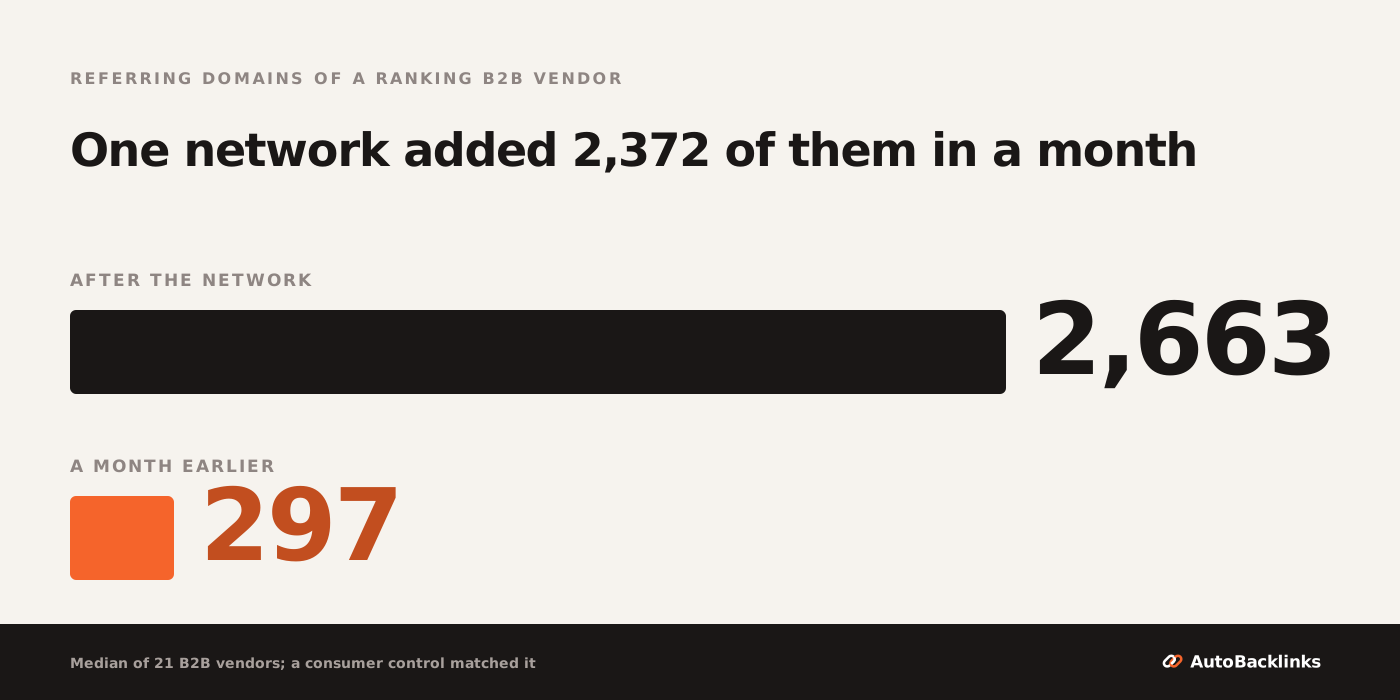
Across 21 B2B vendors ranking on the first page for their own category terms, measured in October 2026, the median company shows 2,663 referring domains. Roughly 300 of them existed a month earlier. A link-selling operation gave each of these companies about 2,372 referring domains in a single month, and none of them asked for it.
Underneath that noise sit somewhere between 1,000 and 1,300 links a person actually chose to place, across all 21 companies combined.
I ran a control too, because a finding that large usually means you measured the wrong thing. The control broke half of it, and that half is the most useful thing on this page.
Why B2B link building is different from B2C link building
B2B link building is the work of earning links to a business vendor's commercial pages when the buyer is a company rather than a consumer. It is harder than consumer link building for a reason everyone states correctly and then draws the wrong conclusion from.
The audience is small. There is no large population of enthusiast blogs writing about industrial valves or contract packaging for fun, and nothing in the category goes viral.
The usual conclusion is that B2B therefore needs expensive work: commission original research, hire a digital PR team, pitch trade journalists. That advice is right about what is scarce and wrong about what is available.
The thin audience cuts both ways. Nobody in these categories is winning on links, because the real profiles are small enough to catch.
What differs from B2C here is the link surface, not the spam. As the control below shows, the junk arrives in both markets equally. Where a consumer business has review sites, local press and enthusiast blogs to work with, a B2B vendor has industry directories, trade associations and the blogs of the companies it already trades with.
This page is about non-software B2B: manufacturers, distributors, industrial services, logistics, and trades operating at commercial scale. Software sits on a different search surface with a different answer, measured separately in SaaS link building.
What is in a B2B backlink profile?
In October 2026 I took twelve commercial B2B searches, pulled the organic results for each, and kept the real vendors that ranked: 21 companies across valves, injection molding, CNC machining, contract manufacturing, packaging, fasteners, 3PL, freight forwarding, automation integration, commercial cleaning, commercial HVAC and commercial security.
For each one I pulled live backlink data from DataForSEO: mode=one_per_domain, limit 1,000, live links only, subdomains included, ordered by domain_from_rank descending.
Sorting by referring-domain authority was the wrong first move, and the data said so immediately.
The top of nearly every profile was a private blog network selling links. The hostnames sit on fourteen cheap top-level domains, which I filtered out in full: .store, .shop, .website, .online, .space, .site, .info, .link, .click, .fun, .xyz, .top, .icu and .buzz. They carry titles like "Premium SEO Backlink Services for Building Quality Links" on about twenty shared URL paths, with anchor text templated from each target's own domain. They link to each other heavily, so the authority score reads them as strong and sorts them to the top.
43 hostnames link to all 21 vendors, 42 of them on that filtered list and one an ordinary .com.
Then the timestamps turned it from a curiosity into the story. Of the 17,532 PBN links in the sample, 17,403 were first seen in October 2026, within about three weeks of the pull. Restrict the sample to links first seen before September 2026 and the junk share of these profiles is 4.4%.
So this is one event, in one month, that added 49,815 referring domains across 21 companies and took their junk share from roughly 4% to roughly 86%.
| Vendor sample | Referring domains |
|---|---|
| All 21 vendors, live | 58,146 |
| Added in October 2026 by the network | 49,815 |
| Left after the fourteen-TLD filter | 8,331 |
| Median per vendor, after the filter | 297 |
A caveat the filter deserves: those fourteen top-level domains are a proxy for the network, not a definition of it. The same URL footprint also appears on 541 .com referring pages that survive the filter, so the 8,331 is cleaner, not clean.
The control, and what it takes away from this finding
A pattern that uniform across valves, 3PL, HVAC and commercial cleaning is suspicious, so I ran the same measurement on fourteen consumer local-service businesses ranking for terms like wedding photographer chicago and dog grooming seattle. If the blast were a B2B phenomenon, they should look different.
They do not.
| Measured in October 2026 | 21 B2B vendors | 14 consumer vendors |
|---|---|---|
| Median referring domains | 2,663 | 2,561 |
| Median junk-TLD share | 88.8% | 92.8% |
| Mean domains added by the network | 2,372 | 2,360 |
| Median referring domains after the filter | 297 | 186 |
2,209 of the 2,393 network hostnames hitting the consumer sample, 92.3%, are the same hostnames hitting the B2B sample. The same operation sent a wedding photographer in Chicago and an industrial valve manufacturer in North Carolina the same links, in the same month, to within about twelve domains of the same count.
What follows below the blast layer is B2B-specific, because it is drawn from B2B search results and B2B vendors. The blast itself is simply weather.
Collapsing the remaining templates, where one page title or one URL path appears on more than two different hostnames for the same vendor, leaves 5,320 distinct link events across the 21 companies, or 9.1% of the 58,146 referring domains. One press release syndicated to a hundred hosts is one event here, not a hundred findings.
Then the question is how many of those events are a link a person chose to place.
I drew a seeded random sample of 150 events and labelled every one by hand. A second reviewer who had not seen my labels re-labelled all 150 independently and fetched every URL.
| What the link is | My labels | Second reviewer |
|---|---|---|
| Placed by a person on a relevant site | 37 (24.7%) | 28 (18.7%) |
| Automated listing, profile or syndication clone | 49 (32.7%) | 56 (37.3%) |
| Link network, spam blog or off-topic placement | 64 (42.7%) | 66 (44.0%) |
We disagreed on 17 of 150 rows, and 12 of the 17 moved a link out of the placed bucket rather than into it. Take the placed share as 19% to 25% rather than a single number. Projected across the 21 companies that is roughly 1,000 to 1,300 placed links, against 58,146 referring domains.
Five qualifications, because they bound everything above.
I labelled from the URL and the page title first. That method reads a guest-post farm as an editorial site, which is why the second reviewer fetched all 150 pages before labelling. Their lower figure is the better one, and the 19% to 25% band should be read from the bottom.
This is the strong end of each profile. I pulled the highest-authority referring domains first, and a real placement is more likely at the top of that ordering than at the bottom. The band is a ceiling on the placed rate, not a population estimate.
One in five of these "live" links is already dead. Of the 150 events, 29 return a 404, an expired-domain page, or nothing at all when fetched, despite the data reporting them live. One page I had labelled a genuine editorial placement now serves a gambling site in another language.
The sample is concentrated in a few vendors. Events were pooled before sampling, so the three largest profiles supplied 58 of the 150 rows, and one commercial security integrator alone supplied 24 rows and 11 of the 37 placements. The placement mix below leans on its link profile more than on any other.
The per-company figure is an average, not a measured median. Spread across 21 companies, 1,000 to 1,300 placed links is about 50 to 60 each, but the sample cannot give any single company its own number.
Where do ranking B2B sites get their real backlinks?
Strip everything automated and what is left answers the actual question. Of the 150 events two of us labelled by hand, 28 to 37 were placements. Here is what they were.
| Kind of placement | Count, of 28 to 37 | Share |
|---|---|---|
| Editorial post on a topically relevant site | 17 to 21 | 57% to 61% |
| Partner, supplier, reseller or linecard page | 3 | 8% to 11% |
| Trade media, news or sponsored content | 2 to 4 | 7% to 11% |
| Curated resource page or ranked list | 2 to 5 | 7% to 14% |
| Industry forum thread | 2 | 5% to 7% |
| Sponsor listing or transaction announcement | 2 | 5% to 7% |
The ranges are the two reviewers' labels, and the ordering held under both. Every row but the first is a count of two to five, so read them as direction and not as rates.
Read the top row as a prospect list. Most real B2B links are ordinary posts on sites that operate near the vendor: an adhesive manufacturer writing about manufacturing costs, a valve distributor announcing a new supplier line, an access-control installer explaining camera law. Those are companies with a blog and a commercial reason to answer email.
The glamorous sources are the small ones. Trade media is 2 to 4 of those placements.
How to tell a real B2B site from a guest-post farm
This is the question my own labelling raised, because the thing that separates a placement worth having from a wasted send is not Domain Rating. It is whether a human editor is on the other end.
The tells, in the order they are worth checking:
- Does the site publish across unrelated verticals? A "technology" blog carrying office-cleaning, freight-broker and furnace-repair posts is selling slots, not covering a beat.
- Is there a "write for us" or "submit a guest post" page? A standing invitation means the slot is for sale to anyone.
- Count the outbound links in the post. In my sample the pages I labelled spam carried a median of 30 external links, against 16 on the placements. It is a weak tell on its own and a useful one alongside the first two.
- Is the anchor text the target's bare domain? Templated anchors built from the destination domain were the network's signature throughout this dataset.
- Does the site rank for anything itself? A farm with no topical relevance to your category has nothing to pass you.
This also explains the dead-link rate above. Farms churn: domains expire, get resold, and the link you paid for ends up on something else entirely. Links on real sites outlive the campaign that won them, which is most of what makes a backlink worth having.
What ranks for a B2B search term, and where can you get a link?
Profile data tells you what competitors have. It does not tell you which pages are worth being on. So I labelled every organic result from those twelve searches by who published it, 117 distinct results across 86 domains.
| Who published the ranking page | Results | Share |
|---|---|---|
| A vendor selling the service | 52 | 44.4% |
| A directory or aggregator | 38 | 32.5% |
| A ranked list published by a vendor | 12 | 10.3% |
| Reddit, Quora, YouTube or Wikipedia | 7 | 6.0% |
| A trade association | 3 | 2.6% |
| A trade publication or research firm | 3 | 2.6% |
| A retail marketplace | 2 | 1.7% |
A vendor holds the first position on 9 of the 12 searches, a directory on 2, a trade association on 1.
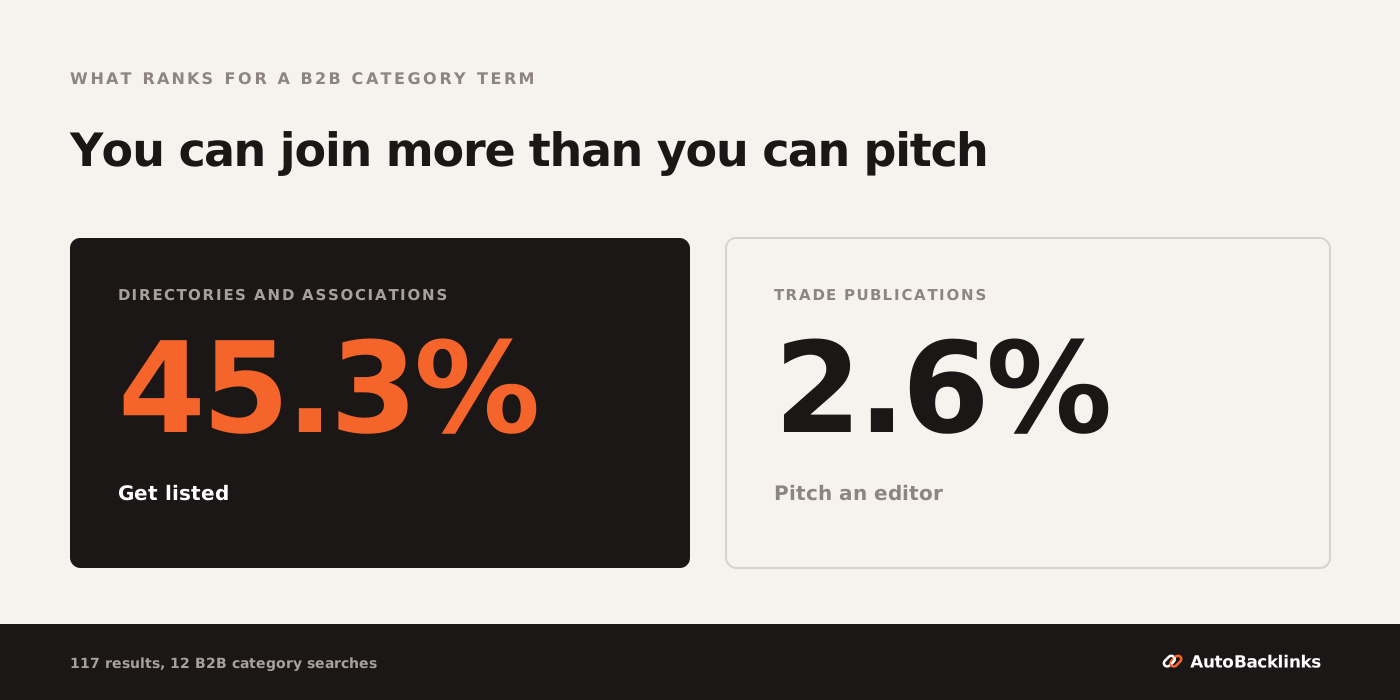
Add the directories, the vendor-published ranked lists and the trade associations and 53 of those 117 results, 45.3%, are a page you can be added to.
Two honest reads of the bottom of that table before anyone quotes it.
That 2.6% is three pages, and only one of them is a trade publication in the ordinary sense. The second is a pay-to-play "Top Companies" listing magazine and the third is a market research firm. At three observations the confidence interval runs from roughly 0.5% to 7%, so treat it as "small" rather than as a rate.
The vendor bucket is three things fused. Of the 52, ten are informational explainers rather than service pages and seven belong to software companies, in a study otherwise about non-software B2B.
What survives both caveats is the shape: the pages you can join outnumber the pages you have to pitch by more than ten to one. The same pattern shows up in software, where best-of lists are mostly published by other vendors rather than by media. B2B adds a layer software does not have, which is the industry directory.
Which B2B directories and trade associations are worth a listing?
Directories are 38 of the 117 ranking results I labelled, the largest single publisher type after vendors themselves. That makes them the first place to spend a week, because the work is finite and it ends.
Not all of them are worth having. Google's spam policies name "low-quality directory or bookmark site links" as link spam, and the general-purpose submission sites that will list anything are exactly that.
The ones that count in B2B share three properties: they rank for your category term, a human reviews the listing, and the listing carries a real description rather than a scraped stub.
The method is short:
- Search your own category term and its city or region variants, then write down every directory and aggregator that ranks.
- Check which ones already list your competitors. In this dataset Superpages and DexKnows each appeared on 17 of the 21 profiles and YellowPages on 16, which tells you what the category standard is.
- Claim or submit, with a description written for the buyer rather than for the keyword.
- Join the association your category actually has. Most industrial categories have one, most publish a member directory, and membership is the only qualifying step.
If you want acquisition routes ranked by yield rather than this B2B cut, how to get backlinks measures nine of them across a larger sample.
How do you get B2B backlinks from partner and supplier pages?
Partner and supplier pages are 3 of the placements in the sample, and the ask is cheaper than anything else on this page because the relationship already exists. Three rows is a hypothesis, not a finding, so treat the ranking as untested and the cost of trying as near zero.
Every B2B company already has commercial relationships: suppliers, distributors, resellers, integrators, the manufacturers whose lines it carries. A good share of those companies publish a partner page, a supplier list or a linecard.
The ask is not an outreach pitch. It is a sentence in an email to someone whose invoices you already pay.
What makes it work is that the relationship is real, which is also what keeps it inside the rules. Google's policy names "excessive link exchanges" and "partner pages exclusively for the sake of cross-linking" as spam. A supplier listing you on the page where it lists its distributors is not that. Two companies agreeing to link to each other to trade authority is.
Does trade media coverage still earn B2B backlinks?
Trade media is the smallest source measured here and still worth doing, at 2 to 4 of the 37 placed links and 1 of the 117 ranking results.
The reason to do it anyway is an argument rather than something this data measures: an industry title's write-up tends to get cited by the consultants and vendors who follow the category, so one placement can seed others. Take that as the argument it is.
It is also slow, and it needs something to pitch. In B2B the thing you have that nobody else does is usually operational: lead times, failure rates, scrap rates, quote-to-order ratios, what changed in your input costs. You do not need a commissioned study. You need one number from your own system that an editor in your category has never seen published.
Reporter request platforms are the cheapest way in, and that market changed when HARO shut down. The surviving options and what a pitch costs on each are in HARO alternatives. For the paid route, digital PR agencies publish cost per earned link between $367 and $1,200.
Judge this channel over a year, not a quarter.
What does B2B link building cost per link?
Prices in link building run in one order, and B2B does not change it. The site owner's direct price is the floor. A marketplace adds a spread on top of that owner price. An agency adds its own margin and management on top of the marketplace.
The cheapest version of any given placement is the one you ask for yourself, which moves the cost from money to hours.
What B2B does change is the denominator. If a ranking competitor's real profile is fifty or sixty placements built up over the life of the company, a budget sized for hundreds of links a year is sized for a problem you do not have.
The full ladder with live marketplace listings, and cost per attempt against cost per won link, is in link building cost. The agency and in-house break-even is in link building for agencies.
What Google's link spam policy says about paid B2B placements
Three of the sources on this page can be paid for, so the rule matters.
Google's spam policies define link spam as "the practice of creating links to or from a site primarily for the purpose of manipulating search rankings", and list "exchanging money for links, or posts that contain links" among the examples. The same page lists "advertorials or native advertising where payment is received for articles that include links that pass ranking credit".
The policy then says what to do about it rather than banning the transaction:
Google does understand that buying and selling links is a normal part of the economy of the web. It's not a violation of our policies to have such links as long as they are qualified with a
rel="nofollow"orrel="sponsored"attribute value to the<a>tag.
A paid placement is fine when it carries the attribute and a violation when it does not. The decision belongs to the publisher, so ask what they do before you pay.
Directory listings deserve one more read of that policy text, since "low-quality directory or bookmark site links" is named explicitly. A reviewed, category-relevant directory is not what that bullet is aimed at. A submission site that lists anyone for $5 is.
A B2B link building campaign you can copy
Here is the whole thing in order, sized against what the measurement says you are chasing.
- Measure the real gap. Pull the backlink profile of the two or three competitors that outrank you, drop the junk top-level domains, collapse anything appearing on more than two hostnames with the same title, and count what is left. That number is your target, not their referring domain count.
- Clear the listable surface first. Every directory, aggregator and association that ranks for your category term. This is a finite job with an end date.
- Run the partner audit. Suppliers, distributors, resellers, integrators. Ask the ones with a partner page.
- Then run outreach for the editorial layer, which is around six in ten of the real links and the only part that scales. The prospects are the companies writing about your category: adjacent vendors, installers, distributors, consultants.
- Pitch one operational number to your trade title each quarter and let it compound.
On outreach volume, the benchmark I can give you is our own. In a published campaign we sent 187 emails, 155 were opened, 32 replied and 6 bounced, a 17.1% reply rate. What moved that number was prospecting rather than copy: picking pages that were already a plausible home for the link.
On timing, this measurement contains no answer and I will not invent one: it counts what sits in a profile, not how long any of it took. What the campaign above gives you is a rate. Our 187 sends produced 32 replies, so a month of steady outreach at that volume puts a few dozen real conversations in front of you, and the listing and partner work in steps 2 and 3 is a few weeks of finite effort that does not repeat. Judge the editorial layer by the quarter.
Steps 2 through 4 are what AutoBacklinks runs. It is our own tool, so here is the spec rather than a review:
- Scans competitor backlink profiles and the live web for the page types above
- Filters prospects on topical relevance as well as DR, traffic and referring domains
- Finds and verifies the contact before anything sends
- Writes each email from the prospect's own page rather than from a template, then sends the follow-ups and tracks replies
Every send waits for your approval. The stage-by-stage version of this workflow is in how to run a link building campaign.
One closing caution, because it is the limit of everything above. After the network layer came off, the smallest profile in this sample held 104 referring domains and the largest 1,226, and both rank on the first page for their category term.
A twelvefold spread in real links produces no difference in page-one presence here. Every company in this sample was selected because it ranks, so the measurement sizes the competitive gap and says nothing about what links do to rankings. Read 50 or 60 placements as what a page-one competitor's profile looks like, not as a threshold you have to cross. On what the evidence does support about links and position, I measured that separately in does link building still work.
FAQ
What is B2B link building?
B2B link building is the work of earning links to a business vendor's commercial pages when the customer is another company rather than a consumer. The practical difference from consumer link building is that the audience is small and there are few enthusiast publishers, so the available link surface is dominated by industry directories, partner and supplier pages, and posts on the sites of adjacent companies rather than by media coverage.
How many backlinks does a B2B company need to rank?
Far fewer than a referring domain count suggests. Across 21 B2B vendors ranking on the first page for their own category terms, measured in October 2026, the median company showed 2,663 live referring domains, but 49,815 of the 58,146 domains across all 21 arrived from one private blog network that month. Under that layer the median company had 297 referring domains, and between 1,000 and 1,300 links across all 21 were placements a person had made. A control group of 14 consumer local-service businesses showed the same pattern, so this is a property of small commercial domains rather than of B2B.
Where do B2B companies get their backlinks?
From a narrow set of sources. Two reviewers independently labelled the same 150 links from 21 ranking B2B vendors' profiles and agreed on the ordering: 57% to 61% of the placements were editorial posts on topically relevant sites, 8% to 11% were partner, supplier or linecard pages, 7% to 11% were trade media or sponsored content, 7% to 14% were curated resource pages, and the rest were industry forums and sponsor listings.
How long does B2B link building take?
This measurement does not answer that, because it counts what sits in a backlink profile rather than how long any of it took to build. What it gives you is a size: a page-one competitor in these categories holds roughly 50 to 60 placements accumulated over the life of the company. The listings and partner-page work is a few weeks of finite effort that does not repeat, and the editorial layer should be judged by the quarter. In a published campaign of ours, 187 sends produced 32 replies.
How much does B2B link building cost?
Placements are priced by the publisher, so the order is the same as anywhere: asking the site owner directly is the floor, a marketplace adds a spread on top of that, and an agency adds its margin on top of the marketplace. What B2B changes is how many you need. If a ranking competitor's real profile is fifty or sixty placements accumulated over years, the budget should be sized against that gap. The priced breakdown is in link building cost.
About Rachid Idali
Founder & SEO Strategist
Rachid Idali has spent 10 years in SEO, running multi-six-figure SEO and link-building budgets across content, digital PR, and outreach programs. He writes about practical systems for finding relevant prospects, earning links, and turning SEO operations into repeatable pipelines.
More from Rachid Idali