

Link Building for Agencies: In-House or White Label?

by Rachid Idali
Last Updated: October 22, 2026
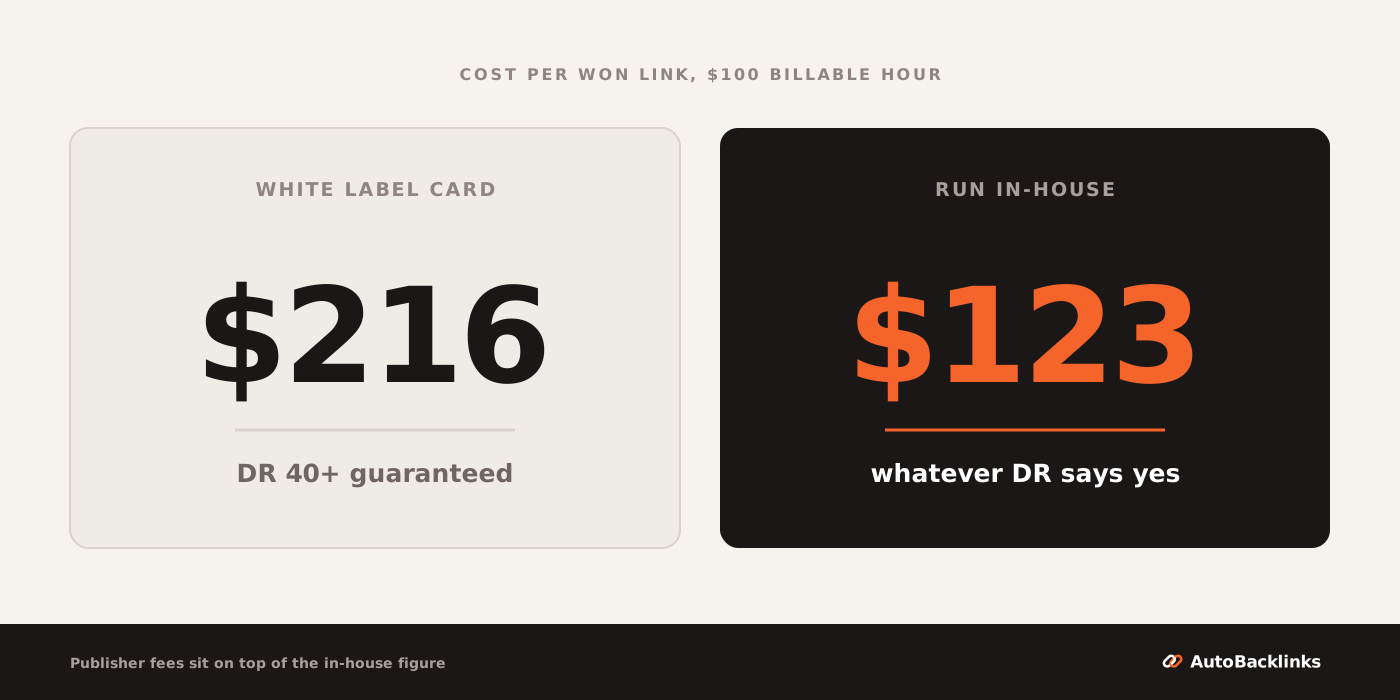
An agency can deliver a client's backlinks three ways: resell a full-service link building agency, buy placements on a white label rate card at about $216 for a DR 40+ link, or run the outreach in-house with software at roughly $123 a link once you price your own hours at $100 and win one link per six replies. In-house is the cheaper of the two priced routes until your billable hour passes about $179, and above that the rate card wins. The card also guarantees the authority band, which outreach never does, so the honest version of this decision has two axes rather than one.
I have spent ten years on both sides of this, buying links for clients and running the outreach that produces them. The pitch decks all cost the client's side. This page costs yours.
Link building for agencies: three delivery models
You have a client who needs links. Three models cover almost all of how that work gets done, and they differ in where the labor sits.
Resell a full-service link building agency. You hand the account to a specialist, they run strategy and delivery, you add a markup and keep the relationship. Your cost is their retail price.
Buy a white label rate card. You order individual placements from a wholesale supplier at a published per-link price, present them under your own brand, and keep strategy, reporting and client management. Your cost is the card.
Run it in-house with software. Your team does the prospecting and the outreach, with a tool handling discovery, filtering, contact finding and drafting. Your cost is a subscription plus your own hours.
Only two of those three can be priced per link, and the rest of this page does exactly that. The third is priced by engagement, which is the first thing worth knowing about it.
What a white label link building placement costs you
White label is the honest middle. A supplier sells you placements at wholesale, you present them under your brand, and your margin is whatever your retainer leaves above the card.
FATJOE publishes a six-tier ladder for blogger outreach, each tier a Domain Rating floor with a traffic band attached:
- DR 10+, 0 to 1,000 monthly visits: $72
- DR 20+, 0 to 5,000: $96
- DR 30+, 100 to 10,000: $120
- DR 40+, 500 to 20,000: $216
- DR 50+, 1,000 to 30,000: $336
- DR 60+, 1,000 to 60,000: $456
Those are the dollar figures its pricing page shows; the underlying offers are denominated in pounds, so a currency move shifts them. Not every supplier prices this way: Loganix sells from a self-serve directory it describes as unvetted, and uSERP sells retainers rather than placements, so neither drops into a per-link comparison without changing what you are buying. Rhino Rank prices the same category differently again: curated links and link insertions, the niche edits other vendors sell under that name, from $60, guest posts from $75, listicle placements from $135.
The suppliers do not hide who they are selling to. FATJOE's homepage carries two lines next to each other:
White label services designed for agencies to resell.
We offer reliable low prices that are designed with resellers in mind.
The same page counts 548 SEO agencies signed up in the last 30 days. That is why the pricing is per-placement rather than per-campaign: agencies buy in units.
What a card hides is what a DR tier hides. The DR 40+ tier costs $216 whether the site behind it carries 500 monthly visits or 20,000, which is FATJOE's own published band and a 40 times range in what your client actually receives for one price. I took that ladder apart in link building cost, and the short version is that the authority score does not price the audience.
Reselling a link building agency: the reseller math
Reselling is the model that sounds safest and prices worst. You buy at your supplier's retail and sell at a number the client agreed before you knew your cost.
It also cannot be priced per link, which is the tell. I counted the 50 firms on the first page of Clutch's link building directory, nine of which hold paid slots. Of those 50, 49 publish a minimum engagement size: 32 will not open below $1,000, 12 start at $5,000, four start at $10,000 and one starts at $50,000. Those are engagement floors, not monthly rates and not per-link prices, and none of them says what you get.
So reselling buys you a floor on spend rather than a floor on delivery. A $648 card order buys three DR 40+ placements. A $1,000 minimum buys a conversation.
There is a second cost that never appears on an invoice. When a specialist owns the strategy, the relationship and the reporting, the client eventually works out they could call that specialist directly. Outsourcing link building is a fair trade for a brand with no outreach function. It is thinner for an agency whose product is supposed to be the outreach function.
Agency link building in-house: what the software costs
The in-house model replaces the supplier with a subscription and your own team. The subscription part is small and exact, and it is the number most agencies have never worked out.
AutoBacklinks prices by workspace and credits, and the website limit is what makes it a per-client number:
- Starter, 2 client websites, 2,500 credits: $79 list, $49 a month under the current launch offer, so $24.50 per client
- Growth, 5 client websites, 7,500 credits: $179 a month, so $35.80 per client
- Scale, 25 client websites, 20,000 credits: $399 a month, so $15.96 per client
That is a step, not a slope. The sixth client pushes you from Growth to Scale and the per-client cost rises to $66.50 before it falls again, so the cheap end of this is 25 clients, not six.
Credits buy contacted prospects rather than links. At the per-prospect prices I worked out in link building cost, Growth's 7,500 credits fund about 1,000 fully worked prospects a month with two follow-ups each, which across five client sites is 200 prospects per client per month. Scale works out at about 107 per client, Starter at about 167.
Agency link building in practice: what 200 prospects turn into
So convert the attempts. On one documented campaign I sent 187 emails, 155 were opened, 32 replied and six bounced, a 17.1% reply rate. That is one campaign in one niche, and it sits well above the published benchmark: BuzzStream measured a 3.59% reply rate across more than 51 million outreach emails, which is the largest dataset anyone has put out and the number in our link building statistics round-up.
Replies are not links either, and I have never published a reply-to-link rate, so it stays a dial rather than a figure. At 200 prospects and a 17.1% reply rate, one client's month produces about 34 replies, and:
| Replies per won link | Links per client per month |
|---|---|
| 1 in 4 | 8.6 |
| 1 in 6 | 5.7 |
| 1 in 10 | 3.4 |
The hours are not a dial. Every send waits for your approval, and at the two minutes a prospect I budget in link building cost to read a draft and decide, 200 prospects costs 6.7 hours per client per month. You cannot cut that by working faster. You cut it by approving a shorter list, which moves the links down the table at the same time.
Two costs stay outside all of this. Where a site owner charges for the placement, you still pay them, and that direct fee is the floor under every other route to the same site. And where the site wants a guest post, somebody writes it. A blogger outreach card includes both the fee and the writer. Your software bill includes neither, so add them before you treat the gap as money saved.
The break-even hour: in-house link building against the card
Now the arithmetic that decides it. In-house costs $35.80 of software plus 6.7 hours; the card costs $216 a placement. Divide each by the links it produces and you get a cost per won link.
On the middle line of the table above, 5.7 links a month:
| Your hour, valued at | In-house cost per link |
|---|---|
| $50 | $65 |
| $100 | $123 |
| $149 | $181 |
Set those against the card and solve for the hour that makes them equal: $35.80 plus 6.7 hours, divided by 5.7 links, hits $216 at $179 an hour. In-house link building stays cheaper per link than a $216 placement until your own billable hour is worth about $179. Above that you are spending more sellable time than the supplier charges, and the card wins on price alone.
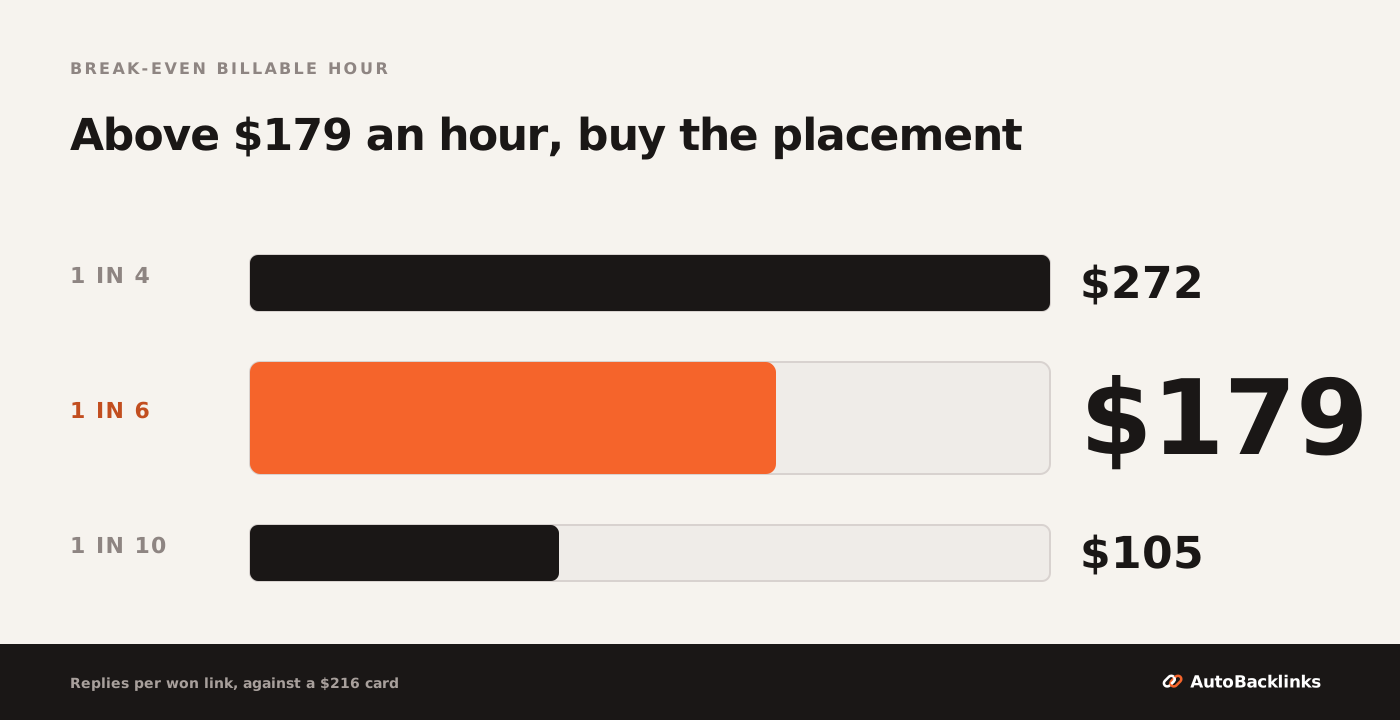
That break-even moves with your conversion rate. At one link per four replies it rises to $272 an hour; at one in ten it falls to $105 an hour.
Two things that number is not. The $179 is a billing rate, not a payroll cost: it only applies to an hour you could genuinely have sold to a client instead. If the hour belongs to a salaried person who would otherwise be idle, the real comparison is loaded cost and in-house wins far more easily. And it assumes no direct publisher fee, so every dollar a site owner charges you pulls the break-even down.
For scale, of the 46 firms in that Clutch sample that publish an hourly rate, 33 bill under $150 an hour and only 13 bill $150 or more. Those are link building specialists rather than generalist agencies, so read them as a range and not as your peers. If your own sellable hour sits in that lower band, you are below the middle break-even, and a card order is buying you certainty rather than cheaper links.
Time to first backlink under each link building model
Cost is half the decision and the calendar is the other half, which is where in-house looks worst.
A card order runs on a turnaround the supplier publishes next to the price: FATJOE quotes blogger outreach from 14 days, and the clock starts when you pay. Reselling runs on your supplier's onboarding, so add a scoping call and a contract on top.
In-house starts slower than either. A new sending mailbox needs warming before it carries campaign volume, our own plans pace a mailbox at about 30 campaign emails a day, and outreach replies arrive over weeks rather than on a turnaround. A client expecting links inside their first month is a client you should buy placements for while your own pipeline fills behind them.
How to run agency link building across several clients
The per-client cost only holds if the operation scales. Four things keep client accounts from bleeding into each other.
One workspace per client website. Prospects, campaigns and results stay scoped to the site they belong to, which is what makes the plan's website limit your real client limit.
One mailbox per client. Sending for every client from one domain ties their deliverability together and makes a single spam complaint everyone's problem. Growth allows five mailboxes against five websites for that reason.
A relevance gate set per client niche. A DR 70 site irrelevant to the client is a worse prospect than a DR 35 site squarely on topic, which is why relevance is scored per prospect before the SEO filters narrow the list. For software clients the gate has a measurable shape: link building for SaaS found the pitchable placements are about 8% of a typical profile. Running a campaign stage by stage keeps that order intact.
Approvals before spend. Credit spends and sends wait for a human. On a multi-client operation that is not a safety feature, it is what stops one bad prospect list going out under three client brands at once.
Credits bind before mailboxes do: Growth's 7,500 credits fund about 1,000 prospects a month while five mailboxes could carry roughly 4,500 sends, so list quality is the constraint rather than sending capacity. That is the right way round.
How to report link building to a client without naming your supplier
Reporting is where the white label model leaks, and the leak is attribution. The placement goes live on a site your supplier sourced, under an arrangement you did not make, and your client can see all of it with one backlink check.
So decide the disclosure question before the first report, not after a client asks. Three positions are defensible, and the one that is not is pretending the work is yours and being caught.
- Say nothing about sourcing, report only placements. Workable, and the most common. It breaks the moment a client asks "did you do this yourself" and you have to answer.
- Disclose that fulfilment is partnered, without naming the partner. Honest, keeps the supplier relationship private, and survives the question.
- Resell openly as a managed service. Simplest, and the only one that lets you put the supplier's guarantee in your own contract.
Whatever you report, report the placement, the page it sits on, the anchor, the date it went live and whether it is still live three months later. Do not report prospecting volume as an outcome: sends, opens and replies belong in your operations review, because a client who learns to read reply rate will ask you to tune it instead of the links.
Which link building model fits which agency
Two variables decide it: what an hour of your team is genuinely worth, and whether you can staff the niche at all. Client count barely moves it.
- Your sellable hour is under about $179. In-house. You are below the break-even on the middle conversion line, where 33 of the 46 rate-publishing firms in the Clutch sample also sit.
- Your sellable hour is $179 or more, or the team is already fully billed. White label. You are paying yourself more than the card costs.
- The client needs a guaranteed authority band, or links this month. White label, whatever your hourly rate says.
- A niche you cannot staff, in a language or vertical you do not have. Resell, and price the markup honestly.
- Campaign-led coverage rather than placements. Resell to a specialist: digital PR is a different product with a different cost structure, and it does not compare to a per-placement card in either direction.
The threshold is not a philosophy. Time what one client's outreach actually takes you for a month, value that hour at what you could have billed it for, and compare the result to $216 a link.
If you want to run the in-house number against your own client count, the plans and credit allowances are published per tier. The 7-day trial carries 120 credits and asks for a card up front, which is about 16 prospects taken all the way through: enough to time your own approval minutes, not enough to fill a client's month.
FAQ
What is white label link building?
White label link building is buying placements from a supplier at a wholesale price and presenting them to your client under your own brand. You keep the client relationship, the strategy and the reporting; the supplier does the prospecting and the outreach. Published cards run about $216 for a DR 40+ placement and $336 at DR 50+, so your margin is whatever your retainer leaves above that.
Is white label link building profitable for agencies?
It is profitable whenever your own hours are worth more than the card costs. Against a $216 DR 40+ placement, running the same work in-house costs about $65 a link if you value your hour at $50 and about $123 at $100, so the card only wins once your sellable hour passes roughly $179. It also wins whenever the client needs a guaranteed authority band, because outreach cannot promise one.
Should an agency build links in-house or outsource?
Measure first. Time the hours one client's outreach actually takes for a month, value them at what you could have billed instead, and divide by the links won. Of the 46 firms publishing an hourly rate on Clutch's link building directory, 33 bill under $150 an hour, which puts most agencies below the break-even and makes in-house the cheaper route on price.
How much should an agency charge for link building?
There is no single number, because a price means nothing without a basis: the DR band, the traffic, whether you are buying a placement or an attempt, and who delivers it. Price the retainer above your cost of goods plus your hours at your own billing rate. For reference, 32 of the 50 firms on Clutch's link building directory will not open an engagement below $1,000.
How many clients can one person run link building for?
Bounded by the plan's website limit first and your approval time second. A plan covering five client websites and 7,500 credits funds about 200 fully worked prospects per client per month, and at two minutes of approval per prospect that is 6.7 hours per client, or roughly 34 hours a month across five. One operator can carry that if discovery, filtering, contact finding and drafting are automated, and far fewer clients if those stages are done by hand.
About Rachid Idali
Founder & SEO Strategist
Rachid Idali has spent 10 years in SEO, running multi-six-figure SEO and link-building budgets across content, digital PR, and outreach programs. He writes about practical systems for finding relevant prospects, earning links, and turning SEO operations into repeatable pipelines.
More from Rachid Idali