

SaaS Link Building in 2026: Where the Links Come From

by Rachid Idali
Last Updated: October 23, 2026
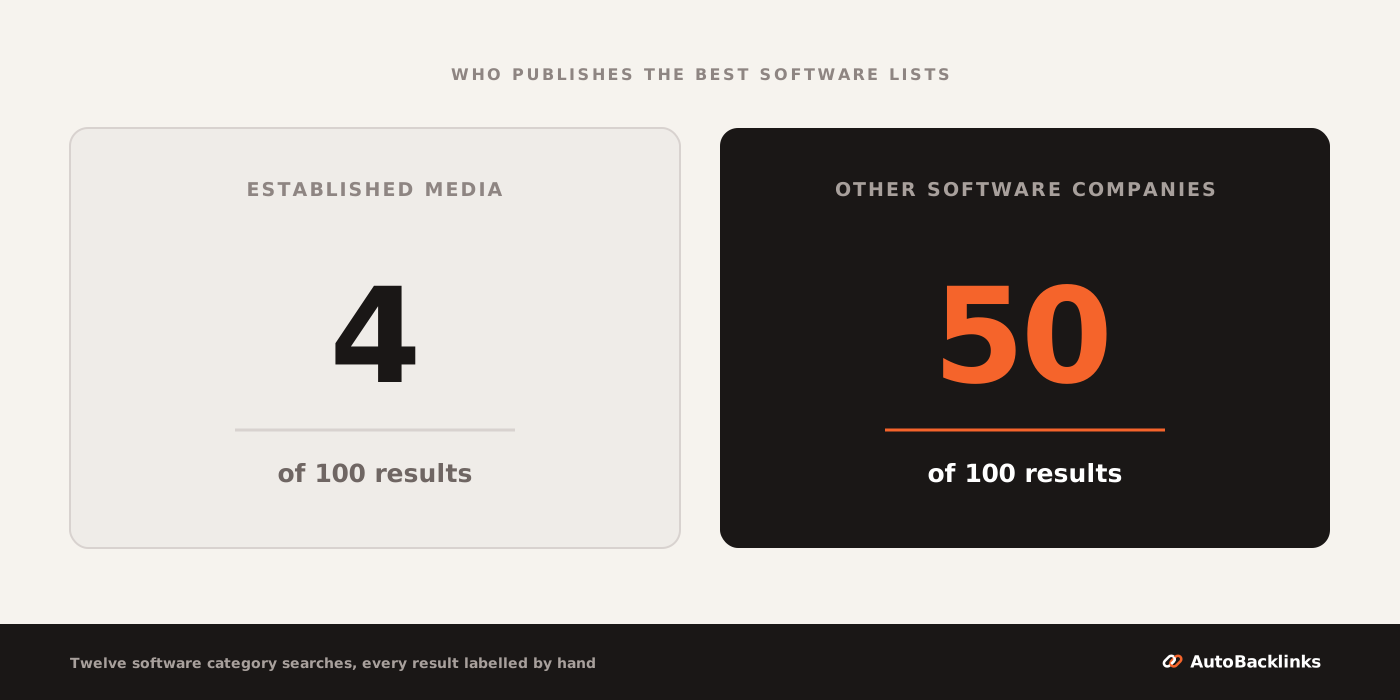
The best-software lists a SaaS company needs to be listed in are written by other software companies. I labelled 100 ranking results across twelve software category searches: 50 came from a company that sells software, and 4 came from an established publication. SaaS link building is peer outreach, not press.
That one number changes the job. If you believed the standard advice, you commissioned a research report and hired someone to pitch journalists.
The placements that actually rank for your category term are sitting on a competitor's blog, or on the blog of a company that sells next to you. Those people answer email.
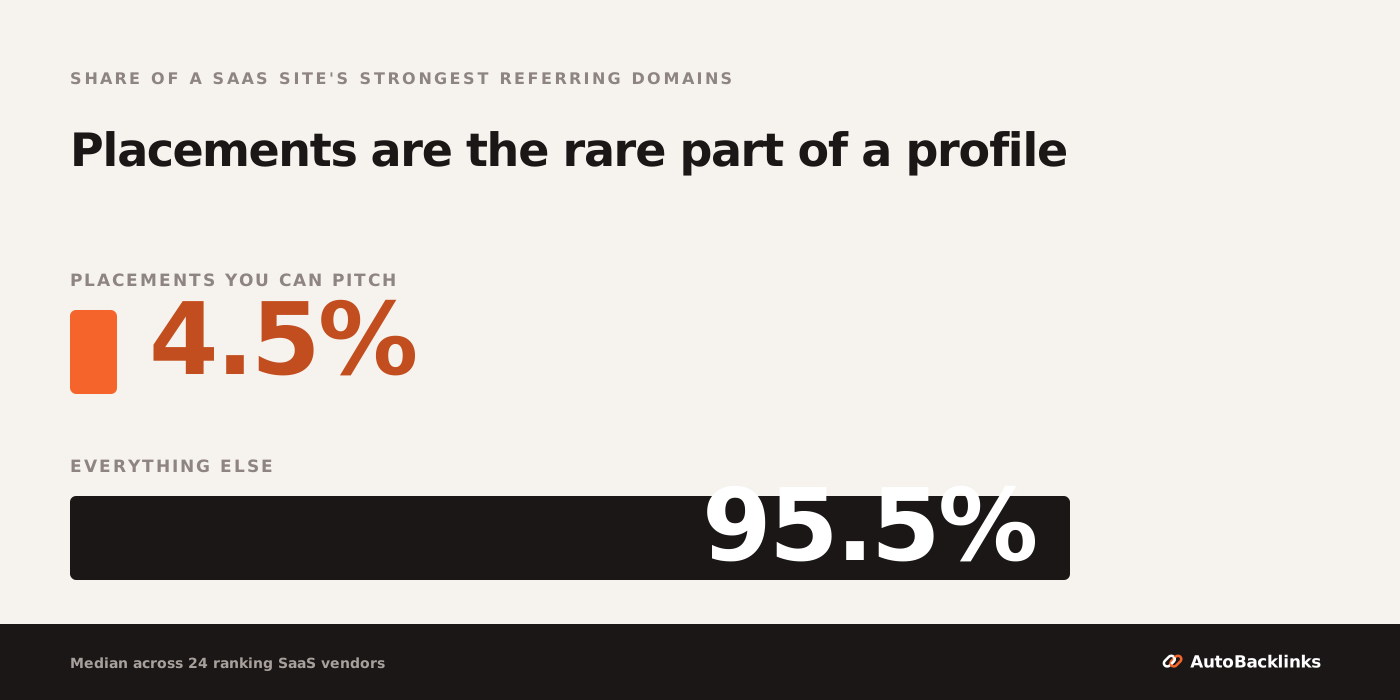
Here is the second number, and it is the one that should change your reporting. In the strongest thousand referring domains of 24 SaaS companies that rank for their own category term, the placements worth having are a median of 4.5%. Everything else in the profile is something you would never have pitched for.
Why SaaS link building is different from other link building
SaaS link building is the work of earning links to a software product's commercial pages, and it differs from link building anywhere else because the highest-intent search in your category resolves to a list of tools rather than to any one product page.
A SaaS category keyword is answered by a list, not by a product.
Search best help desk software and Google does not hand you a help desk. It hands you a page of articles that rank help desks. Your product page is not competing in that search. It is a candidate for inclusion in the pages that are.
That is the structural difference. In most industries the money page can rank on its own. In SaaS the money pages are comparison pages, alternatives pages, integration directories and free tools, and the highest-intent search in your category resolves to a list you have to be named in.
This is also why domain-level thinking fails here faster than elsewhere. When I measured whether link building still works, links pointing at the specific ranking page tracked position on 81 of 98 commercial queries while links pointing at the whole domain tracked nothing at all. A stronger domain does not get you onto a list. Being relevant to the list does.
SaaS link building and AI search visibility
The same measurement answers a question people usually treat as separate.
When an assistant answers "what is the best help desk software", it is summarising documents. The documents available to summarise in a software category are the same best-of listicles and alternatives pages that rank, and half of those are published by other software companies.
So getting listed is the AI-visibility work. There is no separate channel to buy: the page that an assistant reads to build its answer is the page you were already trying to get named on, and the link is the by-product rather than the point.
That also changes what a miss costs. Being absent from a roundup used to mean losing the clicks that page sends. Now it means being absent from the source material for every generated answer that page feeds, which is a wider loss than the referral traffic.
Who publishes the best SaaS software listicles
I took twelve software category searches, pulled the organic results for each, and labelled every result by hand according to who published it.
The categories: applicant tracking, cold email, CRM, esignature, form builder, help desk, knowledge base, landing page builder, live chat, project management, social media management, product analytics. Google returned between seven and nine organic results per search, 100 in all, across 85 unique domains.
| Who published it | Results | Share |
|---|---|---|
| A company that sells software | 50 | 50% |
| A software review or comparison publisher | 20 | 20% |
| An agency, consultancy or personal blog | 15 | 15% |
| Reddit, Quora or YouTube | 11 | 11% |
| An established news or trade publication | 4 | 4% |
A software company holds the first position on 6 of the twelve keywords.
Read that table as a prospect list and the strategy writes itself. Half your targets are companies with a content team, a blog, and a commercial reason to keep their roundup current. One in five is a review publisher with a submission process. One in nine is a community you cannot pitch at all.
And 4% is press.
That review-publisher fifth is where G2 and Capterra sit, and they work differently from everything else on this page. You do not pitch them. You claim a vendor profile, complete it, and collect reviews, which is a listing job rather than an outreach job and belongs to whoever owns your review programme. Treat them as a one-time setup, not a channel, and note that a large part of this segment runs on affiliate commissions, which is relevant later when the question is whether a placement was paid for.
Two honest qualifications before you act on that table.
Not every vendor result is a roundup. About 7 of the 50 are product pages, definition pages or how-to-choose guides with no slot to be added to: an analytics vendor ranking its own product page, a knowledge base tool ranking a buyer's guide. The publisher count stands. The pitchable vendor results are closer to 43 than 50.
The publishers are not neutral, and it matters less than it sounds. Most of them rank a roundup in a category they only partly compete in: a demo tool ranking applicant tracking systems, a document tool ranking CRMs, a hosting company ranking cold email software. Adjacent, not rival. Those are the ones who say yes.
Where ranking SaaS sites actually get their backlinks
Knowing who publishes the lists is half of it. The other half is how much of a real SaaS backlink profile those placements account for, because that sets what a good month looks like.
So in October 2026 I took 24 of the vendors that ranked in those twelve searches and pulled the thousand highest-ranked referring domains for each from DataForSEO, one link per referring domain, live links only. Each referring page was classified by its URL and title into one type. Where this article cites a spam score, it is DataForSEO's, on a 0 to 100 scale.
Three things about that sample before the numbers, because they change what it can be used for.
- It is the top slice, not the whole profile. A thousand domains is 96.6% of goodday.work's profile and 1.3% of brevo.com's. Per-vendor shares are shares of each vendor's strongest thousand, which is the part anyone would want to copy, and they are not estimates of a whole backlink profile.
- Template networks are counted once. Where one URL path and page title turned up on more than two different hostnames for the same vendor, I counted that network as a single observation. Without that rule one spam blast reads as 872 separate findings. More on this below, because it is the most useful thing in the dataset.
- The classifier reads URLs and titles, not pages. It is a signature match, so a reviewer who did not write it and did not see its code re-read a seeded random 60 of its decisions. They agreed with 50. Treat every share below as approximate, and the gap between a big category and a small one as solid.
That leaves 14,387 English referring pages, from 24,000 pulled and 18,497 before the template networks were collapsed.
This does not match my own earlier count, and the gap is worth naming. In how to get backlinks roundups and alternatives pages came to 12.4% of a profile across twelve SaaS sites, corrected by hand to 9 or 10. Three things move the number down here: that study dropped domains scoring 30 or higher for spam and this one does not, this one collapses template networks to one observation and that one did not, and the rule here requires a product noun rather than a bare "best". Read the earlier figure as the looser classifier and this one as the tighter.
| Page type | Share of referring pages |
|---|---|
| Article-shaped page | 49.8% |
| Auto-generated company profile | 16.5% |
| Could not be classified | 9.7% |
| Boilerplate (privacy, cookie, terms) | 6.4% |
| Best-of listicle | 5.4% |
| Homepage root | 4.8% |
| Alternatives or comparison page | 2.3% |
| News or press | 1.1% |
| Jobs, directories, social | 1.1% |
| Integration or partner page | 1.0% |
| Tag archive | 1.0% |
| Link-farm page | 0.8% |
Per vendor, the medians are what you should plan against:
- Best-of listicles: 2.5% of referring domains
- Alternatives and comparison pages: 1.7%
- The two together: 4.5%, ranging from 1.1% to 30.6% across the 24
- Integration and partner pages: 0.8%
Those are three separate medians, so the first two do not add up to the third. Pooled across all 14,387 pages rather than per vendor, listicles and alternatives pages come to 7.8%, or one page in 13. The per-vendor median is the number to plan a campaign against; the pooled rate is the number to describe the dataset.
One caveat on that split. The line between a best-of listicle and an alternatives page is soft, and the reviewer above found the classifier moving pages across it in both directions. The combined 4.5% held up in their check; the 2.5 and the 1.7 are the softer halves of it.
The obvious objection to a 4.5% headline is the 49.8% sitting above it, so here is what is in that bucket. Article-shaped pages are ordinary posts that mention the product in passing: a marketing blog citing a statistic, a how-to that names the tool it used, a roundup of tips rather than of products. Some of them are guest posts someone placed and some are link insertions someone paid for, and the honest position is that a classifier reading URLs and titles cannot tell those apart from a mention a writer added unprompted. That is why this article counts placements rather than mentions. If you want the acquisition routes behind the whole profile ranked by yield, how to get backlinks measures them across a wider sample.
That also sets a sane target. On the median profile the whole pitchable layer is about thirty domains built up over the life of the company, and on the best of the 24 it is 183, which is why a campaign that lands four good ones in a quarter is working rather than failing.
The SaaS backlinks that look good and do nothing
Here is the finding I did not expect, and the reason the counting rule above exists.
Nine of the 24 vendors carry a link network built from one page copied across dozens or hundreds of hostnames. On seven of them it supplies between 18% and 89% of their strongest thousand referring domains.
Counted by grouping every referring page by its exact path and title, then keeping the groups served by 20 or more different hostnames.
| Vendor | Domains from one network | Share of its top thousand |
|---|---|---|
| blueink.com | 872 | 89.2% |
| clustdoc.com | 850 | 88.0% |
| alloysoftware.com | 656 | 67.6% |
| heyflow.com | 369 | 55.6% |
| proprofschat.com | 496 | 54.0% |
| revechat.com | 176 | 19.6% |
| niftypm.com | 164 | 18.5% |
Two more carry a smaller one: fullstory.com at 62 domains and goodday.work at 20.
Every one of these is the same page published on hundreds of throwaway hostnames. One path, one title, 872 hostnames: backlinksubmitter.online, webtrafficseo.store, cheapbacklink.space and several hundred more, all serving a page titled Premium SEO Link Building Solutions for Increasing Website Authority....
Nobody at blueink.com earned 872 referring domains. Somebody ran one blast, or bought one package.
Seven is a floor rather than a count, because the same reviewer found the classifier filing a couple of link-selling pages as ordinary articles. If anything there is more of this in these profiles than the table shows.
There is a second layer below that one. Auto-generated company profiles are 16.5% of the referring pages: Is PandaDoc Down?, Heap Review 2026, Amplitude free tier 2026, scraped tool directories, tech-stack databases, coupon pages. A crawler made every one of them.
They are not placements and they are not a problem. They are just not evidence of anything.
Two numbers people reach for do not survive this sample. Dofollow share does not separate good pages from bad: best-of listicles are 79.8% dofollow and auto-generated profiles are 93.4%, because real publishers hedge commercial roundups and scrapers have no reason to hedge anything. And spam score does not flatter the placements either, with 10.3% of best-of listicles scoring above 30 against 6.4% of all pages, which is what you would expect when a slice of the roundup market is paid.
The spread between vendors matters more than any median here. One project management tool has 30.6% of its top thousand in pitchable placements. An esignature tool has 2.9%, and the largest single thing in its profile is that blast. Both rank in the first page of results for their category term.
One caution on that spread, because it cuts against the easy reading. The vendors with the smallest profiles show the highest pitchable shares, and the two track each other closely across the 24. A fixed cap of a thousand domains reaches the whole of a small profile and only the top slice of a large one, so some of this spread is the sampling rather than the strategy.
What survives that caution is the composition point, not a claim that smaller profiles are better built.
SaaS page types that earn links
Work backwards from the measured shares and the list of things worth building gets short.
Best-of listicles you are included in. 5.4% of referring pages, the largest genuinely pitchable type. This is the one to spend outreach on, for the reason the first section gave: half of them are published by companies that will read your email.
Comparison and alternatives pages. 2.3%, and the cleanest of the three categories I measured spam on, at 3.6% above the threshold against 6.4% for all pages. These earn links both ways. Yours attracts them, and getting named on someone else's is the second most common pitchable placement there is.
Integration and partner directories. A median of 0.8% per vendor. Build integrations because customers need them. The listing is a real link and it is permanent, but it is not a channel you can scale.
Free tools, templates and calculators. These sit inside the article-shaped bucket, so I cannot give you a clean share for them. The standard advice treats them as the centrepiece. Nothing in this data supports that weighting over getting listed.
Original data. Same caveat. The reason to publish it is citations and relevance, not referring-domain count, and it is the slowest of everything on this list.
Notice what is missing. Press and news pages are 1.1% of 14,387 referring pages.
A SaaS link building campaign you can copy
Six steps, in order. This is the shape of a link building campaign applied to a software category.
-
Pick one money page. The comparison page, the alternatives page, or the category landing page. One, not the homepage.
-
Take your category keyword and list who ranks for it. Not to beat them, to inventory them. Every roundup in those results is a page with a slot. Note which are vendor blogs, which are review publishers, and which are communities you should skip.
-
Widen the pool with competitor backlink scans. Export the referring domains of two or three rivals from whatever backlink index you already pay for, or from our competitor backlinks analyzer, deduplicate by template, then throw away everything that is not a listicle or an alternatives page. On these profiles that is roughly 95% of the rows. The remainder is pre-qualified: those pages already link to a tool like yours.
-
Qualify on topical fit before authority. A page with a Domain Rating (DR) of 80 about enterprise IT in general will not add your form builder. A DR 35 page titled
best form builders for agencieswill. Neither study here measures reply rate by topical fit, so take this as the argument it is rather than a measurement. -
Pitch the page, not the site. Name the roundup. Say which position your product belongs in and why, in one sentence, with the specific gap their current list has. A pitch that could have been sent to anyone gets the reply rate of a pitch sent to anyone. What that looks like:
Your "11 best form builders for agencies" piece ranks third for that term and every tool on it is priced per seat. Heyflow is priced per flow, which is the model agencies running twenty client funnels actually ask for, so the list currently has no entry for that buyer. Happy to send a two-line description and a screenshot if it is useful.
-
Follow up twice, roughly four and ten days after the first email, then stop. I have no measurement on the right number of follow-ups. Two is where I stop because the third reads as pressure. What is measured is the reply rate a relevant list produces: on the campaign we published, 187 sends produced 32 replies, a 17.1% reply rate, and the thing that produced it was prospecting rather than copy.
At those rates the arithmetic is unforgiving and worth doing before you start. A list of 200 qualified roundups produces something like 34 replies, and replies are not placements: editors say no, go quiet, or ask for a fee. Four placements landed in a quarter off a list that size is a campaign working as designed, which is the point of the 4.5% measurement above. Sizing the pool properly is covered stage by stage in how to run a link building campaign.
Steps 2 through 5 are what AutoBacklinks runs. It scans for the pages that already rank and already link out in your category, scores each on topical fit rather than authority alone, finds a verified contact, and writes the pitch from the prospect's own page so the roundup gets named. You approve before anything sends.
How to measure SaaS link building
The dataset above says the standard report is counting the wrong thing, so here is what to count instead.
Count placements, not referring domains. The number that moves your category ranking is how many pages that rank for your category term now name your product. On the median profile that layer is about thirty domains, so a quarter that adds four of them is a real quarter. Referring domains in total will move faster than that and tell you almost nothing.
Deduplicate by template before you count anything. Group referring pages by path and title, and treat a group served by dozens of hostnames as one. Do it to your own profile as well as a competitor's, because seven of the 24 vendors here would otherwise report a number inflated several times over.
Track where the link sits, not the strength of the domain. A placement on a page that ranks for your category term does two jobs. A stronger domain that ranks for nothing in your category does one, and not the one you were buying.
Two metrics to stop reporting, because this sample kills both. Dofollow share does not separate good pages from bad: listicles are 79.8% dofollow and scraped profiles 93.4%. Spam score does not either: 10.3% of best-of listicles sit above 30, against 6.4% of all pages.
What SaaS link building costs and when a SaaS link building agency is worth it
Placement prices do not change because the buyer sells software. The numbers below are the same ones that apply to any niche.
When I priced ten listings on one guest-post marketplace the median was $89.80, and FATJOE's published card for a DR 40+ placement works out at $216. Those two numbers are not comparable until you fix the DR band, the traffic behind it, who you are buying from, and whether you are paying per placement or per attempt, which is what link building cost works through.
Running outreach yourself prices differently, because you pay per attempt rather than per placement. AutoBacklinks starts at $49 a month for a first-time account under the current launch offer, against a $79 list price, which covers the discovery, contact lookup and email generation for a small campaign.
An agency does not have access you lack.
The people publishing these roundups are software marketers who answer their own email, and nothing about them requires a relationship you cannot build. What an agency buys is time and a process already running, which is a real thing to buy. Link building for agencies works through the economics from the other side, and best link building services prices ten of them per link.
Four questions to put to a SaaS link building agency before you sign, all of which this measurement equips you to judge:
- Which publishers, specifically? The answer should name software companies in or next to your category. If it names magazines, they are selling you the 4%.
- Show me a placement on a page that currently ranks for my category term. Not a link, a placement, on a page you can search for and find.
- How do you count referring domains when one template covers hundreds of hosts? If they have no answer, their reporting is inflated and they do not know it.
- Is the placement paid, and is it marked? Asked before the work, not after.
What Google's link spam policy says about paid SaaS placements
Some roundup owners will ask for money. Many of the review publishers in that 20% run on affiliate commissions, and some vendor blogs sell placement outright.
Google's spam policies name both. The link spam list covers "Exchanging money for links, or posts that contain links" and "Exchanging goods or services for links".
The policy also says what makes it acceptable. Buying and selling links is "a normal part of the economy of the web for advertising and sponsorship purposes", and it is "not a violation of our policies to have such links as long as they are qualified with a rel="nofollow" or rel="sponsored" attribute value to the <a> tag".
So a paid placement is not automatically a problem. An unmarked paid placement is. This matters more in SaaS than elsewhere, because affiliate roundups are a large share of the review-publisher segment, and it is part of why listicle dofollow share sits at 79.8% rather than higher.
FAQ
What is SaaS link building?
SaaS link building is the work of earning links to a software product's commercial pages: the category page, the comparison page, the alternatives page. What makes it different from link building in other industries is that the highest-intent search in a software category resolves to a list of tools rather than to any one product page, so the central job is getting included in the pages that rank, not outranking them directly.
How do SaaS companies get backlinks?
Mostly from ordinary article-shaped pages, but the placements that match category search intent are much narrower than that. Across the strongest thousand referring domains of 24 ranking SaaS vendors, measured in October 2026, best-of listicles were 5.4% of classified pages and alternatives or comparison pages were 2.3%. Per vendor those two together have a median share of 4.5%, ranging from 1.1% to 30.6%. Most of the rest is article mentions, auto-generated company profiles and boilerplate.
Who writes the best software roundups I need to be listed in?
Other software companies, in about half of cases. Across 100 ranking results from twelve software category searches, 50 were published by a company that sells software, 20 by a review or comparison publisher, 15 by an agency or personal blog, 11 were Reddit, Quora or YouTube, and 4 came from an established publication. A software company held the top position on 6 of the twelve keywords.
How much does SaaS link building cost?
The same as link building anywhere, because placements are priced by the publisher and not by your business model. The median of ten listings I priced on one guest-post marketplace was $89.80, and FATJOE's published card for a DR 40+ placement works out at $216. Running the outreach yourself shifts the cost from per placement to per attempt. The full breakdown is in link building cost.
How long does SaaS link building take?
Judge it by the quarter, not the month. This measurement counts what sits in a backlink profile rather than how long any of it took, so it supports no time-to-ranking figure. What it does show is that the pitchable layer is small and accumulates over the life of a company: about thirty placements on the median profile and 183 on the best of the 24 measured. Against that, four new placements in a quarter is a campaign working rather than a campaign stalling.
Do I need a SaaS link building agency?
Only to buy time. The measurement in this article says the people who publish the placements you want are software marketers at other companies, not gatekeepers at publications, so an agency is not selling you access you could not get. It is selling you a process that is already running and hours you do not have to spend. That is worth paying for when your team has neither, and worth skipping when it has one of them.
About Rachid Idali
Founder & SEO Strategist
Rachid Idali has spent 10 years in SEO, running multi-six-figure SEO and link-building budgets across content, digital PR, and outreach programs. He writes about practical systems for finding relevant prospects, earning links, and turning SEO operations into repeatable pipelines.
More from Rachid Idali