

50 Link Building Statistics for 2026 (Measured, Not Copied)

by Rachid Idali
Last Updated: October 21, 2026
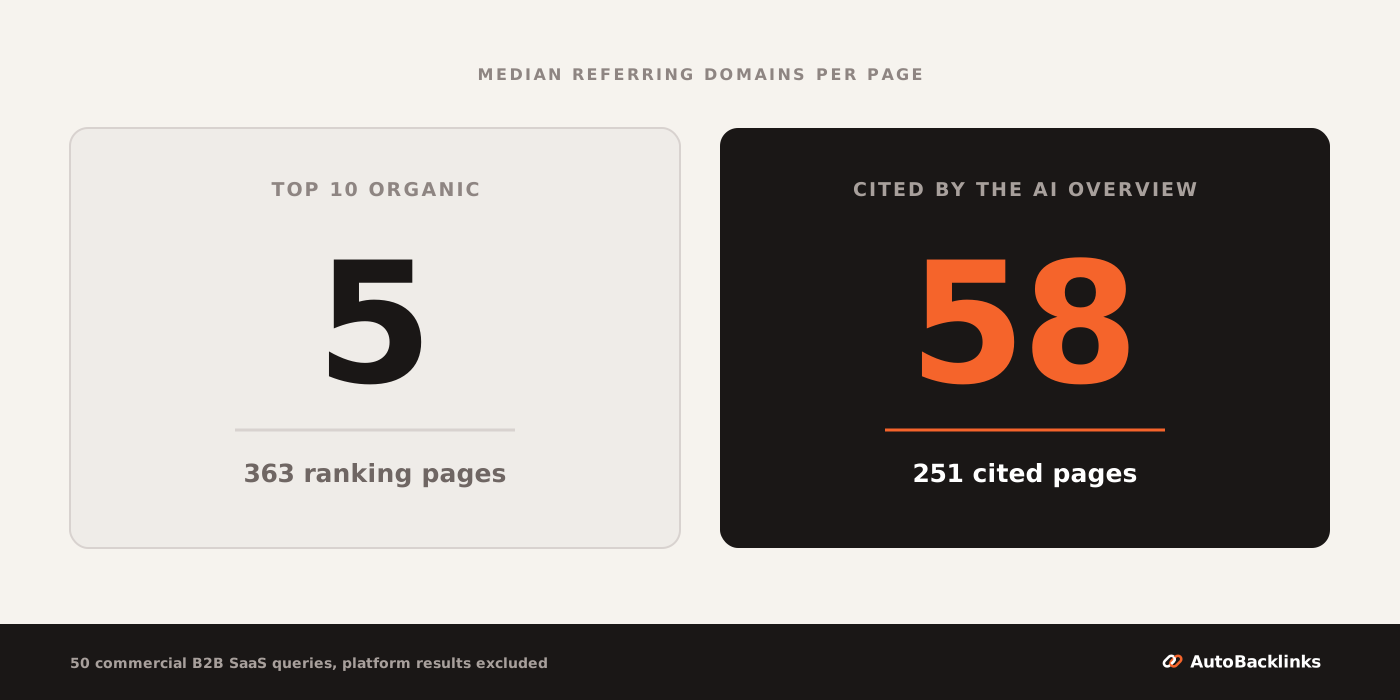
When Google answers a commercial query with an AI Overview, the pages it cites carry a median of 58 referring domains, once platform results like YouTube and Reddit are excluded from both sides. The other pages ranking underneath that answer carry 5. That is the clearest result in 50 link building statistics measured for this page, 37 of them from our own data, with every third-party figure carrying its publisher, its sample and its real year.
The most-quoted numbers in this field are four to ten years old and get re-stamped every January with a new year in the title. So I measured the ones that matter and dated the ones I could not.
The ten link building statistics that matter most
- Pages cited in Google's AI Overviews carried a median of 58 referring domains, against 5 for the pages ranking in the top ten organic results on the same 50 commercial queries, measured in October 2026 with platform domains excluded.
- On 27 of 49 of those queries, not one of the ten organic URLs was cited in the AI Overview above them.
- Across 99 commercial Google queries, the median page in positions 1 to 3 carried 11 referring domains to the ranking URL, and the median page at 11 to 20 carried 2.
- 32.6% of page-one results across those 99 queries had zero links pointing at the ranking page itself.
- A bought backlink costs $70 to $456, with the median of ten live marketplace listings at $89.80.
- The widely quoted "$509 average cost of a link" is not a price paid. It is what 412 survey respondents said they would consider acceptable; the same kind of survey measuring what was actually paid returned $83.
- Link builders reply at 3.59% across more than 51 million outreach emails, the largest published dataset. One campaign of ours ran at 17.1% across 187 sends.
- Across 15 ranking sites and 180 site-months, 45% of months ended with more referring domains lost than gained.
rel="sponsored"appears on 0.030% of 108,383,205 referring pages, so its absence tells you nothing about whether money changed hands.- US Google Ads search volume fell for all ten link building terms measured, a median of 58.5% year over year, against a median of -3.35% for ten unrelated control terms.
How these link building statistics were measured
Three things to know before you quote anything here.
The samples are named and small rather than large and vague. Where a statistic says "99 commercial queries" or "15 sites", that is the entire population it describes. None of our figures are surveys of what practitioners believe.
Two studies were run fresh for this page. One pulled Google results for 50 commercial B2B SaaS queries, collected every source cited in the AI Overview, and counted referring domains for all 728 unique URLs involved. The other compared Google Ads search volume for ten link building terms over January to September 2026 against the same nine months of 2025, with ten unrelated commercial terms as a control.
Third-party numbers carry their real date, not the date on the page. A 2019 survey is still useful. A 2019 survey presented as a 2026 fact is not, and that turns out to cover most of this category.
Every search result and backlink figure here is US, English, desktop, pulled through DataForSEO. Where a figure says platform domains are excluded, that means exactly these eleven: youtube.com, reddit.com, wikipedia.org, quora.com, facebook.com, linkedin.com, x.com, twitter.com, amazon.com, yelp.com and google.com. Their link counts describe the platform rather than the page, and a different exclusion list moves the headline figure, so it is published here rather than left implied.
Do backlinks still affect rankings in 2026?
Yes, when the links point at the page rather than the domain. That distinction is the whole answer.
- Across 99 commercial Google queries measured in October 2026, referring domains to the ranking URL correlated with a better position on 81 of 98 queries. Referring domains to the whole domain did so on 47 of 99, which is a coin flip. The median correlation is -0.196, weak in size at roughly 4% of the variation in position, but consistent in direction. The method is in does link building still work.
- Across those same 99 queries, the median page in positions 1 to 3 carried 11 referring domains to the URL, the median page at 4 to 10 carried 5, and the median page at 11 to 20 carried 2, excluding platform domains.
- 32.6% of page-one results across those queries had zero links pointing at the page itself, 53.8% had fewer than ten, and 72.2% had fewer than fifty.
- On those 99 queries, the single most-linked page on page one finished in the top three 48 times, 49%, against the 30% you would expect if link counts meant nothing.
- Page-level referring domains climb steeply with DataForSEO keyword difficulty, across 125 commercial SaaS keywords. Each row is the median keyword's figure, and each keyword's figure is the average across its ten ranking pages, so these run above what a median page carries:
| Keyword difficulty | Median keyword's average referring domains |
|---|---|
| 0 to 10 | 23 |
| 11 to 30 | 80 |
| 31 to 50 | 323 |
| 51 to 70 | 878 |
| Above 70 | 1,308 |
- Ahrefs put referring domains at a 0.255 Spearman correlation with rankings, backlinks at 0.248 and Domain Rating at 0.131, across the million highest-volume US keywords, in links matter less but still matter, published January 2025. The same study puts the referring-domains correlation at 0.33 on local queries.
- In that same Ahrefs study, link correlations on a matched query set fell from 0.27 and 0.29 in 2019 to between 0.22 and 0.24. That publisher-stated decline is the best evidence anyone has published for "links matter less", and it is a measurement rather than a quote.
- The only published intervention in this field: Ahrefs disavowed all 3,476 links to three of its own blog posts for four weeks. Two of the three lost traffic, 18% and 13.3%, and recovered when the file came off. Three pages with one null result is not proof, but it is the only experiment anyone has run.
- Semrush put referring domains at 0.18 across 16,298 English keywords and 300,000 positions, published January 2024. That study does not name its correlation method, so it is not strictly comparable with the Spearman figures above.
- Backlinko found the first result carries about 3.8 times the backlinks of positions 2 to 10, across 11.8 million results, excluding pages with no backlinks. The page carries a recent update stamp, but the study names Alexa as a data partner, a service shut down in 2022, so the measurement is at least four years old.
The spread matters more than the median.
A third of top-three pages have no links at all and a quarter have over a hundred, so the only number worth acting on is the one on the pages currently above you.
Do backlinks matter for AI search and AI Overviews?
They matter more there, not less. Fifty commercial B2B SaaS queries, sampled across the full difficulty range and pulled in October 2026, every source cited in the AI Overview recorded, referring domains counted for every cited page and every ranking page.
- 49 of the 50 queries returned an AI Overview above the organic results. All 50 are software-category searches, so read the coverage rate as a property of that market rather than of commercial search generally.
- Those 49 answers made 375 citations, a median of 8 sources each, drawn from 185 distinct domains, 154 of which were cited exactly once.
- Only 19.2% of those 375 citations pointed at a URL that also ranked in the top ten organic positions for the same query.
- 33.3% came from a domain that appeared in the top ten, so even counting generously, two citations in three came from outside page one.
- On 27 of the 49 queries, not one of the ten organic URLs was cited at all. The first organic result was cited on 12 of 49.
- 33.1% of all citations went to platform domains, with YouTube alone taking 89 of 375.
- Across those 50 queries, pages cited in the AI Overview carried a median of 58 referring domains to the cited URL, against 5 for the pages in the top ten organic results, with platform domains excluded from both sides. The cited median was higher on 38 of the 48 queries where both sides had at least one non-platform page, lower on 8, with 2 ties; a two-sided sign test on the 46 that differ gives p = 0.0000092. The two groups overlap on 62 pages that are both cited and ranking, and comparing only the disjoint sets the medians are 49 against 4.
- Counting every result including platforms, those same medians are 9 against 4, and the cited median is higher on 30 of 48 queries. The direction holds on both bases; the size of the gap depends heavily on whether YouTube and Reddit are in the count.
- Of the cited pages with platforms excluded, 6.4% had no referring domains at all, against 22.3% of the organic results beneath them.
Statistic 13 is a replication rather than a discovery, and should be read that way. Published measurements of how often a cited page also ranks run from about 17% at BrightEdge to 38% at Ahrefs. My 19.2% lands inside that band on a new sample. Read it as a moving target rather than a stable quantity, though: Ahrefs' own AI Overview series fell from 76% to 38% in eight months, so a measurement seven months later is as likely to be a continuation of that slide as a confirmation. For AI assistants rather than AI Overviews the overlap is lower again, at 12% across 15,000 long-tail queries.
The 58-versus-5 gap is the one I have not found published anywhere. The citation layer is not a separate game played without links.
One confound I cannot close with this data, and it matters. The study carries no domain-level authority score, so page links may be standing in for site size. Pages from domains cited more than once carry a median of 107 referring domains against 26 for domains cited once, and when I restrict the comparison to the 34 domains that appear both as a citation and as an ordinary ranking result, the cited page out-links its own non-cited pages on only 21 of 33, at p = 0.16.
Hold the site constant and most of the effect goes with it. So read the gap as a statement about which sites get cited at least as much as which pages, and treat it as a reason to care about links rather than proof that links buy citations.
Be careful with the direction of that arrow. Ahrefs' study of 75,000 brands found the strongest correlate of AI Overview visibility was brand mentions at 0.664, against 0.218 for backlink count. Pages that get cited are pages the web already talks about, and links are one of the ways you can tell. Which tactics survive measurement is covered in link building for AI search.
How much does a backlink cost in 2026?
Between $70 and $456 for a placement, and the spread is wider than that once you price it against anything real.
- One backlink costs $70 to $456 in 2026 if you are buying a placement. The floor is one live marketplace listing and the ceiling one published agency rate card for a DR 60 site, so read it as an observed span rather than a distribution. That rate card runs $216 at DR 40+, $336 at DR 50+ and $456 at DR 60+. The basis is in link building cost.
- Across ten live marketplace listings priced on one screen, the range was $70.00 to $176.51, median $89.80.
- Priced against the organic traffic each of those ten listings reports, reaching 1,000 monthly visitors cost $0.43 to $179.00, a spread of more than 400 times. Domain Rating explained almost none of it.
- PressWhizz's pricing report, built on 22,703 completed orders, puts the average guest post at $164 and the average link insertion at $112, rising to $252 for casino placements and $221 for finance.
- Digital PR costs $367 to $1,200 per earned link across the ten agencies that publish both a fee and a link count, measured in best digital PR agencies.
- BuzzStream's study of 257,267 guest post marketplace sites rated 1.37% of them High Quality or Top Tier. The inventory most of this spending buys is poor.
- The widely quoted $508.95 average cost of a link is not an observed price. Editorial.Link's 2026 survey asked 412 respondents what they would consider acceptable to pay, which is willingness to pay rather than a transaction record.
- Authority Hacker's 2022 survey of 755 link builders put the average actually paid per link at $83. Set against PressWhizz's 22,703 completed orders at $164, that 2022 figure looks low for 2026, and four years of price movement is part of the gap.
$83 and $164 are what people paid. $509 is what they said they would accept. Only the first two are prices.
The vertical premium in statistic 23 is the one that catches budgets: a finance buyer who plans against the $89.80 median will be out by more than double. No first-party return-on-investment figure appears on this page because we have not measured one, and the "78.1% report positive ROI" in circulation is self-reported survey data.
What is a normal link building outreach reply rate?
Between 3.59% and 17.1%, and the distance between those two numbers is the list rather than the email.
- BuzzStream's analysis of more than 51 million outreach emails puts the reply rate for link builders at 3.59%, roughly one reply in 28. The page was last updated in 2025 and publishes no collection period.
- In that same 51-million-email BuzzStream dataset, the digital PR subset replied at under 1%. Only that ceiling is published, not an exact figure.
- The 8.5% response rate quoted across this category comes from Backlinko's analysis of 12 million Pitchbox emails, published in 2019. In that dataset a single follow-up lifted replies by 65.8%, and emailing the same contact more than once doubled them.
- One AutoBacklinks campaign, published in full, sent 187 emails, had 155 opened, 32 replied and 6 bounce, for a 17.1% reply rate. The write-up is the education-niche case study.
- Carried through every stage, one campaign's 2,674 discovered domains became 673 qualified prospects, which became 305 distinct mailboxes anyone could send to: 11.4% end to end, or about 877 domains discovered per 100 first-touch emails. That is one campaign in one niche rather than a benchmark, and the stage table is in how to run a link building campaign.
- Of that campaign's 673 qualified prospects, 46.2% published a usable email address, and 68.9% of the mailboxes found were a role inbox rather than a named person.
- In one three-competitor backlink pool, 92% of the 2,674 domains linked to exactly one of the three competitors and only 36 linked to all three, so a second and third competitor scan is new inventory rather than overlap.
How many backlinks does a site gain and lose each month?
Nearly every published answer is an absolute count, which means nothing without the size of the site it came from.
- Across 15 ranking sites and 180 site-months, new referring domains in a typical month ran from 3 to 1,020 in raw count but clustered between 1.6% and 6.3% of each site's existing profile, median 2.5%. The dataset is in how many backlinks per month is safe.
- 45% of those 180 site-months ended with more referring domains lost than gained, and 11 of the 15 sites finished the year with a smaller profile than they started, while still ranking in the top 20.
- Across those same 15 sites, the median site-month lost 2.35% of its referring domains and gained 2.5%, for a median net change of 0.17%. Those three medians are each computed separately, so they do not subtract. Most ranking sites are running to stand still.
- On the strongest part of four competitor backlink profiles, 654 of 4,000 links, 16.4%, were already gone by the time the export was read, and of the 2,566 rows that cleared every quality filter, 26.7% were nofollow. The classification is in how to find competitor backlinks.
- Authority Hacker's 755 link builders reported an average of 3.1 months for a new link to affect rankings, in a 2022 survey whose original page now redirects to the site's homepage. The buckets under six months sum to 89.3%; the publisher's own narrower framing was 618 of 755, or 81.9%.
That 16.4% already-dead rate is why a competitor's headline referring-domain count overstates what is live, and why a prospect list you built last year is not a prospect list.
How many backlinks are nofollow, sponsored or spam?
The first four come from the largest sample on the page: every referring page to twelve live B2B SaaS profiles. The last three come from two smaller top-of-profile samples, a different twelve SaaS sites and four tool-vendor profiles.
- Across 108,383,205 referring pages,
rel="sponsored"appears on 0.030% andrel="ugc"on 0.092%. The absence ofrel="sponsored"tells you nothing about whether money changed hands. The breakdown is in what backlinks are and which ones count. - Plain
nofollowappears on 10.8% of those 108,383,205 referring pages. Counted by domain instead, 91,861 of 673,314 referring domains, 13.6%, send at least one nofollow link, and the median site among the twelve sits at 16.2%. - Link placement in that same sample: of the referring pages whose position could be read, 48.6% put the link outside the content, in a footer, sidebar or template.
- 6.2% of counted referring pages link with an image rather than text, so the alt attribute does the work anchor text usually does.
- Anchor text in a real profile is almost entirely brand: across the top twenty anchors pointing at plausible.io, covering 12,819 referring domains of its 5,775 distinct anchors, 93.2% are either the brand name or a bare URL, and not one commercial keyword phrase appears.
- One referring domain in six, 1,909 of 11,971, scores 30 or higher on DataForSEO's backlink spam score and is worth discarding before any counting begins.
- In-content mentions account for 51.4% of the 10,062 clean referring domains behind that study, a ceiling rather than a point estimate since some link-farm residue survives the filter. Roundups and alternatives pages take 12.4%, which a hand review puts nearer 9 to 10%, and digital PR 0.3%. The nine methods are ranked in how to get backlinks.
- Domain-shape rules and a spam threshold leave 88.1% of 4,000 competitor backlink rows unjudged, which is the ceiling on what metric sorting alone can decide. The test is in AI backlink analysis agents.
The 0.3% digital PR share is the one that should change a plan. Digital PR is the tactic practitioner surveys rate most effective, and it produced three links in a thousand across twelve real SaaS profiles. Those measure different things, a rating of yield per campaign against a share of a finished profile, but a tactic costing $367 to $1,200 a link is never going to be where your volume comes from.
Is demand for link building growing or shrinking?
Shrinking sharply, on absolute search volume, and the answer flips if you read a share index instead.
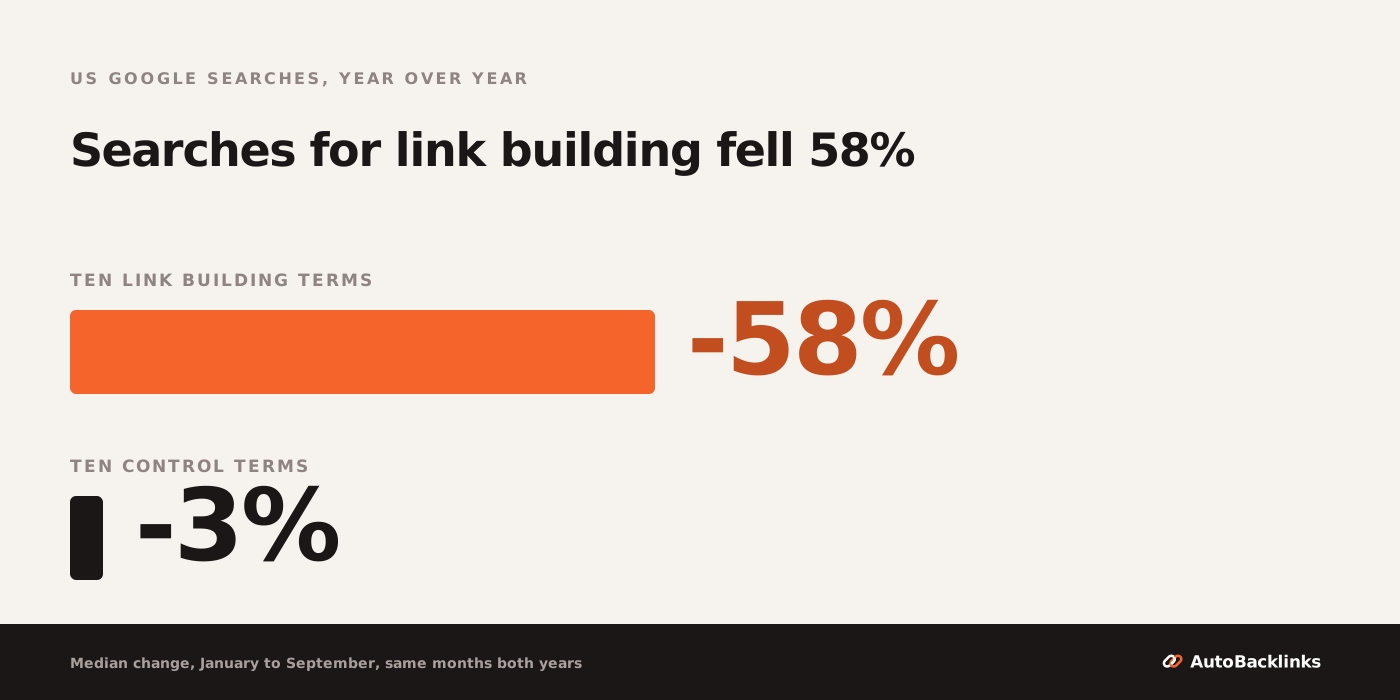
- All ten link building terms fell in US Google Ads search volume, January to September 2026 against the same nine months of 2025, between 43.4% and 76.9%, median 58.5%. "Broken link building" fell furthest at 76.9%, "link building" itself fell 71.9%, "buy backlinks" 55.8% and "link building agency" 43.4%.
- Over the same months, ten unrelated commercial control terms moved a median of -3.35% and three of them rose, so the fall is specific to this category rather than a platform-wide change in how volumes are reported.
- In that October 2026 Google Ads data, buying intent still prices high as volume drops: cost per click is $54.63 on "niche edits", $45.96 on "link building services", $44.49 on "link building agency" and $44.36 on "buy backlinks".
Two honest caveats. Google Ads volumes are rounded estimates, and the control set moved from -36% to +660% across its ten terms, so this series is noisy keyword by keyword.
The sharper limit is that the controls are not matched on size. They sit between 197,500 and 96 million searches over the nine months while the link building terms sit between 4,770 and 83,300, and Google Ads buckets low-volume keywords harder than head terms. So these ten do not rule out a reporting change that hits the mid-tail. What they do show is clean separation: not one control term fell as far as 43.4%, the smallest link building fall, while all ten link building terms did.
It is also worth knowing this conflicts with the statistic most quoted on the subject. BuzzStream's 2026 report opens by saying interest in link building is at an all-time high, read from Google Trends. Both can hold: Trends reports a normalised share of all searches, Google Ads reports an absolute estimated count. If total searches fall and link building falls by less, share rises while volume drops.
Which link building statistics are wrong, and where they came from
I tried to trace every third-party number I planned to use back to the publisher's own page. Four needed a correction, two more I could not close, and one source turned out to have stopped publishing.
The most-cited survey in this field, Aira's State of Link Building, has published no edition since 2022. Editions ran in 2019, 2020, 2021 and 2022, the last with 270 respondents. Percentages lifted from it are at minimum four years old whatever year sits in the title quoting them.
The four corrections, in order of how often you will meet them:
- "94% to 95% of pages have no backlinks" matches neither Ahrefs figure it is drawn from. Ahrefs measured 66.31% of pages in its Content Explorer index with no referring domains, in a 2020 study of about a billion pages, and separately 96.55% of pages getting no Google traffic in a 2023 edition covering about 14 billion. Those are different metrics from different years, and I could not find a published source for 94% to 95% at all. Ahrefs itself calls that index "somewhat biased towards the 'quality side of the web'", so neither figure describes the open web.
- The 3.8x backlink multiple is older than its timestamp. The page carries a recent update stamp, but the URL dates to 2016 and the study names Alexa as a data partner, a service Amazon shut down in 2022. The analysis predates mid-2022 at the latest.
- The "48.6% say digital PR is most effective" figure is not Aira's, which is how it is usually attributed. It is the same Editorial.Link survey behind the $509 in statistic 26: 518 respondents in total, of whom 412 answered the cost question, run by a link-building agency, recruited largely through personal outreach, with no sampling frame published, and the same sample size and headline figures were reported a year earlier. Treat it as a reading of that agency's network. Note also that this 48.6% is unrelated to the one in statistic 42, which is about link placement, not tactic preference.
- The link building market size figure cannot be traced to a research firm. The widely repeated "$25.98 billion in 2025 rising to $57.07 billion by 2030" goes back through statistics roundups to agency pages, and I could not find a named report with a published method behind it. The nearest real report, DataIntelo's link building software market report, puts that narrower market at $2.8 billion in 2025 rising to $7.1 billion by 2034. That is a different scope and a different end year, so it neither confirms nor refutes the bigger number. Both are out of the 50 above.
What Google says about links
The policy text is short, public, and quoted less often than it should be. Google's spam policies define the offence this way:
Link spam is the practice of creating links to or from a site primarily for the purpose of manipulating search rankings.
And on paid links specifically:
Google does understand that buying and selling links is a normal part of the economy of the web for advertising and sponsorship purposes. It's not a violation of our policies to have such links as long as they are qualified with a
rel="nofollow"orrel="sponsored"attribute value to the<a>tag.
Read against statistics 40 and 41, those two sentences sit awkwardly beside observed practice. The attribute Google names specifically for paid placement appears on three links in every ten thousand, while the nofollow it also accepts appears on 10.8%. Whatever share of that 10.8% is paid, rel="sponsored" is not working as the disclosure signal it was designed to be.
On whether links matter less, Google's most quotable recent line is an aside the speaker took back the same day. Gary Illyes told a conference audience in April 2024 that "we need very few links to rank pages" and that "over the years we've made links less important", then posted hours later: "I shouldn't have said that." John Mueller had put it more carefully in 2022, guessing that over time links "won't be such a big factor as sometimes it is today".
Neither is a measurement. The Ahrefs 2019-to-2026 correlation decline in statistic 7 is, and it points the same way: a real fall, published on a matched query set, and a long way short of zero.
Those numbers are why we built AutoBacklinks around the page rather than the domain. It scans for pages relevant to one target URL, scores them on topical fit rather than Domain Rating alone, finds the contact, and writes each email from the prospect's own page. Start a campaign against a page you actually want to rank.
FAQ
What percentage of web pages have no backlinks?
Nobody knows, and the figure usually quoted is wrong twice over. Ahrefs measured 66.31% of pages with no referring domains in a 2020 study of about a billion pages, and separately found 96.55% of pages get no Google traffic, which is a different metric people often merge into "94% to 95% have no backlinks". Both describe Ahrefs' own index rather than the web. Measured inside live commercial results in October 2026, 32.6% of page-one results had zero links pointing at the ranking page, excluding platform domains like YouTube and Reddit.
How many backlinks do you need to rank in 2026?
Fewer than most budgets assume, and the answer scales with difficulty. Across 125 commercial SaaS keywords the median keyword's top-ten pages averaged 23 page-level referring domains at keyword difficulty 0 to 10, rising to 323 at 31 to 50 and 1,308 above 70. Inside live page-one results the median page carried 11 referring domains at positions 1 to 3 and 5 at positions 4 to 10. Check the pages currently above you rather than copying either figure.
Do backlinks matter for AI search?
The pages Google cites in AI Overviews are much better linked than the pages ranking beneath them. Across 50 commercial B2B SaaS queries measured in October 2026, cited pages carried a median of 58 referring domains against 5 for the organic results on the same queries, with platform results like YouTube and Reddit excluded from both sides, and the cited median was higher on 38 of 48 queries. Only 19.2% of citations went to a URL that also ranked in the top ten. The study carries no domain-level authority score, so some of that gap is about which sites get cited rather than which pages.
How much does one backlink cost in 2026?
A bought placement costs between $70 and $456 in 2026, with a median marketplace listing at $89.80 and published agency rate cards running $216 at DR 40+ to $456 at DR 60+. Digital PR works out at $367 to $1,200 per earned link across ten agencies that publish both a fee and a link count. Treat the $509 figure in circulation with care: that was a survey asking 412 people what they would consider acceptable to pay, not a price paid. Two measures of money actually spent, a 2022 survey of 755 link builders and 22,703 completed marketplace orders, returned $83 and $164.
What is the average reply rate for link building outreach?
The average link building outreach reply rate is 3.59%, measured by BuzzStream across more than 51 million outreach emails, the largest published dataset. One AutoBacklinks campaign, published in full, ran at 17.1% across 187 sends. The gap is almost entirely prospecting: a small list of genuinely relevant pages replies several times more often than a large generic one, and the digital PR subset of that same dataset replied at under 1%.
About Rachid Idali
Founder & SEO Strategist
Rachid Idali has spent 10 years in SEO, running multi-six-figure SEO and link-building budgets across content, digital PR, and outreach programs. He writes about practical systems for finding relevant prospects, earning links, and turning SEO operations into repeatable pipelines.
More from Rachid Idali