

Does Link Building Still Work in 2026? I Measured It

by Rachid Idali
Last Updated: October 19, 2026
Yes, link building still works, but not the version most people argue about. In October 2026 I pulled 99 commercial queries and measured two things separately: links pointing at the ranking page, and links pointing at the ranking domain. Links to the page pointed the right way on 81 of 98 queries. Links to the domain pointed the right way on 47 of 99, which is a coin flip.
That split explains why this argument never ends. One side measures domains and says you need an empire. The other side looks inside a results page, sees giant brands in no particular link order, and declares the whole practice dead.
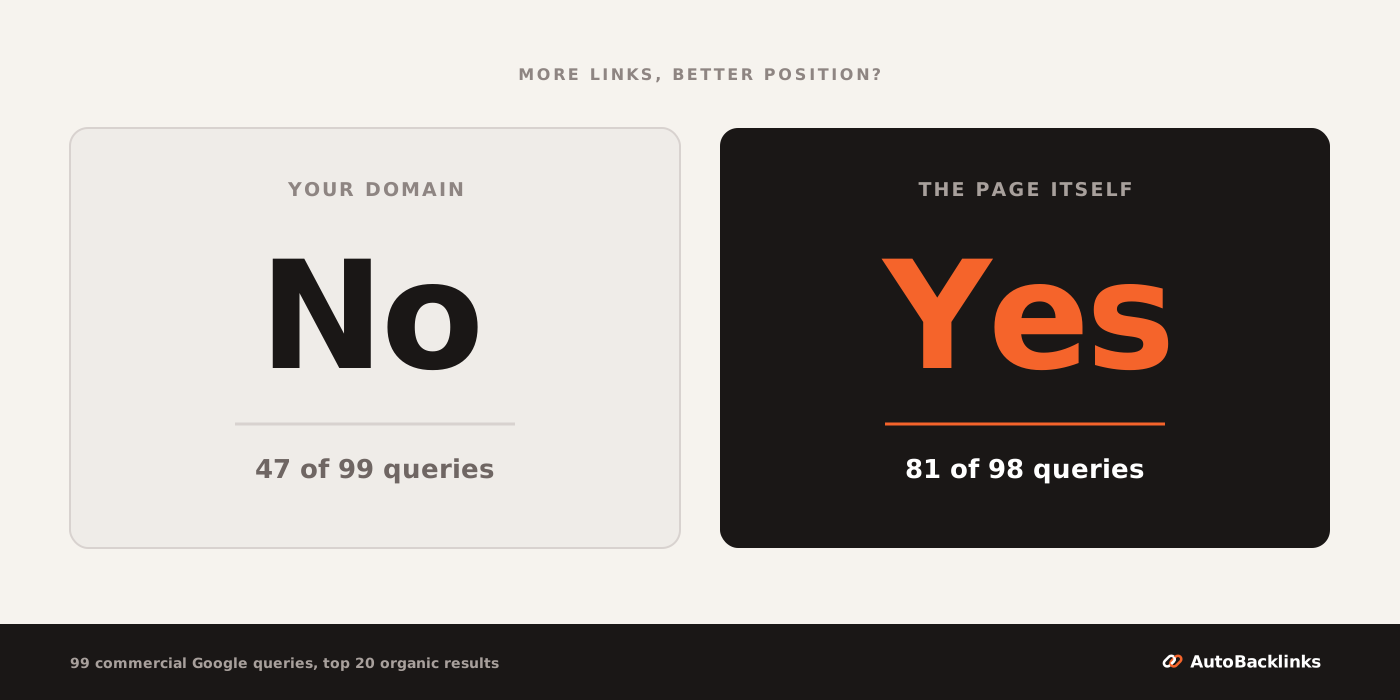
Both are reading the same results page and counting two different things. Here is what separating them shows.
Does link building still work in 2026
Short answer: your domain's link count decides whether you are in the race, and the page's link count decides where you finish. The second number is much smaller than anyone selling link packages wants you to think.
Here is how the measurement ran, so you can repeat it.
- Eleven product categories, chosen to spread across software and physical goods: CRM, project management, email marketing, web hosting, accounting software, VPNs, running shoes, standing desks, mattresses, life insurance and password managers.
- Up to ten commercial queries per category, taken by volume from keyword suggestions filtered to commercial or transactional intent. Two categories gave fewer: VPNs yielded 2 and password managers 8. That is 100 queries, of which 99 returned results.
- Google US desktop organic results to depth 20 for each query, pulled through DataForSEO: 1,811 ranking URLs in all, across 582 unique domains.
- Two link counts per result: referring domains to that exact URL, and referring domains to the whole domain. Plus each domain's registration date.
- A Spearman correlation computed inside each query separately, then summarized across the set with a sign test. One query, "mattress stores near me", had zero links to every one of its 19 results, so no page-level correlation exists for it. That is why the page-level counts below are out of 98 and the domain-level ones out of 99.
Two notes on what this sample is before the numbers. Google groups close variants when it reports volume, so several of these queries are different strings drawn from the same variant group, and the volume attached to any one of them describes the group rather than that string. I checked that this does not quietly make the sample smaller than it looks: the result pages are genuinely distinct, with 13 of 4,851 query pairs sharing half their URLs or more.
The second note is that about one result in five is a platform nobody competes with by building links: YouTube, Reddit, Yelp, Quora, Amazon, Wikipedia. Those 369 rows, 20.4% of the sample, carry a median of zero links to the ranking page and a median of 3.1 million to the domain. I report the numbers below both with them and without them, because they move the headline figure by roughly double.
What the data shows: links to the page, not links to the domain
Measured inside each query, links to the specific URL track position consistently. Links to the domain do not track it at all.
| What was measured | Median correlation | Queries pointing the right way | Sign test |
|---|---|---|---|
| Referring domains to the page | -0.196 | 81 of 98 | p below 0.0000001 |
| Referring domains to the domain | 0.007 | 47 of 99 | p = 0.69 |
A negative number means more links went with a better position. The domain row is a coin flip: 47 of 99 is what you would get from noise, and the sign test agrees.
One thing the table does not say, and should. A median correlation of -0.196 is weak: it accounts for roughly 4% of the variation in where pages land, and 21 of the 98 queries sit below 0.1 either way. What is strong here is the consistency of the direction, not the size of the effect. Links are one input among many, and this measures that they are an input, not that they are the deciding one.
The page-level result held under every cut I tried, though not equally well in all of them:
- Inside page one only, where the field is tightest: -0.189, pointing the right way on 72 of 98 queries.
- Excluding every page with no links of its own, in case the zeros were doing the work: -0.208, but this is the weakest cut by some distance, right on 51 of 72 queries at p = 0.0005 rather than the headline's p below 0.0000001. Dropping the zeros removes about a third of the sample, and the signal gets correspondingly noisier.
- Counting raw backlinks instead of referring domains: -0.201, right on 80.6% of queries.
- Split by category, the median points the right way in 10 of the 11. The exception is VPNs, where only two queries survived the intent filter.
- Holding domain strength constant, which is the objection worth taking seriously, since big brands could have both: -0.187, right on 76 of 98 queries. Page links do work that domain size does not explain.
- Excluding the platforms nobody competes with by building links (YouTube, Reddit, Yelp, Quora, Amazon, Wikipedia and the like, 20.4% of all results): -0.208, right on 73 of 94 queries. The domain side stays null there too, at -0.043 on 48 of 94.
One more way to say it without a correlation coefficient. On each page one, I took the single page with the most links pointing at it. That page sat in the top three on 48 of 98 queries, 49%, against the 30% you would expect if link counts meant nothing.
I should be straight about what the query-by-query method does and does not buy, because it is less than I expected when I started. Pooling all 1,811 rows into one correlation gives -0.142 for page links and 0.024 for domain links. Measuring inside each query gives -0.196 and 0.007. So the method sharpens the page signal by about a third and leaves the domain conclusion where it was. The page-versus-domain split is in this data either way. It is not an artifact of how the correlation is computed, and I am not going to claim the pooling is what hides it.
That matters for how this sits next to the published studies. Ahrefs ran Spearman correlations on the top million US keywords and published referring domains at 0.255 and backlinks at 0.248, with Domain Rating, a weighted 0 to 100 authority score rather than a raw count, at 0.131. Backlinko found the top result carrying about 3.8 times the backlinks of positions 2 to 10 across 11.8 million results, and Semrush put link metrics at 0.18 across 16,298 keywords. Those are signed the opposite way from mine: they count up for better rankings, I count position numbers, so their positive is my negative.
My domain figure is near zero where Ahrefs' Domain Rating is 0.131. The likely reason is sample, not method: 99 head commercial queries in eleven consumer categories, a fifth of them won by platforms, against a million keywords of every kind. Take the split as a finding about competitive commercial results, which is where most people are actually trying to rank, rather than about the whole web.
Is this just pages getting links because they rank?
That is the right objection, and it is the strongest one against everything above. A page sitting at position two is seen by more people, gets cited more often, and accumulates links for reasons that have nothing to do with why it got there. Cross-sectional data cannot separate the two directions, and mine is cross-sectional. I cannot rule it out.
Three things narrow it, though none of them closes it.
The first is the domain-strength control. If the relationship were purely the rich getting richer, it should weaken once brand size is held constant, and it does not: -0.187 against -0.196.
The second is that the same exposure argument applies just as well to domain-level links, which also accrue to whoever ranks. Those show nothing. An attention effect that produces a clean signal in one link count and none at all in the other is a strange attention effect.
The third is the closest thing to a causal test anyone has published. Ahrefs' Patrick Stox disavowed all 3,476 links to three of its own blog posts for four weeks, then removed the file, which is an intervention rather than an observation. Two of the three lost traffic, 18% and 13.3%, and recovered when the links were restored. The third barely moved during the test and then rose afterwards. Stox names the confounds himself: algorithm changes, recrawl lag, competitors gaining links meanwhile.
Three pages with one null result is not proof. It is one experiment pointing the same way as the correlation, and it is more than the "links are dead" side has produced.
The link gap between the top three and the rest of page one
Here is the part that should change what you do on Monday. The link counts in play are far smaller than the domain figures above, and far more uneven than a single number suggests.
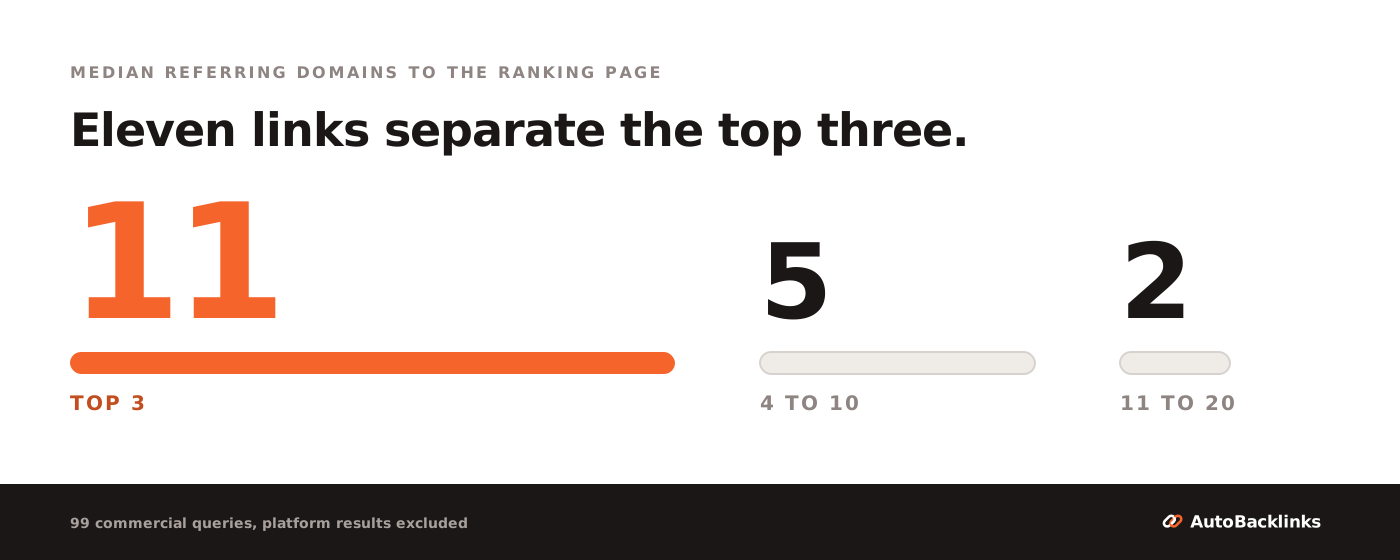
Counting every result, the median page in positions 1 to 3 had 6 referring domains pointing at it, the median page at 4 to 10 had 2, and the median page at 11 to 20 had 1.
Those numbers are held down by results you cannot be. Strip out the platforms, which is a fifth of this sample, and the bands become 11, 5 and 2. That is the version to plan against, because it describes the competitors you could actually displace.
Not thousands. Eleven.
The floor underneath is lower still. Among those same non-platform results on page one, 32.6% of ranking pages had zero links pointing at the page itself, 53.8% had fewer than ten, and 72.2% had fewer than fifty.
Now the part that a median hides, and that matters more than the median. The spread inside the top three is enormous: the 75th percentile is 117 referring domains and the 90th is 410, against a median of 11. So "build eleven links" is not a target. A third of top-three pages have no links at all and a quarter have over a hundred, which means the only number that tells you anything is the one on the specific pages above you. That is a five-minute check, and it is step three of the sequence at the end of this piece.
Where the pages above you are in single digits, the gap is closeable in a month. Our own guide on how many backlinks per month is safe puts the band at 1.6 to 6.3 percent of your existing referring domains a month, median 2.5 percent, and at these page-level numbers that pace is enough.
What Google says about links and link spam
Google's spam policies still define link spam as "creating links to or from a site primarily for the purpose of manipulating search rankings", and the examples are specific. Buying or selling links for ranking purposes, including exchanging goods, services or a free product for a link. Excessive link exchanges. Automated programs that create links. Advertorials and guest posts carrying optimized anchor text that passes ranking credit.
The policy also makes room for paid links done honestly:
Google does understand that buying and selling links is a normal part of the economy of the web for advertising and sponsorship purposes. It's not a violation of our policies to have such links as long as they are qualified with a
rel="nofollow"orrel="sponsored"attribute value to the<a>tag.
Read that carefully, because it sets the boundary the rest of this article works inside. A paid link is not against the rules. A paid link that passes ranking credit is. If you are weighing it anyway, we costed the routes in buying backlinks and what link building actually costs.
On the other side of the ledger, Google still says plainly that links count. Its How Search Works explainer puts it this way:
For example, one of the factors used to determine quality is understanding if other prominent websites link or refer to the content. This is generally a good sign that the information is trustworthy.
Note the scope. One quality factor among several, phrased as a trust signal. The Search Central guidance is similarly narrow: links are "a signal when determining the relevancy of pages and to find new pages to crawl". Neither says top three, and neither has for years.
Two things get repeated wrongly.
The most-quoted evidence that Google has downgraded links is a line from a 2024 conference stage, that Google needs very few links to rank pages. It was transcribed by an attendee, not published by Google, and Gary Illyes' own reply was that he should not have said it. Treat it as a Googler's offhand remark that he walked back, not as policy.
The other is that there has not been a named link spam update since December 2022, when Google used SpamBrain to "neutralize the impact of unnatural links on search results". Every spam update since, up to the one in September, has been a general one. Link spam enforcement did not get louder. It got absorbed.
The most useful line Google has published on this whole argument came in the March 2024 spam policy announcement, and it is about the metrics people use to measure link building rather than about links:
Some third-party services provide "reputation" or "authority" scores for sites. These don't correspond to any of Google's own signals nor come from Google.
Which fits what I measured exactly. The domain-level number everyone optimizes toward is not a thing Google publishes or uses, and inside a query it predicts nothing.
Where backlinks decide the outcome: AI search and new domains
The domain side of my data is brutal, and it is the honest half of the answer. The median page-one domain in these commercial categories carried 18,860 referring domains. Only 0.5% of page-one results came from a domain with fewer than 100. More than half, 58.2%, came from a domain with 10,000 or more.
Age looks the same. The median page-one domain was 23.4 years old, 70.5% were at least 20 years old, and just 2.0% were younger than five.
But notice what age does not do. Inside a single query, domain age has no relationship to position either, at a correlation of -0.011. Like domain links, it is an entry condition rather than a dial.
The 20 page-one results from domains under five years old are worth sitting with, because they cut against the rest of this piece. They carried a median of 1,941 referring domains to the domain, far below the 18,860 median but a long way above nothing. And their median count of links to the ranking page itself was zero. The sites that broke in young did it on domain links and content, not on page links. Whatever the page-level effect is, it is not the only road onto page one.
So for a new site in a mature commercial category, the sequence is not optional: earn enough domain-level links to be considered at all, then compete page by page. For everyone else already in the index, the page is the whole game.
AI search does not get you around any of this. Google describes the grounding behind its AI answers as relying "on our core Search ranking systems to retrieve relevant, up-to-date web pages from our Search index", and the same guidance says there are no additional requirements to appear there. In other words the citation competition is the ranking competition, which is the page-level one. We covered which pages get picked and how to reach them in link building for AI search.
Link building tactics that stopped working
Nothing in this data rescues the tactics that made link building disreputable.
- Blasting links at the homepage. This is the measured one. Across these queries I could not detect any relationship between a domain's referring-domain count and where its page landed, pooled or query by query. That is a failure to detect rather than proof of no effect, but it is the opposite of what a root-domain campaign assumes.
- Bought links that pass credit. Explicitly against the policy quoted above, and the inventory is poor: BuzzStream's study of 257,267 guest post marketplace sites rated 1.37% of them High Quality or Top Tier, down from 4.6% when they first ran it.
- Private blog networks. Same policy line, with the added problem that the whole network fails at once.
- Mass reciprocal exchanges. "Link to me and I'll link to you" is named in the policy by those words. Normal reciprocal links between real sites are a different thing, which we measured in link exchanges.
- Volume as a strategy. When the median top-three page has six referring domains, a thousand of anything is not the constraint you are solving for.
- Expired domain buys. Google named this one directly in its March 2024 policy round, as purchasing an expired domain and repurposing it to carry ranking signals it did not earn.
- Low-quality directory, comment and forum-signature links. Google's policy names all three. The yield data says the same thing more gently: in our own count of acquisition sources, community and forum links were only 28.9% dofollow, so seven in ten passed no ranking signal at all. Real directories still have a place, at 5.4% of links and 61.8% dofollow; bulk submission to low-quality ones does not.
- Scaled content written to carry links. Also named in March 2024, as generating many pages whose primary purpose is to manipulate rankings. Generative AI does not change the assessment; Google's stated position is that automation is spam when the purpose is ranking manipulation.
The pattern across all of these is the same. Each one produces links to a domain cheaply and at volume, which is precisely the quantity the measurement above says has no bearing on where a page lands.
Link building that still works in 2026
What survives is narrow, and it all points the same way: a relevant editorial link, on a page that already has an audience, aimed at the specific URL you want to rank.
- Link insertions into pages that already rank. The page is indexed, trusted and getting traffic, and you are adding one contextual link to your URL. This is the cheapest route to moving a page from one referring domain to six. The mechanics are in link insertions and niche edits.
- Placement in listicles and resource pages that cover your category. Same logic, and these pages are built to add entries.
- Guest posts written to be read, with the link pointing at the deep page rather than the homepage, and without stuffed anchor text.
- Digital PR, which earns links to a specific asset from sites you could not pitch any other way.
- Taking the links your competitors already have. A site that linked to a rival will usually consider you, and finding competitor backlinks is the fastest list of qualified prospects you can build. The software for this stage is scored in link prospecting tools, and the nine acquisition methods are ranked by yield in how to get backlinks.
The common thread is relevance, and relevance is also what moves reply rates. On one published campaign I sent 187 emails and got 32 replies, a 17.1% reply rate. The lever was not the copy. It was prospecting against pages that genuinely matched the topic.
How to run link building in 2026
Six steps, in the order the data argues for.
- Pick one URL. Not the site. The page you want to move.
- Count what it has. Referring domains to that URL, not to the domain. If you are new to the distinction, what backlinks are and which ones count sets it out.
- Count what the pages above it have. In these categories the gap was usually a handful of links, and it will often be smaller than you expect.
- Find pages that already link to things like your page. Competitor backlinks, listicles in your category, resource pages, articles that cover the topic without citing you.
- Pitch the page, not the site. The pitch has to make sense on the prospect's specific page, which is also the only version that gets replies.
- Measure the one number that matters. Referring domains to that URL, tracked against its position.
That sequence is what we built AutoBacklinks to run. It scans for pages relevant to one target URL and scores them on topical fit rather than authority alone, then finds the contact and writes each email from the prospect's own page.
Starter is $49 a month under the current launch offer, list price $79. The trial is 7 days and 120 credits, and it asks for a card. If you would rather assemble the same sequence from separate tools, you can start a trial later and begin with the prospecting step instead.
FAQ
Does link building still work in 2026?
Yes, when the links point at the page you want to rank. Across 99 commercial Google queries measured in October 2026, referring domains to the ranking URL correlated with position at a median of -0.196 and pointed the right way on 81 of 98 queries. Referring domains to the whole domain correlated at 0.007, on 47 of 99, which is a coin flip. The correlation is weak in size, around 4% of the variation in position, so treat links as one input rather than the deciding one. The practice works; the homepage-focused version of it does not.
Is link building dead?
No, but the domain-level version of it is. Measured inside each query, the count of links pointing at a root domain had no consistent bearing on where its page ranked. What still moves a page is a relevant editorial link aimed at that page, and the margins are small enough to be winnable.
How many backlinks does a page need to rank?
Fewer than most people assume, but check rather than copy a number. Excluding platform results like YouTube and Reddit, the median page in positions 1 to 3 had 11 referring domains to the URL and the median page at 4 to 10 had 5. Counting every result those figures are 6 and 2. The spread is what matters: a third of top-three pages have none at all and a quarter have over a hundred, so the only number worth acting on is the one on the pages currently above you.
Should I build links to my homepage or to the page I want to rank?
The page. This is the clearest finding in the data: domain-level link counts had no relationship to position inside a query, while page-level counts did, consistently and across every robustness check. Links to the homepage help you clear the threshold to compete in a category, and after that they stop doing work.
Do backlinks still matter for AI search?
Yes, mostly indirectly. Assistants tend to cite pages that already rank, so the competition that decides rankings also decides citations, and that competition is page-level. We set out which pages get cited and how to reach them in link building for AI search.
Are backlinks still important, or is this just correlation?
Both can be true, and the honest answer is that the measurement here is a floor rather than a precise figure. Some of the relationship is pages earning links because they already rank. Two things argue it is not all of it: the relationship survives holding domain size constant, and the same exposure effect would have to explain why page-level links show a signal while domain-level links show none. The one intervention on record, Ahrefs disavowing every link to several of its own blogs, saw traffic and rankings fall.
About Rachid Idali
Founder & SEO Strategist
Rachid Idali has spent 10 years in SEO, running multi-six-figure SEO and link-building budgets across content, digital PR, and outreach programs. He writes about practical systems for finding relevant prospects, earning links, and turning SEO operations into repeatable pipelines.
More from Rachid Idali