

Local Link Building in 2026: What Map-Pack Winners Have

by Rachid Idali
Last Updated: October 25, 2026
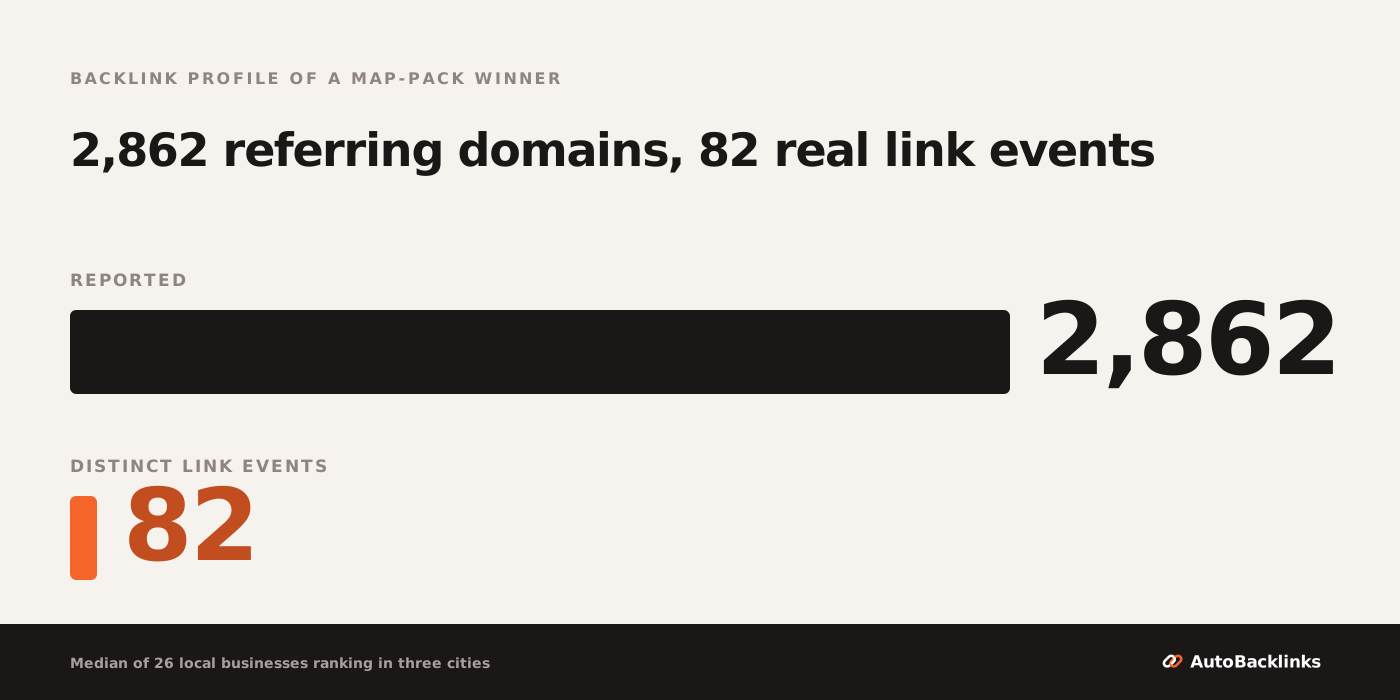
Local link building is the work of earning links from sites tied to the city a business serves. Across the 26 businesses holding top-three local-pack positions in three US cities and three trades, the median business reports 2,862 referring domains and holds about 82 real link events, of which one or two come from a site actually based in its city.
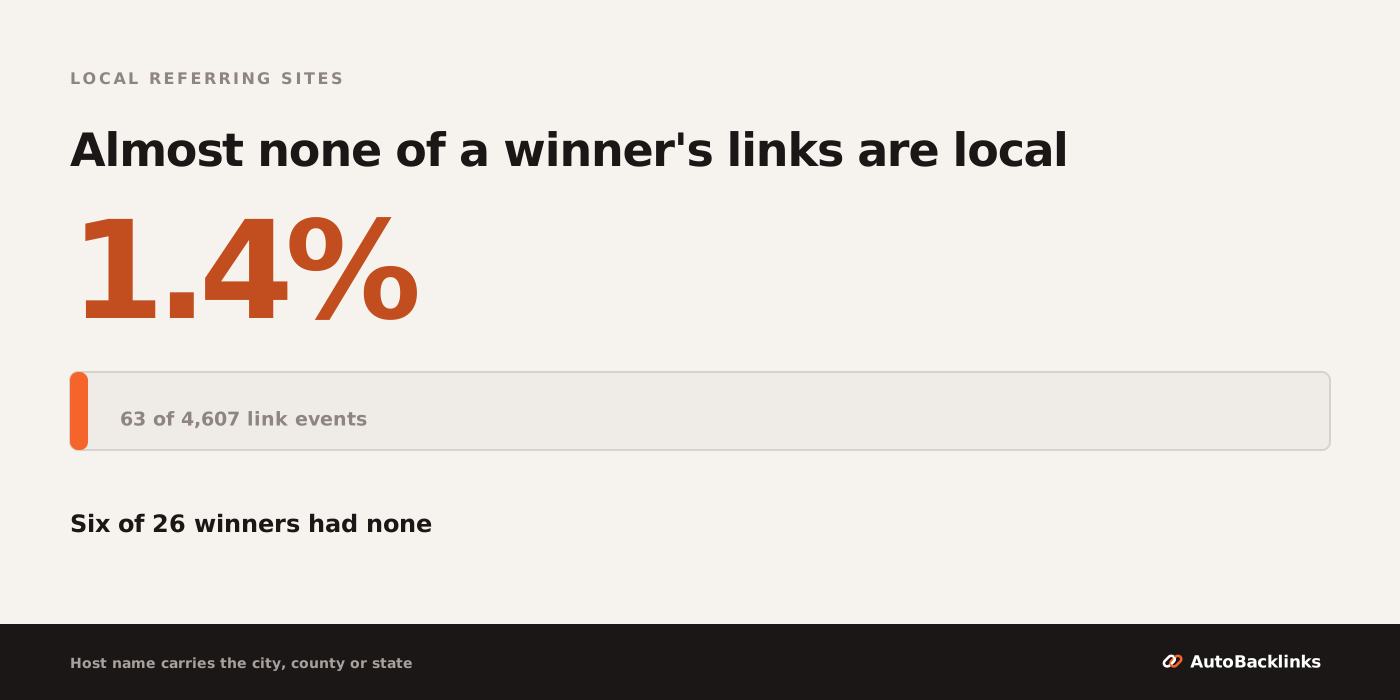
Six of the 26 had no local link at all.
The tactics every guide lists are real. There is just far less of any of them than the lists imply, and most of what fills these profiles instead is bought, generic, and not local.
What local link building is, and what Google counts
Local link building is earning links to a local business's website from sites tied to the area it serves, so that Google treats the business as well known in that area.
The reason it matters is not a theory. Google states the input in its own Business Profile help documentation.
Local results are mainly based on relevance, distance, and popularity.
And on the third of those:
Prominence means how well-known a business is. Prominent places are more likely to show up in search results. This factor's also based on info like how many websites link to your business and how many reviews you have.
Read that last sentence closely. Google names a count of linking websites, alongside reviews, as an input to prominence. It does not promise the count is weighted by quality, and it says nothing about where those sites are.
Local citations vs backlinks for local SEO
These get mixed together constantly, and they are not the same thing.
A citation is a mention of your name, address and phone number (your NAP) on a listing site. Yelp, the Better Business Bureau, Apple Maps, a chamber directory. Its job is consistency: the same details everywhere, so Google is confident the business is real and is where you say it is.
A backlink is a link on any page that points at your website. It carries authority and context.
Many citations happen to include a link, which is where the confusion starts. The useful distinction is who creates it. You create a citation by submitting it. You earn a backlink when someone chooses to put it on their page.
Both feed the prominence signal Google describes. Only one of them is finite. In my experience there are a few dozen citation sites worth filling in, you fill them in once, and that work is done. Link building is the part that never finishes, which is why it is the part worth measuring.
How many backlinks map-pack winners have: 26 local businesses measured
In October 2026 I ran nine searches: plumber, dentist and personal injury lawyer in Austin, Charlotte and Portland. For each one I took the three businesses in the local pack and pulled live backlink data for their websites from DataForSEO, one link per referring domain, up to the 1,000 highest-authority domains each.
Twenty-seven businesses ranked. One was a site-builder subdomain with no crawlable profile, which left 26.
Two limits to hold onto before any number below.
This cannot tell you whether any of these links caused the ranking. Google weighs relevance, distance and prominence together, and in a local pack distance and reviews do a great deal of the work. I measured 26 winners and zero non-winners, so there is no control group here. What a profile shows is the link inventory a business holds while it ranks, which sizes the gap you would be closing. It is not proof that closing it moves you.
Every count below is a count inside the top 1,000 referring domains, not a whole profile. All 26 businesses report more referring domains than I sampled. One case shows what that cap costs: a Charlotte firm with 1,051 reported referring domains had 990 of them sampled, so its profile is almost fully covered, and it alone shows 941 link events against a median of 82.
Why a local backlink count is weather, not a score
The first thing I found was not local at all.
Of 25,990 sampled links, 21,465 sat inside template networks: the same URL path and page title repeated across dozens or hundreds of hostnames, on domains like .store, .shop, .website and .online, carrying titles along the lines of "Premium Authority Backlinks to Help Your Website Improve Google Rankings".
I counted each of those 82 networks as one observation rather than hundreds, because one blast is one event. That takes 25,990 rows down to 4,607 distinct link events across all 26 businesses.
This is the same operation I measured on 21 B2B vendors, where the same hostnames hit a wedding photographer and an industrial valve manufacturer in the same month. The full teardown is in B2B link building. An Austin plumber showing 2,641 referring domains did not build 2,641 links.
What a map-pack winner really holds
After the collapse, the median map-pack winner holds about 82 distinct link events inside its top 1,000 referring domains. The split by trade matters more than the pooled figure.
| Trade | n | Median referring domains reported | Median link events | Median local sites |
|---|---|---|---|---|
| Plumber | 9 | 2,643 | 51 | 1 |
| Dentist | 8 | 2,637 | 51.5 | 0.5 |
| Personal injury lawyer | 9 | 3,226 | 333 | 5 |
These are medians of eight and nine businesses, not population estimates. A median of 0.5 local sites for dentists means four of the eight have one or more and four have none.
The nine personal injury firms hold 75.9% of all 4,607 link events in this study. That concentration runs through every pooled number on this page, so read the trade rows above as the real answer and the pooled figures as a description of a well-funded local profile.
Plumbers and dentists are ranking in the local pack on roughly fifty real links. If you sell plumbing in a mid-size city, the gap between you and the top of the map pack is probably a few dozen links, not a few thousand. That is what winners hold, not a threshold proven to produce a ranking. The national version of the same question is in how many backlinks do you need.
Where local backlinks actually come from
Here is the finding that reframes the advice.
Of the 4,607 link events, 63 come from a host whose own name carries the city, metro, county or state. That is 1.4%. The median business has one or two. Six have none.
That rule is rough in both directions, and I want to be clear about which. It undercounts genuine outlets whose names omit the city, like the Charlotte TV station WCNC. It also overcounts: charlottetoprated.com and portlandtoprated.com are listing sites, southcarolinalawtv.com got counted for a North Carolina firm, and austindailyherald.com is the Austin Daily Herald of Austin, Minnesota. Treat 1.4% as an order of magnitude, not a measurement.
I had a second reviewer check the rule anyway. They fetched all 150 links in a random sample, labelled each independently, and agreed with the local flag on all 150 rows, in both directions. A separate sweep for city names I might have missed turned up nothing.
Then I hand-audited every one of the 63, because an automated label is not good enough for the most important table on this page.
| What the local link actually is | Count | Share |
|---|---|---|
| A local directory or "best of" listing site | 23 | 37% |
| Local editorial: city magazine, news, local blog | 18 | 29% |
| A chamber, bar association or local institution | 9 | 14% |
| A local-looking content farm or press release | 8 | 13% |
| A sponsorship or community event page | 5 | 8% |
Fifty-five of the 63 are genuine, across 40 distinct hosts. Nineteen of the 26 businesses hold at least one.
The genuine ones are worth naming, because they are the whole target list:
- Editorial. CultureMap Austin wrote up a plumber known for its parody ads. The Austin Chronicle Readers Poll listed another. Voyage Austin ran founder interviews with a plumber and a dentist. OregonLive quoted a Portland dentist on teeth whitening. WCCB covered a Charlotte firm, and the Daily Journal of Commerce covered a sewage case.
- Chambers and institutions. The Austin Young Chamber, the Austin LGBT Chamber, the Charlotte Area Chamber, the Home Builders Association of Charlotte, the State Bar of Texas, and Austin Energy's approved contractor list.
- Sponsorships. Austin Pets Alive, Austin FC's corporate partners page, the Austin Trail of Lights sponsor list, and the Oregon Humane Society's Doggie Dash.
Every one of those is a page you could be on next quarter, and none of them needs a budget a plumber does not have.
What the rest of a local backlink profile is made of
So if 1.4% is local, what is the other 98.6%?
The same reviewer labelled all 150 sampled links by what kind of link they are. The answer is blunt.
| What the link is | Of 150 sampled | 95% range |
|---|---|---|
| A guest post on a generic, non-local blog | 58 | 31% to 47% |
| A link network, backlink seller or scraped page | 38 | 19% to 33% |
| A listing or profile the business created itself | 25 | 12% to 23% |
| Press release syndication | 11 | 4% to 13% |
| A genuine editorial placement | 6 | 2% to 9% |
| Gone, with no way to tell what it had been | 12 | 5% to 14% |
Four percent. Six of 150 links were a real editorial placement someone chose to make, and nine of the sampled pages openly sell link building on the page itself.
Three caveats bound that table.
The sample is lopsided the same way the study is. Links were pooled before sampling, so the personal injury firms supplied 121 of the 150 rows, and only 19 of the 26 businesses appear at all.
A quarter of the sample is already broken. 38 of the 150 pages no longer load or no longer carry the link, and a further batch answered only a bot challenge, so those were classified from the host rather than the page.
And "guest post on a generic blog" is a judgement about the page, not proof that money changed hands. What is visible is that the page is a content farm, it is not local, and it carries this kind of placement routinely.
The local news links are mostly one press release
Before you conclude that local media is the answer, look at what "local news" means in this data.
337 of the 4,607 link events are press release syndication, spread across 182 news-shaped hosts: business. and lifestyle. subdomains of real newspaper domains, serving /story/559727/ pages no reader ever visits.
One Charlotte law firm's single release appears on 48 distinct hosts, and three of its releases account for 124 between them.
That is not coverage. It is one wire purchase rendered 48 times, and a backlink tool reports it as 48 referring domains.
Local link building sources, ranked by what I could measure
Ordered by how many of the 26 businesses actually held one, which is the only reliability measure this data supports.
- Local directories and "best of" listing sites. The largest measured category, 23 of the 63 local links. Finite, claimable, and closer to citation work than link building. Do them once.
- Local editorial: city magazines, news and neighbourhood blogs. 18 of 63, and the highest value of anything here. One or two a year is a good year.
- Chambers of commerce, bar associations and local institutions. 9 of 63. Unambiguously local, and the price is a membership you may already be paying.
- Sponsorships and community organizations. 5 of 63. Youth sports, a race, a shelter, a festival. Small checks, durable pages, almost no competition.
Three sources that every guide recommends are not on this list because I could not measure them: partner and supplier pages, local guest posts, and unlinked brand mentions. They may work. This study cannot tell you whether they do, and I would rather say so than rank them on vibes.
Two thirds of the link events I counted, 66.2%, are dofollow. Nofollow is not a reason to turn down a chamber listing or a sponsorship page.
Why local links are worth building when six winners have none
That is the obvious objection to everything above, and it deserves a straight answer.
Six of these 26 businesses rank in the local pack with no locally named referring host at all. Local links are plainly not mandatory. Distance and reviews carry enormous weight in the map pack, and a business sitting in the right postcode with 400 reviews can win without any of this.
What local links buy you is the cheapest available units of the one input you can actually move. You cannot relocate, and reviews accumulate at the speed of your customers. Prominence is partly a count of linking sites, and the local set is a few dozen pages that your competitors have mostly not claimed.
How to pitch local sites for a backlink
The method is the one in how to get backlinks, narrowed to a city.
Start from the map. Search your city plus your category, take the three businesses in the local pack, and pull their referring domains with any backlink tool that exports them. You are not looking for their biggest links.
You are looking for the twenty or thirty hosts that carry the city's name, because that is the finite, nameable set of places that link to businesses like yours. Finding competitor backlinks covers the mechanics.
Then filter, because my own rule returned a third junk. Open each host and ask one question: does this site serve the place, or is it just named after it? A city magazine with bylines serves the place. A cityname-toprated.com with an auto-generated listing for every business in town does not, and neither does a newspaper in the other Austin.
Sort what survives into three asks, because they are not the same pitch.
- A listing you can claim. A chamber page, a directory, a supplier's "where to buy". Fill in the form. No email required.
- A page you can be added to. A roundup of plumbers in the city, a resource list, a neighbourhood guide. The ask is one sentence: here is what we do, here is why we fit the list.
- A story someone might run. An interview, a local award, a piece of city-specific data you have and they do not. This is the one that needs a real angle.
At local scale, relevance to the city is worth more than authority. A DR 12 neighbourhood blog that serves your service area beats a DR 70 national legal content farm, and the audit above shows your competitors have the farm links and not the blog.
In our own published campaign, 187 sends produced 155 opens and 32 replies, a 17.1% reply rate. Prospect relevance moved it, not email copy, which matters more at local scale than national, because your whole prospect list might be forty names.
What local link building costs per link
A bought placement runs $70 to $456, and the median live marketplace listing I priced sits at $89.80. The full breakdown, with the live listings behind those numbers, is in link building cost.
The price order never changes. Asking the site owner directly is the floor, a marketplace adds a spread on top of that owner's price, and an agency adds its margin on top of the marketplace.
Local changes two things about that ladder.
More of the list carries no placement fee. In the 63 local links I audited, the genuine ones are dominated by chamber memberships, sponsorship pages, institutional listings and directory entries. A chamber membership is a membership, a race sponsorship is a donation, and a contractor listing is a form. None of those is priced as a link.
The volume you need is small. If a ranking plumber holds about fifty real links, you are budgeting against a gap of a few dozen, not a few thousand. At $89.80 a placement, buying that entire gap is a four-figure number, which is exactly why the free local set should be exhausted first.
A local link building campaign you can copy
Four weeks, one city, repeatable. Budget roughly two to four hours a week.
- Week one, map the city. Pull the referring domains of the three local-pack winners for your main term. Keep every host carrying the city, county or state name, then filter out the listing farms by hand. Add your chambers, trade associations and local newspapers. You should finish with thirty to eighty names, which is the entire realistic universe.
- Week two, claim everything claimable. Chamber listings, supplier pages, trade association directories, the finite citation set. No outreach needed. Competitors in this dataset have claimed very few of these, so the claimable set is mostly unworked.
- Week three, ask to be added. Roundups, resource pages and neighbourhood guides that already exist. One short email each, referencing the actual page.
- Week four, pitch the two or three stories. Local media, a city blog, an interview series. Expect one to land.
Then stop, and repeat next quarter. Twelve real local placements would put you near the top of the local-host count of every plumber and dentist in this dataset. The campaign structure in general is in link building campaign, and the vocabulary in what are backlinks.
This is the part AutoBacklinks is built for, specifically step one and step three. It is our own tool, so here is the spec rather than a review:
- Scans the local-pack competitors for your city and category.
- Filters prospects on topical relevance, not authority alone.
- Finds and verifies the contact behind each prospect.
- Writes each email from the prospect's own page rather than a template.
Every send waits for your approval. It does not replace walking into the chamber, and for a forty-name local list it removes the part that usually stops the campaign at week two. You can start a trial if you want to run the map step on your own city.
FAQ
What is local link building?
Local link building is earning links to a local business's website from sites tied to the area it serves: chambers of commerce, trade associations, sponsorships, community organizations, local media and nearby businesses. Google's Business Profile documentation names links as a local ranking input, saying prominence is based partly on "how many websites link to your business". It does not say how many you need, or that they have to be local.
How many backlinks does a local business need to rank in the map pack?
Fewer than a referring domain count suggests. Across 26 businesses holding top-three local-pack positions in Austin, Charlotte and Portland, the median one reported 2,862 referring domains, but 21,465 of 25,990 sampled links sat inside template networks. Collapsing each network to one event leaves a median of about 82 real link events, and the plumber and dentist medians are near 51. These are counts winners hold, not a proven threshold.
Are local citations the same as backlinks?
No. A citation is a listing of your name, address and phone number on a directory, and its value is consistency across sites. A backlink is a link on any page pointing at your site, and its value is authority and context. You create citations by submitting them and the set is finite, while backlinks have to be earned from someone who chooses to publish one.
Where do local businesses get their backlinks?
Mostly not from local sites. Of 4,607 distinct link events across 26 ranking local businesses, 63, or 1.4%, came from a host whose name carries the city, county or state, and six of the 26 had none. I hand-audited those 63: 23 were local directory listings, 18 local editorial, 9 chamber or institutional, 5 sponsorships, and 8 were local-looking content farms.
How much do local backlinks cost?
A bought placement runs $70 to $456, with the median marketplace listing at $89.80. Local changes the mix more than the price: among the 63 local links I audited, most genuine ones are chamber memberships, sponsorship pages, institutional listings and directory entries that carry no placement fee. The price order never changes. Asking the owner directly is the floor, a marketplace adds a spread, an agency adds margin.
About Rachid Idali
Founder & SEO Strategist
Rachid Idali has spent 10 years in SEO, running multi-six-figure SEO and link-building budgets across content, digital PR, and outreach programs. He writes about practical systems for finding relevant prospects, earning links, and turning SEO operations into repeatable pipelines.
More from Rachid Idali