

Ecommerce Link Building in 2026: What Ranking Pages Hold

by Rachid Idali
Last Updated: October 26, 2026
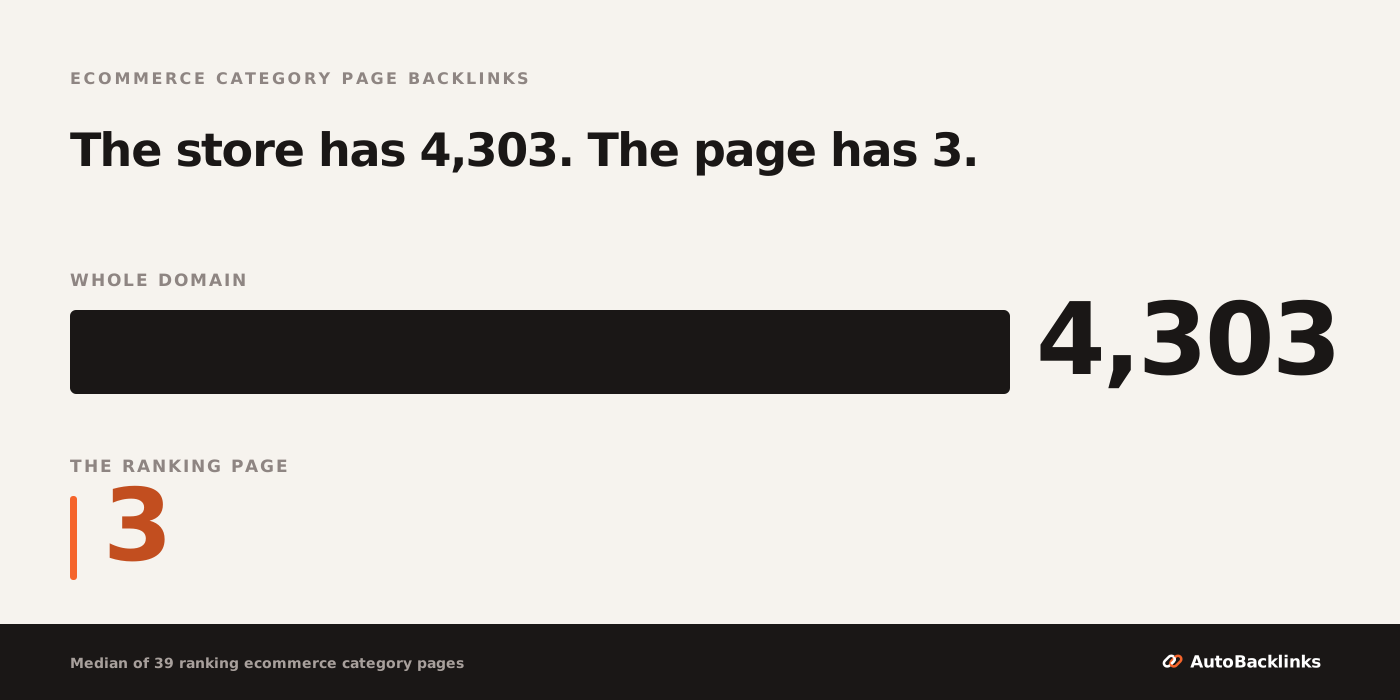
Ecommerce link building is the work of earning links to an online store, and the advice everywhere is to aim them at category pages. I measured 39 category pages ranking in the US top 20 for a head product search, and the median one holds three referring domains. Twelve hold none at all.
Across 28 of those stores, the median share of link events pointing at any category page is 5.9%. The share pointing at the home page is 47.6%.
So the budget split you have been told to use is backwards, and the page you were told to ignore is the one that collects.
What ecommerce link building is, and why it is different
Ecommerce link building is the work of earning links from other websites to an online store: its home page, its category pages (called collections on Shopify), its product pages, and whatever it publishes on its blog. The links are a ranking input. Which page they land on decides what they rank.
That last part is where stores and content sites part company.
A content site has one job for its links: point them at the article, because the article is the thing that ranks.
A store has a problem the content site does not. The pages that make money are category and product pages, and nobody links to a page whose purpose is to sell them something. There is no reason to cite a collection of yoga mats. There is a reason to cite an article about choosing one.
That mismatch is the whole subject, and the standard answer to it is to build links to the category pages anyway. The marketplace Collaborator puts a number on it in its ecommerce guide:
Category pages take top priority in a standard strategy, typically commanding 50-60% of the total link building budget.
I wanted to know whether the pages that actually rank are built that way. They are not.
The general version of the question, which sources produce links at all, is measured across nine acquisition methods in how to get backlinks.
The segment versions of this question are measured separately: software in SaaS link building, manufacturers and distributors in B2B link building, and one-city businesses in local link building. Retail is the one where the gap between the advice and the profiles is widest.
What a ranking ecommerce category page holds: 39 pages measured
In October 2026 I ran eleven head product searches on US desktop: running shoes, office chair, standing desk, coffee grinder, dog beds, yoga mats, mechanical keyboard, electric toothbrush, hiking boots, cast iron skillet, weighted blanket.
From each top 20 I took every result that was a category or collection listing page on a store that sells the product. I excluded general marketplaces and mass merchants (Amazon, eBay, Walmart, Target, Costco, Best Buy, Home Depot, Sam's Club, Staples, Wayfair), because their profiles are driven by the brand rather than by the page, and because you are not one of them.
That left 39 category pages on 39 specialty retailers. For each I pulled live backlink data from DataForSEO twice: once with the exact page URL as the target, once with the domain.
| Measure | Value |
|---|---|
| Median referring domains to the page | 3 |
| Pages with zero | 12 of 39 |
| Pages with five or fewer | 27 of 39 |
| Pages with 50 or more | 6 of 39 |
| Median referring domains to the domain | 4,303 |
| Median page share of its own domain's referring domains | 0.03% |
Fourteen of the 39 rank in the top three. Four of them rank there on almost nothing:
vikingculinaryproducts.com/collections/cast-iron, #1 for "cast iron skillet", zero indexed links to the page.yogadirect.com/all-yoga-mats, #2 for "yoga mats", zero.mechanicalkeyboards.com/collections/other-profile-keyboards, #1 for "mechanical keyboard", two.mybobs.com, #1 for "office chair", two.
Position does track links, faintly. The 28 pages ranking in the top 10 have a median of three. The 11 ranking 11 to 20 have a median of zero.
Two limits before you use any of this.
There is no control group. I measured 39 winners and zero losers. What a profile shows is the link inventory a page holds while it ranks, which sizes the gap you would be closing. It is not proof that closing it moves you.
Zero means zero in one index. "No referring domains" means DataForSEO's live index returns nothing for that exact URL. A handful of low-authority links can be missed. Read the table as an order of magnitude, not a census.
Where ecommerce backlinks actually point: home, product, category
The page-level count says the category page is thin. It does not say where the store's links went instead. So I pulled the strongest 1,000 referring domains for each of 28 of the stores and classified every link by the page it points at.
Which 28, and why: every store in the 39 whose whole profile sits between 2,600 and 6,000 referring domains. That is the size band a specialty retailer is actually in. It drops the four giants in the set (rei.com at 74,005 referring domains, chewy.com at 56,923, westelm.com, orvis.com), because a brand that size collects links nobody pitched for, and it drops the handful at the other end. No store inside the band was left out.
That is 28,000 rows. Two things happen to them before any number below means anything.
Template networks count once. Where one referring URL path and page title appears on more than two distinct hostnames for the same store, that is one blast, not hundreds of findings, so I collapsed each to a single observation. 122 networks covering 20,037 hostnames collapse to 122 rows. 28,000 rows become 8,085 link events, and minus 306 pointing at images and PDFs, that leaves 7,779 classified.
Everything below is a share of those link events, not of raw referring domains. The two differ by a factor of three and a half, which is the whole point of collapsing.
This is the top slice, not the whole profile. A thousand domains covers between a sixth and just over a third of these profiles, 16.7% at the low end and 38.0% at the high. Per-store shares are shares of each store's strongest thousand, which is the part anyone would actually want to reproduce.
Here is where they land.
| Target page type | Median store share |
|---|---|
| Home page | 47.6% |
| Product page | 24.7% |
| Category page | 5.9% |
| Blog or article | 2.6% |
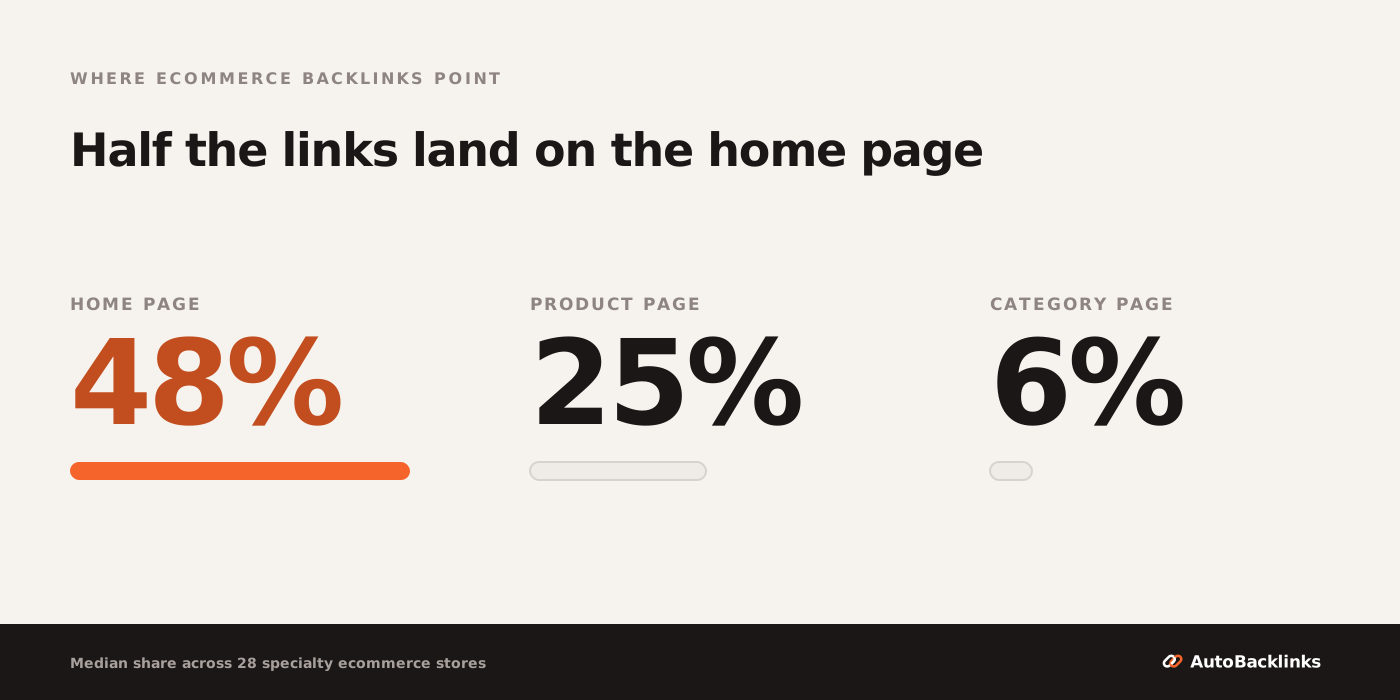
The home page is the single largest bucket for 22 of the 28 stores, and 17 of the 28 put under 10% of their link events on a category page.
Pooled across all 7,779 events rather than averaged by store: home 42.9%, product 25.0%, blog 9.6%, category 9.2%, other site pages 7.1%, unclassified 6.3%.
Three things to know about those figures before you lean on them.
The classifier is URL rules, and it is about 87% accurate. I sorted the links by the URL they point at, and these are eleven retail categories running on a dozen ecommerce platforms, so one rule does not cover them. Shopify is easy: /collections/ is a category, /products/ is a product. For the rest I wrote the rule store by store. A second reader hand-labelled a random 150 links and agreed with me on 131, or 87.3%. The disagreements were not scattered: four stores on legacy or bare-slug URLs accounted for nearly all of them, and all four were undercounting category and product pages. I relabelled 333 links on those patterns and rewrote the rules before publishing this table. That audit covered 22 of the 28 stores; the six added afterwards carry rules written the same way but not independently checked.
The median weights a small store like a large one. After the collapse, the stores range from 15 surviving link events to 790, and eight of the 28 sit under 100. Drop those eight and the home median moves from 47.6% to 45.0% and the category median from 5.9% to 5.5%. The finding holds either way, which is why I am showing you the number rather than only the median.
The sample is the strongest thousand domains, and strong domains favour home pages. A publisher that links to a store at all usually links to its home page, so ordering by domain strength pushes the home share up. Read 47.6% as the top slice, not the whole profile.
So read category as under one link in ten, not as 5.9% exactly. The direction is what holds: a twentieth to a tenth of the profile, against a home page taking close to half.
The ecommerce backlinks that are not real
Every one of the 28 stores is inside at least one blast network. Not most. All 28.
Here are the eight largest, each a single network aimed at a single store:
| Hosts | Store | The page title repeated across all of them |
|---|---|---|
| 983 | wholesaleyogamats.com | "High Quality Authority Link Building Services to Improve Web..." |
| 975 | vermontkitchensupply.com | "Premium SEO Links and High Authority Backlinks to Strength..." |
| 937 | scottsdental.com | "Premium SEO Backlinks for Increasing Website Authority, Im..." |
| 932 | lancastercastiron.com | "Premium High Authority Links for Websites Wanting Better Sea..." |
| 925 | majesticpet.com | "Premium SEO Backlink Experts Providing High Authority Link B..." |
| 921 | bayouclassic.com | "High Authority SEO Links for Websites That Need Better Searc..." |
| 920 | thebackstore.com | "High Quality SEO Backlinks and Expert Link Building Services" |
| 903 | vikingculinaryproducts.com | "Expert Premium Link Building Services for Stronger Website A..." |
Now the one number in this study that looked like good news.
One category page in the 39 is a genuine outlier: vernalspace.com/collections/standing-desks holds 1,254 referring domains, 30.7% of its entire domain's referring domains, on one page. If you were looking for proof that ecommerce category-page link building works at scale, that is the only candidate here.
So I pulled that page's own links and read them. Two separate operations are running on this store.
The first is the blast above: 735 hosts carrying the single title "Professional Backlink Experts Providing Premium Link Building Services to Improve...". Those point at the store's home page, not at the category page.
The second is what built the 1,254, and it is a different trade. Of the 1,000 referring domains I sampled for that URL, 50 are profile or author pages whose entire title is a username (vernaldesk, vernalstandingdesk, standingdesk2025) on hosts like a forum profile, a free-blog platform and a shopping-directory listing. Another 135 carry one spun title template: a desk phrase, the word "That", and a benefit list. "Adjustable Desks That Improve Comfort, Flexibility, And Work Efficiency" on one host, "Standing Desks With Keyboard Tray That Support Proper Typing Ergonomics" on the next, on domains that otherwise publish nothing about furniture.
The most common anchor text across the whole set is the bare URL.
Those two patterns are 185 of the 1,000 I sampled, and I did not hand-label the rest, so I will not put a spam figure on the whole profile. What I will say is what is not in the part I did read: no publication you have heard of, and almost nothing that reads as a person deciding to cite a shop.
At least a fifth of the best-linked ecommerce category page in this study was placed, one spun post at a time. That is also why it slipped past the network collapse: every title differs slightly, so there is no template to collapse.
This is the third time I have measured the same operation. The same signature turned up across 21 ranking B2B vendors and 26 local-pack winners: the same hostnames, the same template, aimed at businesses with nothing in common.
Links that were never earned for your topic
There is a cleaner way to see it. A standing-desk blog has no reason to also link to a cast-iron store and a dog-bed store.
Across the 28 stores there are 6,292 distinct referring domains. 525 of them link to stores in more than one of the eleven product categories, supplying 1,780 of the 7,779 link events, or 22.9%.
The domains reaching the most stores are couponly.ai (23 of 28), ylutag.com (18), welinkbacklinks.com (15), seotrends.pro (15), thcradar.com (14), authority.dejan.ai (14) and grokipedia.com (14). Coupon aggregators, SEO link services, and AI-generated aggregator pages.
Be fair about what that 22.9% is. The 525 are not all junk: coupon and deal aggregators link to every store by design, and a few large publishers (nymag.com, buzzfeed.com, thrillist.com, wired.com) appear because they cover many categories honestly.
The measurement is "links not earned for this store's topic", not "links from bad sites". It is still a fifth of the profile.
What to do about the blast links pointing at your own store
All 28 stores here have them, so you very likely do too, and none of these stores asked for them. The honest answer is shorter than most people want.
In most cases, do nothing. Google's disavow documentation opens its first step with this:
In most cases, Google can assess which links to trust without additional guidance, so most sites will not need to use this tool.
It then sets two conditions, and both have to hold:
You should disavow backlinks only if: 1. You have a considerable number of spammy, artificial, or low-quality links pointing to your site, AND 2. The links have caused a manual action, or likely will cause a manual action, on your site.
Neither condition is "a competitor pointed junk at me". If Search Console shows you no manual action and you did not buy the links yourself, the tool is not for you, and the same page warns that used incorrectly it "can potentially harm your site's performance in Google Search results". Nothing in these 28 profiles argues otherwise: every one of them carries a blast and every one of them ranks.
Where it does matter is your own reporting. You cannot tell whether a campaign is working while a third party adds thousands of hostnames to your referring domain count for free. Collapse the templates before you count, and the number starts meaning something again.
Product seeding and the Google link spam policy
The first tactic almost every ecommerce link building guide recommends is to send your product to a niche blogger in exchange for a review with a link.
Google's spam policies page names it. Here is the bullet with the heading it sits under, verbatim:
Buying or selling links for ranking purposes. This includes:
- Exchanging money for links, or posts that contain links
- Exchanging goods or services for links
- Sending someone a product in exchange for them writing about it and including a link
The parent clause matters, so read it rather than skip it. The section defines link spam as "creating links to or from a site primarily for the purpose of manipulating search rankings", and the bullet sits under "for ranking purposes".
That is the honest objection to make here, and it is worth answering. If you send a product with no link requested, no anchor specified and no coverage expected, you are arguably outside the scope. But that is not the tactic as it is sold. The tactic as it is sold is product in exchange for a review with a link, which is the bullet, word for word.
The same page says what makes it acceptable:
Google does understand that buying and selling links is a normal part of the economy of the web for advertising and sponsorship purposes. It's not a violation of our policies to have such links as long as they are qualified with a
rel="nofollow"orrel="sponsored"attribute value to the<a>tag.
Read that carefully, because it is the whole trade. A qualified link is allowed, and it is not intended to pass ranking value. (Since 2020 Google treats nofollow as a hint rather than a directive, so "does not count" overstates it, but you are not buying a ranking signal.)
So seeding a product for a link leaves you two options and a third way out. Qualify the link and keep the traffic without the ranking intent. Leave it unqualified and you are in the bullet above.
Or take the version where nothing changes hands: you pitch a reviewer who already covers your category, they buy the product or they do not, and the link is their editorial decision. It is slower and it converts worse. It is also the only version that is both clearly allowed and worth a ranking.
Internal links are how an ecommerce category page gets paid
This is the part the data demands and most ecommerce link building advice skips.
If about half your link events land on the home page and a twentieth on category pages, and that is what ranking stores look like, then the question is not how to redirect the links. It is what carries authority from where it lands to where you need it. Inside your own site, that is internal links, and they are the one part of this you fully control.
Four rules, in the order they pay off.
- Link to the category you are working from the home page itself. Not only from the mega menu, which already links to everything and therefore distinguishes nothing. A named block on the home page body pointing at the handful of collections you actually want ranking.
- Point your blog posts at the collection, not at the home page. A store blog exists to earn the links nobody will give a collection page. That only pays if each post links into the collection it is about, in a sentence, with the collection's own language as the anchor. A buying guide on your blog that links nowhere is a dead end you paid to write.
- Keep the click depth short. Every collection you want ranking should be reachable from the home page in one or two clicks. If a collection is five clicks deep, nothing you earn reaches it.
- Link between related collections. Standing desks to desk converters, cast iron skillets to cast iron care. Related collections link naturally and the pattern survives a redesign.
What I cannot give you is a number. Nothing in this study measures internal links, because a backlink index does not see them, so the four rules above are the argument I would make rather than a measurement I ran. Take them as that.
Ecommerce link building tactics that reach a category or product page
Set aside the home page for a moment. Of the 7,779 classified link events, 2,656 land on a category or product page. Those are the ones worth studying, because they are the outcome everyone wants.
Classified by the kind of page the link sits on, read from the referring page's own title:
| Source page type | Share of the 2,656 |
|---|---|
| Buying guide or how-to | 10.0% |
| Best-of roundup | 10.0% |
| Product review | 5.9% |
| Forum or community | 3.5% |
| Gift guide or seasonal | 2.9% |
| Comparison or alternatives | 1.6% |
| Deal or coupon page | 1.4% |
| News | 1.1% |
| Dealer or partner page | 0.5% |
| Not classifiable from the title | 63.1% |
A title is a weak instrument, so read each row as a floor rather than a count: a dealer page that does not say "where to buy" in its title lands in the last row, not the ninth.
The 63.1% is the finding, not a gap in the method. Reading through it, it is overwhelmingly guest-post-farm prose and profile spam. Titles like "Bookcase Ideas for Contemporary Apartments" on a dog-arthritis domain. A vernaldesk username page repeated across ten unrelated hosts.
Roughly a third of what reaches a category or product page sits on a page type you could pitch. The rest reads as placed. That third is where the work is, and it is four kinds of page.
Best-of roundups and buying guides
Together these are 20.0% of the links reaching a money page, the largest earnable category by a distance.
They are also the only source type on this list that is reliably a category link rather than a product one. Of the 712 category-page links, 14.9% sit on a buying guide or how-to and 9.3% on a best-of roundup, against 1.9% on gift guides.
That matters for sequencing. If the page you want to rank is a collection, this is the one source type that reliably links to collections, so it is where you start rather than where you end up.
The pitch names the specific page, names the gap, and offers the entry. What that looks like for a store:
Your "best cast iron skillets under $100" guide ranks fourth for that term and every pan on it is pre-seasoned factory cast. We make bare, hand-finished skillets in the same price band, which is the one option the list currently has no entry for. Happy to send specs and a photo if it is useful.
Three things that pitch does and a generic one does not: it names the page, it names what the list is missing in the writer's own terms, and it asks for one slot rather than a link. Longer worked examples are in guest post pitch examples. Where the page has no list to join and you want a mention inside an existing paragraph, that is a link insertion and a different ask.
Gift guides and seasonal listicles
2.9% overall, splitting 3.3% of product-page links against 1.9% of category-page links. Smaller than the tactic lists imply, and worth sizing before you build a season around it.
The timing constraint is real and most stores get it wrong. A publisher building a December gift guide is picking products in August. By the time you see the guide ranking, it is a link insertion ask on last year's URL, which is a different and harder pitch.
Product reviews, earned rather than paid
5.9% of the links reaching a money page, and the policy section above is the reason to be careful here. The version that works is pitching a reviewer who already reviews products in your category, with no product changing hands until they have decided to cover it.
Supplier, brand and dealer pages
0.4% by title, which undercounts it, because a "where to buy" page rarely says so in its title. It is still small.
What makes it worth ten minutes is that it is the cheapest link an ecommerce store can get, and almost nobody asks. If you stock a brand, that brand very likely has a stockist, dealer or "where to buy" page. The ask is one email to your account manager, not an outreach campaign, and the answer is usually yes because listing their retailers is in their interest too.
Work the list in this order: brands you buy the most from, brands whose products you rank for, then everyone else.
Three tactics I could not measure
Broken link building, unlinked brand mentions and digital PR are on every ecommerce tactic list, including the one Google assembles at the top of this search. They are not on mine, and the reason is that this method cannot see them.
A link profile shows me the link that exists. It does not show me that the link replaced a dead one, or started as a mention someone converted, or came out of a press push. Those are histories, and a backlink index does not store history.
So treat their absence here as a gap in the measurement, not a verdict. I would rather say that than rank them on feel.
A word on anchor text
Every recommendation above points at a commercial page, which is where anchor text starts to matter.
The anchor pattern in the one page-level profile I read closely, the vernalspace category page, is the bare URL repeated across hundreds of hosts. That is the signature of a placed campaign, and it is the opposite of what an earned link looks like: a buying guide names your brand or describes the product in the writer's own words.
You do not control the anchor on a link you earned, which is the point. If you find yourself specifying one in a pitch, you have stopped doing outreach and started buying placements. What anchor text is and how Google reads it is covered separately.
What ecommerce link building costs per link
Prices do not change because you sell physical products. The full measurement, with ten live marketplace listings and the cost-per-attempt arithmetic, is in link building cost. The short version:
- Asking the site owner directly is the floor. It costs outreach time, and sometimes nothing else.
- A marketplace adds a spread on top of that floor. Ten live listings measured at the DR 50 band ran $70.00 to $176.51, median $89.80.
- An agency adds margin on top of the marketplace price, in exchange for doing the work.
Order matters and never inverts: direct, then marketplace, then agency, at the same DR band.
Against that, the number circulating in this niche is much higher. The marketplace Collaborator puts the average ecommerce link at "around $325" in its own ecommerce guide. Read where that comes from before you budget against it: it is a figure drawn from Collaborator's own catalog, which makes it a vendor's price list rather than a market survey, and the same page lands on $150 to $320 per link once it gets to a specific recommendation at the DR 40 to 60 band.
Compare a quoted average to an agency quote, not to what a marketplace charges, and never to what the site owner would have said if you had asked.
When an ecommerce link building service is worth paying for
Agencies and managed services are most of what the search for this term returns, so it is worth saying plainly where they win and where they do not.
They are worth it when the constraint is hours, not judgement. Finding the forty buying guides that rank for your category, verifying forty contacts and writing forty pitches is maybe two days of work per category per quarter. If nobody on your team has those two days, buying them back is rational.
They are not worth it when the pitch is access. Every number in this article says the pages you need are ordinary buying guides and roundups that rank for your product term, with a published author and a contact form. Nobody needs a relationship to reach those. If a service is selling you a publisher list, check who actually ranks for your category term before you believe it is special.
The economics of running it in-house against buying it, with the break-even hourly rate worked out, are in link building for agencies.
An ecommerce link building campaign you can copy
Six steps. This is a link building campaign shaped for a store.
- Accept where the links will land. The home page collects about half of them and your product pages take roughly another quarter. That is not failure, it is what ranking stores look like. Plan to pass the authority inward with internal links from the home page and the blog to the categories you want ranking.
- Pick one category to work, not the whole catalog. One collection, one quarter. Thirty-nine ranking pages in this study have a median of three links, so your target is a handful, not a hundred.
- Inventory who ranks for your category term. Search it. Every buying guide, best-of roundup and comparison in those results is a page with a slot and a published author. These are 20.0% of all earnable money-page links, so start where the density is.
- Widen the pool with competitor backlink scans. Export the referring domains of two or three rivals, collapse template networks by path and title, and throw away everything that is not a guide, a roundup or a review. On these 22 profiles that discards most of the file, which is the point. What survives already links to a store like yours.
- Pitch the page, not the site. Name the guide, name what it is missing, and say which entry you belong in. A pitch that could have been sent to anyone gets the reply rate of a pitch sent to anyone. On the campaign we published, 187 sends produced 32 replies, a 17.1% reply rate, and the thing that produced it was prospecting rather than copy.
- Follow up twice, then stop. Roughly four days and ten days. I have no measurement on the right number. Two is where I stop because the third reads as pressure.
Steps 3 through 5 are what AutoBacklinks runs for a store. It is our own tool, so here is the spec rather than a review:
- Scans for the buying guides and roundups that already rank and already link out in your product category.
- Scores each on topical fit, not Domain Rating alone.
- Finds and verifies the contact behind each one.
- Writes the pitch from the prospect's own page, so the guide gets named.
Nothing sends until you approve it. If you want to run step three against one collection, start here.
How to measure ecommerce link building
Three changes to the standard report.
Count links to the page you are trying to rank, not to the domain. The median store here has 4,303 referring domains and three on the page that ranks. Domain totals move on their own, mostly from blasts, and tell you nothing about the category you are working.
Deduplicate by template before you count. Export referring domains with the referring URL and the referring page title, which Ahrefs, Semrush and DataForSEO all give you. Group the rows by URL path plus page title, and where one group covers more than two distinct hostnames, count the group as one link event. That one rule turned 28,000 rows into 8,085 here. Run it on your own profile before you report a number to anyone, including yourself.
Count placements on pages that rank for your category term. That is the layer that does a job. A stronger domain that ranks for nothing in your category does not.
Two things not to read into this data. Dofollow share does not separate good from bad here: category-page links are 96.8% dofollow, higher than the home page at 91.9%, and a large share of them are placed rather than earned. And velocity is not in this dataset at all: for how fast a profile can grow without looking engineered, how many backlinks per month measures that separately.
And on how long it takes: this dataset contains no timeline. It is a single snapshot of what profiles hold, not a record of how long any of it took to earn or how long it took to move a ranking. What the numbers do say is that the target is small. A handful of links to one collection is a quarter's work for one person, not a year's, which makes the quarter the right unit to judge a campaign on.
FAQ
What is ecommerce link building?
Ecommerce link building is the work of earning links from other websites to an online store: its home page, its category or collection pages, its product pages, and its blog. The links are a ranking input, and which page they land on decides what ranks. The hard part is specific to retail: nobody links to a page whose purpose is to sell them something, so the pages that make you money are the pages hardest to earn links to.
How do I get backlinks for my online store?
Work one collection at a time and go where the links already are. Buying guides and best-of roundups that rank for your product term carry 20.0% of all the links reaching a store's category and product pages, the largest earnable share by a distance, and they have a published author you can pitch. Ask your suppliers for a stockist listing, which is the cheapest link a store can get. Then use internal links to pass that value from the home page, where about half of it lands, into the collection you want ranking.
Should ecommerce backlinks point to category pages or product pages?
Point them wherever you can genuinely earn them, then pass the authority inward. Across 28 ranking specialty stores the median one has 47.6% of its link events on the home page, 24.7% on product pages and 5.9% on category pages. The advice to put most of your budget into category pages does not describe a single ranking store in this sample.
How many backlinks does an ecommerce category page need to rank?
Fewer than you have been told. Across 39 category pages ranking in the US top 20 for head product searches, the median page holds three referring domains and twelve hold none at all. Pages ranking in the top 10 have a median of three, pages ranking 11 to 20 have a median of zero. These are counts winners hold, not a proven threshold.
Is sending free products to bloggers for reviews against Google's rules?
As usually described, yes. Google's spam policies list "Sending someone a product in exchange for them writing about it and including a link" as an example of link spam. The policy allows paid and incentivised links when they carry rel="nofollow" or rel="sponsored", which also stops them passing ranking value. A review you did not pay for in product or money is the version that counts.
About Rachid Idali
Founder & SEO Strategist
Rachid Idali has spent 10 years in SEO, running multi-six-figure SEO and link-building budgets across content, digital PR, and outreach programs. He writes about practical systems for finding relevant prospects, earning links, and turning SEO operations into repeatable pipelines.
More from Rachid Idali